What if the real secret to managing your career pilot program Florida cost isn't finding the lowest hourly rate, but choosing a location that keeps you in the air? It's a common frustration for aspiring aviators; you see an attractive tuition price, but you're left wondering about hidden fuel surcharges, examiner fees, and the true cost of weather delays. You want to know exactly what it takes to go from zero experience to a professional cockpit without the financial surprises that often derail these dreams.
We understand that this is one of the most significant investments you'll ever make, and you deserve a roadmap that's as precise as a flight plan. You're likely weighing the value of specialized flight training against a traditional degree and looking for a path that offers a clear return on investment. This guide provides a transparent breakdown of the financial landscape in 2026, from initial Private Pilot License fees to the total investment required for airline-ready certification. We'll explore current industry cost structures, modern financing options, and how Florida's year-round flying weather creates a distinct advantage by helping you finish your ratings faster and more efficiently.
Key Takeaways
- Understand how 300+ annual flying days in Florida accelerate your timeline and lower total expenses compared to training in less favorable climates.
- Navigate the 2026 budgeting landscape for your career pilot program Florida cost, including often overlooked fees like examiner costs and fuel surcharges.
- Evaluate the long-term value of training with advanced G1000 avionics at strategic locations like Kissimmee Gateway (ISM) to ensure you are airline-ready.
- Explore current aviation-specific lending options and scholarships that help transform your professional aspirations into a structured, affordable reality.
- Review the benefits of comprehensive tracks like the Airline Pilot Elite program to see how bundled training offers a more predictable financial path.
Understanding the Total Investment for a Career Pilot Program in Florida
A career pilot program is a structured, intensive journey designed to take you from a student with zero hours to a certified commercial pilot ready for the flight deck. In Florida, this path is particularly popular because the state offers a unique combination of infrastructure and professional opportunity. When researching the career pilot program Florida cost, it's vital to look beyond the sticker price of hourly tuition. You'll want to understand the "Total Cost of Professionalism," which encompasses the entire FAA pilot certification process, including examiner fees, FAA medical certificates, and high-quality ground school materials. Budgeting errors often occur when students confuse "dry" rental rates, which exclude fuel, with "wet" rates that include it. We always recommend budgeting for "wet" rates and considering the auxiliary costs of professional gear and software to ensure your financial plan remains as reliable as your pre-flight checklist.
Why Florida Training Efficiency Lowers Total Cost
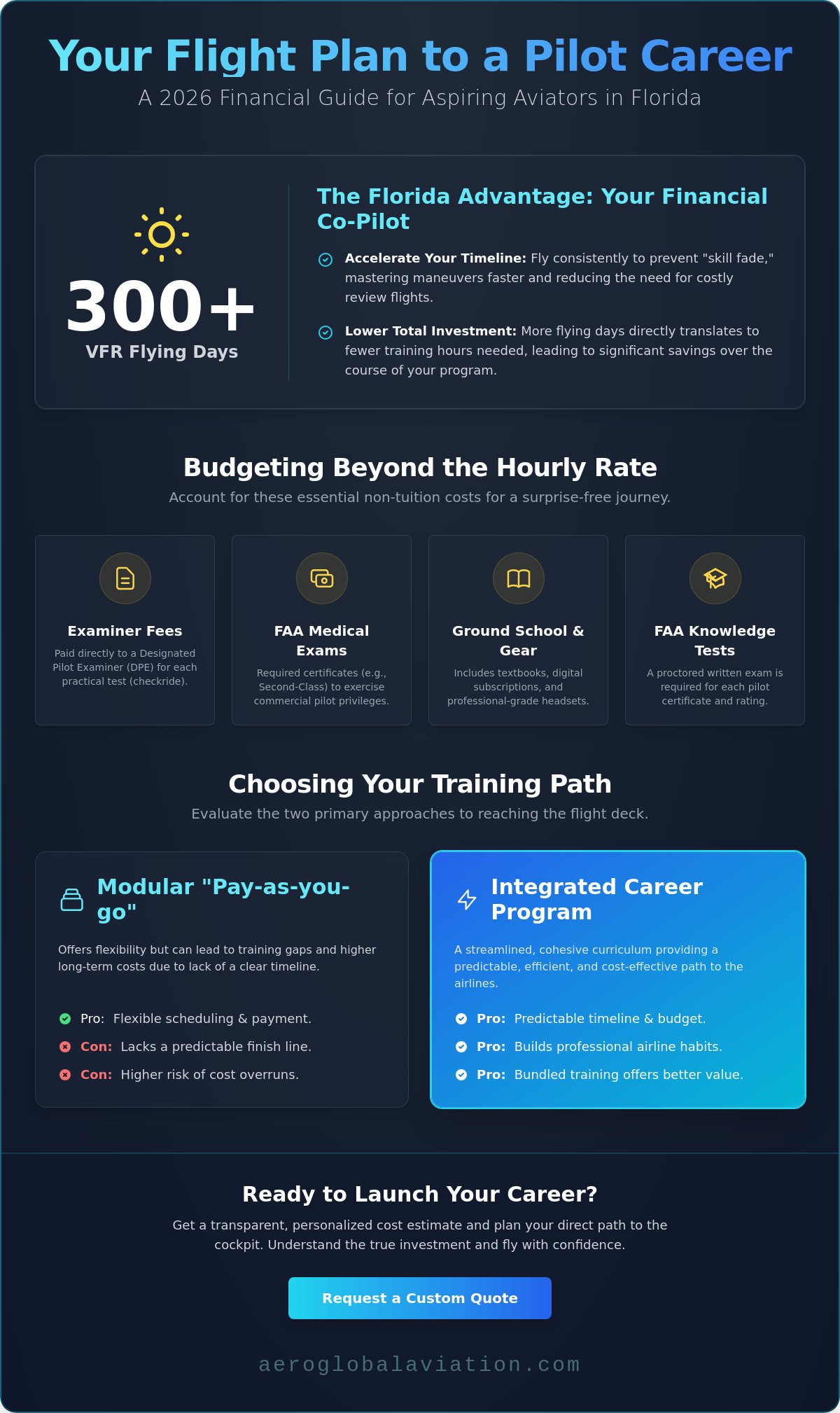
Florida's weather is a strategic asset for your wallet. With over 300 days of VFR (Visual Flight Rules) conditions each year, you can maintain a consistent schedule that prevents "skill fade." When you fly frequently, you spend less time reviewing previous maneuvers and more time mastering new ones; this directly reduces the total number of hours you need to pay for. Central Florida's dense aviation infrastructure also means you'll spend less time and money flying to practice areas. Because of its perfect blend of year-round sunshine, diverse airspace, and premier airport facilities, Central Florida has earned its reputation as the flight training capital of the United States.
Modular vs. Integrated Training Paths
You have two primary ways to reach your goals: the modular approach or an integrated career track. The modular "pay-as-you-go" method offers flexibility but often lacks a clear finish line, which can lead to higher long-term costs due to training gaps. In contrast, an integrated Career Pilot Program streamlines these modules into a single, cohesive curriculum. This structure provides a psychological boost and a predictable timeline, allowing you to plan your finances with confidence. Choosing a dedicated career track ensures that every hour in the logbook is a purposeful step toward your future office at 35,000 feet. It's about more than just logging hours; it's about building the professional habits that airlines value most.
Breaking Down the 2026 Costs: Ratings, Fees, and Hidden Expenses
Navigating your career pilot program Florida cost is much simpler when you view the investment as a series of professional milestones. It's common for prospective students to feel overwhelmed by a single total tuition figure, but these costs are modular. By understanding each phase, you can better manage your cash flow and expectations as you transition from a beginner to a professional aviator. Most students find that breaking the budget into training phases and auxiliary expenses provides the clearest financial picture.
Beyond the actual flight hours, you must account for external expenses that aren't always included in a school's base tuition. These "non-training" costs are essential for your progress through the financing your flight training journey. Key items to include in your 2026 budget are:
- FAA Medical Exams: You'll need at least a second-class medical certificate to exercise commercial pilot privileges.
- Examiner Fees: These are paid directly to a Designated Pilot Examiner (DPE) for your checkrides and are separate from school tuition.
- Ground School Materials: This includes digital subscriptions, textbooks, and professional-grade headsets.
- FAA Knowledge Tests: Each rating requires a proctored written exam at an FAA-approved testing center.
The Wings Foundation: Initial PPL Investment
Your journey begins with the Wings Foundation, where you'll focus on earning your Private Pilot License (PPL). In the Orlando corridor, students train in one of the most active airspaces in the world, which builds incredible confidence early on. While the FAA Part 141 curriculum requires a minimum of 35 flight hours, many students benefit from additional time to master local procedures and advanced avionics. Choosing between a traditional trainer and a modern aircraft with a glass cockpit will influence your hourly investment, but the latter often saves time during later instrument training. For a step-by-step look at this phase, check out our guide on how to get your private pilot license in Florida.
Advanced Ratings and Professional Certifications
Once you've secured your PPL, you'll tackle advanced flight training including the Instrument Rating (IR) and Commercial Pilot License (CPL). The IR is where you learn to fly solely by reference to instruments, a critical skill for airline safety. Adding a Multi-Engine Rating is another vital investment, as it's required for almost all airline positions. Many pilots also choose to become Certified Flight Instructors (CFI). While this adds to the upfront cost, it's an investment that pays for itself by allowing you to earn a salary while building the 1,500 hours needed for the major carriers. If you're looking for a structured way to reach these goals, you can review our career-ready tracks to find your path. Understanding the career pilot program Florida cost is the first step toward a rewarding life in the sky.
Factors That Influence Your Flight School ROI in Central Florida
To maximize your return on investment, you must look at how efficiently your school uses every hour you pay for. The career pilot program Florida cost is heavily influenced by variables that aren't always on the price sheet. For instance, high instructor turnover at large, impersonal academies can force you to repeat lessons, effectively doubling your training time. When you choose a school that prioritizes instructor continuity and professional mentorship, you ensure that your progress remains steady and your budget stays on track. Calculating your career pilot program Florida cost requires looking at the total time to completion rather than just the hourly rental rate.
The Kissimmee Advantage: Training at ISM
Training at Kissimmee Gateway Airport (ISM) offers a distinct financial edge over larger hubs like Orlando International (MCO) or Sanford (SFB). Because ISM has lower commercial traffic congestion, you won't spend twenty minutes idling on the taxiway waiting for a heavy jet to land. In flight training, taxi time is money. By reducing wait times and providing immediate proximity to varied airspace, ISM allows you to dive into complex training scenarios without long, expensive transits. This regional efficiency is a cornerstone of why so many students choose this corridor to pay for flight school and launch their careers with confidence.
Glass Cockpit vs. Analog Gauges
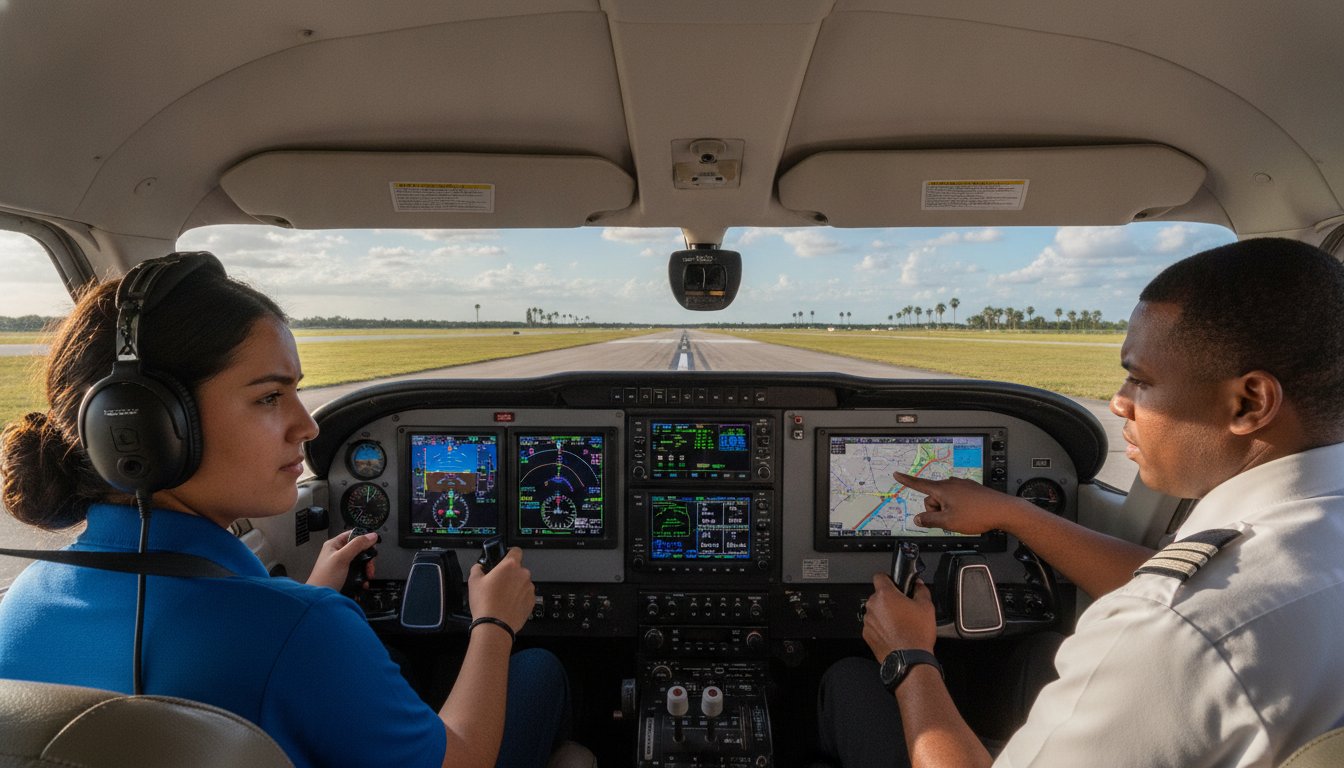
While analog "six-pack" gauges might seem cheaper per hour, training on modern G1000 glass cockpits is often the smarter financial move for airline-bound pilots. Learning on the same digital systems found in regional jets significantly reduces your transition time during airline orientation. Aero Global maintains an airline-oriented fleet to ensure you're learning the high-level systems used by major carriers today. This commitment to modern technology means you won't just earn a certificate; you'll master the tools of the trade before you even reach your first interview. Investing in advanced avionics early on is a strategic choice that pays dividends when you step into a professional flight deck.
Finally, consider the value of local relationships. Schools with deep ties to local Designated Pilot Examiners (DPEs) help you avoid weeks of costly downtime while waiting for an exam date. Staying on schedule keeps your skills sharp and your momentum high, which is essential for finishing your program on budget. When every day counts toward your 1,500-hour goal, these local advantages become your greatest financial assets.
Financing Your Future: Loans, Scholarships, and Payment Plans
Securing the funding for your flight training is just as critical as mastering your first solo landing. While the career pilot program Florida cost represents a significant investment, the 2026 financial landscape offers several specialized pathways to make this goal attainable. Many students weigh the benefits of a "pay-as-you-go" model against full-program financing. While paying as you go can help you avoid debt, it often leads to training gaps that increase the total hours you'll eventually need. In contrast, full financing through aviation-specific lenders like Sallie Mae or Meritize allows you to maintain a consistent, accelerated schedule. These lenders understand the unique needs of flight students and often provide deferred payment options while you're focused on your ratings.
Don't overlook the wealth of scholarship opportunities available to dedicated students. Industry organizations like the Aircraft Owners and Pilots Association (AOPA) and the Experimental Aircraft Association (EAA) provide millions of dollars in grants annually. Additionally, local Florida aviation groups often offer specific funding for residents who are committed to growing the regional aerospace economy. Tapping into these resources can significantly reduce your out-of-pocket expenses and lower your overall career pilot program Florida cost.
Applying for Flight Training Loans
Securing a loan requires a proactive strategy to show lenders you're a serious candidate for success. First, you should obtain your FAA Medical Certificate; this proves you're physically eligible to hold a commercial license, which is a requirement for most aviation-specific lenders. Second, choose a school that offers a structured airline pilot career path. Lenders favor programs with clear milestones and professional oversight. Finally, consider applying with a cosigner. In the current 2026 interest rate environment, a strong cosigner can help you secure a much lower rate, making your monthly debt service more manageable once you start your career.
Maximizing ROI Through Employment
The smartest way to manage your investment is to turn your training into a paycheck as quickly as possible. By earning your Certified Flight Instructor (CFI) rating, you can earn a salary while reaching the 1,500-hour milestone required for airline employment. Our Airline Pilot Elite strategy is designed for this exact purpose; it builds a bridge from your initial training to a professional role. When you compare current pilot starting salaries to the cost of debt service, the value of an accelerated program becomes obvious. You aren't just spending money; you're buying a faster entry into a high-paying industry.
Ready to map out your financial flight plan? Explore our financing and payment options today.
Aero Global Aviation’s Career Pathways: Value-Optimized Training
Selecting a flight school is about more than just comparing hourly rates; it's about finding a dedicated partner that aligns with your specific financial and professional goals. At Aero Global Aviation, we've structured our training pathways to eliminate the ambiguity that often inflates the career pilot program Florida cost. By providing a clear framework for every stage of your development, we ensure that you aren't just logging time, but building the precise skills required by modern airlines. Our approach centers on personalized mentorship, which serves as a powerful tool for cost control. When you have an expert guide monitoring your progress, you avoid the expensive training plateaus and scheduling delays that can quietly drain a budget. We believe that your success is our success, and that starts with a transparent, high-value curriculum.
Choosing the Right Program for Your Budget
We understand that every student's journey is unique, which is why we offer three distinct tiers of training to fit different professional aspirations and financial plans:
- Wings Foundation: This program is designed for hobbyists or those who want to "test the waters" by earning their Private Pilot License (PPL) before committing to a full career track. It's a low-risk entry point that provides a solid foundation in aviation.
- Career Pilot Program: For those with an immediate professional goal, this path takes you from zero experience to a Commercial Pilot License (CPL). It's our most popular option for students looking for a transparently priced and efficient route to the cockpit.
- Airline Pilot Elite: This is our most comprehensive and aggressive track. It covers everything from your initial PPL to advanced instructor certifications. By bundling these ratings, you create the most cost-efficient timeline to reach the 1,500-hour airline minimums.
By choosing the track that best fits your current situation, you can manage your career pilot program Florida cost with precision. Our goal is to help you transition from a beginner to a professional aviator without the financial surprises that often derail these dreams.
Next Steps: Your Discovery Flight
The most important investment you'll make at the start of your journey is your Discovery Flight. For approximately $200, you'll get more than just a few minutes at the controls; you'll get a firsthand look at our modern fleet and the professional environment at Kissimmee Gateway Airport. This is your chance to audit our aircraft, meet the instructors who will be your practical mentors, and feel the excitement of the Central Florida flight training corridor. It's a small step that provides immense clarity on your future career. Don't let uncertainty hold you back from the flight deck. Book your discovery flight at Aero Global Aviation Academy today and take the first step toward a rewarding life in the sky.
Your Flight Deck Career Starts in Central Florida
You've explored the full financial landscape of professional training, from the initial Wings Foundation phase to the advanced ratings required for major carriers. Understanding your career pilot program Florida cost is the first step toward a successful life in the sky. By choosing a program that emphasizes training efficiency at Kissimmee Gateway Airport and leverages a modern fleet, you ensure your investment is working as hard as you are. Success in this industry requires a combination of clear financial planning and high-quality instruction.
At Aero Global Aviation, we pride ourselves on providing transparent 2026 pricing with no hidden surcharges. You'll receive professional mentorship from airline-experienced instructors who are dedicated to your individual success. This personalized attention, combined with our airline-oriented curriculum, transforms a complex professional world into a structured and attainable journey. We're committed to helping you reach your destination with confidence, reliability, and technical excellence.
Are you ready to stop dreaming and start flying? Start Your Career with a Discovery Flight in Kissimmee. We're here to help you navigate every mile of your journey toward the flight deck.
Frequently Asked Questions
Is flight school in Florida more expensive than in other states?
Florida is often more cost-effective because the high volume of flyable days prevents expensive training delays. While hourly rental rates are comparable to other regions, you'll likely complete your ratings in fewer total calendar days. This efficiency reduces your overall living expenses and prevents the need for costly refresher lessons that often occur after long weather delays in northern states.
Can I get a student loan for a career pilot program in 2026?
Yes, specialized aviation lenders like Sallie Mae and Meritize offer loans specifically designed for professional flight training. These financial products often include options for deferred payments while you're actively training. Lenders in 2026 typically look for students enrolled in structured, professional programs that provide a clear path to commercial employment.
What are the hidden costs of becoming a pilot in Florida?
Commonly overlooked expenses include FAA medical certificates, Designated Pilot Examiner (DPE) fees, and digital ground school materials. Examiner fees for your checkrides are paid directly to the evaluator and are usually not included in your career pilot program Florida cost. It's also smart to budget for professional gear like a high-quality noise-canceling headset and iPad subscriptions for navigation software.
How much does it cost to go from a Private Pilot to a Commercial Pilot?
This phase of training involves earning your Instrument Rating and completing the flight hour requirements for your Commercial Pilot License. The total investment varies based on whether you choose a modern glass-cockpit aircraft or a traditional trainer. Most students find that the efficiency of a structured career track provides the best financial predictability during this intensive period of hour-building.
Is the Airline Pilot Elite program worth the extra investment?
The Airline Pilot Elite program is a strategic choice because it includes your Certified Flight Instructor (CFI) ratings. This allows you to start earning a salary as an instructor immediately after graduation while you build the 1,500 hours required for major airline positions. It's a self-funding career move that often results in a faster return on your initial investment.
How long does a typical career pilot program take to complete in Orlando?
Full-time students can typically complete their training in 6 to 12 months due to the exceptional flying weather in Central Florida. The career pilot program Florida cost is optimized by this speed, as a high-frequency schedule helps you retain skills and progress through milestones without the setbacks of seasonal changes. Our location at Kissimmee Gateway Airport further streamlines this timeline by reducing taxi and transit times.
Are there scholarships available specifically for Florida flight students?
Yes, Florida residents can tap into several regional grants and scholarships offered by organizations like the Florida Aviation Trades Association. Additionally, local chapters of the EAA and AOPA frequently provide financial assistance to students who demonstrate a strong commitment to the local aviation community. We encourage all students to apply for these external funds to help offset their training expenses.
What happens to my investment if I fail a checkride?
A failed checkride requires you to receive additional remedial training and pay a re-test fee to the examiner, but it doesn't mean you've lost your progress. We use a mentorship-heavy approach to ensure you're fully prepared and confident before any exam date. This rigorous internal evaluation process is designed to protect your investment and minimize the risk of unexpected costs during the certification process.


