Did you know that choosing the wrong training structure could cost you an extra $13,000 before you even reach the cockpit of a commercial jet? It's frustrating to browse flight school websites only to find vague prices that don't account for fuel surcharges or checkride fees. You want a clear path to the flight deck, not a mountain of unexpected invoices. Understanding the commercial pilot license florida cost in 2026 is about more than just hourly rates; it's about maximizing your time in the air through efficiency and smart planning.
We believe that your journey to the sky should be as transparent as a clear Florida morning. This guide provides a realistic 2026 budget for your training, showing you how to leverage our local climate and structured Part 141 programs to save both time and money. We'll break down everything from ground school expenses to the long-term ROI of the flight instructor path. You'll gain a clear strategy to minimize your total flight hours and the confidence to choose a school in the Orlando area that treats your success as a partnership. Let's transform your passion for aviation into a tangible professional destination.
Key Takeaways
- Leverage Florida's year-round flying weather to complete your hours faster and avoid the financial drain of seasonal training delays.
- Navigate the financial differences between Part 61 and Part 141 training to find the most efficient path for your commercial pilot license florida cost.
- Uncover the "hidden" fees of flight training, from examiner checkride costs to medical certification, so you can plan your 2026 budget with total confidence.
- Evaluate how a comprehensive Career Pilot Program streamlines the transition from student to professional by combining your Private and Commercial training into one efficient track.
- Master the strategy of building your 1,500-hour requirement through instructor roles to turn your initial training investment into a high-earning airline career.
The Investment Landscape: Average Commercial Pilot License Costs in Florida (2026)
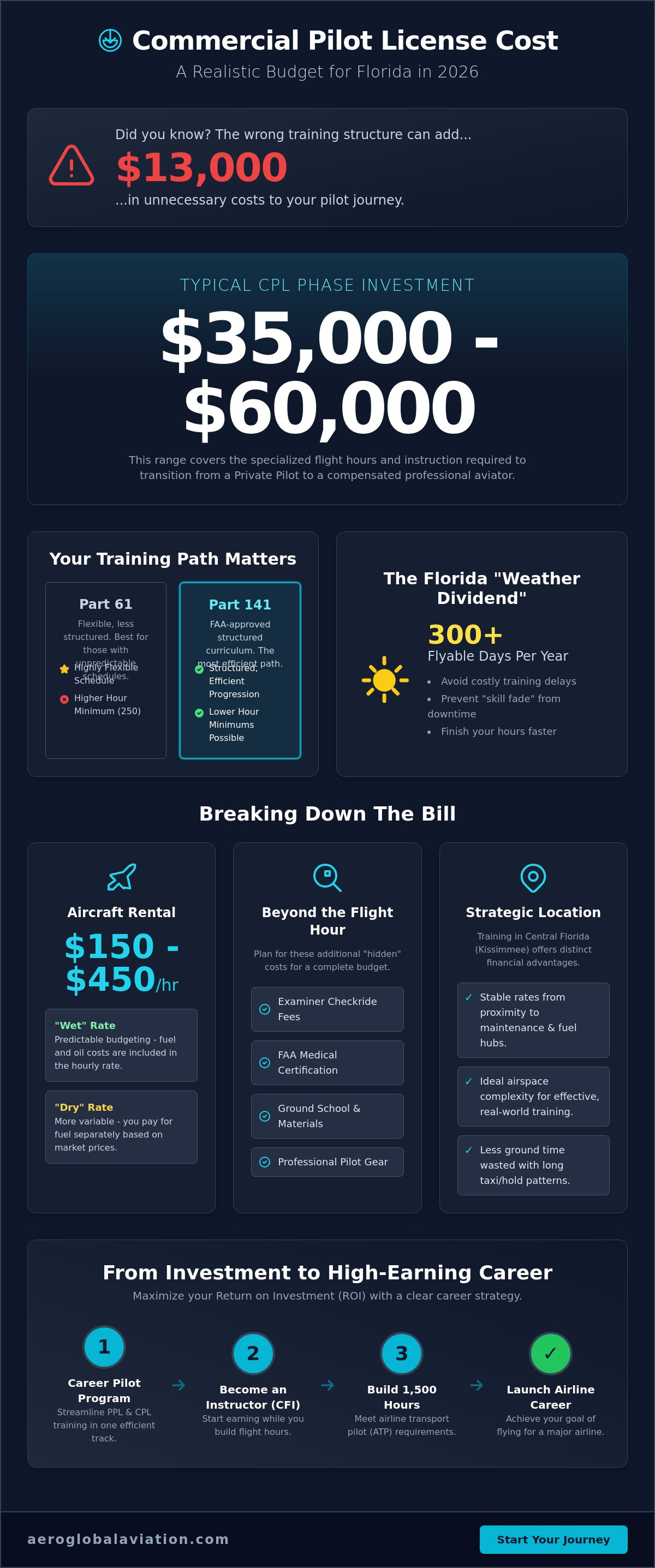
Florida isn't just a destination for sun-seekers; it's a global powerhouse for aviation training. For those transitioning from a private pilot certificate to a professional career, the 2026 baseline for the commercial pilot license florida cost typically ranges between $35,000 and $60,000 for the CPL phase alone. This investment covers the specialized instruction and flight hours required to move beyond recreational flying and into a role where you're legally compensated for your skills. While the initial number might seem high, it represents the final hurdle before you begin generating a return on your investment through professional pilot salaries.
One of the primary reasons students flock to Central Florida is the "Weather Dividend." In Kissimmee, we enjoy more than 300 flyable days per year. This climate isn't just a perk; it's a financial strategy. In northern states, a week of snow can ground a student, leading to "skill fade" and the need for expensive remedial flights. Here, the consistency of the weather ensures your training remains on track, allowing you to finish your hours faster and keep your total spend closer to the minimum requirements. When you're paying for aircraft time, every cancelled flight is a missed opportunity to advance your career.
Understanding aircraft rental is vital for your budget. Most schools offer "Wet" or "Dry" rates. A "Wet" rate includes the cost of fuel and oil in the hourly price, providing a predictable expense. A "Dry" rate covers only the aircraft rental, leaving you to pay for fuel separately. In 2026, many students prefer wet rates to hedge against fluctuating fuel prices at the pump, ensuring their budgeting remains stable throughout their training duration.
Defining the CPL Financial Milestone
The Commercial Pilot License serves as the essential gateway to professional earnings, marking the moment your hobby transforms into a high-stakes career. Your total cost will vary depending on whether you pursue a Single-Engine Commercial rating or a Multi-Engine Commercial rating, with the latter requiring more complex aircraft that command higher hourly rentals. To qualify, you'll need to meet specific FAA Commercial Pilot Requirements, which generally mandate 250 hours of flight time under Part 61 rules. However, many students find that enrolling in a structured program allows them to reach these milestones with greater precision and fewer "wasted" hours.
Regional Cost Drivers in Central Florida
Location matters when it comes to your bottom line. Training near Kissimmee Gateway Airport provides a strategic advantage over coastal schools or those buried within the busy airspace of Orlando International (MCO). We benefit from proximity to major maintenance hubs and fuel suppliers, which helps stabilize aircraft rental rates even when global fuel trends fluctuate. Additionally, the airspace complexity around Kissimmee is ideal. It's challenging enough to prepare you for the real world without the long taxi times and holding patterns common at larger international airports that can eat into your paid flight hour.
Breaking Down the Bill: Aircraft, Instruction, and Rating Components
To accurately plan your budget, you need to look past the total sticker price and examine the specific line items that make up the commercial pilot license florida cost. This phase of training is more complex than your initial private pilot certificate because it requires precision in high-performance environments. Your primary expenses will be split between aircraft rental, professional instruction, and the specialized materials needed to master advanced maneuvers. By understanding how these costs are calculated, you can make smarter choices about where to invest your training dollars for the best return.
Aircraft rental remains the most significant variable in your training budget. Depending on the fleet available at your chosen school, you can expect to pay anywhere from $150 to $450 per hour. Basic trainers are perfect for building the required cross-country time, but you'll eventually need to transition into complex or high-performance aircraft to meet FAA certification standards. These advanced machines carry higher hourly rates due to increased maintenance and fuel requirements, but they provide the essential experience needed for professional operations.
Aircraft Selection: From Trainers to Complex Platforms
Many students choose to do the bulk of their time building in a reliable Cessna 172 to keep costs manageable. However, the modern industry moves fast. Investing in glass cockpit training early in your commercial phase is a strategic move. While digital avionics might carry a slightly higher rental premium, they mirror the technology you'll find in regional jets. Learning these systems now prevents a steep learning curve during airline transition training. You can balance your budget by using simpler, non-complex aircraft for solo time building and reserving the advanced platforms for your dual instruction hours.
Instructional Hours: Dual vs. Solo Costs
You'll need a minimum of 20 hours of dual instruction to prepare for the commercial checkride, where a Certified Flight Instructor (CFI) will guide you through advanced maneuvers and emergency procedures. It's vital to choose a mentor who prioritizes Official FAA Training Standards. While some schools offer cut-rate instruction, poor mentorship often leads to more total flight hours because you'll spend extra time correcting bad habits. High-quality instruction ensures you master the requirements efficiently, which actually lowers your final bill by reducing the need for remedial training flights.
Don't forget to account for ground school and the Multi-Engine add-on. Modern digital accelerated modules have made ground school more affordable and flexible than traditional classroom settings. While the Multi-Engine rating is often viewed as an additional expense, it's a non-negotiable requirement for most airline career paths. If you're ready to start mapping out these specific milestones, our Career Pilot Program provides a structured framework that integrates these costs into a single, transparent path to the flight deck.
Part 61 vs. Part 141: How Program Structure Impacts Your Total Spend
One of the most significant decisions you'll make involves choosing between Federal Aviation Regulations (FAR) Part 61 and Part 141. This choice acts as the primary lever for managing your commercial pilot license florida cost. While both paths lead to the same certificate, the journey there differs in structure, oversight, and, most importantly, the minimum flight time required by the FAA. Understanding these differences allows you to align your training with your financial goals and professional timeline.
The 190-Hour Advantage
The most striking difference between these two paths is the total time requirement. Under Part 61, you typically need 250 hours of flight time to qualify for your commercial checkride. In contrast, an FAA-approved Part 141 school follows a highly structured syllabus that allows you to test at just 190 total hours. This 60-hour difference is a game-changer for your budget.
Think about the financial impact of that gap. If you're renting a modern trainer at $200 per hour, that's a direct savings of $12,000 on aircraft rental alone. While Part 141 programs sometimes carry higher ground school fees due to their rigorous documentation and oversight, the reduction in flight time usually makes them the more cost-effective choice in the competitive Florida market. Beyond the raw numbers, many major airlines view Part 141 graduates favorably because they've proven they can thrive in a disciplined, fast-paced environment similar to airline initial training.
Flexibility vs. Speed: Calculating Your ROI
If you already have a significant number of flight hours or need to balance your training with a full-time job, the "pay-as-you-go" flexibility of Part 61 might be your best bet. It allows you to build time at your own pace without the rigid schedule of a traditional academy. To help offset these costs regardless of the path you choose, you should explore Aviation Scholarship Opportunities offered by organizations like AOPA. These funds can significantly lower the barrier to entry for dedicated students.
However, you must consider the "Total Time to Airline" factor. Finishing your training just three months earlier through a fast-track program could mean entering the workforce one quarter sooner. In an industry where senior pilots earn high salaries, those three months represent a massive opportunity cost that far outweighs a few dollars saved on hourly rental rates. Your specific PPL to CPL timeline will ultimately dictate which structure offers the best return on your investment. Lower hourly rates often result in slower career starts that cost you more in the long run.
Beyond the Flight Hour: Managing Hidden Costs and Professional Gear
Planning for your commercial pilot license florida cost requires looking beyond the fuel and the wings. Many students focus solely on the aircraft rental while overlooking the "soft" costs that can add thousands to a 2026 training budget. These expenses are essential for your professional transition and include everything from administrative fees to the gear that marks you as a career pilot. By identifying these items early, you can avoid the "sticker shock" that often occurs during the final weeks of training.
One of the most significant 2026 expenses is the Designated Pilot Examiner (DPE) fee. Because these examiners are independent contractors, their rates have risen alongside demand. In Central Florida, you should budget between $800 and $1,500 for your commercial checkride. This fee is paid directly to the examiner and is separate from your school's tuition. If a re-test is necessary due to a failed maneuver, you'll likely face an additional "re-check" fee, making it vital to be fully prepared before scheduling your date.
Administrative and Licensing Fees
Your journey involves several mandatory payments to the FAA and testing centers. Budget approximately $175 for the FAA Commercial Pilot Knowledge Test. Additionally, you'll need to maintain a First-Class Medical Certificate to exercise commercial privileges. While a basic exam might be affordable, any specialized testing required for your medical clearance can increase this cost. We recommend setting aside a 10% contingency fund specifically for your checkride phase. This buffer covers unexpected ground school needs, digital tool subscriptions like ForeFlight, and any extra prep flights needed to ensure you pass on your first attempt.
Professional Development and Insurance
As a commercial student, you're transitioning into a professional mindset. This includes investing in high-quality gear that will last into your airline career. A professional-grade noise-canceling headset is a non-negotiable tool for protecting your hearing and ensuring clear communication in busy Florida airspace. You'll also need to budget for non-owned aircraft insurance, often called renter's insurance. This protects you financially while you're building solo time or performing advanced maneuvers. See our Best Flight Schools in Florida checklist for advice on vetting school insurance policies and ensuring you have the right coverage.
Finally, don't underestimate the cost of "airline-ready" attire. Many structured programs require professional uniforms to instill the discipline required for Part 121 operations. If you're ready to start a journey where every cost is clearly mapped out from day one, take a look at our Career Pilot Program to see how we help you manage your investment effectively.
Aero Global Aviation Academy: Maximizing Your ROI with the Career Pilot Program
Choosing where to train is the final piece of the puzzle when managing your commercial pilot license florida cost. At Aero Global Aviation Academy, we understand that every hour in the logbook represents a significant investment in your future. We've designed our programs to eliminate the ambiguity often found in flight training. By providing a clear, structured path from your first takeoff to your commercial checkride, we ensure that your budget is used effectively to build the skills airlines demand.
Our Career Pilot Program offers an all-in-one transition from a Private Pilot License to a Commercial Pilot License. We pride ourselves on being a "Practical Mentor" rather than an impersonal corporation. This means our instructors are deeply invested in your individual progress, helping you optimize every flight hour to prevent the costly "re-training" loops mentioned earlier. Additionally, our commitment to maintaining a modern fleet in Kissimmee reduces maintenance-related delays, keeping you on schedule and protecting your ROI.
Structured for Success: Airline Pilot Elite
For those aiming for the highest levels of the industry, our Airline Pilot Elite track provides a comprehensive journey from PPL all the way to advanced instructor certifications. This structured environment prepares you for the high-stakes world of the flight deck much faster than independent time building. Training in a hub like Kissimmee offers a strategic advantage. With high CFI availability and a supportive aviation community, you'll find the momentum needed to reach your 1,500-hour goal efficiently. We've seen many of our alumni transition successfully to regional airlines, proving that a disciplined start leads to a rewarding career destination.
Your Next Steps in Kissimmee
Your professional pilot career shouldn't be a guessing game. We invite you to take control of your future by scheduling a personalized cost-consultation with our admissions team. We'll help you map out a realistic timeline and budget tailored to your specific goals. If you're ready to feel the difference that training efficiency makes, book a discovery flight to experience our fleet and mentorship firsthand. The sky is waiting, and we're here to help you navigate the path upward with confidence. Start your professional journey with Aero Global Aviation Academy today.
Launch Your Professional Pilot Career in Kissimmee
Your journey to the flight deck is a significant investment in a future defined by professional freedom and high earnings. We've explored how navigating the commercial pilot license florida cost requires a strategic look at program structures and the "weather dividend" provided by our unique climate. By choosing between our FAA Part 141 and Part 61 options, you can customize your training to fit your specific background and goals. Whether you're building time independently or following a fast-track syllabus, success comes from meticulous planning and transparent expectations.
At Aero Global, we provide the tools you need to succeed, including a modern glass cockpit fleet and a prime location at Kissimmee Gateway Airport (KISM). Our goal is to ensure you aren't just checking boxes, but becoming a safe, proficient pilot ready for the regional airlines. Don't let hidden fees or training delays ground your aspirations before you even take off. Take the next step toward your professional destination today.
Request a Detailed CPL Cost Breakdown from Aero Global
The sky isn't just a limit; it's your future workplace. We're ready to help you reach it with confidence and clarity.
Frequently Asked Questions
How much does a commercial pilot license cost in Florida on average?
The total investment for a student starting with zero experience typically ranges between $80,000 and $100,000 in 2026. This comprehensive path includes your Private Pilot License, Instrument Rating, and Commercial Certificate. If you already hold a private license, the commercial pilot license florida cost for the remaining training usually falls between $40,000 and $70,000 depending on your current flight hours.
Can I get a commercial pilot license in Florida for under $40,000?
You can complete the Commercial Pilot License phase for under $40,000 if you already possess a Private Pilot License and an Instrument Rating. However, for a student starting from scratch, the total cost will be higher because you must first fund the initial 200 to 250 hours of flight experience required by the FAA. It's important to budget for the entire journey from your first discovery flight to your final checkride.
What is the difference in cost between Part 61 and Part 141 for a CPL?
Opting for a Part 141 program can save you between $9,000 and $13,000 in total training expenses. This structure allows you to qualify for your commercial certificate at just 190 total flight hours, whereas a Part 61 program requires 250 hours. That 60-hour difference represents a massive reduction in aircraft rental and fuel costs, making the structured fast-track a very efficient financial choice.
Do Florida flight schools offer financing or payment plans for CPL training?
Most professional flight academies partner with specialized aviation lenders to help students manage their tuition. While specific terms depend on your credit and the lender, these programs often provide the capital needed to maintain a full-time training schedule. You should reach out to our admissions team to discuss current third-party options and how to structure your training for maximum efficiency.
How much should I budget for a commercial pilot checkride in 2026?
You should set aside between $800 and $1,500 for the Designated Pilot Examiner (DPE) fee in 2026. This fee is paid directly to the examiner for their professional services during your practical test. Don't forget to also budget for approximately three hours of aircraft rental time for the duration of the exam, as this is billed separately from the examiner's fee.
Is it cheaper to build flight hours in Florida than in other states?
Florida is often more cost-effective because our consistent weather prevents expensive training delays. In regions with harsh winters, students frequently lose proficiency during long breaks, forcing them to pay for "refresher" flights once the weather clears. Our 300+ flyable days in Kissimmee mean you stay sharp and finish your hours in the shortest time possible.
What are the hidden costs of becoming a commercial pilot in Orlando?
Beyond aircraft rental, you must account for the FAA First-Class Medical exam, written knowledge tests which cost about $175, and professional renter's insurance. You'll also need to budget for high-quality gear like a noise-canceling headset and digital navigation subscriptions. These items are essential tools for any pilot training in the busy and complex airspace around Orlando and Kissimmee.
How does the Florida weather affect the total cost of pilot training?
The favorable climate acts as a "weather dividend" that reduces your total flight hours by ensuring training continuity. When you fly four or five times a week without seasonal interruptions, you master maneuvers much faster than a student flying once every two weeks. This increased efficiency often allows you to pass your checkride at the FAA minimum hour requirements, keeping your overall investment lower.


