While many people assume it takes years of grueling study to reach the cockpit, the reality of the 2026 aviation landscape is that your transition from the ground to a professional flight deck can happen in months rather than years. If you are asking how long does it take to become a commercial pilot, you likely feel the pressure of a 24,000-pilot shortfall and want to start your career while demand is at its peak. It is common to feel anxious about the difficulty of FAA exams or the fear of wasting time and money in a slow-moving program that stalls your progress.
We understand that your goal is a seat on the flight deck, not a permanent spot in a classroom. This article provides the exact timeline from your first flight to the commercial level, including how to fast-track your training using the favorable flying conditions in Florida. You will get a clear roadmap that distinguishes between CPL and ATP requirements and explains how our Career Pilot Program streamlines the journey. Read on to learn how to navigate your certifications efficiently and reach your professional destination sooner than you thought possible.
Key Takeaways
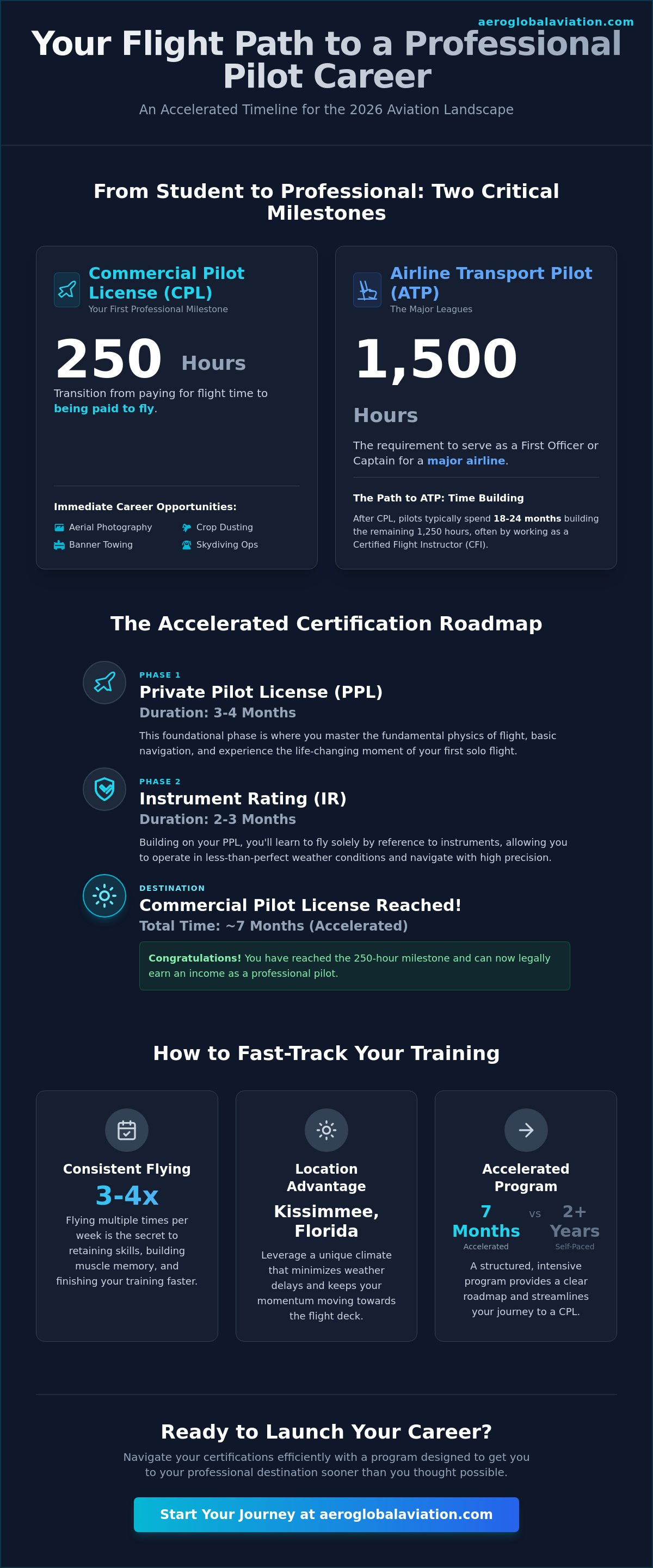
- Identify the critical milestone at 250 hours where you can transition from student to paid professional, long before reaching the 1,500-hour airline requirement.
- Master the logical progression of ratings, from your Private Pilot License to Multi-Engine certification, to build a foundation for a lifelong career.
- Learn why training frequency is the ultimate secret to success and why flying 3-4 times per week ensures you retain skills and finish your training faster.
- Discover how long does it take to become a commercial pilot when you leverage an accelerated 7-month program compared to traditional, self-paced routes.
- See how the unique climate in Kissimmee works in your favor to minimize weather delays and keep your momentum moving toward the flight deck.
Defining the Timeline: Commercial Pilot vs. Airline Transport Pilot
Understanding the difference between being a "commercial pilot" and an "airline pilot" is the first step toward your career. Many aspiring aviators ask how long does it take to become a commercial pilot and feel discouraged by the high hour requirements they see online. It's vital to separate the Commercial Pilot License (CPL) from the Airline Transport Pilot (ATP) certificate. While you need 1,500 hours to fly for a major airline under Part 121 operations, you can actually begin your professional career much sooner. For a detailed breakdown of these levels, you can explore the standards for Pilot certification in the United States.
Generally, a dedicated student can earn a CPL in 6 to 10 months through an intensive program. When considering how long does it take to become a commercial pilot, remember that reaching the ATP level typically takes two or more years of consistent flying. This distinction is crucial because it means you can start earning a paycheck while you build the experience required for the major leagues. You don't have to wait years to see a return on your investment; you just need to reach that first professional milestone.
The 250-Hour Milestone: When You Start Earning
Reaching 250 flight hours is the most transformative moment in your training. At this stage, you transition from paying for flight time to being paid to fly. The CPL is the legal requirement that allows you to accept compensation for your skills. While you aren't yet eligible for the airlines, many rewarding paths open up immediately. You can find work in the following areas:
- Aerial Photography: Capturing high-quality imagery for real estate or mapping.
- Crop Dusting: Supporting the agricultural industry through precision flying.
- Banner Towing: Building hours while flying over high-traffic coastal areas.
- Skydiving Operations: Transporting divers to altitude for jump centers.
An intensive training path allows you to reach this milestone in about six months, providing a fast track to your first professional paycheck and a new lifestyle in the sky.
The 1,500-Hour Journey: Reaching the Major Leagues
The journey from 250 to 1,500 hours is often called "time building." Most pilots choose to become Certified Flight Instructors to bridge this gap. This role allows you to sharpen your own skills while helping others learn, all while earning an income. In the current 2026 market, pilots typically spend about 18 to 24 months building those remaining 1,250 hours. The ultimate destination is the ATP certificate, which is required to serve as a First Officer or Captain for a major carrier. This phase is about developing the maturity and precision needed for high-stakes airline operations, turning you into a seasoned professional ready for the heavy jets.
The Certification Roadmap: Breaking Down Each Phase
Your journey to the flight deck is a series of building blocks. Each rating you earn adds a new layer of skill and authority, moving you closer to your professional goals. When students ask how long does it take to become a commercial pilot, they are really asking about the sum of these individual phases. By breaking the journey down into manageable milestones, the process feels less like an endurance test and more like a sequence of rewarding victories. Every phase concludes with a "checkride," a practical exam with an FAA examiner that validates your hard work and grants you your new privileges.
Phase 1: Private Pilot License (PPL): 3 to 4 Months
The first step is the most exciting. This foundation is where you master the fundamental physics of flight and experience the life-changing moment of your first solo. You'll focus on takeoffs, landings, and basic navigation. Ground school is equally vital during this time, as you prepare for the FAA written exam. Understanding how to get your private pilot license in Florida is essential because the local weather allows for more consistent flying days, helping you finish this phase on schedule. Our Wings Foundation course at Aero Global Aviation Academy is specifically designed to provide the supportive mentorship needed to clear this first hurdle with confidence.
Phase 2: Instrument Rating (IR): 2 to 3 Months
Once you've mastered the basics, you'll learn to fly solely by reference to your instruments. This is a critical skill for any professional, as it allows you to fly through clouds and in low-visibility conditions. Many students find this phase intellectually challenging because it requires intense focus and precision. You can explore our guide to advanced flight training to see how this rating integrates into your overall career path. Mastering the "scan" of your cockpit instruments is a transformative skill that marks your transition from a recreational flyer to a serious aviator. If you want to see our facilities, you can visit our campus today.
Phase 3: Commercial Pilot License (CPL): 3 to 4 Months
The final stretch involves refining your maneuvers to a professional standard. This is where you build the cross-country flight time required by the FAA. The mindset shifts here; you're no longer just learning to fly, you're learning to fly for hire. The legal framework for this progression is governed by FAA regulations for commercial pilots, ensuring you meet the high safety standards of the industry. After passing your Commercial checkride, you're officially eligible to be paid for your services. If you're ready to turn your passion into a profession, our Career Pilot Program at Aero Global Aviation Academy offers the most direct path to this milestone.
Accelerated vs. Self-Paced: Which Training Model Saves More Time?
Choosing between an accelerated program and a self-paced schedule is the most significant logistical decision you'll make. This choice directly impacts how long does it take to become a commercial pilot based on your current life commitments. While a fast-track model can get you through the CPL phase in approximately seven months, a flexible schedule often extends that timeline to 12 or 18 months. The most compelling reason to choose speed is the seniority argument; in the airline industry, your hire date determines your rank, your pay, and your quality of life for decades. Reaching the airlines even six months earlier can translate into a massive advantage in career-long earnings.
Regardless of which path you select, success depends on maintaining a steady rhythm. Regular flying ensures that your muscle memory stays sharp and your theoretical knowledge remains fresh. You can find more details on this requirement in our commercial pilot training guide. For a broad overview of what to expect during this process, the AOPA guide to the Commercial Pilot Certificate offers a fantastic perspective for newcomers.
The Accelerated 'Career' Track
This immersive approach requires you to treat flight school like a full-time job. You'll typically train five days a week, surrounding yourself with other dedicated students and mentors. This environment fosters rapid growth because you're constantly living and breathing aviation. Our Career Pilot Program at Aero Global Aviation Academy is designed for this exact purpose. It streamlines the transition from zero experience to a professional standard by using a structured syllabus that minimizes downtime and maximizes your time in the air. This is the ideal choice if you want to enter the workforce as quickly as possible to meet the growing demand for new pilots.
The Flexible 'Professional' Track
We recognize that not everyone can pause their life for seven months. Many of our students at Aero Global Aviation Academy are career changers with families or existing professional obligations. This track allows you to train two or three times per week. While it takes longer, it provides the flexibility needed to maintain your current lifestyle while building your future. When considering how long does it take to become a commercial pilot on a part-time basis, expect the journey to take roughly 12 to 18 months. The primary challenge here is "knowledge decay," where skills can fade between lessons. You can mitigate this by engaging in extra ground study and using flight simulators to keep your mind in the cockpit.
Variables That Impact Your Speed: Weather, Frequency, and Focus
While your personal dedication is a huge piece of the puzzle, external factors often dictate your actual graduation date. Many students ask how long does it take to become a commercial pilot without accounting for what we call "Hidden Timeline Killers." These logistical hurdles, such as aircraft maintenance delays or the limited availability of Designated Pilot Examiners (DPEs), can add weeks to a program if they aren't managed properly. When evaluating how long does it take to become a commercial pilot, you must look beyond the syllabus and consider the operational efficiency of your chosen training partner.
To stay on track, flying three to four times per week is the ideal sweet spot for skill retention. If you fly less frequently, you'll likely spend the first half of every lesson relearning what you forgot since the last flight, which leads to wasted time and money. Additionally, your focus on the ground is just as vital as your time in the air. Completing your ground school and FAA written exams before starting the corresponding flight phase prevents your training from stalling while you wait for paperwork. This proactive approach ensures that your momentum remains high and your path to the cockpit stays clear.
The Florida Advantage: 300+ Days of Flying Weather
Geography is perhaps the most overlooked variable in flight training efficiency. In northern states, winter weather can ground students for weeks at a time, leading to significant skill regression and frustration. Florida offers over 300 days of flyable weather each year. This consistency allows students in the Sunshine State to maintain their progress through every season, often finishing their ratings significantly faster than those in colder climates. Training at Kissimmee Gateway Airport provides an additional edge; you'll gain experience in an active, professional environment without the long ground delays found at larger international hubs, allowing for more actual flight time per lesson.
Instructor Availability and Maintenance Support
A school's infrastructure is just as important as the weather. You should avoid the "one instructor" trap where your entire career timeline depends on a single person's schedule or health. At Aero Global Aviation Academy, we ensure that our students have access to a deep pool of talented mentors and a well-maintained fleet. Having a dedicated on-site maintenance team means that aircraft are serviced quickly and returned to the flight line, keeping your training schedule on track. If you want to see how a professional infrastructure supports your professional goals, explore our training fleet and facility to see the Aero Global Aviation Academy difference.
Launching Your Career in Kissimmee: The Aero Global Advantage
Choosing the right environment is the final piece of your professional puzzle. While we've discussed the technical roadmap and the impact of weather, the quality of your mentorship ultimately determines your success. At Aero Global, we function as a practical mentor rather than an impersonal corporation. We provide the personalized attention you need in a professional setting that mirrors the standards of major airlines. Our Career Pilot Program serves as the definitive path for those who are serious about reaching the commercial flight deck with efficiency and confidence.
For those aiming even higher, our Airline Pilot Elite track is specifically designed to prepare you for day one at a regional carrier. This program goes beyond the basics to instill the cockpit resource management and advanced technical skills that airline recruiters look for. When you consider how long does it take to become a commercial pilot, you should also consider the quality of the hours you log. Training at Kissimmee Gateway Airport gives you a strategic edge, as you'll learn to operate in a diverse and active airspace that builds real-world experience from your very first lesson.
From Zero Experience to Commercial Certified
The transition from a beginner to a professional is a structured process that rewards focus. Our syllabus is built for efficiency, ensuring that every hour you spend in the air moves you closer to your goal. Once you achieve your CPL, the journey continues as you transition from student to instructor. This is the most common way to build the 1,500 hours required for airline operations while earning an income. Many of our successful graduates have used this exact fast-track method to reach their career destinations months ahead of their peers. Your commitment combined with our structured environment makes the question of how long does it take to become a commercial pilot a matter of months rather than years.
Take Your First Step Today
There has never been a better time to enter the aviation industry. In 2026, the U.S. is facing a projected shortfall of 24,000 pilots, and Boeing projects a global need for 660,000 new aviators over the next two decades. This demand means that airlines are actively looking for well-trained professionals to fill their ranks. You don't have to wait to start your journey; you can begin with a discovery flight to experience the thrill of the cockpit firsthand. Whether you start with our Wings Foundation for your PPL or dive into the full professional track, we are here to guide you. Contact an admissions counselor today to schedule your visit to Kissimmee and see how we can help you launch your career into the skies.
Take Command of Your Professional Future
Reaching the cockpit is a matter of clear goals and consistent action. You've learned that the answer to how long does it take to become a commercial pilot is often shorter than most people imagine, especially when you leverage the right environment. By focusing on an accelerated schedule and utilizing the optimized Florida flying weather, you can transition from zero experience to a certified professional in months. This journey is supported by professional FAA-certified instructors who ensure you meet every standard with precision and confidence.
Our programs are designed to provide direct paths to the 1,500-hour airline requirements, helping you bridge the gap between your commercial rating and a major carrier seat. The global demand for pilots is at an all-time high, making this the perfect moment to invest in your skills. We invite you to step into our facility and experience the supportive, high-standards atmosphere that defines our academy. Start your journey today with our Career Pilot Program in Kissimmee! Your seat on the flight deck is waiting, and we are honored to be the partner that helps you reach it.
Frequently Asked Questions
Can I become a commercial pilot in less than a year?
Yes, you can achieve your Commercial Pilot License (CPL) in approximately 7 to 10 months through an accelerated, full-time program. This timeline requires a dedicated commitment, often training five days a week. By immersing yourself in a structured curriculum and taking advantage of consistent flying weather, you'll move through the Private Pilot, Instrument, and Commercial ratings efficiently to reach your professional goals sooner.
How many flight hours do I need for a commercial pilot license?
You generally need 250 flight hours to earn a Commercial Pilot License under FAA Part 61 regulations. If you train under a Part 141 school, this requirement can be reduced to 190 hours. These hours include specific categories like cross-country flying, night operations, and solo time. This ensures you possess a well-rounded skill set and meet the safety standards required before you begin flying for hire.
What is the fastest way to get 1,500 flight hours?
Becoming a Certified Flight Instructor (CFI) is widely considered the most efficient way to reach the 1,500-hour airline requirement. As an instructor, you earn a paycheck while logging hours every time you fly with a student. This role allows you to build time rapidly, often reaching the ATP milestone within 18 to 24 months after earning your initial commercial certificate and beginning your teaching career.
Do I need a college degree to be a commercial pilot in 2026?
No, a college degree is not a legal requirement to become a commercial pilot or fly for many regional airlines in 2026. While some major carriers historically preferred four-year degrees, the current pilot shortage has led many companies to prioritize flight experience and technical proficiency over a diploma. You can focus entirely on your flight training to enter the workforce and start earning a salary sooner.
How much does it cost to go from zero to commercial pilot?
The investment for training from zero experience to a commercial pilot certificate varies based on how frequently you fly and the training path you choose. When asking how long does it take to become a commercial pilot, it's also vital to consider that finishing faster often reduces overall costs by minimizing the need for remedial training. You'll need to budget for the Private Pilot, Instrument, and Commercial phases of your education.
How many days a week should I fly to finish flight school fast?
Flying three to four days per week is the optimal frequency for most students to maintain progress and minimize skill decay. If you're enrolled in an accelerated track, you'll likely fly five days a week. This high frequency keeps your muscle memory sharp and ensures you're always prepared for your next milestone. This consistency is the most effective way to finish your ratings on the shortest possible timeline.
What is the difference between Part 61 and Part 141 training times?
Part 141 schools use a highly structured, FAA-approved syllabus that can allow you to earn a CPL in as few as 190 hours. Part 61 training offers more flexibility for your personal schedule but requires a minimum of 250 hours for the same license. While Part 141 can be faster for full-time students, Part 61 is often a better fit for those who need to balance training with other life commitments.
Can I work a full-time job while training to be a pilot?
You can certainly balance a career with flight training by choosing a self-paced, flexible schedule. While this path extends the total time it takes to reach your goals, it allows you to maintain financial stability. We recommend flying at least twice a week to ensure you don't lose momentum. Consistency remains the key to mastering complex aviation skills while managing your other professional responsibilities.


