
Did you know that major airlines are forecasted to hire 7,672 pilots in 2026 while nearly 5,000 veterans reach mandatory retirement? It's a massive industry shift that has many aspiring aviators asking if the initial investment in flight school truly pays off. You've likely felt the confusion of comparing complex hourly rates to an actual commercial pilot salary, or perhaps you're worried about the financial commitment without a clear map of your future earnings. We understand those concerns because we view our students as future colleagues, not just numbers in a classroom.
Senior cargo pilots at carriers like FedEx and UPS often earn salaries that rival or exceed those of passenger airline captains. These positions are highly sought after because they offer excellent stability and competitive retirement contributions. While the schedules often involve more night flying, the financial rewards for "flying boxes" remain among the highest in the entire aviation industry. For those interested in the broader Florida logistics sector, East USA CDL ACADEMY provides a ground-based alternative; you can learn more about CDL Entry Level Driver Training – Automatic Transmission Standard Beginner Course to explore high-demand transport roles.
You deserve a clear view of the financial horizon before you take flight. This guide reveals exactly what pilots earn in 2026, from regional First Officers starting near $90,000 to major airline captains earning over $350,000. You'll learn how to navigate the 10 year pay trajectory and discover how to maximize your training ROI by choosing an efficient path to the flight deck. We'll compare different aviation sectors and provide a practical framework to help you choose a training program that turns your professional goals into a tangible destination. Whether you're considering a Career Pilot Program or advanced instructor certifications, the path to a rewarding career is more attainable than you think.
Key Takeaways
- Understand how the current pilot shortage transforms your earning potential and why 2026 is a pivotal year for airline compensation.
- Demystify the complex pay structures of the industry to see how a commercial pilot salary is built through hourly rates and flight hour guarantees.
- Compare the financial trajectories of regional and major airlines to map out your journey from a first officer seat to a high-earning captaincy.
- Identify the hidden opportunity costs of slow flight training and learn how to choose a program that gets you to the flight deck faster.
- Discover how training in a high-efficiency environment like Kissimmee improves your ROI by utilizing favorable weather for more consistent flight hours.
The 2026 Commercial Pilot Salary Landscape: Why the Numbers Are Rising
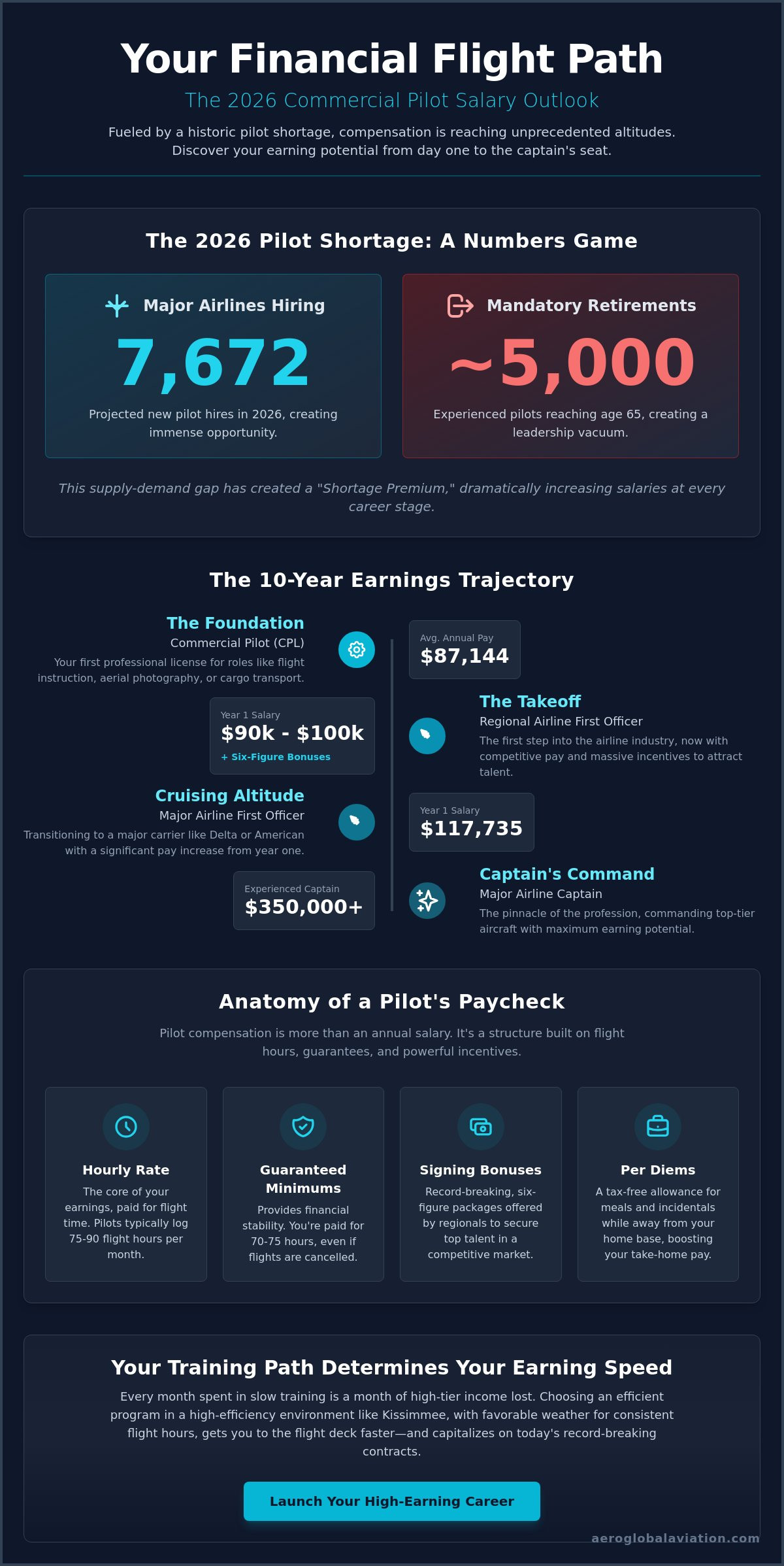
The aviation industry has reached a historic turning point where the demand for skilled aviators significantly outpaces the supply. In 2026, major airlines are forecasted to hire an estimated 7,672 pilots, a figure driven by a massive wave of mandatory retirements. Approximately 4,500 to 5,000 pilots will reach the age of 65 this year alone, creating a consistent vacuum that airlines must fill to keep their fleets in the air. This dynamic has shifted the power directly into the cockpit, allowing new pilots to enter the workforce with more leverage than ever before. For anyone tracking a commercial pilot salary, the data shows that compensation is no longer just about seniority; it's about the urgent need for qualified flight deck leadership.
Commercial vs. Airline Pilot: Clearing the Confusion
It's vital to distinguish between the different tiers of the Aircraft pilot profession to understand your earning potential. A Commercial Pilot License (CPL) is your first major professional milestone, allowing you to fly for compensation in roles like flight instruction, aerial photography, or cargo transport. While the average annual pay for a commercial pilot in the United States is approximately $87,144 according to May 2026 ZipRecruiter data, this is often the foundational stage of a career. To reach the top tier salaries at major carriers, which often exceed $300,000 for experienced captains, you need an Airline Transport Pilot (ATP) certificate. Our Airline Pilot Elite Program acts as the essential bridge, taking you from your first flight to the advanced instructor certifications required to build the 1,500 hours needed for that ATP rating.
The "Shortage Premium" in 2026
The current market has introduced what many call a "shortage premium." Regional airlines, once known for modest starting pay, have undergone a total revolution to retain talent. In 2026, starting salaries for First Officers at regional carriers have stabilized between $90,000 and $100,000. This shift is fueled by new union contracts at major airlines like Delta and American, where Year 1 First Officers now earn $117,735. These aggressive pay scales create a rising tide that lifts the entire industry. In 2026, the scarcity of qualified flight hours has transformed pilot compensation from a steady climb into a vertical takeoff.
The role of mandatory retirement ages cannot be overstated. With the U.S. Bureau of Labor Statistics projecting about 18,200 openings per year through 2034, the salary floor remains incredibly high. Airlines aren't just competing on pay; they're competing for your time. Choosing a training path that prioritizes efficiency allows you to enter this high-paying market while these record-breaking contracts are in full effect. Your journey toward a premium commercial pilot salary starts with understanding that every month spent in training has a real-world dollar value in the current hiring climate.
Beyond the Base Pay: Understanding the Pilot Compensation Structure
Calculating a commercial pilot salary involves much more than looking at a single annual figure. Unlike traditional office roles, aviation pay is a multi-layered structure designed to reward time in the cockpit and professional commitment. Most pilots are paid based on an hourly rate, but it's a mistake to compare this directly to a standard 40-hour work week. In reality, a pilot typically logs between 75 and 90 flight hours per month. To provide financial stability, airlines offer "guaranteed minimums," ensuring you receive pay for a set number of hours, usually 70 to 75, even if your flights are canceled due to weather or maintenance.
In 2026, we're seeing record-breaking signing and retention bonuses that fundamentally change the entry-level math. Many regional airlines now provide six-figure incentive packages to attract new First Officers, aiming to secure talent in a highly competitive market. These bonuses, combined with tax-free per diems for meals and lodging, mean your take-home pay is often significantly higher than the base rate suggests. To truly understand the potential of a commercial pilot salary, you have to look at the total package. If you're ready to start this journey, exploring a comprehensive flight training path is the first step toward accessing these lucrative contracts.
The Math of Flight Hours and Credit Hours
Pilot pay is typically calculated "block-to-block," meaning you're paid from the moment the aircraft pushes back from the gate until it arrives at the destination. However, the industry also uses "soft time" to compensate you for duties performed outside of flying. This includes pay for deadheading, which involves traveling as a passenger to a different city for an assignment, attending required training sessions, or being on "reserve" duty. For those currently building their 1,500 hours, earning a Certified Flight Instructor (CFI) rating provides an immediate way to generate income while gaining the professional experience major carriers demand.
Benefits, 401k, and Lifestyle Perks
The long-term value of this career is often found in the benefits package. Major airlines are known for industry-leading 401k plans, often providing direct employer contributions of 14% to 16% without requiring any employee match. When you look at Official pilot salary data, it's clear that these retirement contributions and comprehensive health coverage add massive value over a 30-year career. Beyond the numbers, the non-monetary perks like flexible scheduling and worldwide travel benefits for your family make this profession uniquely rewarding. It's a lifestyle that offers both financial security and the freedom to see the world.
Comparing Career Trajectories: Where Is the Most Money?
Choosing your path in aviation is like selecting a destination on a flight plan; the route you take determines both the scenery and the reward. While many associate the peak of a commercial pilot salary with major passenger airlines, the 2026 market offers diverse high-earning opportunities across cargo and corporate sectors. Understanding these trajectories helps you align your training investment with your long-term lifestyle goals. Whether you're aiming for the prestige of a global carrier or the unique challenges of cargo logistics, the financial floor has never been higher.
The "Big Three"—Delta, American, and United—remain the gold standard for long-term earnings. A Year 12 Captain at American Airlines now earns approximately $351,339 annually, while a Year 12 Captain at Delta earns around $349,540. According to the Bureau of Labor Statistics pilot salary data, the median pay for airline pilots sits at $226,600, reflecting the strong upward pressure from recent union contract negotiations. These figures don't even include the senior widebody captains who often cross the $450,000 mark by picking up premium trips or maximizing their monthly credit hours.
Regional vs. Major Airline Pay Scales
The gap between regional and major carriers has narrowed significantly in 2026. A First Officer at a regional airline now starts with a salary between $90,000 and $100,000, providing a solid financial foundation right out of the gate. Most pilots view regionals as the essential first step, especially with "flow-through" agreements that provide a structured path to a major carrier seat. If you're curious about the specific ratings needed to enter these sectors, check out our Commercial Pilot Training Guide for a detailed breakdown of the certification steps required to turn your ambition into a career.
The Cargo and Charter Alternatives
Don't overlook the cargo sector, often referred to as "flying boxes." Senior captains at giants like FedEx and UPS often earn a commercial pilot salary that rivals or exceeds passenger airline pay. These roles offer incredible stability and different scheduling patterns, often flying at night when the skies are quieter. Alternatively, the corporate and private charter world offers a high-end lifestyle with varied destinations. While leading private aviation firms provide a premium experience and competitive pay, some pilots prefer the variety of Part 135 charter work, where no two days are ever the same; to learn about the elite standards of FlyEliteJets, read more. Each sector has its own trade-offs between pay, schedule, and lifestyle, but the 2026 market ensures that every path is financially rewarding.
Calculating Training ROI: Is Flight School Worth the Investment?
Investing in flight school is a significant decision that requires a clear-eyed look at the numbers. While the upfront costs for tuition, checkrides, and living expenses can seem daunting, the long-term financial rewards often outpace other high-skill professions. Unlike law or medicine, where practitioners might spend a decade in school before seeing a substantial return, a pilot can reach a six-figure commercial pilot salary relatively quickly. In the current 2026 market, the rapid progression from student to regional First Officer allows for an aggressive "break-even" point that was nearly impossible a decade ago.
The real secret to a high return on investment (ROI) is speed. In aviation, the most expensive mistake isn’t the tuition, it’s the lost seniority from delayed training. Every month you spend on the ground is a month of high-tier Captain pay you lose at the end of your career. Because airline seniority determines your pay scale, schedule, and aircraft type, starting your journey early is the most effective way to maximize your lifetime earnings. If you are ready to take that first step, you can start your flight training journey today to secure your place in the hiring queue.
The 5-Step ROI Calculation for Pilot Students
To understand your specific financial path, follow this structured framework. First, calculate the total investment for a comprehensive Career Pilot Program. Second, estimate your earnings as a Certified Flight Instructor (CFI). While these earnings are modest, they allow you to build the 1,500 hours required for airline entry without paying for flight time. Third, factor in the current regional First Officer starting pay of $90,000 to $100,000, often supplemented by significant signing bonuses. Fourth, project your transition to a major airline by Year 5, where First Officer pay typically jumps above $117,000. Finally, compare these cumulative earnings against your initial training debt to see your 10-year net gain.
Mitigating Risk: Financing and Career Longevity
Many students use financing as a strategic tool to accelerate their training rather than seeing it purely as debt. By finishing your ratings faster, you enter the workforce sooner and begin earning a professional commercial pilot salary while the 2026 hiring surge is at its peak. If you're worried about starting later in life, our 2026 Career Change Guide explains why the mandatory retirement of thousands of pilots makes this an ideal time for a second career. Whether you are 21 or 45, the combination of high starting pay and robust retirement contributions creates a compelling case for the flight deck.
Launching Your High-Earning Career from Kissimmee: The Aero Global Advantage
Where you choose to train is just as critical as the ratings you earn. In the competitive 2026 landscape, the speed at which you transition from student to professional determines your lifetime earnings. Florida has long been recognized as the heart of the global aviation corridor, and training in the Orlando/Kissimmee area offers a strategic advantage that generic programs elsewhere simply can't match. By positioning yourself in a high-activity hub, you aren't just learning to fly; you're immersing yourself in a professional environment that mirrors the fast-paced operations of the major airlines you aim to join.
Our approach at Aero Global Aviation Academy is built on the philosophy of a practical mentor. We understand that your goal is to reach the flight deck as efficiently as possible to begin earning a commercial pilot salary that reflects your dedication. We leverage our unique geographic location and technical expertise to remove the traditional barriers to entry, providing a clear, structured path that respects both your time and your investment. When you train here, you're joining a community of aviators who are deeply invested in your individual success.
Efficiency Equals Earnings
In aviation, time is literally money. Because airline seniority is based on your hire date, finishing your training just six months faster can equate to an extra $50,000 to $90,000 in career earnings by the time you reach the major airlines. Kissimmee Gateway Airport (KISM) provides the perfect training ground, offering a diverse flight environment with a control tower and multiple runways to build real-world confidence. Most importantly, Central Florida provides over 300 days of flyable weather per year. This consistency means you don't have to worry about weeks of "grounded" time due to winter storms, allowing you to maintain momentum and reach your checkrides on schedule.
Your First Paycheck: From Student to Instructor
The journey to a premium commercial pilot salary doesn't have to be a multi-year wait for a paycheck. Our Airline Pilot Elite program is specifically designed to bridge the gap between earning your commercial license and reaching the 1,500-hour airline requirement. This track prepares you to earn your advanced instructor certifications so you can begin working as a professional flight instructor right here at Aero Global Aviation Academy. It's a transformative process where you move from student to mentor, gaining the leadership skills that major carriers look for in their future captains.
By the time you complete this track, you'll have the flight hours and the professional network needed to step directly into a regional airline seat. You'll be ready to take advantage of the record-breaking hiring surge we're seeing across the industry. Don't let your career stay on the taxiway while others are taking off. Start your career assessment at Aero Global Aviation Academy today and take the first step toward your future in the flight deck.
Take Command of Your Aviation Future
The path to a rewarding commercial pilot salary is a structured journey that rewards speed and professional excellence. As we've explored, the 2026 market offers unprecedented leverage, but realizing that potential depends on where and how you begin your training. By choosing an environment that prioritizes your return on investment, you ensure that every hour in the cockpit moves you closer to a high-earning seat at a major or cargo carrier. Success in this industry is about more than just flying; it's about making strategic choices today that secure your seniority tomorrow.
At Aero Global Aviation Academy, our Career Pilot Program is built to exceed 2026 airline standards, providing the expert mentorship and high-efficiency training needed to reach the flight deck faster. We leverage the unique advantages of our Kissimmee location to keep your training on schedule and within reach. Download Our 2026 Pilot Career & Salary Prospectus to see exactly how your ambition aligns with today's industry demand. The sky isn't a limit; it's your new workplace, and we're ready to help you take command of your future with confidence and pride.
Frequently Asked Questions
What is the starting salary for a commercial pilot in 2026?
Starting salaries for regional First Officers in 2026 typically range between $90,000 and $100,000. While general commercial roles in charter or cargo might average around $87,144 according to recent ZipRecruiter data, the airline sector offers a more aggressive pay scale. This initial commercial pilot salary is often bolstered by significant signing bonuses that help you manage your training investment from your very first day on the job.
How much do major airline captains make per year?
Captains at major airlines like American and Delta earn approximately $350,000 annually by their twelfth year of service. Those flying widebody aircraft on international routes often exceed $450,000 when factoring in premium trip pickups and monthly credit hour maximums. These figures reflect the high level of responsibility and technical expertise required to lead a professional flight crew at the highest level of global aviation.
Do pilots get paid during flight school?
Students don't typically receive a salary while in flight school; however, you can begin earning as soon as you achieve your instructor ratings. Our Airline Pilot Elite program is specifically designed to help you transition from student to mentor. This allows you to earn an income as a flight instructor while building the 1,500 hours required to secure a professional position at a regional airline.
What is the difference between a regional and a major airline salary?
The primary difference lies in the career stage and the size of the aircraft flown. Regional First Officers start between $90,000 and $100,000, while major airlines like Delta and American offer Year 1 First Officer pay of $117,735. As you progress to Captain, major airlines offer significantly higher ceilings, with top-tier pay reaching double what most regional captains earn, reflecting the increased complexity of global operations.
How many hours a month do commercial pilots actually work?
Commercial pilots typically fly between 75 and 90 hours per month. It's important to understand that "duty time," which includes pre-flight planning, ground delays, and layovers, usually totals 120 to 150 hours per month. This schedule offers a unique lifestyle balance compared to traditional 40-hour work weeks, providing more consecutive days off between your scheduled flight pairings and more time at home.
Is the pilot shortage still affecting salaries in 2026?
Yes, the pilot shortage continues to drive a high commercial pilot salary floor in 2026. With major airlines forecasted to hire 7,672 pilots this year and nearly 5,000 reaching mandatory retirement age, the demand for qualified aviators remains at historic levels. This scarcity has pushed airlines to offer record-breaking contracts and improved benefits to attract and retain the next generation of flight deck talent.
How much do cargo pilots make compared to airline pilots?
Senior cargo pilots at carriers like FedEx and UPS often earn salaries that rival or exceed those of passenger airline captains. These positions are highly sought after because they offer excellent stability and competitive retirement contributions. While the schedules often involve more night flying, the financial rewards for "flying boxes" remain among the highest in the entire aviation industry, making cargo a very lucrative career path.
What are the typical signing bonuses for new pilots in 2026?
Signing bonuses for new pilots at regional airlines in 2026 frequently reach six figures. These incentives are designed to attract candidates who have completed their 1,500 hours and are ready to enter the flight deck immediately. These bonuses provide a massive boost to your first-year earnings and help you realize a much faster return on your initial flight training investment as you begin your airline career.


