
What if the biggest obstacle to your airline career isn't the total tuition, but how you choose to pace your training? You've likely seen the headlines about rising interest rates and the daunting price tags associated with the cost of career pilot program Florida options, leaving you worried about falling into a "Zero to Hero" debt trap. It's a valid concern; the financial side of flight training can feel like flying through heavy fog without an instrument rating.
We're here to clear the air and help you master the economics of your education. This guide provides a comprehensive breakdown of pilot program costs in Orlando and offers a strategic roadmap to funding your career without compromising your financial health. You'll discover Florida-specific funding sources, learn how to balance working while training, and understand the massive ROI of taking advantage of Kissimmee's 300-plus annual flying days to accelerate your path to the cockpit.
Key Takeaways
- Learn how training in Orlando’s 300-plus flying days per year accelerates your timeline and directly reduces your total training investment.
- Identify the primary aviation lenders for 2026 and master the strategies needed to secure competitive interest rates through qualified co-signers.
- Navigate the specific cost of career pilot program Florida pathways with a clear breakdown of tuition, hidden fees, and regional ROI.
- Uncover a roadmap of national and local scholarship opportunities, including Florida-specific grants that can significantly lower your out-of-pocket expenses.
- Discover how modular options like the Wings Foundation provide a manageable financial entry point for new pilots starting their journey.
Evaluating the Investment: Cost of Career Pilot Programs in Florida
Starting your journey in Central Florida means entering one of the most active aviation corridors in the world. As you research the cost of career pilot program Florida options, it's vital to view this as a strategic investment rather than a simple expense. The 2026 landscape for professional pilot training in the Orlando region is shaped by high demand for cockpit seats and the rising efficiency of modular training paths. By choosing a program in the Kissimmee area, you are positioning yourself where the industry is most vibrant.
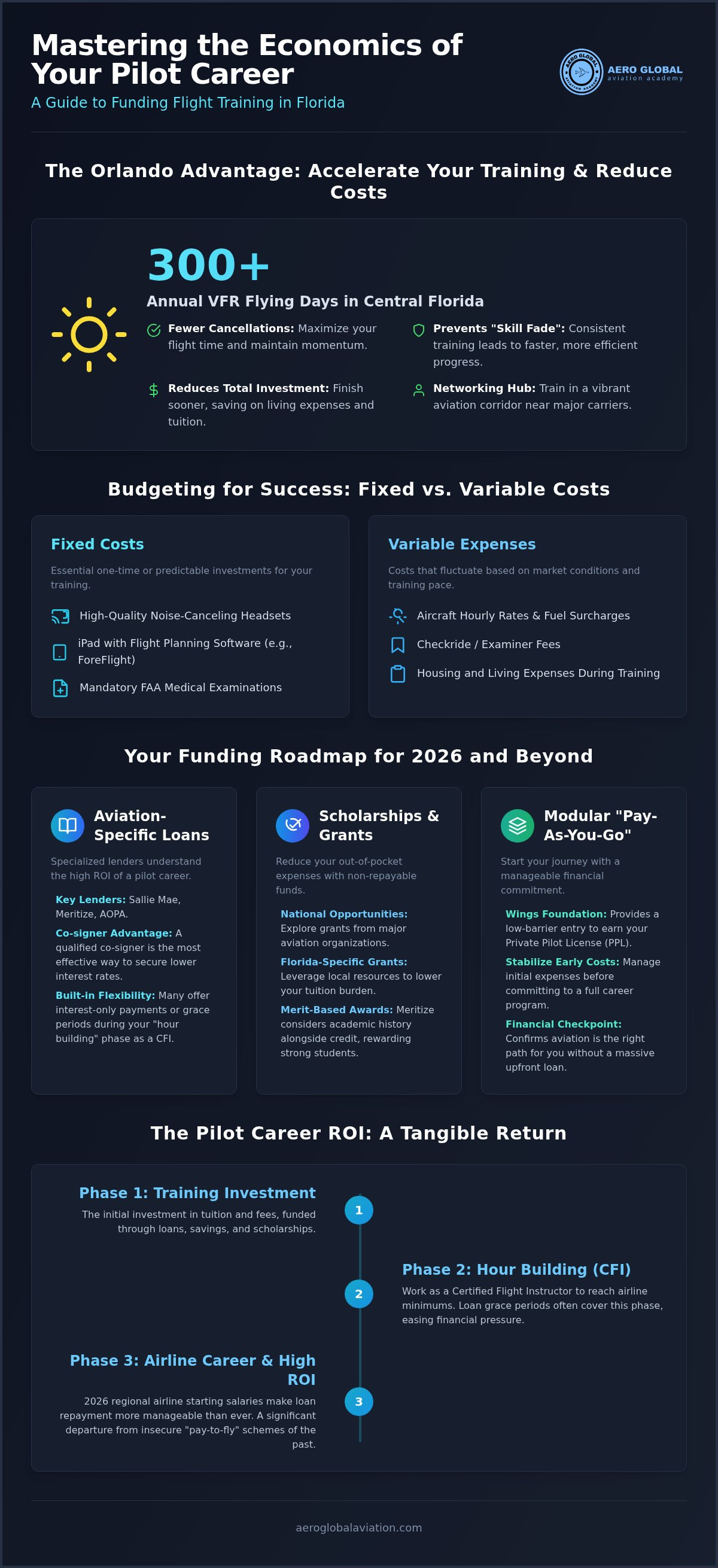
One of the most significant financial advantages of training in Orlando is the local climate. With over 300 days of Visual Flight Rules (VFR) flying weather each year, students face fewer weather-related cancellations than their peers in the north. This consistency isn't just about convenience; it directly reduces your total training investment by preventing "skill fade" between lessons and lowering the total amount of time you need to pay for housing and living expenses while in school. Proficiency-based training focuses on mastering specific skills rather than just accumulating hours, which allows dedicated students to progress efficiently and control their variable flight costs.
Fixed Costs vs. Variable Training Expenses
Successful budgeting requires you to look beyond the hourly rate of the aircraft. You must account for fixed costs like high-quality noise-canceling headsets, an iPad equipped with flight planning software, and your mandatory FAA medical examinations. In Central Florida, you should also be aware of how fuel surcharges can impact hourly aircraft rates, as these fluctuate based on market conditions. To help manage these initial hurdles, the Wings Foundation acts as a vital financial checkpoint. It provides a structured, low-barrier entry point for your Private Pilot License (PPL), allowing you to stabilize your early costs before committing to a full career track.
The ROI of an Orlando Aviation Career
The return on investment for a pilot education has never been more tangible. While the initial debt can seem high, 2026 regional airline starting salaries have reached levels that make repayment much more manageable than in previous decades. Unlike historical Pay-to-fly schemes that offered little long-term security, modern professional programs are designed to get you into a paying seat as quickly as possible. Training in Kissimmee also offers a strategic networking advantage, placing you in close proximity to major Florida-based carriers and flight operations. To see how these ratings translate into a long-term paycheck, explore The Airline Pilot Career Path: A Comprehensive 2026 Guide for a full career roadmap.
Primary Funding Sources: Flight Training Loans and Personal Financing
Financing your flight training requires a strategy as structured as your pre-flight checklist. While the cost of career pilot program Florida options represents a significant commitment, modern lending products are specifically designed for the high-ROI nature of aviation. Most students in the Orlando area utilize a combination of specialized loans and personal capital to bridge the gap between their first flight and their first airline paycheck. Understanding how to leverage these tools is the first step toward a debt-managed career.
Specialized lenders like Sallie Mae and Meritize dominate the 2026 landscape for aspiring aviators. Unlike standard bank loans, AOPA Flight Training Loans and similar products are built to support the specific milestones of pilot progress. Meritize stands out by evaluating your academic history and flight potential alongside your credit score, which can be a game-changer if you're just starting to build your financial history. Adding a qualified co-signer remains the most effective way to secure competitive interest rates, potentially saving you thousands of dollars over the life of your loan. When you prepare your application, ensure your financial profile is organized and reflects a clear commitment to the full career track.
Aviation-Specific Loans vs. Traditional Student Debt
You'll also need to plan for the "hour building gap." After earning your Commercial Pilot License (CPL), you'll likely work as a Certified Flight Instructor (CFI) to reach airline minimums. Many aviation-specific loans offer interest-only payment options or grace periods during this phase. This flexibility allows you to focus on teaching and accumulating hours before full principal and interest payments kick in, making the transition from student to professional much smoother.
Private Support and Family Financing
If you're considering using personal savings or 401k withdrawals, weigh the immediate liquidity against the loss of long-term compound interest. Some students find success with a "rating-by-rating" sponsorship model where family members fund specific milestones rather than the entire cost upfront. If you choose this route, it's a professional move to create a formal agreement with clear repayment terms. This keeps expectations transparent and treats your training like the business investment it is. To get a better sense of that first financial milestone, check out our guide on How to Get Your Private Pilot License in Florida: The 2026 Step-by-Step Guide.
Finding the right balance between debt and equity is a personal journey that requires careful planning. Having a dedicated mentor to review your financial roadmap can provide the clarity you need to move forward with confidence and keep your focus where it belongs: on the flight deck.
Scholarships and Grants: Reducing Out-of-Pocket Training Costs
Scholarships are often the most overlooked resource when students calculate the cost of career pilot program Florida training. Unlike loans, these awards don't require repayment; they are essentially "free money" that preserves your future income. By adopting a "Stacking Strategy," you can combine multiple smaller awards to fund specific milestones. For instance, three $1,000 grants can effectively cover a significant portion of your Instrument Rating. Many students wait until they're deep into their flight hours to start looking, but the most successful aviators begin the hunt before their first takeoff.
Niche funding also exists for veterans, minorities, and career changers who are training in the Kissimmee area. If you're transitioning from another industry—such as moving into aviation after training at NPTI Florida—highlight your transferable skills to scholarship committees. These groups value maturity and a proven track record of professional success. When you stack these opportunities alongside the efficiency of Orlando's flying weather, the path to a debt-free or low-debt education becomes much more attainable.
National Organizations with Local Florida Chapters
National organizations like Women in Aviation International and the AOPA Aviation Scholarships program offer millions in funding annually. However, your strongest advantage lies in local Florida chapters. The Kissimmee EAA chapter provides a tight-knit community where mentors often share leads on regional funding that isn't widely advertised. Diverse student pilots should look to the Organization of Black Aerospace Professionals (OBAP) and the Ninety-Nines for dedicated financial support. Additionally, the Florida Airports Council (FAC) and the Greater Orlando Aviation Authority (GOAA) frequently offer grants to students committed to the local aviation ecosystem. Early application is the #1 factor in scholarship success, so you must start your research months in advance.
Winning Application Strategies for 2026
To win in the 2026/2027 cycle, your application must resonate with aviation professionals. Your "Statement of Purpose" should clearly define your professional goals and explain why you've chosen Central Florida as your training base. Committees want to see a logical plan for completion, not just a dream of flying. A high-impact letter of recommendation from your Chief Flight Instructor can provide the professional validation that sets your application apart. Stay disciplined with your calendar; for example, the Florida Airports Council typically conducts interviews in April, while other regional awards may have deadlines as early as October. By treating scholarship hunting like a part-time job, you can significantly lower your out-of-pocket training costs.
Strategic Payment Plans: Pay-As-You-Go vs. Accelerated Financing
Choosing how to pay for your training is just as important as choosing your flight school. You have two primary paths to consider when evaluating the cost of career pilot program Florida options: the modular "pay-as-you-go" approach and the "accelerated" financed track. Your decision should align with your current financial liquidity, your employment status in Orlando, and how quickly you want to reach the captain's seat. Both methods have distinct advantages that can help you avoid the debt traps often found in less flexible programs.
The Modular Strategy for Local Orlando Students
If you're currently working in the Central Florida area, the "pay-as-you-go" model offers a level of financial safety that full financing cannot match. By training at Kissimmee Gateway Airport while maintaining a part-time job, you can fund your ratings in stages, effectively minimizing your reliance on high-interest student loans. The key to success here is maintaining "flight currency." We recommend a schedule of at least 2 to 3 days per week. This frequency ensures you aren't spending extra money relearning skills from a previous week, which is a common "stop-start" trap that inflates total flight hours. Consistency is your best tool for keeping costs low.
Financing the Airline Pilot Elite Track
For those ready to dive in full-time, the Airline Pilot Elite track utilizes accelerated financing to move you through your ratings in as little as 9 months. While this involves taking on debt upfront, it's a strategic move to hedge against rising inflation in aircraft rentals and fuel surcharges. More importantly, it addresses the "opportunity cost" of a delayed airline entry. In a market where seniority is everything, reaching the airlines six months earlier can translate into significantly higher lifetime earnings. By fast-tracking your CFI rating, you can begin earning a professional salary while building the 1,500 hours required for airline eligibility. You can explore the specific milestones of this journey in our Commercial Pilot Training: Your 2026 Guide to Professional Flight Certification.
To determine which payment structure fits your life best, schedule a strategy session with a flight training mentor today to map out your personal financial flight plan.
Funding Your Future at Aero Global: Personalized Financial Mentorship
At Aero Global Aviation Academy, we believe that your focus should be on the horizon, not buried in a ledger. We don't just provide flight hours; we act as a practical financial mentor for every student who walks through our doors at Kissimmee Gateway Airport. Understanding the cost of career pilot program Florida pathways is complex, so we work with you to build a personalized roadmap that aligns your professional aspirations with a realistic, sustainable budget. Our goal is to ensure that you reach the flight deck with a solid financial foundation and a clear path toward career advancement.
For many, the Wings Foundation serves as the first essential financial checkpoint. This PPL-only course provides a low-barrier entry point, allowing you to earn your Private Pilot License and validate your aptitude for flight before committing to a full professional track. Once you've mastered the basics, transitioning into our full Career Pilot Program becomes a structured, logical progression. This modular approach allows you to manage your investment in phases, ensuring that every dollar spent moves you closer to your ultimate destination. You can explore the full details of this journey in The Ultimate Career Pilot Program in Kissimmee, Orlando: Your Path to the Flight Deck.
Milestone-Based Training and Payments
We've designed our professional tracks to be manageable by breaking them into distinct financial phases, including PPL, Instrument Rating (IFR), and Commercial Pilot License (CPL). This milestone-based structure prevents the overwhelming "sticker shock" often associated with aviation and allows you to fund your training as you progress. Because our Kissimmee location offers over 300 flying days per year, you maximize the value of every flight hour by avoiding the costly skill decay that happens during long weather delays. We invite you to schedule a one-on-one financial consultation at our Orlando training center to see exactly how these efficiencies can work for your specific timeline.
Next Steps: Your Financial Flight Plan
Taking the first step toward your career is about gathering the right information. We recommend following these three practical steps to launch your journey with confidence:
- Step 1: Secure your FAA Medical Certificate. This is the most important first move to confirm your eligibility for a long-term career before you invest in training.
- Step 2: Book a discovery flight. Experience the cockpit firsthand at our Kissimmee base to validate your passion and ensure the pilot lifestyle is the right fit for you.
- Step 3: Meet our team. Sit down with our mentors to map out your specific 2026 funding strategy, whether you're looking at specialized lenders or a pay-as-you-go modular plan.
Take Flight with a Strategic Financial Plan
You now have the roadmap to navigate the cost of career pilot program Florida options without losing sight of your financial health. By leveraging Kissimmee's 300-plus annual flying days, you can maximize your training efficiency and reach your professional goals faster. We've explored how a multi-engine strategy of loans, scholarships, and modular training can protect your investment while keeping your career on track. Whether you begin with the budget-conscious Wings Foundation or dive into an accelerated path, your journey is a structured process toward a rewarding destination.
Our team is ready to act as your practical mentor, providing personalized financial guidance from your first solo flight through your final instructor ratings. We understand the specific advantages of our Orlando location and want to help you use them to your benefit. Book a Financial Consultation for Your Career Pilot Program today to map out your specific funding strategy. The sky is waiting for you, and with the right plan in place, your professional future is well within reach.
Frequently Asked Questions
Can I get federal financial aid (FAFSA) for flight school in Orlando?
Federal financial aid through FAFSA is typically reserved for degree-granting university programs rather than standalone vocational flight academies. If you're training at a private academy in Orlando, you'll likely utilize specialized aviation lenders like Sallie Mae or Meritize. These lenders understand the unique timeline of the cost of career pilot program Florida students face and offer loan products designed for professional flight training.
What is the typical interest rate for a flight training loan in 2026?
Interest rates for aviation loans in 2026 generally range between 10% and 15% depending on your credit profile and whether you have a co-signer. While these rates are higher than traditional student loans, they reflect the specialized nature of the industry. Many students find that the rapid salary increases at the airline level make these rates a manageable part of their long-term career investment.
Do I need a co-signer for a pilot school loan if I have good credit?
You don't strictly need a co-signer if your credit is exceptional, but having one is almost always a strategic financial move. Lenders often provide significantly lower interest rates when a qualified co-signer is attached to the application. This simple step can save you thousands of dollars in interest over the life of your loan, making your path to the cockpit much more affordable.
Are there specific grants for student pilots living in Florida?
Florida offers several regional grants through organizations like the Florida Airports Council (FAC) and the Greater Orlando Aviation Authority (GOAA). These groups are dedicated to growing the local workforce and provide funding specifically for students training within the state. You should also explore the GMAA-Batchelor Aviation Scholarship Fund, which supports students across the Florida aviation landscape.
Is it better to pay for flight school as I go or take out a full loan?
The best choice depends on your current employment and how quickly you want to reach the airlines. Paying as you go minimizes high-interest debt and provides a safety net for those working part-time. However, taking a full loan allows you to finish training faster, which hedges against rising aircraft rental costs and puts you in a high-paying airline seat much sooner.
Can I use my GI Bill for flight training at Aero Global Aviation Academy?
Veterans can often use Post-9/11 GI Bill benefits at VA-approved Part 141 flight schools. For the 2026-2027 academic year, the annual cap for vocational flight training is $17,662, effective August 1, 2026. You should meet with our admissions team to verify current VA approval status and see how these benefits apply to your specific training milestones.
What happens to my loan if I am unable to finish my pilot training?
If you are unable to finish your training, you remain responsible for the balance of the funds you've already utilized. Most flight schools operate on a pro-rated basis, meaning you only pay for the flight hours and instruction you've actually received. It's vital to review the refund and cancellation policies in your training agreement before you sign any loan documents.
How much should I have saved before starting the Wings Foundation program?
You should aim to have enough saved to cover the initial Wings Foundation PPL milestone plus a 10% buffer for mandatory supplies. This buffer accounts for fixed costs like your FAA medical exam, a quality headset, and digital flight charts. Having these funds ready ensures your training remains consistent, which is the most effective way to manage the total cost of career pilot program Florida training.


