

If you want to hit your 1,500-hour airline minimums before your peers, Central Florida isn't just a training hub; it's a high-velocity career engine where the right school can shave six months off your timeline. You likely already know that the local market is crowded, and the rising cost of living in Orlando makes those early career steps feel like a heavy lift. It's frustrating to watch your logbook stall because of poor scheduling or market saturation, especially when your ultimate goal is a professional flight deck. You need a strategy that turns the region's year-round VFR weather into a personal competitive advantage.
This guide shows you how to master the flight instructor career path Florida offers by choosing high-density environments that prioritize your professional growth. We'll explore how to navigate the 2026 hiring landscape, maximize your monthly flight time at Kissimmee Gateway Airport, and use structured mentorship to reach the airlines within 18 months. By focusing on the Airline Pilot Elite track, you can secure a stable position that balances technical excellence with the rapid hour accumulation you need to launch your long-term career.
Key Takeaways
- Understand why Central Florida’s high-density training environment is the fastest way to bridge the gap to your 1,500-hour airline requirement.
- Compare the benefits of Part 61 and Part 141 flight schools to find the teaching style that best fits your professional goals.
- Leverage the strategic advantage of 300+ annual VFR flying days and complex Orlando airspace to build a superior pilot logbook.
- Learn how to master the flight instructor career path Florida offers by prioritizing advanced ratings like CFII and maintaining a high student pass rate.
- Discover how structured mentorship in the Airline Pilot Elite program prepares you for the high standards of commercial airline flight decks.
Navigating the 2026 CFI Job Market in Central Florida
The aviation industry in 2026 has entered a phase of normalization, but for aspiring airline pilots, the core challenge remains the same: reaching that 1,500-hour milestone. In Central Florida, the market for instructors is vibrant and competitive. Orlando and Kissimmee have solidified their status as global training hubs because they offer something most regions can't: consistency. When you choose the flight instructor career path Florida provides, you aren't just taking a job. You're entering a high-density ecosystem designed to move you into a jet cockpit as efficiently as possible.
To truly understand what a flight instructor does, you have to look beyond just logging time; you're the primary mentor for the next generation of aviators. Balancing the Orlando cost of living with your earnings is a key part of the 2026 landscape. While the average annual salary for instructors in Orlando has climbed to approximately $88,415, smart pilots choose schools that offer high student volume to ensure their paycheck matches their career ambitions. It's about finding that sweet spot where professional growth and financial stability meet.
The 1,500-Hour Rule and Your Career Timeline
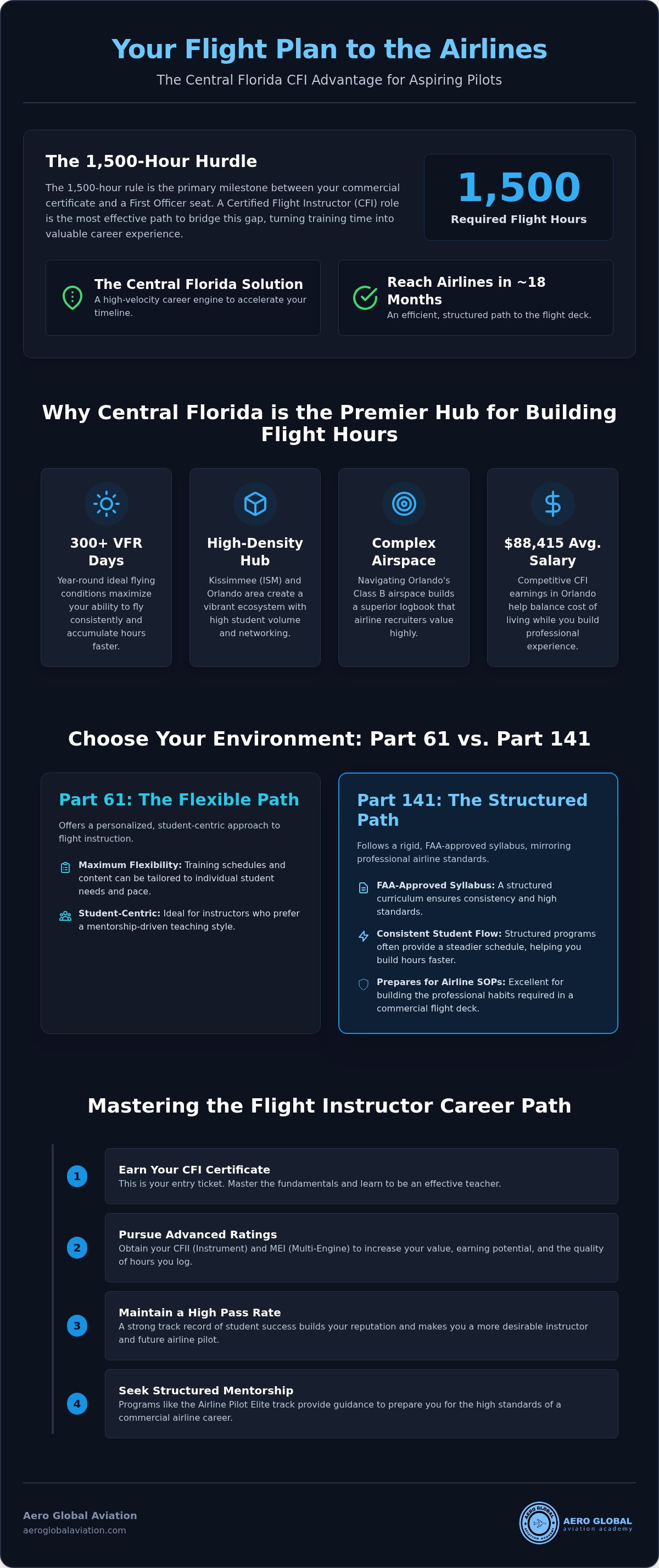
The 1,500-hour rule is the primary hurdle between your commercial certificate and a First Officer seat at a major carrier. Working as a CFI is the most common and effective method to bridge this gap. However, airlines in 2026 aren't just looking for quantity. They want to see quality hours spent in complex airspace and diverse weather conditions. The CFI-to-airline path is a strategic career move that transforms your technical knowledge into professional leadership. By teaching others, you master the fundamentals of flight in a way that solo time simply can't replicate. It builds the command presence you'll need in a multi-crew environment.
Central Florida: The Flight Training Capital
Kissimmee Gateway Airport (ISM) serves as a primary engine for this growth. The density of flight schools here creates a unique networking ecosystem where you're constantly interacting with recruiters and senior pilots. With over 300 days of VFR flying conditions annually, your ability to fly consistently is unmatched. This regional demand for CFIs, CFIIs, and MEIs remains high because students from around the world flock to Florida for its efficiency. Navigating the busy Class B airspace around Orlando ensures your logbook reflects the high-intensity experience that airline recruiters value most. You'll gain professional advantages here that are simply unavailable in quieter, less complex regions.
Types of Flight Instructor Opportunities in Orlando and Kissimmee
Choosing your first teaching role is a pivotal moment in the flight instructor career path Florida offers. Central Florida isn't just a collection of airports; it's a diverse marketplace with different training philosophies. You can find roles in large collegiate programs, local flying clubs, or professional aviation academies that specialize in career transitions. Each environment offers a unique rhythm to your workday and impacts how quickly you reach your 1,500-hour goal. Understanding these distinctions helps you align your teaching style with your long-term airline ambitions.
Part 61 vs. Part 141: Choosing Your Environment
The primary choice you'll face is between Part 61 and Part 141 schools. Part 61 instruction offers maximum flexibility, which is ideal if you value a personalized, student-centric approach. However, Part 141 schools follow a rigid, FAA-approved syllabus. These structured environments often provide a more consistent student flow, ensuring your schedule stays full year-round. Teaching under a Part 141 certificate also prepares you for the standard operating procedures (SOPs) you'll encounter at the airlines. It’s a great way to build professional habits early.
Before you apply for any position, ensure you meet the basic FAA eligibility requirements for the certificate you're pursuing. Many instructors in Kissimmee start in Part 61 environments to gain experience before transitioning to elite training tracks that offer more stability. If you're looking for a path that mirrors the professional standards of a major carrier, exploring the Airline Pilot Elite program at Aero Global Aviation can provide that structured foundation you need.
Advanced Instruction: CFII and MEI Career Perks
While a basic CFI certificate gets you started, adding advanced ratings significantly boosts your hireability and earning potential. Multi-Engine Instructors (MEI) are in high demand across Central Florida, often commanding a pay premium due to the complexity of the equipment. Similarly, being a Certified Flight Instructor-Instrument (CFII) allows you to guide students through advanced flight training milestones, helping them master the clouds safely. Specializing in these areas doesn't just increase your hourly rate; it makes you a more versatile pilot.
- Actual Instrument Time: Florida’s 2026 weather patterns provide frequent opportunities to build actual IMC time, which is a vital metric for airline recruiters.
- Multi-Engine Experience: Logging dual-given time in a twin-engine aircraft makes your resume stand out in a competitive hiring market.
- Career Velocity: Instructors with multiple ratings typically fill their schedules faster, reaching their 1,500-hour goal months ahead of their peers.
You'll learn to manage more complex systems and navigate challenging weather, skills that are directly transferable to the First Officer seat. By focusing on these advanced roles, you position yourself as a premier candidate for the next hiring wave. This strategic approach ensures that every hour you log is a step toward a more sophisticated professional future.
Why Central Florida is the Premier Hub for Building Flight Hours
Central Florida isn't just a place to fly; it's a strategic asset for your professional logbook. The region’s infrastructure and climate create a high-velocity training environment that is difficult to replicate in other parts of the country. Recent research into Florida's aviation industry highlights how this sector remains a cornerstone of the state's workforce competitiveness, ensuring that your teaching career is backed by a robust and growing market. When you choose this path, you're positioning yourself in a location where the demand for quality instruction remains high year-round.
The proximity to major airline hubs like Orlando International Airport (MCO) creates a powerful network effect. You aren't just building hours in a vacuum; you're operating within a professional ecosystem where airline recruiters are constantly looking for talent. Teaching a diverse mix of international and domestic students also sharpens your communication skills, preparing you for the multicultural environment of global air travel. Every flight from Kissimmee Gateway Airport (ISM) is an opportunity to prove your proficiency in a fast-paced, professional setting.
The Weather Advantage: Flying Year-Round
If you've ever trained in northern hubs, you know how seasonal delays and winter storms can stall your progress for weeks at a time. In Central Florida, we benefit from more than 300 days of VFR flying conditions annually. This consistency is the primary engine behind your 1,500-hour goal, allowing you to fly multiple blocks a day without the constant threat of weather cancellations. Central Florida weather significantly reduces checkride wait-times by ensuring that designated pilot examiners can maintain their schedules with minimal disruptions. This reliability helps you move through the flight instructor career path Florida provides with much greater speed than your peers in less favorable climates.
Complex Airspace and Professional Development
Teaching at an airport like ISM puts you right on the doorstep of some of the most complex airspace in the United States. You and your students will regularly navigate the interaction between Orlando’s busy Class B airspace and the surrounding Class D environments. This high-traffic density builds superior radio work, navigation skills, and situational awareness. When you're managing a student pilot while coordinating with approach controllers and watching for commercial traffic, you're developing the exact multitasking abilities required in a turbine cockpit. This diverse airspace experience makes you a more attractive airline candidate because it proves you can handle high-intensity operations with confidence and precision.
How to Land a CFI Job: Requirements and Competitive Edge
Securing a position in the competitive Central Florida market requires a strategic approach that goes beyond simply holding a certificate. While every applicant has the basic CFI, your competitive edge comes from having your CFII and MEI ratings ready on day one. Schools in the Orlando area prioritize instructors who can take a student through their entire training lifecycle. Your resume should highlight a strong first-time pass record for your students; this metric tells a chief flight instructor that you value quality instruction over just logging time. When you follow the flight instructor career path Florida provides, you'll find that your reputation as a safe, reliable, and professional aviator is your most valuable currency.
Local networking is your secret weapon. Spend time at Kissimmee Gateway Airport (ISM) and engage with the community. Many of the best roles aren't just posted on job boards; they're filled through professional referrals and face-to-face introductions. Demonstrating a genuine interest in the local aviation ecosystem shows that you're not just looking for a paycheck, but a place to grow. By building these connections early, you position yourself as a known entity when a prime opening becomes available.
The CFI Hiring Process in 2026
Expect a multi-stage evaluation that tests both your hands and your mind. Most academies will put you through a technical interview where you'll explain complex aerodynamics on a whiteboard, followed by a flight evaluation from the right seat. They're looking for instructors whose teaching style aligns with a structured career pilot program philosophy. You'll also need to demonstrate deep knowledge of local Letters of Agreement (LOAs) and practice area boundaries. Showing that you understand the nuances of the flight instructor career path Florida offers during your interview proves you're ready to operate safely in our busy airspace.
Standing Out as a Professional Mentor
Airlines don't just want pilots; they want leaders. You can stand out by showing you're committed to commercial pilot training standards rather than just counting down the minutes to 1,500 hours. This means focusing on student retention and success through strong soft skills and personalized attention. If you can prove that you treat every lesson as a strategic step toward your student's professional future, you'll become an indispensable asset to any academy. Schools value instructors who can communicate effectively with diverse student populations, ensuring high completion rates and professional excellence.
Launching Your Instructor Career with Aero Global Aviation
Choosing where to work as an instructor is just as important as where you did your initial training. At Aero Global Aviation Academy, we've built a professional teaching environment that mirrors the standards of a major airline flight deck. Located at the Kissimmee Gateway Airport (ISM), our academy provides you with a modern fleet and a high-volume student base, ensuring you stay active and engaged throughout the year. When you join our team, you aren't just an employee; you're a vital part of a community dedicated to excellence. We understand that the flight instructor career path Florida offers is a stepping stone, and we're here to make sure that step is as solid as possible.
Our instructors benefit from the strategic advantages of the Central Florida climate, which we've discussed as a primary driver for rapid hour accumulation. By working in a structured, professional setting, you develop the habits and discipline that airline recruiters prioritize during their hiring phases. We focus on creating a collaborative spirit where experienced mentors guide newer instructors, ensuring that everyone on our team is prepared for the technical and leadership challenges of commercial aviation.
The Aero Global Aviation Academy Advantage
The Airline Pilot Elite program is at the heart of our instructor development strategy. This program doesn't just stop at your initial certification; it provides a clear framework for you to obtain advanced ratings like CFII and MEI while you work. We believe that a versatile instructor is a more effective teacher and a more competitive pilot. By supporting your growth into multi-engine and instrument instruction, we help you fill your logbook with the high-quality hours that matter most. Our focus on airline-oriented training environments means you'll be teaching students according to the same professional standards you'll eventually use as a First Officer.
- Modern Fleet: Fly well-maintained aircraft equipped with the technology you'll encounter in professional aviation.
- Strategic Location: Benefit from the complex airspace and consistent weather patterns at Kissimmee Gateway Airport.
- Professional Mentorship: Access a network of senior pilots and instructors who are invested in your individual success.
How to Apply and Join the Team
As we move into the 2026 Central Florida training season, we're looking for instructors who are passionate about teaching and committed to safety. To prepare for your Aero Global Aviation Academy interview, focus on your ability to simplify complex technical concepts and demonstrate a high level of situational awareness during your flight check. We value candidates who show a genuine interest in student success and a desire to contribute to our academy's professional culture. It's helpful to review our guide on the airline pilot career path to see how your time with us fits into your long-term professional goals. If you're ready to master the flight instructor career path Florida provides, we invite you to bring your passion and proficiency to Kissimmee.
Take Command of Your Aviation Future
The journey from a newly certified instructor to a commercial airline pilot is a high-stakes transition that requires more than just logging time. By leveraging Central Florida's 300 plus days of VFR weather and complex airspace, you can accelerate your progress toward that 1,500-hour goal. Mastering the flight instructor career path Florida offers means prioritizing advanced ratings and aligning yourself with a training environment that values professional mentorship. You've seen how the right school at Kissimmee Gateway Airport (ISM) can transform your daily flight blocks into a strategic bridge toward a First Officer seat.
Aero Global Aviation provides the structured paths and airline-ready standards you need to excel in the 2026 market. We focus on developing world-class instructors through our Airline Pilot Elite program, ensuring every hour you fly contributes to your long-term success. It's time to move beyond simply building hours and start building your career with a team that understands your destination.
Join the Aero Global Academy Team: View Instructor Opportunities
Your path to the flight deck is within reach. We look forward to seeing you in the right seat, guiding the next generation of pilots toward their professional dreams.
Frequently Asked Questions
What is the average salary for a CFI in Central Florida in 2026?
The average annual salary for a flight instructor in Orlando is approximately $88,415 as of July 2026. This typical range generally falls between $64,500 and $104,700 depending on your experience and the specific flight academy where you teach. While the base hourly rate in Kissimmee is around $23.59, your total compensation increases significantly with high student volume and advanced ratings. This makes the region one of the most financially viable places to build your professional foundation.
How many flight hours can a CFI expect to build per month in Orlando?
You can typically expect to build between 70 and 100 flight hours per month in the Orlando area. Thanks to the high density of students and favorable weather, busy instructors often hit their 1,500-hour goal much faster than in other regions. This consistent schedule is vital for maintaining your professional momentum. It ensures that you're constantly honing your skills while moving steadily toward your next career milestone in a high-velocity training environment.
Do I need my CFII to get hired as a flight instructor in Florida?
You don't strictly need a CFII to get hired, but it's a massive advantage for the flight instructor career path Florida academies provide to students. Most schools in Kissimmee and Orlando prefer instructors who can guide students through their instrument ratings from start to finish. Having this certification on your resume shows you're ready to handle complex training from day one. It also increases your earning potential and makes your schedule more resistant to weather delays.
Is Kissimmee Gateway Airport a good place to work as a CFI?
Kissimmee Gateway Airport is an exceptional place to work because of its proximity to complex Class B airspace and a vibrant networking ecosystem. Operating at ISM allows you to build superior radio and navigation skills while staying close to major airline hubs like MCO. The professional environment here is designed for career-track pilots who want to be noticed by recruiters. You'll gain high-intensity experience that simply isn't available at smaller, less busy regional airports.
What are the benefits of working at a Part 141 flight school vs Part 61?
Part 141 schools offer a structured, FAA-approved syllabus that mirrors the standard operating procedures you'll find at major airlines. This environment is perfect for instructors who want a predictable student flow and a professional atmosphere. Part 61 schools provide more flexibility, allowing you to tailor your teaching style to individual student needs. Choosing a Part 141 program often prepares you more effectively for the rigid training requirements and professional standards of a commercial flight deck.
How does the Central Florida weather affect a CFI’s ability to build hours?
Central Florida's weather is a major asset, providing over 300 days of VFR flying conditions annually for active instructors. This consistency means fewer cancellations and a more predictable income for those building their hours. While summer afternoons often bring brief thunderstorms, the ability to fly year-round is what makes this region a global destination. You'll find that your 1,500-hour timeline stays on track even when other parts of the country are grounded by winter storms.
Can I work as a CFI while finishing my own advanced ratings?
Yes, many schools allow you to work as a CFI while you finish advanced ratings like your CFII or MEI certifications. This approach lets you start earning a paycheck and building hours immediately after your initial commercial checkride. However, having those ratings completed before you apply often leads to better starting pay and more student assignments. It's a strategic way to balance your own professional development with the practical needs of a busy, high-demand flight school.
What do airlines look for in a CFI’s logbook during the hiring process?
Airlines look for a high student pass rate and experience in complex airspace when they review your logbook during an interview. They want to see that you've been a professional mentor rather than just someone who sat in the right seat to build time. Demonstrating command presence and a commitment to safety standards is essential for any applicant. Your logbook should reflect a diverse range of training scenarios, proving you can handle the high-stakes environment of a commercial jet.


