

What if the biggest barrier to your pilot's license isn't your bank account or your 9-to-5, but the myth that you have to quit your job to reach the cockpit? If you're wondering, "can I work full-time while in flight school Orlando?" you're already thinking like a strategic pilot. Many aspiring aviators feel trapped between the rising costs of training and the anxiety that a full-time career leaves no room for flight hours. It's natural to worry about burnout or how you'll ever fit ground school into a rigid work calendar. You want to start your journey toward a Private Pilot License, but you need the security of your current salary to make it happen.
Balancing a professional career with flight training is not only possible; it's a path many of our most successful students take. This guide reveals the realistic strategies and scheduling secrets that turn this challenge into a manageable, rewarding process. We'll show you how to leverage Central Florida's 300-plus days of flyable weather and modular programs like the Wings Foundation to keep your momentum high. You'll get a clear look at week-by-week time commitments and practical tips for choosing a school in Kissimmee that acts as a mentor for your journey through every takeoff and landing.
Key Takeaways
- Discover how you can work full-time while in flight school Orlando by integrating two to three lessons per week into your professional routine.
- Learn why the modular Wings Foundation program offers the ideal, low-pressure entry point for working professionals to secure their Private Pilot License.
- Implement "Dawn Patrol" strategies to take advantage of Orlando’s clear morning skies and finish your training before your workday starts.
- Identify the five critical signs that your current job is flight-school compatible, including schedule flexibility and geographic proximity to Kissimmee.
- Understand the mental bandwidth requirements and the 2:1 study-to-flight ratio needed to maintain peak safety and progress.
Working Full-Time in Flight School: Orlando Training
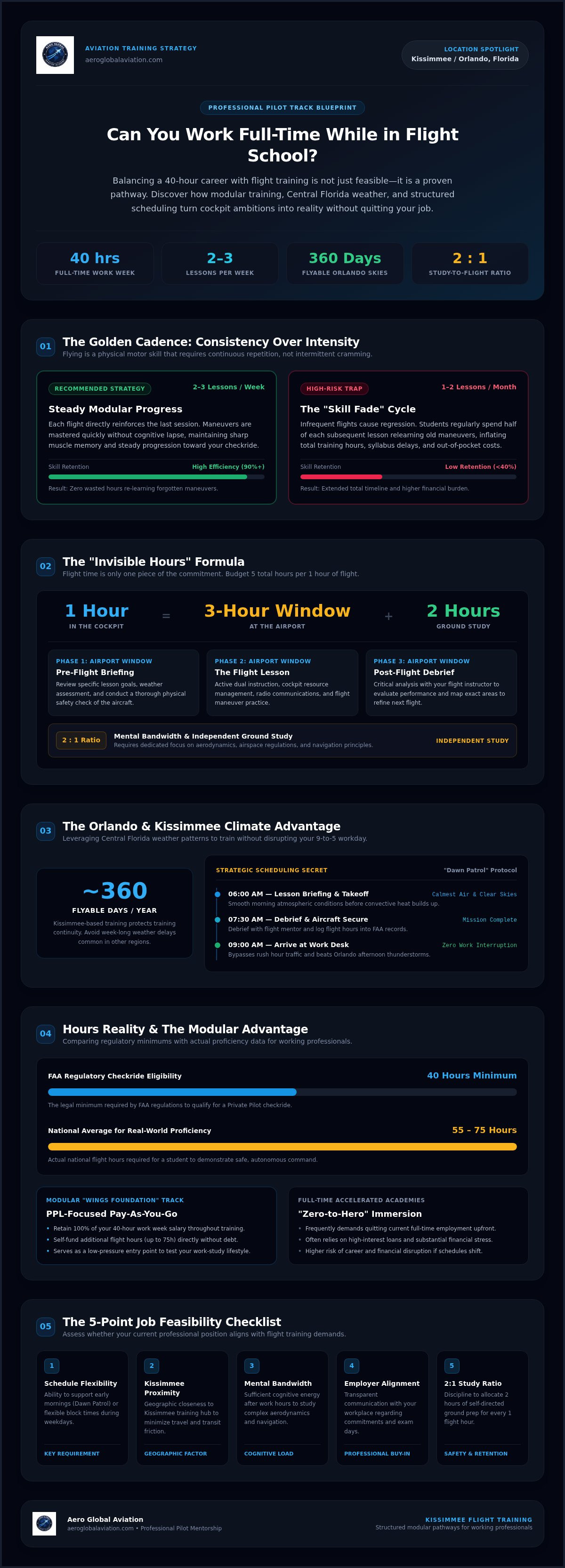
You don't have to sacrifice your current livelihood to chase a career in the clouds. The reality is that the question "can I work full-time while in flight school Orlando" has a very positive answer, provided you approach it with a mentor's mindset. Most working professionals find their rhythm by treating flight school as a high-priority part-time commitment, typically involving two to three lessons per week. This approach balances the 40-hour work week with the steady progress needed to earn your wings without the risk of financial burnout.
The secret to making this work is prioritizing consistency over intensity. Flying isn't like cramming for a college exam; it's a physical skill that requires regular repetition to master. By adhering to FAA pilot certification regulations through a structured program, you ensure that every hour in the air builds directly on the last. This steady pace prevents "skill fade," which often happens when students try to fly only once or twice a month and spend half their next lesson relearning old maneuvers.
The "Invisible" Hours of Flight Training
Flight training involves much more than the time the engine is running. To stay on track, you should budget a three-hour window for every one-hour flight lesson. This window accounts for the essential steps that turn a simple flight into a learning experience:
- Pre-flight Briefing: Reviewing the specific goals for the day and performing a thorough safety check of the aircraft.
- The Flight: Active instruction, radio communication, and maneuver practice.
- Post-flight Debrief: Analyzing your performance with your instructor to identify exactly what needs work for next time.
Beyond the airport, the mental bandwidth requirement is significant. Plan for at least two hours of independent ground study for every hour of flight. Topics like aerodynamics and navigation require deep focus, so it's wise to discuss these needs with your employer before you begin your training journey.
Why Orlando’s Climate Impacts Your Working Schedule
When you ask can I work full-time while in flight school Orlando, the answer is often found in the local forecast. Orlando is a premier global hub for training because of its exceptional climate. Kissimmee-based centers leverage nearly 360 days of flyable weather, which is a massive advantage for a working student. In other regions, a week of rain could stall your progress for a month. Here, you can rely on "Dawn Patrol" slots starting at 6:00 AM. These early sessions let you finish a lesson and be at your desk by 9:00 AM, avoiding both the afternoon thunderstorms and the worst of the local traffic. This reliability keeps your training efficient and protects your professional reputation.
Choosing the Right Path: Flexible PPL vs. Accelerated Career Programs
Deciding how to reach the cockpit involves more than just picking a school; it's about selecting a syllabus that respects your professional life. When you're asking can I work full-time while in flight school Orlando, the answer depends on whether you choose a modular or an accelerated track. Many students feel they must dive into a zero-to-hero program immediately. However, starting with a modular approach allows you to keep your 40-hour work week and pay for your training as you go, which reduces the need for the high-interest debt common in some accelerated academies.
The transition from a full-time job to a full-time flight schedule doesn't have to happen on day one. Most students find that the Private Pilot License (PPL) stage is the perfect time to test their work-study balance. While the FAA permits a checkride at 40 hours, national averages show most students need 55 to 75 hours to be truly proficient. By working while you train for your PPL, you can fund these additional hours from your salary, ensuring you reach the required standards without financial stress.
The Wings Foundation: Built for Professional Flexibility
This PPL-focused course serves as a manageable first milestone for full-time workers. The FAA guide to becoming a pilot outlines the eligibility and medical requirements you'll need to meet before your first solo, and our instructors act as practical mentors to help you navigate these hurdles. The Wings Foundation is designed to fit around your work calendar, providing a structured yet adaptable environment. These fundamental skills are the essential bedrock for all future commercial pilot training.
The Airline Pilot Elite Challenge
While the Wings Foundation is flexible, the Airline Pilot Elite track is a higher-intensity path built for those ready to move quickly toward a professional cockpit. You'll eventually reach a transition point, typically during your Instrument or Commercial ratings, where the cognitive focus required might conflict with a standard 9-to-5. Identifying this point early helps you plan your exit strategy from your current job. This structured airline pilot career path ensures you aren't just flying; you're building a professional future with clear milestones. To see which path fits your current career, you might consider speaking with a mentor about our foundational flight programs.
The Financial Math: Working for Tuition vs. Financing
Your bank account often dictates your flight schedule as much as the weather does. If you're asking "can I work full-time while in flight school Orlando," you're likely trying to avoid the heavy debt associated with accelerated academies. Maintaining your salary provides a vital safety net for healthcare and living expenses, which is a massive advantage during the foundational stages of your training. However, you must balance this with the "Part-Time Tax," which is the hidden cost of training too slowly.
When you fly sporadically, you spend more time in each lesson reviewing old material rather than mastering new maneuvers. According to the Bureau of Labor Statistics pilot career outlook, the long-term earning potential in this field is substantial, but reaching that salary requires getting through your ratings efficiently. This is why many students choose "hybrid financing," which involves using monthly income for regular lessons and taking a smaller, targeted loan to maintain momentum during more intensive certifications.
Calculating the Real Cost of Slow Training
The "Part-Time Tax" is the cumulative financial burden of repeating lessons because a lack of currency has caused your skills to fade between flights. While the FAA minimum for a Private Pilot License is 40 hours, national statistics show the true average completion time is 55 to 75 total flight hours. If you fly three times a week, you're likely to finish on the lower end of that scale. If you only fly once every two weeks, you might need 80 hours or more to reach checkride readiness. Because you're paying for the aircraft and the instructor by the hour, that 20-hour difference can add thousands of dollars to your total bill. Consistency isn't just about learning faster; it's a deliberate money-saving strategy.
Strategic Savings for the Commercial Phase
Smart students use their full-time income to "bank" hours during the PPL phase, treating their job as a personal scholarship. This stage is where you build the stick-and-rudder skills that serve as the foundation for our Career Pilot Program. Eventually, most pilots reach a transition point where they leave their 9-to-5 to focus on advanced ratings. Orlando’s lower cost of living compared to major aviation hubs like New York or Miami allows your savings to stretch further during this transition.
- PPL Phase: Use your salary to fund the 55 to 75 hours typically required for proficiency, avoiding interest on early training.
- CPL Phase: Transition to full-time training once you've built a solid financial and skill-based foundation.
5 Strategies for Balancing a 40-Hour Work Week and Flight Lessons
Turning your dream into a reality requires more than just passion; it takes a tactical approach to your calendar. If you're wondering, "can I work full-time while in flight school Orlando," the secret lies in these five field-tested strategies. By treating your training like a second, high-value career, you can maintain your professional standing while checking off milestones toward your license.
- The "Dawn Patrol": Schedule your flights for 6:00 AM. This allows you to complete a lesson and be at your desk by 9:00 AM, fresh and ready for the workday.
- Remote Work Synergy: Use your lunch breaks for digital ground school modules or procedure reviews. If you work from home, a dedicated hour of study mid-day keeps the material fresh.
- The Monday-Wednesday-Friday Rhythm: Create a repeatable schedule. Instructors appreciate students who commit to specific blocks, ensuring you never lose your spot on the flight line.
- Front-Loading Ground School: Complete your FAA written exam before you ever step into the cockpit. Removing the burden of testing early allows you to focus 100% on flying once you start.
- Immersive Weekends: Save your Saturdays for long cross-country flights. These required training legs often take three to five hours, making them difficult to fit into a standard work week.
Mastering the Orlando "Early Bird" Slot
Morning air in Central Florida is notoriously smoother and cooler than the turbulent afternoon heat. This stability makes it much easier to learn precision maneuvers like steep turns or stalls. Kissimmee Gateway Airport is exceptionally well-suited for early departures, allowing you to beat the commercial traffic at larger nearby hubs. However, always respect the "12-hour rule." Ensure you have a clear mental break between high-stress work meetings and your pre-flight briefing to maintain peak safety standards.
Leveraging Ground School for Productivity
Modern digital ground school apps have revolutionized how working students learn. You can turn a 30-minute commute or a quiet evening into a productive study session. We also recommend incorporating home flight simulators to practice checklist flows and instrument procedures without the hourly rental cost of an aircraft. One of the most effective tools is "Chair Flying," which is a zero-cost way to build muscle memory by mentally rehearsing every step of a flight while sitting in a quiet room at home. To see how these strategies fit into a structured path, explore our Wings Foundation program.
Is Your Job Flight-School Compatible? The 5-Point Feasibility Test
Before you commit your time and resources, it's vital to perform a reality check on your current professional environment. While the answer to "can I work full-time while in flight school Orlando" is a resounding yes, your specific job plays a major role in how smoothly that journey unfolds. Use this five-point feasibility test to evaluate if your current career provides the necessary runway for your aviation goals.
- Schedule Flexibility: Can you shift a morning meeting if the weather is perfect for a solo cross-country flight? Aviation is weather-dependent, and the ability to swap work hours for flight hours is a massive advantage.
- Commute Time: Is your office or home base close enough to Kissimmee Gateway Airport to make a mid-day lesson viable? Spending two hours in I-4 traffic for a one-hour flight will quickly lead to burnout.
- Mental Fatigue: Does your job leave you with the cognitive energy required for advanced flight training? Mastering complex regulations and aircraft systems requires a sharp mind after the workday ends.
- Financial Runway: Does your salary comfortably cover your living expenses plus at least two flight lessons per week? Consistency is key to avoiding the "skill fade" we discussed earlier.
- Support System: Do your employer and family understand that flight school is a serious professional commitment? Having a boss who supports your "Dawn Patrol" schedule makes a world of difference.
The Kissimmee Commute Advantage
Aero Global’s location at Kissimmee Gateway Airport is a strategic asset for anyone asking can I work full-time while in flight school Orlando. Unlike larger, more congested international hubs where you might spend twenty minutes just taxiing to the runway, Kissimmee offers efficient departures. This proximity to the Orlando metro area means you can plan "training blocks" that minimize travel time. You can realistically leave your office, complete a focused training session, and return to your desk without losing half your workday to logistics.
When to Make the Leap to Full-Time Training
There often comes a "Crossover Point" where the demands of professional aviation ratings outpace a 40-hour work week. While you can certainly earn your Private Pilot License while working, advanced certifications like Commercial and Multi-Engine ratings require deeper immersion. When you reach this stage, use our best flight schools in Florida checklist to ensure your chosen academy has the mentor-led structure to support your transition. Working full-time is a powerful way to fund your start, and with the right partner in Kissimmee, that transition from the office to the flight deck becomes a logical, rewarding progression.
Take the First Step Toward Your New Career
Balancing a 40-hour work week with flight training is a strategic career move that many of our most successful students master. By leveraging Orlando’s 360 days of flyable weather and focusing on modular milestones like the Wings Foundation, you can fund your journey through your current salary while building elite skills. If you find yourself asking, "Can I work full-time while in flight school in Orlando?" many ambitious professionals prove every day that the answer is yes by following a structured, mentor-led plan that respects their existing professional commitments.
Our academy at Kissimmee Gateway Airport is specifically positioned for maximum accessibility, offering mentor-driven programs designed for career-changing professionals. From foundational courses to our comprehensive Airline Pilot Elite track, we provide the customizable training paths you need to succeed without sacrificing your livelihood. Your transition from the office to the flight deck is a structured and attainable process that begins with a single, focused decision.
With the right mentor and a clear plan in place, your professional aviation goals are well within reach. We're ready to help you clear the runway for your future and turn your aspirations into a tangible destination.
Frequently Asked Questions
Can I really learn to fly just by training on weekends?
You can absolutely learn to fly on weekends, provided you stay disciplined and avoid long gaps between lessons. Since Kissimmee offers nearly 360 days of flyable weather, your weekend sessions are far less likely to be cancelled than in other regions. We recommend flying both Saturday and Sunday to maintain muscle memory. This consistency ensures you progress through the Wings Foundation syllabus efficiently without spending half your lesson relearning maneuvers.
How many hours a week should I dedicate to flight school if I work full-time?
Plan to dedicate 10 to 15 hours per week to your training. This includes roughly four hours at the airport for flight lessons and briefings, plus another six to ten hours for independent ground study. If you're asking can I work full-time while in flight school Orlando, this balance is the gold standard. Spreading these hours across early mornings or weekends helps you maintain your professional career while staying on track.
Is it safer to train full-time rather than part-time?
Safety depends on your personal proficiency and fatigue management rather than your training schedule. Part-time students often have more time to digest complex aerodynamic theories between flights, which can lead to a deeper understanding of the material. However, you must ensure you aren't flying while exhausted from a stressful day at the office. Our mentors emphasize a clear mental break between work and the cockpit to ensure every student is prepared.
Does working full-time make flight school significantly more expensive?
Working full-time only increases costs if you fly too sporadically. Flying less than twice a week leads to "skill fade," where you pay for extra instructor time to repeat previous lessons. By maintaining a consistent schedule of at least two sessions weekly, you avoid this financial burden. Using your salary to pay as you go actually saves you money over time by avoiding the high interest rates of large student loans.
What happens if I have to take a break from training due to work commitments?
Taking a break is manageable, but you should expect a few review flights when you return to the cockpit. If a major work project demands your full attention for a few weeks, continue your ground study at home to keep the regulations fresh in your mind. Our modular programs are designed to allow for these life adjustments. Your instructor will help you transition back into the aircraft safely once your schedule reopens.
Can I use financial aid for part-time flight school in Orlando?
Many traditional loans are geared toward accelerated tracks, but several aviation lenders now offer flexible options for modular students. Most working professionals in Orlando choose to "cash-flow" their training using their monthly salary to avoid debt entirely. If you do require assistance, we recommend looking into specialized lenders like Meritize or Stratus Financial. They often consider your professional background and career potential when evaluating your application for a training loan.
How do I explain my flight school schedule to my current boss?
Present your flight training as a professional development goal that builds discipline and leadership. Explain that you've chosen a school at Kissimmee Gateway Airport specifically for its efficiency and early morning slots. By showing that your training happens before the workday begins, you reassure them that your job remains a top priority. Most employers respect the dedication required to earn a pilot's license while working a 40-hour week.
Which pilot rating is the hardest to complete while working a full-time job?
The Instrument Rating is often considered the most challenging milestone for full-time workers. Unlike the visual maneuvers of the Private Pilot License, instrument training requires intense cognitive focus on technical procedures that can be draining after a full day of work. This is the stage where many students utilize our mentor-driven approach to break the curriculum into smaller, digestible blocks. This strategy ensures you master the high-stakes requirements without overwhelming your mental bandwidth.


