
Waiting for interest rates to drop before starting your flight training might actually cost you more in lost airline seniority than the loan itself. It's a bold reality in 2026, but every month spent on the ground is a month of high-tier captain's pay you'll never recover. If you're feeling overwhelmed by the logistics of financing a career pilot program in Orlando, you aren't alone. Most prospective students struggle with the confusion of choosing between lenders like Sallie Mae or Meritize while fearing how debt-to-income ratios will affect their early career years.
We're here to act as your practical mentor and guide you through this transition. This article promises to reveal the most effective ways to fund your training so you can focus on your checkrides instead of your bank balance. We'll provide a clear roadmap of loan options, identify scholarships you actually qualify for, and explain the long-term ROI of training in the Florida sun. Whether you're starting with the Wings Foundation or aiming for the Airline Pilot Elite program, your journey to the airlines is closer than you think.
Key Takeaways
- Break down the full investment by distinguishing between flight hours, FAA fees, and equipment to avoid unexpected financial surprises during your training.
- Compare specialized aviation lenders like Sallie Mae and Stratus Financial to identify the loan structures that best support your long-term career goals.
- Master the "Stacking Strategy" to lower the total cost of financing a career pilot program in Orlando by combining multiple smaller grants and scholarships.
- Calculate your potential return on investment by comparing current airline salaries against training debt and leveraging the CFI "Bridge Phase" to earn while you build hours.
- Explore personalized pathways like the Airline Pilot Elite track or the Wings Foundation to align your professional training pace with your specific financial comfort level.
Understanding the Investment: Career Pilot Program Costs in Orlando
Embarking on a journey to the flight deck is an exhilarating decision that requires a clear-eyed look at the financial commitment involved. In 2026, the path from zero experience to a professional cockpit involves several distinct phases of training. This path is most effectively navigated through a structured Career Pilot Program, which organizes your training milestones into a logical sequence. When you begin financing a career pilot program in Orlando, you're investing in more than just flight hours. You're securing the instruction, technology, and certifications required to meet the rigorous Commercial Pilot Licence (CPL) requirements set by the FAA.
The Breakdown of Tuition and Flight Fees
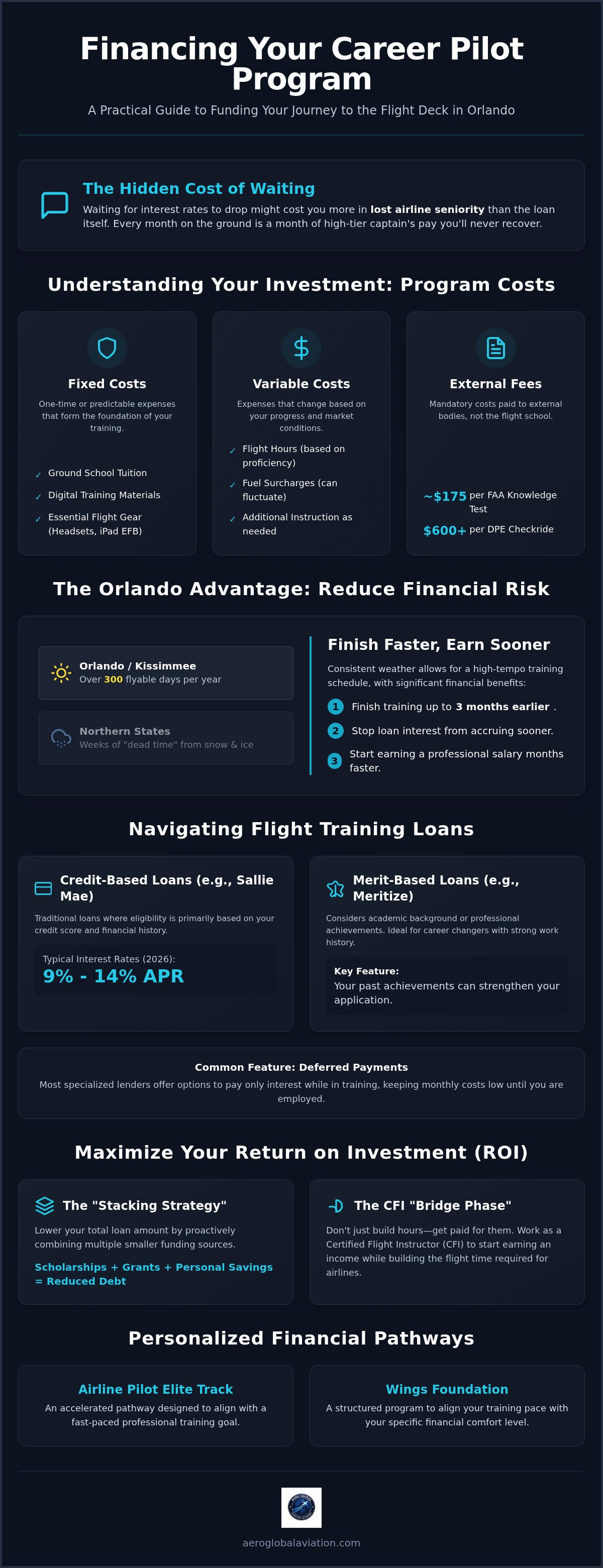
It's vital to distinguish between fixed and variable costs to avoid budget surprises. Fixed costs generally include ground school tuition, digital training materials, and essential flight gear like headsets and iPad EFBs. Variable costs are primarily driven by flight hours. While most programs provide a quote based on FAA minimums, your actual investment depends on how quickly you master specific maneuvers. You should also account for external fees that aren't typically part of school tuition. For instance, FAA knowledge tests currently cost around $175 each, and designated pilot examiners charge between $600 and $1,000 per checkride. Always ask if a quote includes fuel surcharges, as these can fluctuate and impact your total loan draw.
Why Orlando’s Weather Reduces Your Financial Risk
Geography is one of the most overlooked factors in flight training ROI. In northern states, students often face "dead time" where snow, ice, or low ceilings ground the fleet for weeks. If you've taken out a loan, your interest continues to accrue even when you aren't flying. This delay doesn't just stall your progress; it makes your training more expensive over time. Kissimmee and the greater Orlando area offer a strategic advantage with over 300 flyable days per year. This consistent weather allows for a high-tempo training schedule, often enabling students to reach their commercial checkride months faster than their peers elsewhere. By finishing your training three months early, you stop the clock on interest accrual and start earning a professional salary three months sooner. In the high-stakes world of airline seniority, those ninety days can translate into thousands of dollars in lifetime earnings.
Navigating Flight Training Loans and Financing Partners
Securing the capital for your flight training is the first major hurdle on your path to the airlines. Unlike a standard personal loan, aviation financing is a specialized product designed to account for the high return on investment that comes with a pilot's salary. When financing a career pilot program in Orlando, you'll encounter a few primary lenders that dominate the space: Sallie Mae, Meritize, and Stratus Financial. These organizations understand the aviation industry and recognize that while the upfront cost is significant, the long-term career potential justifies the lending risk.
Private Student Loans vs. Specialized Aviation Financing
The choice between credit-based and merit-based lending can define your financial experience. Traditional credit-based loans, like the Sallie Mae Smart Option Loan, rely heavily on your credit score and history. In 2026, these loans typically feature interest rates between 9% and 14% APR. Alternatively, lenders like Meritize offer merit-based lending, which considers your academic background or professional achievements. This is an excellent option for career changers who may have a thin credit file but a strong work history. Most of these specialized lenders offer deferred payment options, allowing you to pay only the interest while you're in training. This keeps your monthly obligations manageable until you transition into your first professional role.
Deciding between fixed and variable interest rates is another critical step in the current economic climate. Fixed rates provide peace of mind with a consistent payment throughout the life of the loan, while variable rates might offer a lower starting point but carry the risk of increasing over time. While you weigh these options, don't forget to supplement your funding by applying for AOPA flight training scholarships to reduce the total amount you need to borrow.
The Role of Cosigners and Credit Scores
If you're under the age of 25, you'll likely need a cosigner to secure the best possible terms. A cosigner with a high credit score acts as a safety net for the lender, which often results in a significantly lower interest rate. This can save you thousands of dollars in interest over the duration of your loan. If you don't have access to a cosigner, you can still find success by focusing on merit-based lenders or by building your credit through smaller, manageable lines of credit before applying. Choosing a school with recognized training standards is also vital, as lenders like Stratus Financial often provide more favorable terms to students attending reputable academies. If you have questions about which lender fits your specific goals, we encourage you to speak with our admissions team to explore your personalized options.
Scholarships and Grants: Lowering the Financial Barrier
Scholarships shouldn't be your last resort when you're short on funds; they should be your first strategic step before signing any loan documents. In the aviation community, millions of dollars in grant money go unclaimed every year simply because students assume the competition is too fierce. When you approach financing a career pilot program in Orlando, treat scholarship applications as your first professional assignment. By using a "stacking" strategy, you can combine multiple smaller grants of $500 to $2,500 to cover 10-20% of your total training costs, significantly reducing the principal amount of your student loan.
Winning these awards requires more than just a high GPA. To write a compelling essay, move beyond the cliché of "loving the clouds" and instead focus on your professional roadmap. Connect your personal story to the promising pilot salary and job outlook data to show committees that you're a safe, dedicated investment. The best flight schools in Florida often maintain strong relationships with local aviation chapters, giving their students an advantage when new funding cycles open.
National Aviation Scholarships to Target
Several major organizations offer substantial support for students entering professional pilot tracks. Keep these critical 2026 deadlines on your calendar to ensure you don't miss out:
- The Ninety-Nines Amelia Earhart Memorial Scholarships: Applications are due by January 1, 2026.
- AOPA Flight Training Scholarships: The spring cycle deadline is February 11, 2026.
- Women in Aviation International (WAI): These prestigious awards have a deadline of September 1, 2026.
- EAA Aviation Foundation: Their primary application period runs from October 1 to December 19, 2026.
- OBAP (Organization of Black Aerospace Professionals): Offers various grants throughout the year to support diversity in the flight deck.
Local Orlando and Florida-Specific Incentives
Central Florida is a massive hub for aviation, which translates into unique local funding opportunities. The Florida Department of Transportation (FDOT) frequently provides aviation grants that support workforce development in the state. Local EAA chapters in Central Florida also offer youth initiatives and smaller flight training awards that are often less competitive than national programs. If you're training at Kissimmee Gateway Airport, ask about local work-study opportunities or hangar-help positions. These roles don't just provide a small income; they help you build the professional network that will eventually lead to your first airline job. Engaging with the local aviation community is the fastest way to discover "hidden" scholarships that aren't advertised on major job boards.
Calculating Your ROI: Pilot Salaries vs. Training Debt
The decision to take on debt for flight school is often the most stressful part of the process. However, when you look at the 2026 market, the numbers tell a compelling story of resilience and reward. In Orlando, the average pilot salary has reached $122,213, while specialized airline pilots are averaging $161,301. For those who reach the top 90th percentile, earnings climb to $195,880. When you compare these figures to the initial cost of financing a career pilot program in Orlando, it's clear that the airline pilot career path remains one of the highest-yielding investments available today.
The 'Time-to-Income' Metric in Accelerated Training
Traditional four-year aviation degrees offer a great education, but they also delay your entry into the professional workforce by three years. By choosing an accelerated 12-month career program in Orlando, you're prioritizing your seniority number. In the airline world, seniority is everything; it determines your schedule, your base, and your pay scale. Every year you spend in a classroom instead of a cockpit is a year of lost "top-tier" earnings at the end of your career. Because Kissimmee provides consistent flying weather, you can realistically transition from a student to a Certified Flight Instructor (CFI) in about a year. This "Bridge Phase" is crucial because you stop drawing from your loan and start earning a paycheck while building the 1,500 hours required for the airlines. When you're financing a career pilot program in Orlando, you're essentially buying time, which is the most valuable asset in a seniority-based industry.
Managing Debt During Your First Officer Years
Don't let the total loan balance intimidate you during your first year as a Regional First Officer. Most aviation lenders provide income-driven repayment plans that keep your monthly costs low while you're building experience. Many airlines now offer significant signing bonuses or tuition reimbursement programs specifically designed to help pilots retire their training debt quickly. You should also consult a tax professional about potential deductions for flight training expenses, which can further offset your costs. By the time you promote to Captain, which typically brings a 33% salary increase, your training debt will likely feel like a small footnote in your financial history. If you're ready to see how these numbers work for your specific situation, request a personalized ROI breakdown from our team today.
Aero Global Aviation Academy: Personalized Financial Pathways
At Aero Global Aviation Academy, we recognize that every student's financial situation is unique. Our role as your practical mentor is to help you navigate financing a career pilot program in Orlando without unnecessary turbulence. We don't just offer training; we provide a structured roadmap that aligns with your specific budget and professional timeline. By offering multiple entry points, we ensure that the path to the cockpit remains accessible whether you're ready to commit to a full career track or prefer to test the waters first. Our team is deeply invested in your individual success, moving beyond the impersonal approach of larger corporations to provide the guidance you need.
From Wings Foundation to Airline Pilot Elite
For many students, starting with our Wings Foundation course is a brilliant financial move. This PPL-only program serves as a "proof of concept" for both you and your lenders. Successfully completing your Private Pilot License out-of-pocket or with a smaller loan demonstrates your aptitude and commitment, which can often lead to more favorable terms when you apply for larger-scale financing a career pilot program in Orlando later. Once you've secured your PPL, you can seamlessly transition into the Career Pilot Program or the Airline Pilot Elite track to complete your journey to the airlines.
The Airline Pilot Elite program is specifically designed to maximize the value of your financing. By including professional instructor certifications in your initial training plan, you're essentially pre-funding your first job. As we discussed in the ROI analysis, becoming a CFI is the most efficient way to build your required hours. Financing this stage upfront ensures you won't have to pause your momentum to find additional funding once you reach the commercial milestone. It's a logical, rewarding path that turns your technical ratings into a tangible career destination.
Starting Your Journey in Kissimmee
If you're a local student in the Kissimmee area, you might prefer our "pay-as-you-go" option. This allows you to fund your training in smaller, manageable increments, avoiding the interest costs associated with large student loans. Regardless of the path you choose, our mentorship approach is designed to prevent financial waste. We provide personalized attention to ensure every flight hour is productive, preventing the costly re-training cycles that often plague larger academies. Our geography at Kissimmee Gateway Airport is a strategic asset, allowing you to train in the same environment where you'll eventually work.
Your journey begins with a simple discovery flight to validate your passion and investment. From there, you'll meet with our team to map out a 2026 start date that fits your financial reality. Contact Aero Global Aviation Academy today to discuss your financing options and take the first step toward your new career.
Take Command of Your Aviation Career Path
The path to the flight deck is more attainable than ever when you have a structured financial plan and the right regional advantages. By now, you understand that financing a career pilot program in Orlando is a strategic move that leverages Kissimmee's year-round flying weather to get you to a professional paycheck faster. You've seen how combining specialized aviation loans with a proactive scholarship strategy can lower your entry barriers and protect your long-term return on investment.
At Aero Global Aviation Academy, we provide more than just flight hours. You'll benefit from professional mentorship from active airline pilots who understand the industry's current demands. Our comprehensive curriculum, spanning from your initial PPL to advanced instructor certifications, ensures you have the credentials to start earning as soon as possible. Don't let financial uncertainty keep you on the ground when the airlines are waiting for the next generation of captains. We're ready to help you map out your journey and turn your aviation dreams into a tangible professional destination.
Secure Your Future – Apply for the Career Pilot Program Today
Clear skies are ahead, and we're honored to be your partner in this exciting career transition. Your future in the cockpit is closer than you think.
Frequently Asked Questions
Can I get a federal student loan (FAFSA) for flight school in Orlando?
Generally, federal student loans are not available for vocational flight schools. FAFSA funds are typically reserved for accredited, degree-granting universities. Most students in Kissimmee rely on private aviation lenders or merit-based financing to cover their training. If you're pursuing a four-year degree at a university with a flight department, you might access federal funds, but for accelerated career tracks, private financing is the standard and most efficient route.
What is the average interest rate for flight training loans in 2026?
In 2026, interest rates for financing a career pilot program in Orlando typically range between 9% and 14% APR. Your specific rate depends on your credit history and whether you have a cosigner. Lenders like Sallie Mae and AOPA Finance offer both variable and fixed options. While these rates are higher than standard mortgages, the accelerated timeline of Orlando training helps you reach a high-paying airline salary faster, which offsets the total interest accrued.
Do airlines really reimburse tuition or pay off student loans?
Yes, many regional airlines use tuition reimbursement as a powerful recruitment tool. These programs often provide monthly payments to help you cover your loan obligations once you've signed a professional commitment. Additionally, signing bonuses in 2026 are frequently used by pilots to pay down large chunks of their principal training debt. This makes the initial investment much more manageable as you transition from an instructor role into a well-paid First Officer position.
Is it better to pay for the Private Pilot License (PPL) out of pocket first?
Paying for your PPL out of pocket can be a significant strategic advantage. Our Wings Foundation course allows you to complete this foundational step without taking on immediate debt. By self-funding the PPL, you demonstrate "proof of concept" to lenders, which can lead to better approval odds for the rest of your training. It also gives you a chance to validate your passion for flight before committing to a full career loan.
How much money do I need to have saved before starting a career pilot program?
While many students finance the majority of their tuition, having a small reserve is wise. You should aim to have enough to cover initial gear, FAA knowledge tests, and living expenses for the first few months. Since accelerated programs in Kissimmee require full-time focus, having a financial cushion prevents you from needing a part-time job. Most lenders can include living expenses in your loan package if your credit profile allows for the additional draw.
What happens to my loan if I fail a checkride or medical exam?
Your loan obligation remains even if you face training setbacks. Failing a checkride usually requires a few extra hours of training, which might require a small additional draw from your loan. However, failing a medical exam is more serious. We strongly recommend securing a first-class medical certificate before you ever apply for financing a career pilot program in Orlando. This ensures you're physically qualified for the career before you sign any financial agreements.
Can I work a part-time job while enrolled in an accelerated pilot program?
We generally advise against working while in an accelerated track. The Career Pilot Program requires a full-time commitment, often involving five to six days of flying and ground school per week. Working even ten hours a week can lead to fatigue and slower progress, which actually increases your costs in the long run. The goal is to finish quickly in Kissimmee and start your professional career, where your earning potential is significantly higher.
How does my credit score affect my ability to finance flight training?
Your credit score is the primary factor in determining your interest rate and loan approval. A higher score signals lower risk to lenders like Stratus Financial, often resulting in thousands of dollars in interest savings. If your score is lower, you'll likely need a cosigner with a strong credit history to secure funding. Some lenders also consider merit-based factors, like your academic record, to help bridge the gap for students with limited credit history.


