
Your flight training isn't just a tuition bill; it's the acquisition of a high-yield asset that pays dividends for a lifetime. You're likely staring at the cost of your commercial certificate and wondering how to bridge the gap without drowning in high interest rates or getting lost in the maze of Part 61 versus Part 141 eligibility. It's a common hurdle, and the fear of the "training bubble" can make even the most passionate aspiring pilot hesitate. We understand that identifying the best flight school financing options Kissimmee offers can feel as complex as a cross-country flight plan in heavy weather.
The good news is that securing the necessary capital is a manageable process when you have a clear map. We're here to show you that a career in the cockpit is entirely attainable through strategic planning and dedicated mentorship. This guide provides a detailed look at 2026 lender rates from providers like Sallie Mae and Stratus Financial, while highlighting specific Florida-based scholarships and VA benefit strategies. You'll gain a transparent roadmap to funding your Career Pilot Program, ensuring you can focus on mastering the skies above Kissimmee Gateway Airport instead of worrying about the bottom line.
Key Takeaways
- Learn how to break down the total 2026 investment for flight hours and FAA fees to create a realistic and manageable training budget.
- Compare the latest interest rates from national lenders and discover the flight school financing options Kissimmee students use to secure competitive loan terms.
- Navigate the specific requirements for VA benefits and regional Florida scholarships to significantly lower your out-of-pocket costs.
- Explore how the Wings Foundation serves as a low-risk financial litmus test before you commit to a full professional career track.
- Discover how the Airline Pilot Elite program provides a structured, mentor-led pathway to reaching your 1,500-hour milestone efficiently.
Understanding the Investment: Flight School Costs in Kissimmee
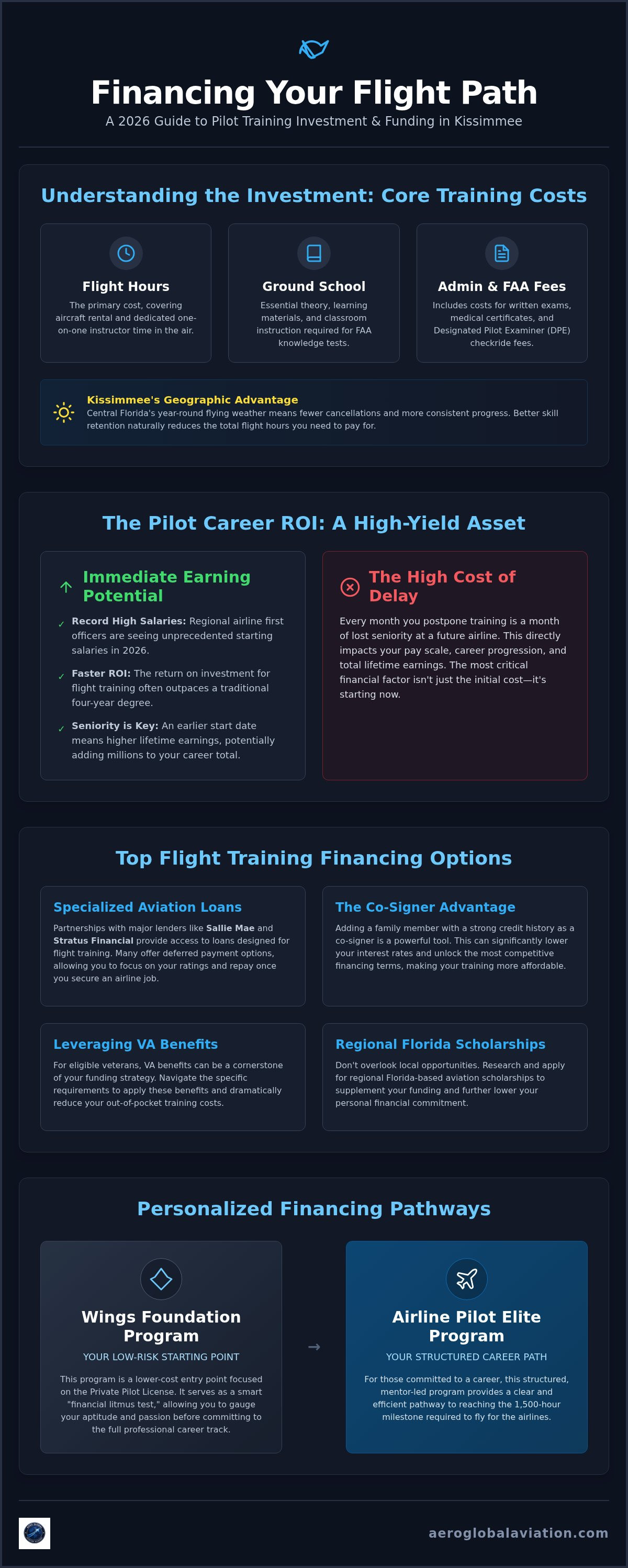
Securing your future in the cockpit starts with a clear-eyed look at the numbers. Before exploring the various flight school financing options Kissimmee provides, you must define the scope of your training goals. In 2026, the total investment for a professional pilot path is multifaceted, covering everything from your first solo to your commercial multi-engine rating. While the headline figure covers your journey to becoming a professional, the true value is found in how efficiently you reach those milestones.
Kissimmee Gateway Airport (KISM) serves as a strategic asset for your budget. Central Florida's year-round flying weather means fewer cancellations and more consistent progress. When you fly more often, you retain skills better; this naturally reduces the total number of hours you need to pay for. The investment generally splits into three main categories:
- Flight hours: This includes aircraft rental and one-on-one instructor time.
- Ground school: The essential theory, materials, and classroom instruction required for FAA knowledge tests.
- Administrative fees: Costs for FAA written exams, medical certificates, and Designated Pilot Examiner (DPE) fees.
For those testing the waters, the Wings Foundation offers a lower-cost entry point focused solely on the Private Pilot License. It's a smart way to gauge your aptitude and passion before committing to the full professional track.
Fixed vs. Variable Costs in Pilot Training
Aircraft rental rates and fuel surcharges are the primary variables in any flight training budget. These prices often fluctuate based on global markets and the complexities of aircraft financing. By enrolling in a structured Career Pilot Program, you gain a more predictable financial roadmap. Don't forget to budget for the essential gear that isn't always in the initial tuition quote. You'll need a quality noise-canceling headset, digital charts subscriptions, and your initial FAA medical certificate to stay flight-ready. Understanding these components helps you choose the right flight school financing options Kissimmee offers to match your specific career trajectory.
The ROI of a Pilot Career in 2026
Think of this as a career investment rather than a simple tuition bill. While a traditional four-year degree can cost just as much, it rarely offers the immediate earning potential found in aviation. Regional airline first officers are seeing record-high starting salaries in 2026, making the return on investment faster than many other professional fields. The most critical financial factor is seniority. Every month you delay your training is a month of lost earnings at the top of the pay scale later in your career. Starting your journey now could mean millions of dollars in additional lifetime income as you move from regional carriers to major airlines.
Top Flight Training Financing Options for Central Florida Students
Securing the capital for your pilot certificates is a structured process that mirrors the precision of flight planning. While the total investment is significant, the 2026 lending market has evolved to offer highly specialized products for aviators. Choosing a flight school that is already vetted by major lenders is a critical first step. Lenders prefer working with established academies because it reduces their risk, which often translates into smoother approval processes and more flexible terms for you. When you explore the flight school financing options Kissimmee offers, you'll find that many programs allow for deferred payments. This means you can focus entirely on your ratings and postpone full loan repayments until you've secured a position at a regional carrier.
A co-signer is often the most effective tool for lowering your interest rates. By adding a family member with a strong credit history to your application, you can unlock the most competitive tiers of financing. This collaborative approach not only makes the training more affordable but also provides a safety net as you transition into the professional industry. If you're ready to see which path fits your budget, you can review our enrollment pathways to get started.
National Aviation Lenders: Meritize vs. Stratus
National lenders provide the backbone for most professional flight training. Meritize offers a unique "merit-based" approach, where they consider your past academic performance or military experience alongside your credit score. This is particularly beneficial for students who may have a thin credit file but a strong GPA. In contrast, Stratus Financial focuses specifically on the needs of student pilots, offering loan structures that align with the milestones of a professional career. For 2026, Sallie Mae remains a powerhouse in this sector, with fixed rates starting as low as 1.95% APR for highly qualified applicants as of August 2026. In 2026, your Debt-to-Income Ratio represents the percentage of your monthly gross income that goes toward paying debts; lenders use this to ensure your future regional airline salary can comfortably support your loan repayments. Many veterans also look to combine these loans with VA flight training benefits to cover the full cost of their professional transition.
Local Banking and Credit Unions in Kissimmee
Don't overlook the specialized products available through Central Florida credit unions. Local institutions often have a deeper understanding of the regional aviation economy and may offer personal lines of credit with more intimate customer service. For instance, the "WeFly" program from We Florida Financial provides a line of credit between $5,000 and $30,000, which can be an excellent way to fund specific ratings. Some students also utilize a Home Equity Line of Credit (HELOC) to access lower interest rates by using their property as collateral. When approaching a local loan officer, present your training as a business plan. Detail your expected timeline for the Career Pilot Program and provide data on current regional airline hiring trends to demonstrate the reliability of your future income.
Leveraging VA Benefits and Aviation Scholarships
Veterans and high-achieving students have access to a unique set of flight school financing options Kissimmee academies support to lower the barrier to entry. While private loans provide the initial lift, federal benefits and merit-based awards can significantly offset your long-term debt. For those with military service, the GI Bill is a transformative tool. However, it's vital to understand the nuances between the different chapters to maximize your funding. For the academic year running from August 1, 2026, to July 31, 2027, the maximum Post-9/11 GI Bill benefit for vocational flight training is $17,661.89. If you're using the Montgomery GI Bill, the VA typically reimburses 60% of approved fees, though you'll often need to pay the school upfront and wait for reimbursement.
The Veteran Advantage in Kissimmee Flight Schools
Most veterans find the greatest value when applying their benefits toward the Commercial Pilot Training phase. It's important to remember that the Post-9/11 GI Bill does not cover the cost of a private pilot license for vocational training; you'll need that rating in hand before the VA begins funding your advanced certificates. At Kissimmee Gateway Airport (KISM), we recommend veterans follow this structured checklist:
- Secure your FAA First or Second-Class Medical Certificate.
- Obtain your Private Pilot License (PPL) through a program like the Wings Foundation.
- Apply for your VA Certificate of Eligibility (COE) early to avoid processing delays.
- Ensure your chosen flight school is VA-approved for the specific ratings you seek.
Winning Aviation Scholarships in 2026
Scholarships are not just for students with perfect grades; they're for those who demonstrate a clear vision for their future. National organizations like Women in Aviation International (WAI) and the Organization of Black Aerospace Professionals (OBAP) offer millions in annual funding. In Florida, the Florida Airports Council Education Foundation is a prime target for local students, with a 2026 application deadline of February 22. You should also explore AOPA financing options and their associated scholarship programs which are highly regarded in the industry.
Our "Practical Mentor" philosophy means we don't just teach you to fly; we help you find the resources to stay in the air. When writing your essay, focus on how your training in Kissimmee will serve the broader aviation community. Mentioning your involvement in local aviation clubs or volunteer work at KISM can set your application apart. By combining these grants with flight school financing options Kissimmee lenders provide, you can build a robust funding package that protects your financial health while you pursue your wings.
Strategic Financial Planning: Reducing Your Out-of-Pocket Costs
Strategic planning is just as vital as your stick-and-rudder skills when you're looking at flight school financing options Kissimmee has to offer. One of the first decisions you'll face is the choice between "pay-as-you-go" and "block-funding." While paying for each lesson individually offers maximum flexibility, block-funding typically involves depositing a larger sum upfront to secure a discounted hourly rate on aircraft rentals. This approach can shave thousands off your total bill over the course of a professional program. You should also consult with a tax professional regarding potential deductions. If you're training for a career change or upgrading skills for an existing aviation job, some of your expenses might qualify as business deductions, further lowering your effective cost.
If you're still weighing the long-term commitment, the Wings Foundation serves as an excellent low-risk financial litmus test. It allows you to complete your Private Pilot License (PPL) before committing to the full financial weight of a commercial track. This phased approach helps you ensure that aviation is the right path for you before you leverage larger flight school financing options Kissimmee lenders provide for the professional phases.
The Cost of "Re-learning": Why Consistency is Financial Strategy
Consistency is the most overlooked way to save money in flight school. When you fly only once a week, a significant portion of each lesson is spent "re-learning" what you forgot since your last flight. Aiming for a frequency of 3 to 4 flights per week keeps your muscle memory sharp and your knowledge fresh. Inconsistent training can lead to needing an extra 10 to 15 hours of flight time just to reach checkride readiness. Currency means you're legal to fly under FAA rules; proficiency means you're actually good enough to pass your checkride without expensive remedial hours. By maintaining a high training tempo, you ensure every dollar spent moves you closer to your rating.
Working While Training: Is it Feasible?
Many students choose to work part-time to offset their living expenses. Working at a Fixed Base Operator (FBO) in a line service role is a popular choice because it keeps you immersed in the airport environment and allows you to network with working pilots. As you move into the Advanced Flight Training phase, your schedule often becomes more predictable, making it easier to balance a job. However, keep the "Time to Airline" calculation in mind. Sometimes it's more financially sound to focus 100% on training to reach a high-paying airline job six months sooner rather than stretching out your training to work a minimum-wage job today. If you're ready to map out your specific timeline, start your financial planning today with our expert team.
Aero Global Aviation Academy: Personalized Financing Pathways
Aero Global Aviation Academy operates as your "Practical Mentor," ensuring you don't just find a loan, but a sustainable financial strategy. We've built a robust local network in Osceola County, connecting our students with regional lenders who understand the specific needs of the Kissimmee aviation community. Unlike impersonal corporate funnels, we provide a student-centric approach that prioritizes your individual success. Our location at Kissimmee Gateway Airport (KISM) is a strategic financial asset. The year-round flying weather significantly minimizes the risk of costly delays that can lead to loan interest accruing while you're stuck on the ground. When you choose us, you're choosing a partner that understands how to maximize the flight school financing options Kissimmee offers to keep your career on track.
The Airline Pilot Elite program offers a superior return on investment compared to modular training. While modular paths often leave students searching for their next rating or instructor, this comprehensive track provides a seamless progression. This structure allows you to lock in your training milestones and reach the flight deck faster. By choosing a structured pathway, you eliminate the hidden costs of downtime and administrative friction that often plague self-paced students. It is a logical, rewarding way to transition from a beginner to a professional pilot with financial confidence.
The Instructor Path: Getting Paid to Build Hours
The transition from student to professional happens the moment you earn your Certified Flight Instructor (CFI) rating. In our academy, this is the point where you stop paying for flight hours and start earning an income. The Airline Pilot Elite track is designed to move you through your ratings efficiently so you can begin working as an instructor. This phase allows you to build the 1,500 hours required for airline employment while receiving a paycheck, effectively turning the final stage of your training into a job. It's a pragmatic shift that balances your financial health before you even reach the regional airlines. You move from a student utilizing flight school financing options Kissimmee banks provide to a professional earning your way to the majors.
Taking the First Step: Financial Consultation
We believe in transparency before commitment. We encourage all prospective students to book a Discovery Flight to assess their aptitude and passion before signing for a loan. Once you've experienced the controls, we invite you to a one-on-one financial planning session at our KISM office. We'll help you evaluate the current lending landscape and tailor a path that fits your unique situation. Our goal is to make the transition into aviation feel both attainable and secure. Contact Aero Global Aviation Academy to discuss your financing options.
Take Control of Your Future in the Cockpit
Your journey toward a professional pilot career is a significant undertaking, but it's one that yields immense rewards when approached with the right strategy. By understanding the full scope of flight school financing options Kissimmee offers, you can transform a daunting investment into a manageable, step-by-step process. Whether you're leveraging VA benefits, securing a merit-based loan, or applying for local Florida scholarships, the key is to stay consistent and proactive. Training at Kissimmee Gateway Airport provides a distinct advantage, as the year-round flying weather ensures you reach your milestones without the financial burden of seasonal delays.
Aero Global Aviation Academy is here to act as your practical mentor, providing the structured PPL to CPL pathways and personalized guidance you need to succeed. We're dedicated to helping you navigate the complexities of funding so you can focus on what truly matters: mastering the skies. If you're ready to turn your aspirations into a tangible destination, explore financing for the Career Pilot Program today. The flight deck is within your reach, and we're honored to help you get there.
Frequently Asked Questions
Can I get a student loan for flight school in Kissimmee?
You can absolutely secure a student loan for your pilot training. Major national lenders like Sallie Mae and Stratus Financial offer specialized products for students at academies in the Orlando area. Additionally, local institutions like We Florida Financial provide specialized lines of credit through their "WeFly" program. These flight school financing options Kissimmee pilots use often feature deferred payment structures; this allows you to focus on your ratings before you begin full repayments once you're employed.
Does the GI Bill cover 100% of flight training costs?
The GI Bill provides significant support but rarely covers 100% of vocational training. For the 2026 to 2027 academic year, the Post-9/11 benefit cap for vocational flight training is $17,661.89. The Montgomery GI Bill reimburses 60% of approved fees after you pay the school. It's also important to remember that the VA typically doesn't cover your Private Pilot License for vocational tracks, so you'll need to fund that foundational step independently before using benefits for advanced ratings.
What is the average interest rate for an aviation loan in 2026?
Interest rates vary based on your credit score and whether you have a co-signer. As of August 2026, Sallie Mae offers fixed rates ranging from 1.95% to 17.64% APR, while their variable rates sit between 3.75% and 17.14%. Other providers like AOPA have rates starting around 11.74% APR for those with a credit score of 660 or higher. Securing a co-signer is often the most effective way to land in the lower, more affordable percentage brackets.
Are there scholarships specifically for flight students in Florida?
Florida offers several region-specific grants that are often less competitive than national awards. The Florida Airports Council Education Foundation is a primary source, with applications typically closing in late February. Residents of neighboring Polk County aged 16 to 19 can also apply for the James C. Ray Aviation Scholarship during three specific windows throughout the year. These local opportunities provide excellent supplemental flight school financing options Kissimmee students use to reduce their total loan reliance.
Is it better to finance my Private Pilot License or pay out of pocket?
Paying out of pocket for your Private Pilot License through the Wings Foundation avoids interest charges and builds immediate equity in your career. However, if self-funding causes long gaps between lessons, you might spend more on "re-learning" forgotten skills. Financing allows you to maintain a high training frequency, which often results in fewer total flight hours. Many students choose a hybrid approach, self-funding the PPL and then financing the professional Career Pilot Program phases to maintain momentum.
Can I use a FAFSA loan for a non-degree flight school?
Federal student loans through FAFSA are generally reserved for students enrolled in degree-granting programs at accredited universities. Since most vocational flight schools operate under Part 61 or Part 141 without being attached to a college degree, you'll typically rely on private aviation lenders. Companies like Meritize and Stratus Financial fill this gap by offering loan structures specifically designed for the career progression and salary trajectories of professional pilots rather than traditional academic students.
How much does the Career Pilot Program at Aero Global cost?
The total investment for the Career Pilot Program depends on your previous experience and how quickly you progress through your Private and Commercial ratings. While we don't provide a single fixed price because every student's journey is unique, our program is designed to be a direct and efficient path to employment. We recommend scheduling a one-on-one financial consultation at our Kissimmee facility to receive a personalized cost estimate based on your specific professional goals and previous flight time.
What happens if I fail my checkride while on a flight school loan?
Failing a checkride doesn't cancel your loan, but it does require additional remedial flight hours before you can re-test. This adds unexpected costs to your training budget. Most lenders provide a small buffer in the loan amount to cover these contingencies. It's vital to stay proficient through consistent training at KISM to minimize this risk. Our mentors work closely with you to ensure you're fully prepared before recommending you for any FAA practical exam to protect your investment.


