
Your commercial pilot license isn't just a certificate; it's the most profitable financial asset you'll ever own. We understand that looking at the upfront costs of professional flight training can feel like staring into a massive storm front. It's natural to feel a bit of turbulence when you're trying to figure out financing for career pilot program Florida options, especially when you're balancing complex loan terms against the dream of a high-earning airline career.
You deserve a clear flight plan for your finances as much as your flight hours. This guide will show you how to secure the funding you need to bridge the gap between your first solo and the captain's seat. We'll explore how to access competitive aviation loans, utilize 529 plans or VA benefits, and leverage the year-round training efficiency of Kissimmee to maximize your return on investment. By the end, you'll see exactly how to transform your professional aspirations into a structured, attainable reality. The path to the cockpit is open; you just need the right map to fund the journey.
Key Takeaways
- Identify the primary lenders that offer specialized financing for career pilot program Florida students to help you start training with confidence.
- Explore how the Airline Pilot Elite track creates a clear, structured path to the 1,500-hour milestone required for major airlines.
- Master the loan application process with a simple checklist for auditing your credit and securing a reliable co-signer.
- Discover how Kissimmee's consistent flying weather protects your investment by preventing costly training delays.
Navigating the Financial Landscape of Flight Training in Florida
Think of flight school financing as something entirely different from a standard student loan. It is a specialized category of professional education funding designed to launch a high-yield career in a high-demand industry. When you pursue financing for career pilot program Florida options, you are essentially securing the capital needed to build a professional asset. Unlike general academic degrees, flight training financing is tied to specific technical milestones and FAA certifications that lead directly to a paycheck.
Florida stands as the global hub for these financed programs for several strategic reasons. Our geography offers over 350 days of flyable weather per year, which means your training schedule remains consistent and your loan interest doesn't accumulate during long periods of seasonal grounding. The density of schools and examiners in the Kissimmee and Orlando regions creates an efficient ecosystem where you can complete the process of flight training much faster than in other parts of the country. This efficiency is why lenders view Florida-based career tracks as lower-risk investments.
It is vital to distinguish between pay-as-you-go Part 61 training and financed, accelerated Part 141 programs. Part 61 is often better suited for hobbyists who fly when they have spare cash, but it can take years to reach professional minimums. Financed career programs are built for speed and immersion. They allow you to treat your training as a full-time job, moving you into a revenue-generating cockpit in months rather than years. At Aero Global Aviation Academy, we act as your practical mentors, helping you view this path not as a debt burden, but as a calculated capital investment in your future earning potential.
Why 2026 is a Pivotal Year for Pilot Financing
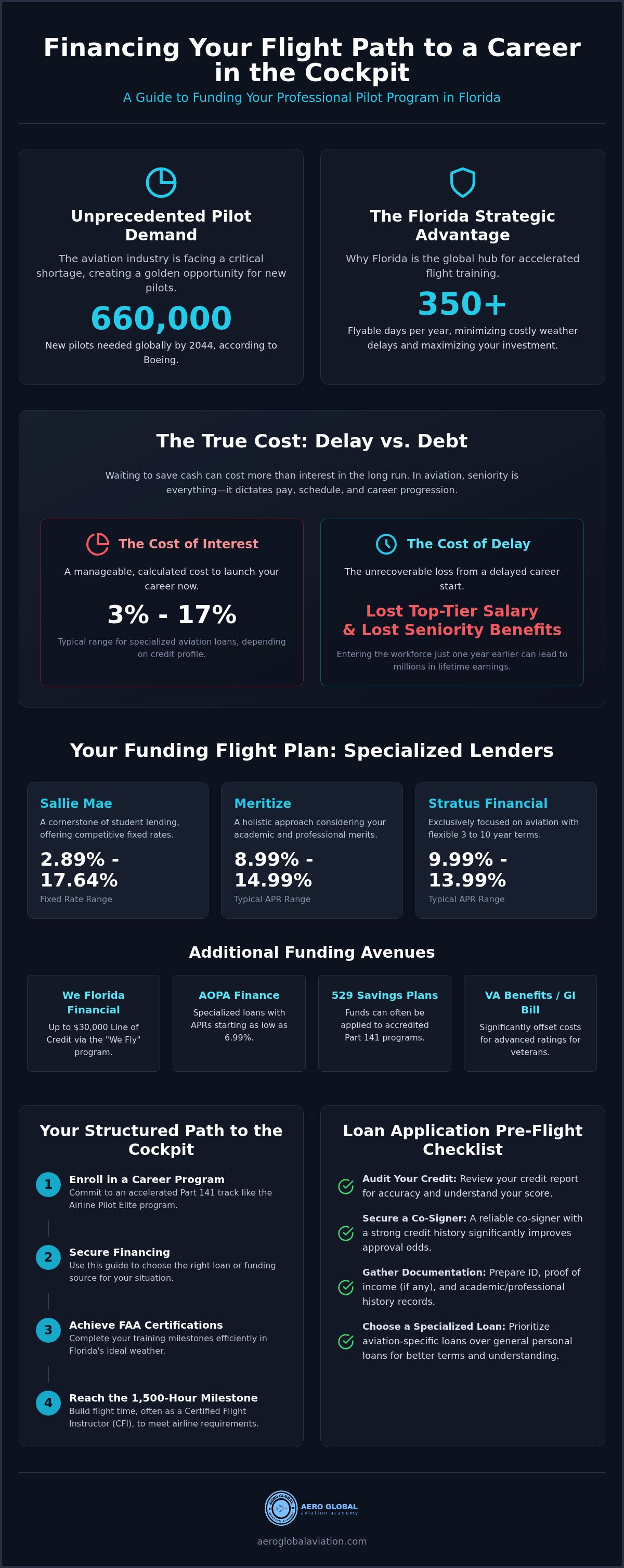
Current market conditions have made 2026 a landmark year for aspiring aviators. Boeing projects a global need for 660,000 new pilots through 2044, and this sustained shortage has significantly boosted lender confidence. Financial institutions are more willing to offer flexible terms because they see the immediate employment opportunities waiting for graduates. Additionally, the FAA has invested $26 million in aviation workforce development grants for 2026, signaling a massive federal push to lower barriers for new students. Lenders now prioritize career-track programs because they provide a structured, predictable path to the 1,500-hour airline requirement.
The Cost of Inaction vs. The Cost of Interest
Many students hesitate because of interest rates, which currently range from roughly 3 percent to 17 percent depending on the lender and credit profile. However, the true cost to consider is the cost of delay. Waiting two years to save up cash can cost you hundreds of thousands of dollars in lost wages at the end of your career. In the airline industry, seniority is everything; it determines your pay, your schedule, and your quality of life. Entering the workforce one year earlier can be the difference between retiring as a junior captain or a senior wide-body captain. Opportunity cost in the aviation industry is the total sum of lost top-tier airline salary and seniority-based benefits resulting from a delayed entry into the professional workforce.
Specialized Aviation Loans and Funding Sources for Student Pilots
Securing financing for career pilot program Florida training has evolved beyond simple bank loans into a sophisticated landscape of specialized products. Today, three major lenders dominate the space by offering terms tailored to the unique needs of aviators. Sallie Mae remains a cornerstone of the industry, providing fixed rates between 2.89 percent and 17.64 percent. Meritize takes a more holistic approach by considering your academic or professional history rather than just a credit score, with APRs typically ranging from 8.99 percent to 14.99 percent. Stratus Financial focuses exclusively on the flight deck, providing 3 to 10 year terms with rates between 9.99 percent and 13.99 percent.
Beyond these primary lenders, non-traditional options offer additional flexibility. The "We Fly" program from We Florida Financial provides a specialized line of credit up to $30,000, while AOPA Aviation Finance offers loans with APRs starting as low as 6.99 percent. If you have a 529 Savings Plan, those funds can often be applied toward professional training at accredited Part 141 schools. For our veterans, Florida is a premier destination to utilize VA Benefits. The GI Bill can significantly offset the cost of advanced ratings when you enroll in a structured professional track designed for employment readiness.
Private Student Loans vs. Personal Loans
Choosing a specialized flight training loan over a generic personal loan is a strategic decision for your long term financial health. Aviation lenders understand that you won't be earning an airline salary on day one. Because of this, they often include grace periods that defer full payments until after you complete your commercial ratings. These specialized loans are also more comprehensive in their coverage. While a standard personal loan might only cover tuition, aviation student loans frequently include funds for FAA checkride fees and living expenses for your time in the Kissimmee area. This all in one approach ensures you stay focused on the cockpit rather than your bank balance.
Scholarships and Grants: The 'Free' Money for Pilots
Never leave money on the table when millions of dollars in scholarships go unclaimed every year. Organizations like Women in Aviation (WAI), the Organization of Black Aerospace Professionals (OBAP), and the Experimental Aircraft Association (EAA) award significant funds to dedicated students. For 2026, the FAA has also allocated $26 million in grants specifically to support aviation workforce development. To maximize your success, time your scholarship applications to align with your enrollment in a professional flight training course. While Federal student aid is a common starting point for many career schools, combining it with local Florida aviation grants can create a powerful financial cushion that reduces your total loan requirement.
Evaluating ROI: The Career Pilot Program as a Financial Investment
Viewing your flight training through the lens of a business owner changes the way you perceive the costs. Securing financing for career pilot program Florida training isn't about taking on debt; it's about acquiring a high-yield professional asset. To understand the true ROI, you have to look past the initial tuition and focus on the speed of entry into the workforce. Our location in Kissimmee provides a massive strategic advantage in this regard. By training in Florida's consistent, year-round flying weather, you avoid the costly seasonal delays that plague schools in the north. Every month saved in training is a month sooner you're earning a professional salary, which significantly accelerates your break-even point.
The 'First Officer' Payback Period
In 2026, the average annual salary for a pilot in Florida sits at $97,833, while the median annual pay for commercial pilots nationwide has reached approximately $122,670 according to the U.S. Bureau of Labor Statistics. When you factor in regional airline signing bonuses that currently range from $10,000 to $30,000, the initial investment in your education begins to pay for itself remarkably quickly. Most graduates find that their debt-to-income ratio stabilizes within the first few years of regional airline service. For a deeper look at the long-term earning potential and how your income scales as you move toward major carriers, explore The Airline Pilot Career Path: A Comprehensive 2026 Guide.
Building Hours: The Financial Benefit of Instructor Ratings
The most efficient way to bridge the gap between your Commercial Pilot License and the 1,500-hour airline requirement is the Airline Pilot Elite track. This program is designed to move you into a paid flight instructor role as quickly as possible. Instead of paying for every hour of flight time out of pocket, you begin earning a paycheck while building the experience airlines demand. This 'work-while-you-build' strategy transforms you from a student into a paid professional, allowing you to begin servicing loan interest while you accumulate time. You can also supplement your primary funding by applying for Aviation Scholarships from AOPA, which can further reduce your total financing needs. This practical approach ensures that your transition from the classroom to the cockpit is both financially sustainable and professionally rewarding.
How to Qualify for Pilot Training Financing: A Step-by-Step Guide
Applying for financing for career pilot program Florida training requires more than just filling out a form. It’s a strategic process that mirrors the precision of a pre-flight checklist. Lenders in 2026 aren't just looking at your bank account; they're evaluating your potential as a professional aviator. We recommend starting this process at least three months before your intended start date in Kissimmee to ensure every document is in order. Follow these steps to prepare your financial flight plan.
- Step 1: Audit your credit score. Pull your reports from all three bureaus and resolve any discrepancies immediately. Even a small error can impact your interest rate by several percentage points.
- Step 2: Identify a strong co-signer. Most students between the ages of 18 and 25 lack the established credit history required for large aviation loans. A co-signer with a stable debt-to-income ratio is often the key to approval.
- Step 3: Secure your FAA Medical Certificate. Lenders view this as a primary risk mitigator. They want to see that you are "fit to fly" before they release funds for your training.
- Step 4: Gather your documentation. Have your last two years of tax returns, recent pay stubs, and proof of Florida residency ready. If you're a veteran, include your Certificate of Eligibility for VA benefits.
- Step 5: Apply in a 30-day window. When you're ready, submit applications to multiple lenders like Meritize or Sallie Mae within a one-month period. Credit bureaus typically treat multiple inquiries for the same loan type as a single event, protecting your score.
The Importance of the Co-Signer
Securing a co-signer is often the most significant hurdle for new students. When you approach a family member, don't just ask for a loan; pitch the Career Pilot Program as a high-yield investment. Explain the 2026 pilot demand and the rapid salary progression in the industry. Many 2026 loan contracts now include "co-signer release" options. This allows your co-signer to be removed from the loan after you've made a specific number of on-time payments, typically between 12 and 36 months after graduation. This provides an exit strategy for your partner while helping you get off the ground.
The FAA Medical: A Financial Prerequisite
Lenders are increasingly hesitant to fund students who haven't yet passed an FAA Medical exam. If a medical condition prevents you from holding a First or Second Class Medical, you cannot work as a commercial pilot, making the loan a high risk for the bank. We suggest visiting an Aviation Medical Examiner (AME) in the Orlando or Kissimmee area early in the process. For more details on the specific ratings you'll need to achieve, read our Commercial Pilot Training: Your 2026 Guide. Once you have your medical in hand, you’ve cleared the biggest non-financial hurdle to your funding. Ready to start? You can apply to our Career Pilot Program today to receive a personalized training and cost breakdown.
Financing Your Future at Aero Global Aviation Academy in Kissimmee
At Aero Global Aviation Academy, we don't just provide flight hours; we act as your Practical Mentors throughout the entire certification process. We understand that securing financing for career pilot program Florida training is a major life decision. Our team is dedicated to helping you navigate the complexities of aviation loans and financial planning with a student-centric approach. We focus on transparency and professional readiness, ensuring that every dollar you invest brings you closer to a captain’s seat at a major airline.
Choosing the right location is a fundamental part of your financial strategy. Training at Kissimmee Gateway Airport offers a level of cost-efficiency that is difficult to find in other regions. By minimizing training lag and maximizing time in the air, we help you reach your professional milestones faster. If you're still testing your aptitude for the flight deck, our Wings Foundation course serves as a low-cost entry point. This program allows you to earn your Private Pilot License (PPL) and gain foundational skills before committing to a larger financing package for the full professional track.
For those ready to launch a high-earning career, our Airline Pilot Elite program is the ultimate comprehensive financing target. This structured path takes you from zero experience all the way to advanced instructor certifications. It is designed to be the most efficient financial bridge to the airlines, as it allows you to begin earning a paycheck as a flight instructor while you build the 1,500 hours required for the majors. This proactive strategy ensures that your transition from student to professional is both logical and financially sustainable.
Local Advantages: Training in the Orlando Hub
The geography of Central Florida is one of your greatest financial assets. With over 360 days of flyable weather per year, you won't have to worry about your loan interest accruing while your plane is stuck in a hangar due to snow or persistent low clouds. This consistency prevents "training lag," where students lose proficiency during long breaks and must pay for remedial flights. Additionally, our proximity to major airline hubs like Orlando International Airport (MCO) provides unparalleled networking opportunities. You aren't just training in a vacuum; you're immersed in a thriving aviation ecosystem where professional goals feel like tangible destinations.
Next Steps: Book a Discovery Flight
Before you commit to a large-scale loan, we invite you to experience our facility and our fleet firsthand. Booking a discovery flight is the most practical way to confirm that the cockpit is where you belong. This flight isn't just a tour; it counts as your first "logged" hour toward your Private Pilot License. It’s an opportunity to meet our instructors, see our Kissimmee campus, and discuss your specific financial questions with a mentor who understands the industry. Start your journey today at Aero Global Aviation Academy and take the first step toward a rewarding, high-earning career in the skies.
Take Command of Your Aviation Career Path
Securing your future in the cockpit requires more than just a dream; it demands a strategic financial flight plan. We’ve explored how specialized aviation loans, 529 plans, and veteran benefits can bridge the gap between your first solo and a high-earning airline career. By understanding the qualification process and the impressive ROI of the current pilot market, you can transform your professional aspirations into a structured, attainable reality. Finding the right financing for career pilot program Florida options is the first step toward reaching your ultimate destination in the sky.
At Aero Global Aviation Academy, we’re committed to your individual success through professional pilot mentorship and our efficient Kissimmee Gateway Airport location. Whether you choose our PPL to instructor structured tracks or an accelerated elite program, we provide the expert guidance you need to succeed. Don't let financial uncertainty ground your ambitions. Schedule a Financial Consultation for Your Career Pilot Program today and see how we can help you clear the path to the flight deck. The horizon is wide open, and your journey starts now.
Frequently Asked Questions
Can I get 100% financing for a career pilot program in Florida?
Yes, you can often secure full funding that covers the entire cost of your training from zero experience to commercial certification. Many specialized lenders provide financing for career pilot program Florida students that includes tuition, books, and even FAA examiner fees. This all-inclusive approach ensures you stay focused on the flight deck without worrying about out of pocket expenses for your essential ratings.
Do I need a co-signer to qualify for a pilot training loan?
Most student pilots between the ages of 18 and 25 will require a co-signer to meet the credit and income requirements of major lenders. A co-signer with a strong debt to income ratio helps you secure more favorable interest rates and higher loan limits. Some 2026 loan contracts even offer a co-signer release option after you've made a specific number of on time payments following your graduation.
Can I use the GI Bill for flight training at Aero Global Aviation Academy?
Veterans can utilize their GI Bill benefits for advanced flight training once they have already obtained a Private Pilot License. While federal regulations generally don't cover the initial PPL, they can significantly offset the costs of your Instrument, Commercial, and Multi Engine ratings. Our team acts as your practical mentor to help you navigate and maximize your hard earned benefits within our structured professional tracks.
What is the typical interest rate for a flight school loan in 2026?
Interest rates in 2026 vary by lender and your credit profile, typically ranging from approximately 3 percent to 17 percent. For example, AOPA Aviation Finance currently offers rates between 6.99 percent and 10.99 percent, while Meritize provides APRs from 8.99 percent to 14.99 percent. Securing a co-signer or demonstrating a strong academic history can help you land on the lower end of these competitive ranges.
Are there flight school loans that cover living expenses in Orlando?
Yes, several private aviation lenders allow you to borrow additional funds to cover housing and living costs while you train in Kissimmee. This is a vital feature for students in full time accelerated programs who cannot work while building their flight hours. Including these expenses in your loan ensures you can live comfortably near our training hub without financial distractions during your professional certification.
What happens to my loan if I fail my FAA checkride?
Failing a checkride doesn't cancel your loan, but it does mean you'll need to pay for a re-test and any additional remedial training required by the FAA. Most lenders understand that the path to becoming a pilot involves rigorous testing and don't penalize you for a single setback. You simply continue your training once you've met the proficiency standards for your next attempt and continue building toward your career goals.
Can I pay off my pilot loan early without penalties?
Most specialized aviation lenders, including Sallie Mae and Stratus Financial, do not charge prepayment penalties. This allows you to use your airline signing bonuses or your higher First Officer salary to clear your debt faster. Paying down the principal early can save you thousands of dollars in interest over the life of the loan as you advance through the airline ranks.
Is it better to get a private student loan or a personal loan for flight school?
Private student loans are almost always the superior choice because they offer deferment options and grace periods tailored to the student experience. Unlike personal loans that often require immediate repayment, specialized financing for career pilot program Florida training allows you to wait until after you've completed your ratings to start full payments. They also typically offer lower interest rates and higher borrowing limits specifically for professional education.


