
What if the only thing standing between you and a professional cockpit in the Sunshine State isn't your talent, but a simple misunderstanding of FAA paperwork? You've likely spent hours scrolling through online forums, feeling overwhelmed by acronyms and conflicting advice about medical eligibility. Technical jargon shouldn't ground your dreams. Mastering the flight school requirements Florida mandates for 2026 is actually a very structured process once you have an expert guide to follow.
We've designed this roadmap to help you clear the air and move forward with total confidence. You'll find a straightforward checklist of every prerequisite, a plain-English explanation of different license paths, and vital updates on the latest FAA knowledge test changes. We'll also break down the reality of medical certificate costs and training timelines. By the time you finish this guide, you'll have the clarity you need to stop wondering and finally book that first discovery flight with peace of mind.
Key Takeaways
- Confirm your eligibility by understanding the specific age and English proficiency standards required by the FAA before you begin your journey.
- Identify which of the three FAA medical certificate classes aligns with your professional goals and learn how to secure your clearance from a local examiner.
- Navigate the flight school requirements Florida pilots must meet by selecting the right training path, whether you're seeking a private license or an accelerated career track.
- Break down the essential educational milestones of ground school and dual flight instruction to see exactly how you'll progress toward your certification.
- Learn how a discovery flight at Kissimmee Gateway Airport serves as your practical introduction to the cockpit and the first step toward your aviation future.
Fundamental Eligibility: Who Can Enroll in Florida Flight Schools?
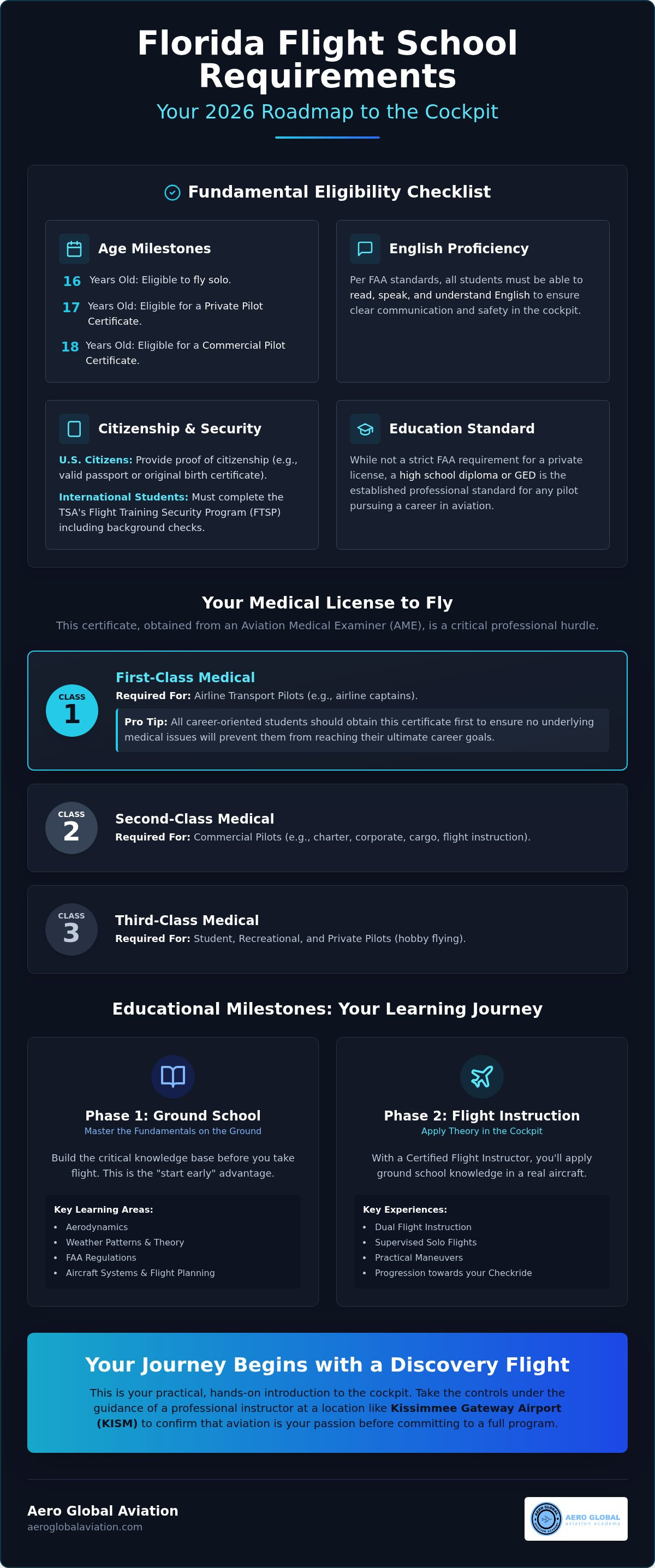
Meeting the flight school requirements Florida has established is the first milestone on your journey to the flight deck. While the cockpit might feel like a world away, the entry criteria are designed to be accessible for anyone with the dedication to learn. The Federal Aviation Administration (FAA) sets clear age benchmarks that allow you to grow into your career. You can fly solo as early as 16 years old, earn your Private Pilot Certificate at 17, and qualify for a Commercial Pilot Certificate once you turn 18. This structured progression is part of the broader system of Pilot certification in the United States, ensuring every pilot meets a high safety standard before advancing.
Communication is the lifeblood of aviation safety. To train here, you must be able to read, speak, and understand English per FAA standards. While a high school diploma or GED isn't a strict legal requirement for a private certificate, it remains the professional standard for anyone aiming for a career in the airlines. Training in Central Florida provides a strategic advantage that few other places can match. With over 300 days of sunshine annually, you won't find your progress stalled by weeks of poor weather. This local climate allows you to meet your training milestones with much greater efficiency, helping you move from the classroom to the clouds faster.
Citizenship and TSA Requirements
Security is a top priority in modern flight training. U.S. citizens must provide proof of citizenship, typically through a valid passport or an original birth certificate. If you are an international student, you'll need to navigate the Flight Training Security Program (FTSP) administered by the TSA. This process involves background checks and fingerprinting to ensure you meet all safety criteria. At Aero Global Aviation Academy, we act as your practical mentor, helping you manage the paperwork and verification steps so you can focus on your training. Our location at Kissimmee Gateway Airport (KISM) means you'll learn to navigate professional airspace while we handle the administrative heavy lifting behind the scenes.
The "Start Early" Advantage
You don't have to wait until you reach a specific age to begin your education. Many of our most successful students start ground school months before they are eligible for their checkride. This allows you to master aerodynamics, weather patterns, and regulations while you're still on the ground. Securing your private pilot license florida is your first legal step toward a professional career. By setting a clear timeline in 2026, you position yourself to take advantage of the ongoing demand for skilled pilots. Starting early isn't just about flying; it's about building the discipline and knowledge base that will define your entire career in the sky.
The FAA Medical Certificate: Your First Professional Hurdle
Securing your medical certificate is often the moment flight training feels real. It's the official confirmation that you are physically and mentally fit to take command of an aircraft. As you research flight school requirements Florida students must navigate, you'll discover that this certificate isn't just a box to check; it's your medical license to fly. You'll need to visit an Aviation Medical Examiner (AME), a physician specifically authorized by the FAA to perform these evaluations. In the Orlando and Kissimmee area, several highly regarded AMEs are available to help you clear this hurdle. Finding the right one is easy through the official FAA's guide to becoming a pilot, which provides a searchable database of examiners near you.
The FAA categorizes medical certificates into three distinct classes, each serving a specific level of pilot certification. A Third-Class Medical is the entry point, sufficient for those pursuing a Private Pilot License for personal travel or hobby flying. If you have professional aspirations, a Second-Class Medical is required to exercise the privileges of a Commercial Pilot License. However, for those aiming for the captain’s seat at a major carrier, a First-Class Medical is the gold standard. We recommend that career-oriented students obtain a First-Class Medical immediately. This ensures that no underlying medical condition will prevent you from reaching the highest levels of the industry before you invest significant time and resources into your training.
First, Second, and Third Class Medicals
Each class of medical has its own set of standards and expiration dates. A First-Class Medical is required for Airline Transport Pilots and has the most stringent requirements, especially for cardiovascular health. Second-Class certificates are the standard for commercial pilots who fly for hire in roles like flight instruction or regional charters. Third-Class certificates are perfect for recreational flyers. If you're unsure which class fits your long-term vision, contacting our team at Aero Global can help clarify your career trajectory.
The MedXPress Process
The process begins online with the FAA MedXPress application. You'll provide a comprehensive medical history, including any medications or previous surgeries. Once you've submitted the form, you'll receive a confirmation number to bring to your physical exam. During the appointment, the AME will check your vision, hearing, and general physical health. Most students find the process straightforward. If you wear glasses, don't worry; as long as your vision is correctable to 20/20, you're usually good to go. Your certificate's validity depends on your age and the class of medical, but for most young pilots, a First-Class medical remains valid for twelve months for airline duties.
Choosing Your Path: Wings Foundation vs. Career Pilot Program
Deciding between a hobby and a career is the pivot point for your training journey. While the basic flight school requirements Florida mandates apply to everyone, your specific path depends on your ultimate destination. For those who want the freedom of the weekend skies, our Wings Foundation provides a focused entry into aviation. If you see yourself in the cockpit of a Boeing 737, the Career Pilot Program offers a comprehensive PPL to CPL program designed for speed and professional readiness. Meeting the flight school requirements Florida demands for 2026 is simpler when you choose a path tailored to your specific goals.
Unlike traditional four-year university programs that mix general education with flight labs, a structured academy approach focuses purely on your aviation skills. This efficiency is why many students choose an airline pilot career path that prioritizes flight hours and technical ratings over a traditional degree. You'll spend more time in the air and less in a lecture hall. Before committing, you should have your FAA Medical Certificate in hand, as discussed in the previous section, to ensure your physical eligibility matches your professional ambitions.
Recreational Requirements
The Wings Foundation is built for the aspiring private pilot. You'll master the basics through a structured syllabus that includes ground school and a minimum of 40 hours of flight time. Most students find that 60 to 70 hours is a more realistic average to reach true proficiency. This path is ideal for business owners who want to fly themselves to meetings or families looking for a unique way to travel. It transforms you from a passenger into a pilot, giving you the keys to explore the state at your own pace while maintaining a flexible schedule.
Professional Career Requirements
Stepping into the professional world requires a more rigorous commercial pilot training roadmap. You'll need to accumulate at least 250 total flight hours to qualify for your Commercial Pilot Certificate. Along the way, you must earn an Instrument Rating (IFR) to fly through clouds and a Multi-Engine Rating (MEL) to handle larger aircraft. For those who want to build hours quickly while helping others, the Airline Pilot Elite track includes instructor certifications. This transition from a student to a mentor is a powerful way to reach the 1,500-hour airline requirement while refining your own skills and gaining valuable leadership experience.
Educational Milestones: Ground School and Flight Training
The transition from a dreamer to a pilot happens through four distinct phases of training. While the technical flight school requirements Florida mandates are rigorous, they are designed to build your skills in a logical, safe progression. You'll begin with Phase 1: Ground School, where you master the intellectual side of aviation. This includes studying aerodynamics, weather patterns, and federal regulations. Once you have a firm grasp of the theory, you'll move to Phase 2: Dual Instruction. Here, you'll sit in the cockpit with a Certified Flight Instructor (CFI) to practice maneuvers, takeoffs, and landings. This hands-on experience is where the classroom concepts finally click into place.
Phase 3 is the most memorable milestone: your first Solo Flight. This is the legal requirement to command the aircraft entirely on your own, without an instructor by your side. It's a powerful moment that builds immense confidence. Finally, Phase 4 is the Checkride. This is the culminating practical and oral exam conducted by an FAA-designated examiner. Passing this test is the final hurdle to earning your wings and officially joining the ranks of certified pilots.
Mastering the FAA Knowledge Test
The FAA Knowledge Test is a critical component of your ground school education. You'll need to demonstrate proficiency in several key subjects to pass:
- Navigation: Plotting courses and using modern GPS systems.
- Radio Communication: Learning the precise language of Air Traffic Control.
- Aircraft Systems: Understanding how engines, electrical systems, and flight controls function.
While a passing score is 70 percent, we encourage our students to aim for much higher. A strong foundational score makes the oral portion of your checkride significantly smoother. At Aero Global, we integrate this ground training into your daily schedule so you're always prepared for the next step.
The Flight Hour Requirements
Meeting the flight school requirements Florida pilots face involves specific time benchmarks. For a Private Pilot License (PPL), the FAA requires a minimum of 40 flight hours, though the national average often falls between 60 and 70 hours for true proficiency. If you're pursuing a Commercial Pilot License (CPL), you'll need to accumulate at least 250 total hours. This time must include cross-country flights and night flying milestones. Central Florida’s flat terrain and diverse airspace around Kissimmee and Orlando provide the perfect environment for building these hours efficiently. You'll learn to navigate complex busy corridors while enjoying the reliability of great flying weather. If you're ready to begin checking off these milestones, start your journey today with our expert team.
Starting Your Journey at Aero Global Aviation Academy
Training at Kissimmee Gateway Airport (KISM) gives you a professional edge you won't find at smaller, uncontrolled airfields. You'll operate alongside corporate jets and navigate controlled airspace from your very first lesson. This environment ensures you meet the flight school requirements Florida establishes while building the radio proficiency and situational awareness needed for airline readiness. Our location in Central Florida means you'll spend more time in the air and less time waiting for clear skies. It's a strategic advantage that helps you build hours faster and with greater consistency.
Enrollment at our academy is a collaborative and structured process. We start with a personal interview to understand your specific career goals, followed by a thorough document review to ensure all FAA and TSA prerequisites are in order. Once the paperwork is settled, we build a personalized training schedule that fits your life. For our local Central Florida residents, we offer various financing and payment plan options to make this investment in your future manageable. We believe that financial clarity is just as important as technical proficiency when you're starting this journey.
The Aero Global Mentorship Approach
We don't just teach you how to fly; we mentor you through the entire aviation landscape. Our instructors help you navigate the best flight schools in florida evaluation so you can see exactly how our structured programs stand out from the rest. Whether you're a full-time student in our Career Pilot Program or a professional needing a flexible schedule in the Wings Foundation, our Practical Mentor philosophy ensures you receive personalized attention. We're invested in your individual success, providing the steady encouragement needed to master the flight school requirements Florida demands of its future captains.
Next Steps: Booking Your Discovery Flight
The Discovery Flight is your unofficial first requirement and the most exciting part of the process. During your first 30 minutes in the cockpit, you'll actually take the controls under the guidance of one of our expert instructors. It's the best way to feel the aircraft's response and confirm that the pilot lifestyle is the right fit for your future. Best of all, this time counts toward your certification. We'll make your first logbook entry, marking your first official hour toward FAA requirements. Ready to fly? Contact Aero Global Aviation Academy today.
Take Command of Your Future in the Skies
The path to becoming a pilot is a journey of precision and discipline, but it's also one of the most rewarding career choices you can make. By mastering the flight school requirements Florida has established for 2026, you've already taken the first step toward the flight deck. You now understand that securing your medical certificate and choosing a training path that aligns with your professional vision are the keys to a successful start. Whether you begin with our Wings Foundation for beginners or dive into the accelerated Career Pilot Program, you're building a foundation for a lifetime of achievement.
Our Airline Pilot Elite track is designed to take you even further, transforming you from a student into a mentor. At Aero Global Aviation Academy, we're dedicated to being your local partner in every mile of your training. The blue skies of Central Florida are waiting for you to claim your place among the clouds. Don't let your dreams stay on the ground. Start Your Aviation Career: Book a Discovery Flight in Kissimmee and experience the thrill of flight for yourself. Your journey starts with a single hour in the cockpit, and we're ready to help you log it today.
Frequently Asked Questions
Do I need a college degree to join a flight school in Florida?
No, you don't need a college degree to begin your journey at a flight school. While many major airlines historically preferred a four-year degree, the primary legal requirement is a high school diploma or equivalent. You can focus entirely on your technical ratings and flight hours first. This allows you to enter the workforce sooner and potentially complete a degree later while you're already building professional experience in the cockpit.
How much does it cost to meet all the requirements for a Private Pilot License?
Meeting the financial flight school requirements Florida students face involves several factors beyond just tuition. An FAA medical certificate typically costs between $75 and $200 depending on the class and examiner. You should also budget for examiner fees and pilot supplies like headsets. Training in Kissimmee's consistent weather helps you stay proficient, which often reduces the total number of hours needed to reach the standard for your checkride.
Can I start flight training if I wear glasses or contacts?
You absolutely can fly with glasses or contact lenses. The FAA requires that your vision be correctable to 20/20 for distance, which is a standard most people meet easily with their current prescription. During your medical exam, the Aviation Medical Examiner will simply note that you must wear your corrective lenses while exercising your pilot privileges. It's a very common occurrence among professional pilots at every level of the industry.
What is the difference between Part 61 and Part 141 flight school requirements?
The main difference lies in the structure and oversight of the training curriculum. Part 141 schools follow a strict, FAA-approved syllabus that often allows for lower flight hour minimums due to the high level of supervision. Part 61 training is more flexible, allowing you to move at your own pace without a rigid schedule. Both paths lead to the same FAA certificates, so the best choice depends on your personal learning style.
How long does it take to complete the requirements for a Commercial Pilot License?
Completing the 250-hour requirement for a commercial license generally takes between six and twelve months of dedicated training. Your timeline depends heavily on how frequently you fly and how well you retain the material. Because Central Florida offers so many flyable days, students here often find it easier to maintain a steady rhythm. This consistency is vital for moving through complex maneuvers and advanced ratings without needing to repeat lessons.
Are there specific requirements for international students training in Florida?
International students must clear the TSA Flight Training Security Program (FTSP) before they can start their training. This process involves a background check and fingerprinting to ensure safety compliance. You'll also need to demonstrate that you can read, speak, and understand English to meet the global aviation standard. Our team helps mentor you through these specific flight school requirements Florida academies must follow for students arriving from abroad.
What happens if I fail my FAA medical exam?
Failing a medical exam isn't necessarily the end of your aviation dreams. If a disqualifying condition is found, you can often work with the FAA to obtain a Special Issuance or a Statement of Demonstrated Ability. This process involves providing additional medical documentation to show that your condition won't compromise flight safety. It's always best to consult with an experienced Aviation Medical Examiner if you have concerns about a specific pre-existing condition.
How do I choose between the Wings Foundation and the Career Pilot Program?
Your choice should align with your long-term destination. If you want to fly for personal travel or business, the Wings Foundation provides the essential skills for a Private Pilot License. If you're aiming for a professional career, the Career Pilot Program offers a structured, accelerated path to your commercial certificate. We sit down with every student to evaluate their goals and ensure they're on the most efficient track for their individual success.


