
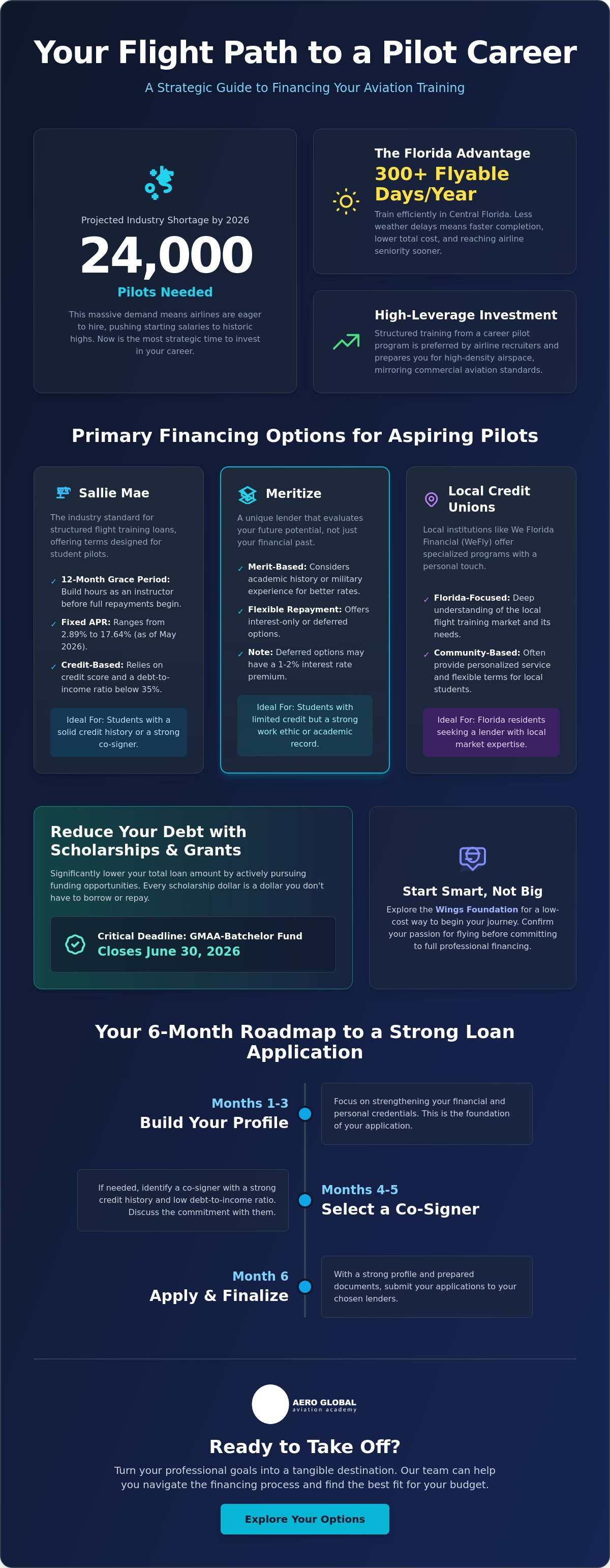
By the end of 2026, the aviation industry faces a projected shortage of 24,000 pilots. This massive demand means airlines are more eager than ever to hire, yet many aspiring aviators remain grounded by the fear of high interest rates and long term debt. You've likely spent hours researching the financing career pilot program Florida schools offer, only to feel confused by complex lender requirements and credit score hurdles. It's a significant investment, and it is natural to want a clear path forward before committing your future to the cockpit.
This guide provides a professional roadmap to funding your flight training with confidence and clarity. We will explore specialized lenders like Sallie Mae, which offers 12 month grace periods for graduates, and highlight critical scholarship deadlines like the GMAA-Batchelor fund closing on June 30, 2026. You'll learn how to navigate credit challenges and understand why the current market makes this the most strategic time to transition from the classroom to the flight deck. Let's look at the practical steps to turn your professional goals into a tangible destination.
Key Takeaways
- Understand why the 2026 pilot demand makes structured training a high-leverage investment for your future career.
- Discover specialized lenders that simplify financing career pilot program Florida paths, even if you're starting with limited credit history.
- Learn how to significantly lower your total debt by targeting Florida-specific aviation grants and national scholarship opportunities.
- Follow a clear six-month roadmap to strengthen your loan application and choose the right co-signer for your training.
- Explore how the Wings Foundation offers a low-cost way to start your journey before you commit to full professional financing.
The Financial ROI of a Career Pilot Program in Florida
Entering the cockpit isn't just about learning to fly; it's about launching a high-value career. When you look at the financing career pilot program Florida options, it's helpful to view the tuition as capital for a business. The Career Pilot Program is a structured path that takes you from your Private Pilot License (PPL) through to your Commercial Pilot License (CPL) in a single, efficient timeline. By 2026, the industry expects a shortage of 24,000 pilots, which has pushed regional airline starting salaries to historic highs. Securing the right financing career pilot program Florida path allows you to capitalize on these market conditions immediately.
Location matters for your bottom line. Training in Central Florida, specifically around Kissimmee and Orlando, offers more than just sun. We enjoy over 300 flyable days per year. While students in other states wait for snow to clear or fog to lift, you're logging hours. This efficiency reduces your total cost by preventing the skill fade that happens during long weather delays. Finishing your training just six months earlier can translate into thousands of dollars in lifetime earnings because airline seniority is everything. The sooner you reach the airlines, the sooner you start climbing the pay scale.
Why Structured Training Wins in 2026
The traditional pay-as-you-go model often leads to fragmented progress and higher long term costs. In contrast, the Career Pilot Program provides a dedicated schedule that builds momentum. Airline recruiters prefer graduates from structured academies because it demonstrates the discipline required for airline operations. Central Florida's high-density airspace also prepares you for real-world challenges, giving you a comprehensive overview of flight training in a professional environment that mirrors commercial aviation standards.
Calculating Your Personal Break-Even Point
Your total investment includes flight hours, examiner fees, and training materials. ROI is the ratio of your training cost to your projected earnings during your first five years at an airline. When planning, don't forget to include Orlando's living expenses. While the cost of living here is competitive, being a full-time student means you'll need a clear budget for housing and transport while you focus on your ratings. Starting with a clear financial plan ensures you can focus entirely on the flight deck rather than your bank balance.
Primary Financing Options: Lenders Who Specialize in Aviation
Securing the right funding is often the final hurdle before your first solo flight. When you look into financing career pilot program Florida options, you'll find that aviation-specific lenders offer terms that traditional banks simply cannot match. Sallie Mae is widely considered the industry standard for structured training. As of May 2026, their fixed rates range from 2.89% to 17.64% APR, and they offer a 12 month grace period for students who began their application after July 2, 2025. This window allows you to focus on building your flight hours as an instructor before full repayments begin. While loans cover the bulk of costs, you should also explore aviation industry scholarships to reduce the total amount you need to borrow.
Traditional personal loans might seem convenient, but they rarely offer the flexibility a pilot needs. Most personal loans lack the grace period feature found in dedicated aviation student loans. If you take a standard loan, you might be forced to start high monthly payments while you're still in the middle of your commercial rating. Dedicated lenders understand that your income will jump significantly once you reach the airlines, so they structure their products to support that transition. If you're feeling overwhelmed by the choices, we can help you explore your options to find the best fit for your budget.
Meritize vs. Sallie Mae: Which is Right for You?
Choosing between these two depends on your financial history and career stage. Sallie Mae prefers a debt to income ratio below 35% and relies heavily on credit scores. Meritize takes a different approach by looking at your potential. They evaluate your academic history or military experience to help secure better rates. This is a game changer for students with limited credit history but a strong work ethic. Keep in mind that interest only or deferred repayment options often come with a 1% to 2% interest rate premium, so it's vital to calculate the long term cost of that flexibility.
Local Credit Unions and Aviation-Specific Lenders
For a local touch, We Florida Financial offers the WeFly program. This credit union understands the Florida flight training ecosystem and provides loans from $5,000 to $30,000. While smaller than some national lenders, their localized expertise makes them a strong partner for specific ratings or bridge funding. They are familiar with the financing career pilot program Florida students need to cover checkride fees and materials. Using block time financing through these institutions can also help you secure lower rates by paying for flight hours in bulk, ensuring your training remains continuous and efficient.
Scholarships and Grants: Reducing Your Total Loan Amount
While loans provide the necessary capital to get started, scholarships and grants act as the high-octane fuel that reduces the friction of long term debt. Many students make the mistake of looking for one single award to cover everything. Instead, we recommend a "stacking" strategy. By combining multiple smaller grants of $1,000 to $5,000, you can often cover 10% to 20% of your total tuition. This approach is particularly effective when researching financing career pilot program Florida options because our state is home to a robust network of aviation foundations and airport councils.
For those who have served in the military, GI Bill benefits for pilot training represent one of the most effective ways to offset costs. Veterans can often have a significant portion of their professional ratings covered when training at VA-approved Part 141 institutions. Beyond government support, some students choose to use personal savings or structured 401(k) distributions to lower their principal loan amount. Reducing your initial loan balance by even $10,000 can save you thousands in interest over the next decade.
Top Aviation Scholarships to Apply for in 2026
Mark your calendar for these key Florida and national deadlines. The GMAA-Batchelor Aviation Scholarship Fund, which has awarded over $350,000 to date, has a deadline of June 30, 2026. If you're looking for regional support, the Florida Airports Council (FAC) Educational Foundation is another vital resource, with video interviews scheduled for April 10, 2026. To win these awards, focus your essay on your specific career goals and your commitment to the Florida aviation community. National organizations like AOPA and the EAA Ray Aviation Scholarship also provide substantial support for students who demonstrate high professional potential.
Company-Sponsored Training and Pathway Programs
The 2026 job market has prompted many regional airlines to offer tuition reimbursement programs to secure their future talent. These programs often kick in once you reach specific hiring milestones, effectively paying back a portion of your training loans as you fly. Understanding The Airline Pilot Career Path is essential for choosing a school that aligns with these airline flow-through agreements. By choosing a path with clear recruitment ties, you ensure that your training is not just an expense but a direct bridge to a high-paying airline seat.
How to Qualify: Building a Strong Loan Application
Securing the capital for your flight training requires more than just a signature; it requires a strategy. While we've discussed the lenders available, your focus should now shift to "Application Readiness." Lenders aren't just looking at your credit score; they're looking for proof that you're a low-risk investment who is committed to a long-term career. When you begin the process of financing career pilot program Florida paths, presenting a Professional Pilot Portfolio can set you apart. Include your FAA First Class Medical certificate and a logbook entry from a Discovery Flight to show lenders you've already passed the initial physical and practical hurdles of the industry.
The Discovery Flight serves as your personal proof of concept. It demonstrates to a financial institution that you've been in the cockpit, handled the controls, and possess the aptitude to complete the program. This proactive approach shows a level of discipline that standard applicants often lack. If you're ready to take that first step and build your portfolio, you can book your discovery flight today to get started.
The Co-Signer Strategy
Most student pilots require a co-signer to secure the most competitive rates. A strong co-signer typically has a credit score of 660 or higher and a stable income history. By adding a creditworthy co-signer, you can often reduce your interest rate by 2% to 4%, which saves you thousands of dollars over the life of the loan. Before applying, sit down with your co-signer and establish a clear agreement regarding repayment timelines and the 12-month grace periods offered by lenders like Sallie Mae. This transparency protects your relationship and ensures everyone is aligned with your professional timeline.
Financial Housekeeping for Aspiring Pilots
Prepare your finances at least six months before you submit your application. Focus on reducing your debt-to-income (DTI) ratio, as specialized lenders like Sallie Mae prefer this to be below 35%. Avoid making any large purchases, such as a new car or a home, during this window, as new credit inquiries and increased debt can negatively impact your approval odds. A clean financial history is as vital as a clean medical certificate when you are pursuing the financing career pilot program Florida lenders provide. Use this 6-month roadmap to strengthen your position:
- Months 1-2: Audit your credit reports and dispute any inaccuracies.
- Months 3-4: Aggressively pay down high-interest credit card balances to lower your DTI.
- Months 5-6: Gather your educational transcripts and professional references for your portfolio.
Aero Global Aviation Academy: Your Partner in Professional Growth
At Aero Global Aviation Academy, we don't just teach you how to fly; we act as your dedicated partner in navigating the complexities of the industry. We understand that the landscape of financing career pilot program Florida options can be daunting, which is why we position ourselves as your Practical Mentor. Our team works closely with you to align your training schedule with your financial resources, ensuring that every hour in the logbook brings you closer to a high-paying airline career. We help you bridge the gap between your aspirations and the practical requirements of the 2026 pilot market.
If you're still deciding if a full-time aviation career is right for you, our Wings Foundation offers a perfect way to start. This PPL only course allows you to "test the waters" and earn your private pilot certificate without the immediate financial commitment of a full professional track. It's a low-risk entry point that builds a solid foundation for your future. Once you've validated your passion, you can seamlessly transition into our Commercial Pilot Training curriculum, where your financial milestones are integrated directly into your flight progress.
Our strategic location at Kissimmee Gateway Airport is a massive asset for your training budget. Central Florida's predictable weather and efficient airspace allow you to maximize your training dollars by avoiding the costly delays found in other regions. You'll spend more time in the cockpit and less time on the ground, which is essential when you're managing a loan. This efficiency ensures that you stay on track while you secure the financing career pilot program Florida students need to reach the airlines ahead of the competition.
Customized Training Tracks to Fit Your Budget
We offer flexible paths to suit your financial goals. You can choose our Airline Pilot Elite track for a comprehensive zero-to-instructor journey, or follow a standard PPL to CPL progression. Our Practical Mentors provide personalized attention to help you stay on budget and on schedule, preventing the "training creep" that can lead to unexpected costs. Investing in our Advanced Flight Training provides long-term career value, as it prepares you for the specific technical ratings that regional airlines are currently prioritizing in 2026.
Taking the First Step in Kissimmee
The best way to start is with a Discovery Flight. This initial experience validates your career choice before you sign a loan agreement and serves as a powerful "proof of concept" for your lender. We invite you to tour our Kissimmee facility and meet with our admissions team to discuss your specific funding needs. We'll help you map out a clear roadmap from the classroom to the cockpit. The 2026 job market is hungry for new talent, the cockpit is waiting, and we have the expert guidance to help you get there with confidence.
Take Command of Your Aviation Career Today
Launching your professional pilot journey is a bold business move. You've explored the specialized lenders and scholarship strategies that make financing career pilot program Florida paths attainable. By preparing your financial portfolio and leveraging Central Florida's superior training weather, you're positioning yourself for a high-leverage return in a 2026 market that is desperate for skilled aviators. Success in this field requires a blend of technical skill and financial discipline.
We're here to help you navigate every step of this process. Aero Global Aviation Academy is partnered with top aviation lenders and offers structured PPL to CPL tracks designed for airline success. Located at the Kissimmee Gateway Airport, we provide the efficiency you need to stay on budget and on schedule. It's time to stop dreaming about the clouds and start planning your flight path.
Contact our admissions team to discuss your financing options and see how our Practical Mentors can support your transition to the flight deck. You have the map and the motivation; now it's time to clear for takeoff. Your seat in the cockpit is waiting.
Frequently Asked Questions
Can I get 100% financing for my pilot training in Florida?
Yes, you can secure 100% financing for your professional training through specialized lenders like Sallie Mae. These loans allow students to cover the full cost of tuition, flight hours, and materials, ensuring you don't have to pause your progress due to out-of-pocket expenses. Securing the full amount upfront is a strategic way to manage the financing career pilot program Florida students need to reach the cockpit on an efficient, uninterrupted timeline.
What credit score do I need for a flight school loan?
Most specialized aviation lenders, such as AOPA Finance, require a minimum credit score of 660 to qualify. If your score is currently below this threshold, you might still qualify by using a creditworthy co-signer or by applying through Meritize, which considers your academic and professional history. Improving your score before applying is always recommended, as it can significantly lower your interest rates and reduce the total cost of your investment.
Are there federal student loans for flight school?
Federal student loans are generally reserved for students enrolled in degree-seeking programs at accredited two or four year universities. For standalone professional flight academies, you'll primarily rely on private aviation loans from institutions like Stratus Financial or Sallie Mae. These private lenders fill the gap by offering terms specifically designed for the rapid pace of pilot training, including grace periods that last until you are ready for hire.
How do I find a co-signer for my pilot training?
Look for immediate family members or trusted mentors who possess a stable income and a credit score above 660. A co-signer provides the lender with extra security, which often unlocks interest rates that are 2% to 4% lower than what you could get alone. When asking, present them with your training roadmap and the 2026 pilot demand data to show that your career is a sound, high-leverage investment.
Can I work while enrolled in a career pilot program?
While you can technically work part-time, we recommend focusing entirely on your flight training to maintain maximum momentum. A structured program is intensive and requires several hours of ground school and flight prep for every hour spent in the air. Many students choose to finance their living expenses as part of their loan package, allowing them to finish six months earlier and reach the high-paying regional airline seats much faster.
What happens to my loan if I fail a checkride or medical exam?
Your loan obligation remains active even if you face a setback during a checkride or a medical evaluation. This is why it's vital to secure your FAA First Class Medical certificate before you ever sign a loan agreement. If you fail a checkride, you'll simply need to log a few additional training hours to reach proficiency, which can be covered by a small bridge loan or personal savings if your initial funding is exhausted.
Are pilot training loans tax-deductible in 2026?
In 2026, the interest paid on qualified student loans is typically tax-deductible up to specific IRS limits, provided you meet the annual income requirements. However, the deductibility of flight training costs depends on whether the IRS views it as education for a new career or improving skills for a current one. You should consult a tax professional to see how your financing career pilot program Florida investment fits into the current tax code and credits.
How long does the loan approval process usually take?
The initial credit decision from lenders like Sallie Mae or Meritize is often very fast, frequently arriving within 24 to 48 hours of your submission. However, the complete process, including verifying your flight school enrollment and finalizing co-signer paperwork, usually takes two to three weeks. Having your Professional Pilot Portfolio and medical certificate ready when you apply will help prevent any unnecessary delays in getting your training off the ground.


