
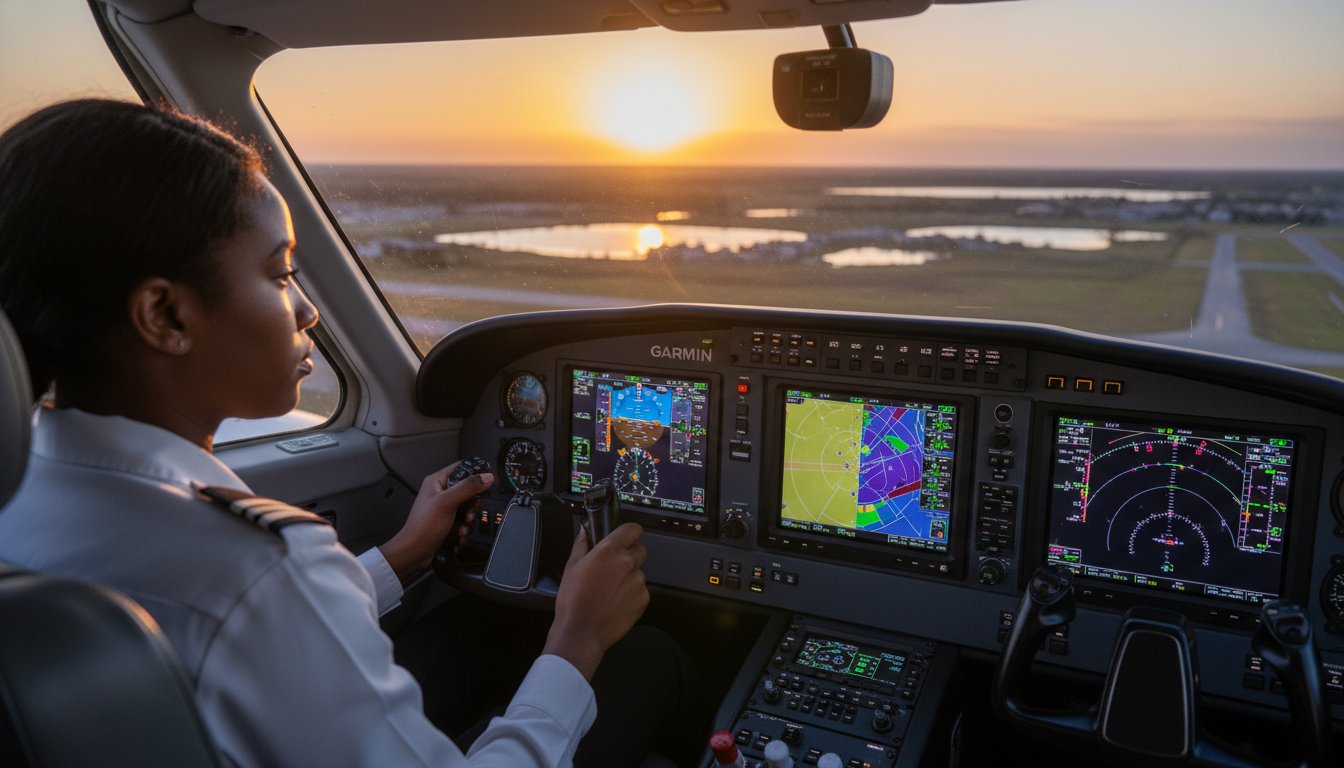
By the time you step onto a professional flight deck in 2026, the traditional "six-pack" of analog gauges will be a historical curiosity rather than a daily tool. This shift means that comprehensive glass cockpit training is now the essential bridge between being a student and becoming a career pilot. It's not just about learning to read a screen; it's about managing high-density information to achieve superior situational awareness in complex airspace.
It's natural to feel intimidated by the glow of a Garmin G1000 NXi or worry that digital displays might dull your basic stick-and-rudder instincts. You want to feel like a pilot, not a computer programmer, and we understand the pressure of balancing training costs with professional aspirations. We're here to show you that mastering these systems actually enhances your core flying abilities by freeing up your mental bandwidth. Through our Career Pilot Program, you'll gain the tactical skills to operate advanced avionics and the confidence to meet the rigorous standards expected by major airlines.
This guide provides a clear roadmap for your transition from analog to digital, breaks down the latest G1000 NXi software features, and explores how new FAA regulations like the MOSAIC rule are expanding opportunities for your professional journey.
Key Takeaways
- Discover why major airline operators now view professional glass cockpit training as a non-negotiable requirement for any pilot entering the 2026 workforce.
- Identify the core components of the Garmin G1000 system to understand how it streamlines navigation, communication, and engine monitoring into a two-screen interface.
- Learn why transitioning from analog gauges to digital displays actually sharpens your situational awareness and prepares you for the high-speed environment of professional flight.
- Master tactical learning strategies like "chair flying" and the "Hub and Spoke" scan pattern to build muscle memory and reduce your time in the air.
- Understand how training in the complex Class B and C airspace around Kissimmee provides the real-world precision required for our Career Pilot Program graduates.
What is Glass Cockpit Training and Why is it Mandatory in 2026?
The modern flight deck has undergone a radical transformation that changes how we perceive the sky. In the past, pilots spent their time scanning a series of individual mechanical dials to piece together their flight status. Today, What is a Glass Cockpit? It's an integrated electronic flight instrument system that replaces those old needles with high-resolution digital displays. For anyone pursuing a career through our Career Pilot Program, glass cockpit training is no longer an optional elective. It's a fundamental requirement for professional entry. By 2026, Part 121 and 135 operators expect new hires to arrive with G1000 proficiency as a baseline skill because modern airliners have almost entirely phased out analog gauges.
The FAA’s NextGen air traffic system relies heavily on the precise data sharing and GPS-based navigation that only glass cockpits can provide. You aren't just tracking a needle anymore. You're managing a complex stream of real-time data, from weather overlays to traffic alerts. This shift from "reading gauges" to "managing systems" is the core of modern professional aviation. It allows you to fly more precise routes and stay safer in crowded airspace, which is exactly why regional and major airlines prioritize candidates who are already comfortable with these platforms. Mastering this technology ensures you can handle the high-density information environments found in major hubs like Orlando International.
The Evolution from Steam Gauges to Digital Displays
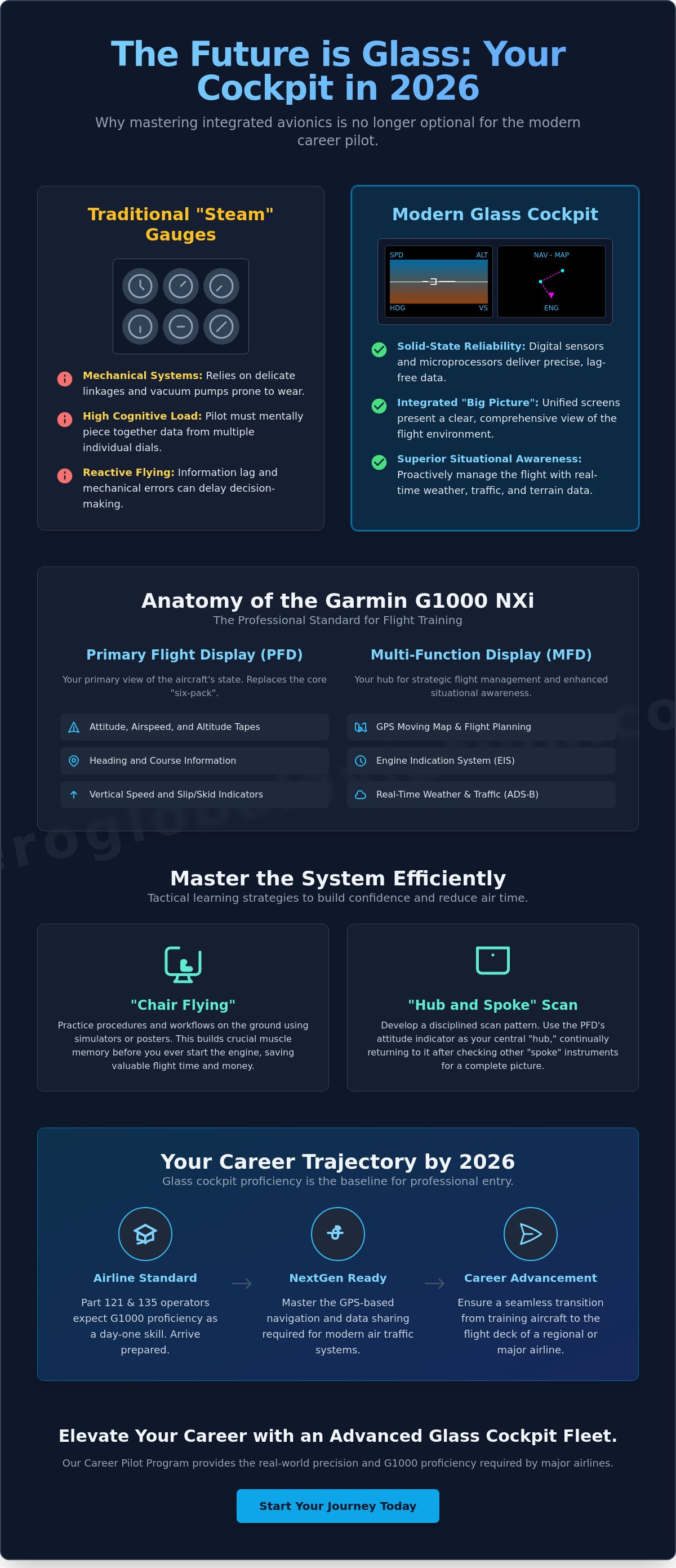
Traditional "steam gauges" rely on delicate mechanical linkages and vacuum pumps that are prone to wear and eventual failure. In contrast, digital displays use solid-state sensors and microprocessors to deliver flight information with incredible reliability. This evolution has fundamentally changed flight safety by removing the lag and mechanical errors associated with analog instruments. Transitioning to this technology requires you to stop interpreting individual dials and start reading the "big picture" presented on a unified screen. It's a move from reacting to mechanical movements to analyzing digital data streams.
Situational Awareness in Modern Aviation
Situational awareness is your mental model of the flight, encompassing where the aircraft is, where it's going, and what threats are nearby. In the context of glass cockpits, situational awareness is the ability to synthesize integrated digital data into a clear understanding of the aircraft's position and environment. Tools like synthetic vision and moving maps drastically reduce your cognitive load. Instead of doing mental math to calculate your position relative to a VOR, you can see your aircraft's exact relationship to terrain and weather in real-time. This clarity allows you to make better decisions faster, which is the hallmark of a professional pilot.
Anatomy of the Garmin G1000: The Professional Standard
The Garmin G1000 has become the undisputed benchmark for initial flight education. It's the most prevalent system you'll encounter in modern flight schools, and for good reason. By consolidating communication, navigation, and flight monitoring into two large liquid crystal displays, it mirrors the "dark cockpit" philosophy used by Boeing and Airbus. Mastering this system during your glass cockpit training ensures that the jump to a regional jet feels like a natural progression rather than a total system shock. Current software versions like the G1000 NXi 4014.04 provide pilots with lightning-fast processing and crystal-clear overlays that were once reserved for heavy metal airliners.
Safety is the primary driver behind this technology. An NTSB safety study on glass cockpits highlights that while these systems offer incredible tools, they require specific, structured training to manage effectively. In our Career Pilot Program, we focus on using these tools to identify hazards long before they become threats. Features like ADS-B integration, terrain awareness (TAWS), and real-time XM weather data give you a level of protection that simply didn't exist in the analog era.
Primary Flight Display (PFD) Breakdown
The PFD is your primary window into the aircraft's performance. Instead of chasing a needle on a dial, you'll learn to read airspeed trend vectors. These magenta lines show you exactly where your speed will be in six seconds, allowing for incredibly precise power management. You'll also master the Flight Director, those "pink needles" that guide your pitch and roll to stay on a programmed path. Learning to trust the digital HSI (Horizontal Situation Indicator) and the vertical speed tapes ensures you can maintain altitude and heading with a level of accuracy that checkride examiners love to see.
Multi-Function Display (MFD) and Engine Indication System (EIS)
The MFD serves as your tactical command center. Its moving map provides a bird's-eye view of your position relative to restricted airspace and navigation waypoints. This screen is also home to the Engine Indication System (EIS). The EIS monitors every cylinder head temperature and oil pressure point in real-time, alerting you to powerplant issues before they become emergencies. Digital checklist integration further reduces cockpit clutter. It allows you to stay "heads up" and focused on flying rather than fumbling with paper charts or booklets during critical phases of flight.
Glass Cockpit vs. Steam Gauges: The Great Training Debate
The "Stick and Rudder" argument is a classic hangar-talk topic. Many veteran pilots suggest that learning on traditional steam gauges builds a superior tactile feel for the aircraft. They worry that digital displays might make new students lazy or overly reliant on automation. However, the reality of 2026 aviation tells a different story. While basic airmanship remains the foundation of flight, glass cockpit training doesn't replace those skills; it layers advanced systems management on top of them. You still need to feel the stall and coordinate your turns, but you also need to process the high-speed data flow that modern cockpits provide.
Skill transferability is a major factor in this debate. Industry experience shows it's significantly easier for a pilot trained on steam gauges to transition to glass than the other way around. However, since almost every professional aircraft you'll fly in your career uses digital displays, starting your journey with modern avionics is the most efficient path. Training in a G1000-equipped Piper Archer provides a massive advantage. It allows you to build "screen-time" early, making you a more attractive candidate to airline recruiters who want pilots ready to handle complex flight decks with minimal remedial training.
Advantages and Disadvantages of Digital Avionics
Digital systems offer unmatched situational awareness and redundancy. If one screen fails, the other can usually display all critical flight data in reversionary mode. The precision of a digital altimeter and the clarity of a moving map are game-changers for safety. On the flip side, the potential for "head-down" time is a real risk. It's easy to get sucked into the screens and forget to look out the window. Our instructors mitigate this by teaching you how to manage information density without losing your external scan, ensuring you remain the pilot in command rather than a passive observer of the computer.
Why Career Pilots Should Prioritize Glass Cockpit Training
Success in a professional aviation career requires matching your skills to what the industry actually uses. By choosing a career pilot program that prioritizes modern technology, you align your training with current airline fleets. This alignment pays off during your Initial Operating Experience (IOE) at a regional or major carrier. When you're already comfortable with digital logic, your transition time to a jet is much shorter and less stressful. Proficiency in these systems is also vital for passing commercial pilot training checkrides, where examiners expect you to utilize every tool available in the cockpit to maintain safety and precision.
Efficient Strategies for Mastering Glass Cockpit Systems
Mastering modern avionics requires more than just flight hours; it demands a structured approach to learning what pilots call "buttonology." Efficient glass cockpit training starts long before you clear the runway. We encourage our students to use the "Chair Flying" method, utilizing home-based PC simulators or tablet apps to memorize the location of every softkey and knob on the Garmin G1000. By building this muscle memory on the ground, you save valuable time and mental energy in the air. When you aren't hunting for a frequency change or a flight plan page, you can focus on the actual art of flying.
A critical part of this mastery is developing a digital scan pattern known as the "Hub and Spoke" method. In an analog cockpit, your eyes move in a circle. In a glass cockpit, your eyes should always return to the Primary Flight Display (the Hub) before glancing at the Multi-Function Display or out the window (the Spokes). This technique ensures you never lose track of your primary flight data while managing secondary systems. Balancing this screen monitoring with outside vigilance is vital to managing "head-down" time, especially in busy training environments where situational awareness is your best defense against traffic.
The 5-Step Transition Process for Student Pilots
Success follows a logical progression. We guide you through these specific milestones to ensure you never feel overwhelmed by the technology:
- Step 1: Ground School and a deep-dive review of the G1000 pilot’s guide and system manuals.
- Step 2: Stationary cockpit familiarization using "power-on" ground time to practice FMS entries without the pressure of flight.
- Step 3: VFR maneuvers to build confidence in interpreting digital airspeed and altitude tapes during climbs, turns, and descents.
- Step 4: Integration into instrument flight rules training to master precision approaches and complex navigation.
- Step 5: Final proficiency check where you demonstrate total system authority and automation management.
Advanced Flow Patterns and Emergency Procedures
True proficiency is proven when things go wrong. You must know how to handle a PFD failure by immediately engaging reversionary mode, which moves your primary instruments to the MFD screen. While digital displays are incredibly reliable, knowing where to find your mechanical or electronic backup instruments is a life-saving skill. You don't want to be searching for the standby attitude indicator when the main screens go dark in the clouds. Practicing "partial panel" glass cockpit emergencies is the only way to ensure your mental model of the flight remains intact when the primary technology fails. If you're ready to start your journey with a mentor who values precision, explore our Career Pilot Program today.
Elevate Your Career with Aero Global’s Advanced Glass Cockpit Fleet
Choosing the right environment for your glass cockpit training makes all the difference in your professional development. At Aero Global, our Kissimmee-based fleet features modern Piper aircraft fully equipped with Garmin avionics. While some schools might provide basic screens, we integrate these systems into every stage of your journey. Navigating the complex Class B and C airspace around Orlando requires absolute precision. It's a high-stakes environment that forces you to utilize every feature of the G1000, from traffic alerts to terrain awareness. This real-world experience ensures you're ready for the pace of a commercial flight deck.
Our instructors act as practical mentors who have logged thousands of hours in advanced systems. They don't just teach you which buttons to push; they share the tactical wisdom gained from years of professional flying. This personalized attention is what prepares you for the advanced flight training ratings that airlines look for during the hiring process. We want you to feel confident and capable every time you step into the cockpit, knowing your skills match the highest industry standards.
The Aero Global Advantage in Central Florida
Kissimmee offers some of the most favorable flying weather in the country. This local climate allows for consistent, year-round mastery of digital avionics without the long delays found in other regions. You can move smoothly from your first PPL flight training Orlando session to professional glass cockpit proficiency. We've designed our Airline Pilot Elite track to weave these technical skills into your overall training, ensuring that your transition to complex aircraft is both logical and rewarding. By the time you reach your commercial checkride, the G1000 will feel like a natural extension of your pilot instincts.
Next Steps: Booking Your Glass Cockpit Orientation
Your first G1000 discovery flight is an eye-opening experience. You'll sit in the left seat and see firsthand how synthetic vision and moving maps transform your perspective of the sky. We customize our approach for every student, whether you're a complete beginner or a pilot looking to transition from analog gauges. Our goal is to make the complex world of modern aviation feel within your reach. We invite you to visit our facility, meet our team, and see how our modern fleet can accelerate your path to the airlines. Start your journey into the modern flight deck with Aero Global Aviation Academy today.
Take Command of the 2026 Flight Deck
Mastering digital avionics is a transformative step that separates tomorrow's airline professionals from today's students. You now understand that glass cockpit training is about more than just looking at screens; it's about developing the systems-management mindset required for the modern industry. By combining a structured scan pattern with the advanced capabilities of the Garmin G1000, you build the situational awareness that recruiters value most.
Our strategic location in Kissimmee offers the ideal training ground, where you'll navigate real-world challenges in some of the nation's busiest airspace. With a modern fleet and a team of mentors who have lived the airline experience, we provide the tools you need to transition from the classroom to the cockpit with absolute confidence. Your future in the sky is waiting, and the right preparation makes all the difference.
Ready to master the modern flight deck? Explore our Career Pilot Program today.
The journey to becoming a professional pilot is an incredible adventure. We're excited to help you take that first step toward a rewarding and successful lifelong career.
Frequently Asked Questions
Is glass cockpit training harder than learning on steam gauges?
It isn't necessarily harder, but it requires a different type of mental focus. While steam gauges require you to mentally piece together data from multiple dials, glass cockpits present everything in one place, which can lead to information overload if you aren't trained to filter it. The challenge lies in mastering the system logic and buttonology rather than just reading a needle.
Can I get a commercial pilot license without glass cockpit training?
Yes, you can technically earn a CPL in an aircraft with analog instruments. However, most modern commercial operators and airlines now require or strongly prefer candidates who have completed comprehensive glass cockpit training. Choosing to train on digital systems early makes you much more competitive when applying for professional pilot positions in the 2026 hiring market.
What is the best aircraft for glass cockpit training at Aero Global?
Our Cessna 172SP equipped with the Garmin G1000 is the ideal platform for mastering these systems. It provides a stable and reliable environment for learning the nuances of digital flight decks while preparing you for the advanced systems found in regional jets. This combination of a classic trainer with modern avionics offers the perfect balance for student success in Central Florida.
Does the FAA require specific glass cockpit endorsements?
The FAA does not currently mandate a specific glass cockpit endorsement in the same way they do for high-performance or complex aircraft. Instead, proficiency is usually demonstrated during your standard checkrides for private or commercial certificates. Your instructor will ensure you are competent in system operation and emergency procedures before signing you off for a practical test with a DPE.
How much extra does glass cockpit training cost compared to analog?
Training in a glass-equipped aircraft generally carries a higher hourly rental rate than an older analog model. This reflects the significant acquisition and maintenance costs of modern avionics. While the hourly price is higher, many students find they progress more efficiently because the integrated systems provide better situational awareness. You should check current rental rates for specific aircraft to compare your total training budget.
What happens if the glass cockpit screens fail during flight?
Modern systems are designed with significant redundancy, including a reversionary mode that allows one screen to display all critical data if the other fails. Additionally, aircraft are equipped with standby instruments, either mechanical or independent electronic units, to ensure you can fly safely even in the event of a total system power loss. Practicing these failure scenarios is a core part of our professional curriculum.
Is the Garmin G1000 the only glass cockpit system I should learn?
The Garmin G1000 is the industry standard for flight training and is the most common system you'll encounter. While other systems like Avidyne exist, the logic you learn on a G1000 translates very well to the Honeywell or Rockwell Collins systems used in large transport aircraft. Mastering the Garmin platform provides a solid foundation for almost any professional airline career.
Should I learn to fly on steam gauges before moving to glass?
There is no single right answer, but starting with glass cockpits is often more efficient for those aiming for an airline career. While steam gauges are excellent for building basic visualization skills, modern professional pilots spend their entire careers looking at digital displays. Learning the digital environment from day one helps you develop the specific scan patterns and data-management habits required for the 2026 flight deck.


