
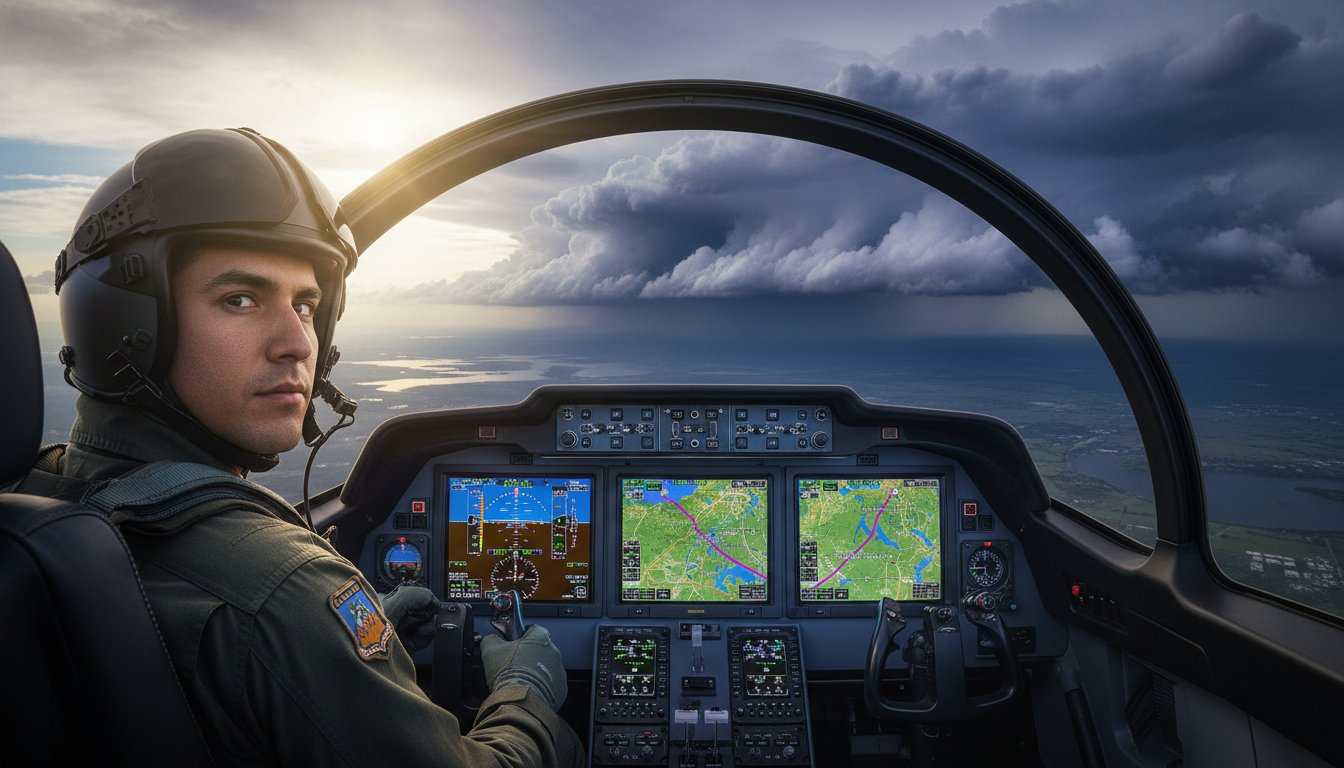
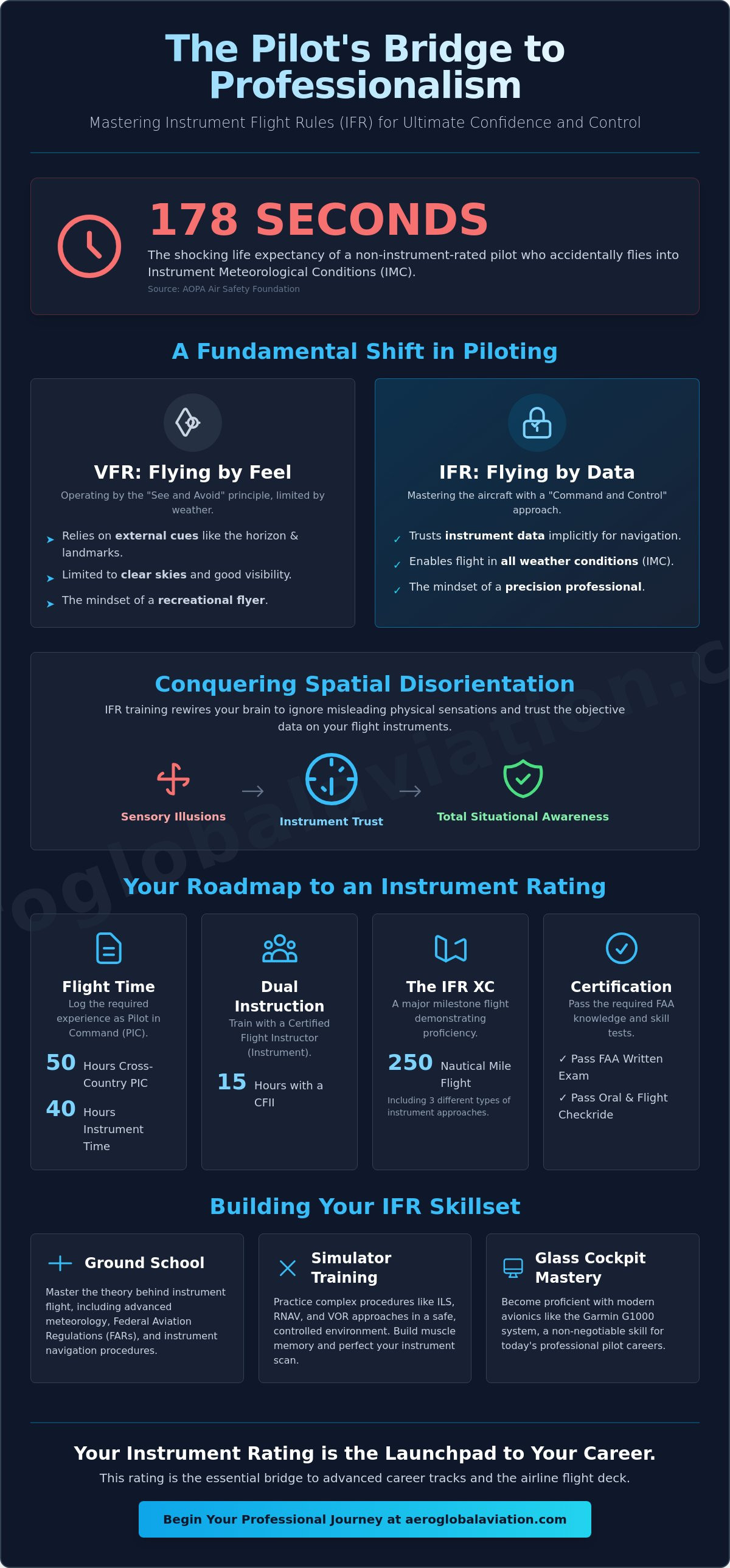
Did you know that the AOPA Air Safety Foundation reports a non-instrument-rated pilot who accidentally flies into bad weather has a life expectancy of just 178 seconds? It's a sobering reality that underscores why instrument flight rules training is the most critical step in your aviation journey. You've likely felt a twinge of anxiety when looking at a low cloud ceiling or wondered if you could truly handle a complex glass cockpit during a sudden loss of visibility. Confusion over FAA hour requirements and the fear of spatial disorientation are common hurdles, but they don't have to stop your progress.
This guide will show you how mastering the instruments transforms that uncertainty into the precision of a professional, giving you the tools to navigate the skies with total confidence. You'll discover how to transition from flying by feel to flying by data and gain a clear understanding of the roadmap to your rating. We'll break down the specific 14 CFR 61.65 requirements for 2026 and explore how this pivotal certification serves as the essential bridge toward a rewarding commercial career. Whether you're training in the favorable climate of a region like Florida or elsewhere, this is where your professional destination truly begins to take shape.
Key Takeaways
- Understand how transitioning from "see and avoid" to a command and control mindset shifts your perspective from a recreational flyer to a precision-focused professional.
- Learn to conquer spatial disorientation and the sensory illusions of flight by mastering the technical skills required to trust your instruments in all conditions.
- Identify the specific FAA milestones necessary for instrument flight rules training, including cross-country requirements and the 250 nautical mile flight.
- Discover how obtaining your instrument rating acts as a critical bridge toward advanced career goals within structured tracks like the Career Pilot Program or Airline Pilot Elite.
What is Instrument Flight Rules (IFR) Training?
Think of your Private Pilot License as your entry into the world of aviation, where you learned to navigate by the "See and Avoid" principle. While visual flight is exhilarating, it limits you to clear skies and fair weather. Instrument flight rules training represents the moment you step beyond those boundaries. It is a specialized set of FAA regulations that govern how you operate an aircraft solely by reference to the flight instruments on your panel. Instead of relying on the natural horizon or ground landmarks, you learn to trust the data in front of you to maintain control and navigate the national airspace system.
This transition marks a fundamental shift from being a passenger of the weather to becoming its master. By moving from a visual-reliant mindset to a "Command and Control" approach, you gain the ability to fly in Instrument Meteorological Conditions (IMC). This means that a layer of clouds or reduced visibility no longer grounds your plans. For many, this training serves as the essential bridge between being a recreational hobbyist and entering a professional career pilot program. It’s the point where you stop flying for fun and start flying with the discipline required for the flight deck.
VFR vs. IFR: A Fundamental Shift
In visual flight (VFR), your primary cues are external. You look at the horizon to level your wings and use roads or rivers to find your way. In contrast, instrument flight rules training teaches you to interpret a constant stream of digital or analog data. You will learn to rely on your altimeter, attitude indicator, and vertical speed indicator to build a mental picture of the sky. This skill is not just a luxury; an Instrument rating is a legal requirement for almost all commercial aviation operations. If you want to fly for an airline or a cargo carrier, you must be proficient in navigating these complex procedures without ever looking out the window.
The 'Great Filter' of Professional Aviation
Many pilots describe the instrument rating as the "Great Filter" of flight school. It is often the most mentally taxing phase because it requires you to ignore your physical sensations and trust the instrument panel implicitly. However, the rewards are unmatched. This discipline sharpens your basic airmanship and significantly boosts your situational awareness, making you a safer pilot in every environment. Mastering these procedures is a prerequisite for the advanced flight training ecosystem. Once you can navigate the sky by data alone, you have proven you possess the focus and professional temperament required for the highest levels of aviation.
The Core Components of an Instrument Rating Course
Achieving your rating requires more than just flying through a layer of clouds. It is a comprehensive educational journey that blends high-level theory with technical precision. Your instrument flight rules training begins on the ground, where you'll dive deep into Federal Aviation Regulations (FARs), advanced meteorology, and the mechanics of instrument navigation. Understanding how to interpret weather charts and predict icing conditions isn't just for passing a test; it's the foundation of your safety as a pilot in command. Reviewing the AOPA instrument rating requirements provides a clear roadmap of the milestones you'll need to hit, from knowledge tests to the final checkride.
Before you ever leave the runway under a hood, you'll likely spend significant time in FAA-approved flight simulators. These devices are invaluable tools for mastering procedures without the distractions of a vibrating cockpit or fuel costs. In the simulator, you can pause the flight to analyze a mistake or repeat a difficult approach ten times in a row. You'll practice precision approaches like the Instrument Landing System (ILS) and non-precision maneuvers such as RNAV (GPS) and VOR procedures. This repetition builds the muscle memory and "scan" patterns you'll need when the visibility drops to minimums.
Mastering the Glass Cockpit: Garmin G1000 Systems
The evolution from traditional "round dial" instruments to modern glass cockpits is a defining feature of contemporary instrument flight rules training. Learning on the Garmin G1000 system is no longer an elective; it's a necessity for anyone eyeing a seat in a regional or major airline. You'll learn to interpret the Primary Flight Display (PFD) for flight data and the Multi-Function Display (MFD) for navigation and traffic. While the learning curve for these systems can feel steep, they vastly improve your situational awareness. They allow you to manage high-workload phases of flight with a level of clarity that old-school gauges simply can't match.
IFR Navigation and ATC Communication
Communication is the heartbeat of IFR flight. You aren't just flying; you're participating in a choreographed dance with Air Traffic Control (ATC). You'll master the "language" of IFR, learning how to copy complex clearances, execute hold entries, and follow specific departure procedures. This phase of training also introduces you to Enroute Charts and Terminal Procedures Publications (TPPs). Being able to pull up an approach plate and brief it while talking to a controller is a skill that separates the amateurs from the professionals. If you're ready to start this transition, enrolling in a structured Career Pilot Program ensures you're learning these skills on the same modern technology used by the major airlines.
Overcoming the Mental Challenges of Instrument Flying
While the technical equipment and regulations are vital, the psychological transition is often the steepest part of instrument flight rules training. You're moving from a world where you trust your eyes to one where you must actively ignore them. This shift isn't just about learning new buttons; it's about rewiring how your brain processes reality while moving through three-dimensional space. You'll find that your body often lies to you in the clouds, making the mantra "Trust Your Instruments" a literal survival skill rather than just a catchy phrase.
Managing the cognitive load is the next hurdle. In the soup, you must simultaneously fly the airplane, navigate a complex flight plan, and communicate with Air Traffic Control. To handle this, you'll develop a disciplined instrument scan. Whether you use the traditional "T" scan, focusing on the attitude indicator before moving to the airspeed and altimeter, or a more fluid circular scan, the goal is the same: never fixate. A single moment of staring at one gauge can lead to a dangerous deviation in altitude or heading. The FAA Instrument Procedures Handbook provides the technical framework for these maneuvers, but the mental discipline comes from hours of focused practice.
Combating Spatial Disorientation
Spatial disorientation occurs when your inner ear sends signals that contradict what your eyes see on the panel. You might feel "The Leans," a sensation that you're in a bank when you're actually straight and level, or the "graveyard spin" illusion during prolonged turns. Maintaining focus on the flight director during turbulent IMC is the only way to stay safe. Instrument Cross-Check is the pilot's primary defense against disorientation. By constantly verifying one instrument against another, you verify the aircraft's true state regardless of what your vestibular system claims.
The IFR Mindset: Precision and Discipline
Training for your rating builds a professional pilot persona through strict adherence to tolerances. While you might have enjoyed the relative freedom of PPL flight training Orlando, IFR requires you to stay within narrow margins of altitude and heading at all times. This level of precision demands intense pre-flight planning and the ability to "stay ahead of the airplane." In instrument flight rules training, if you're thinking about what's happening now, you're already behind; you must always be thinking two steps ahead to your next waypoint or frequency change.
FAA Requirements and Florida's Training Advantages
Before you can begin your instrument flight rules training, you must hold a valid private pilot license florida. This certification is the foundation upon which your professional skills are built. The FAA Part 61 requirements are specific and rigorous, ensuring that only the most prepared pilots earn their rating. You'll need to log at least 50 hours of cross-country flight time as pilot in command, with at least 10 of those hours in an airplane. Additionally, you must complete 40 hours of actual or simulated instrument time, which includes 15 hours of training with a Certified Flight Instructor, Instrument (CFII).
One of the most rewarding milestones in this journey is the long IFR cross-country flight. This requirement involves a flight of at least 250 nautical miles along airways or ATC-directed routing. It must include three different types of instrument approaches at three different airports, using navigation systems like ILS, RNAV, or VOR. Your CFII acts as your mentor during this phase, guiding you through the complexities of the national airspace system and ensuring you're ready for the final evaluation. This stage is where you truly transition from a student into a pilot capable of managing long-distance flights in varied conditions.
Why Central Florida is the IFR Training Capital
Central Florida offers a unique strategic advantage for instrument flight rules training. Unlike the desert where clear skies are the norm, Orlando’s rapid weather changes provide frequent opportunities for actual IMC experience. Encountering real cloud layers and rain helps you build a level of confidence that simulated "hood" time simply cannot replicate. Also, the complex airspace surrounding Kissimmee and Orlando is perfect for mastering high-intensity ATC communication. The year-round flying weather in 2026 ensures your training timeline remains predictable, allowing you to reach your career goals without seasonal delays. If you're ready to start, our Career Pilot Program is designed to help you leverage these local advantages effectively.
The Instrument Checkride: What to Expect
The checkride is the final hurdle between you and your rating. It begins with a thorough oral exam where the Designated Pilot Examiner (DPE) will evaluate your knowledge of weather theory, IFR charts, and aircraft systems. You must demonstrate a deep understanding of how to plan a safe flight in adverse conditions. The flight portion then follows, where you'll be expected to fly precision and non-precision approaches with clinical accuracy. You'll also face "partial panel" emergencies, proving you can keep the airplane stable even if your primary flight display fails. Success here comes down to preparation and the ability to stay calm under pressure.
Launching Your Career with Aero Global Aviation Academy
Choosing where to complete your instrument flight rules training is a decision that shapes your entire professional trajectory. At Aero Global Aviation Academy, we don't just teach you to fly by the gauges; we mentor you into the mindset of a career-ready aviator. Our training is designed to integrate seamlessly into the wider commercial pilot training track, ensuring that every hour you spend under the hood is a direct investment in your future. By training in our modern, G1000-equipped fleet, you're gaining proficiency on the exact avionics standards required by today's leading airlines.
The transition from a private pilot to an instrument-rated professional is often seen as the most significant leap in a pilot's education. We treat this phase as a launchpad for your next milestones, such as Multi-Engine and CFI ratings. Whether you're enrolled in our Career Pilot Program or the Airline Pilot Elite track, our goal is to provide a structured path that moves you efficiently from the classroom to the flight deck. You'll find that mastering the instruments here isn't just about passing a checkride; it's about building the reliability and precision that recruiters look for in a professional pilot.
Mentorship-Led Training in Kissimmee
We pride ourselves on being a "Practical Mentor" rather than a high-volume pilot mill. At Kissimmee Gateway Airport, you'll find a community atmosphere where your success is personal. You'll have direct access to experienced instructors who have successfully navigated the same career paths you're currently pursuing. This individualized attention ensures that you don't just meet the FAA minimums but truly master the art of instrument flight. Our location allows you to practice complex procedures in a busy terminal environment while enjoying the supportive spirit of a dedicated local partner.
Your Path to the Flight Deck Starts Here
Obtaining an Instrument Rating is a transformative step that unlocks significantly higher salary potential and broader job opportunities. With the U.S. Bureau of Labor Statistics reporting a median salary for airline pilots of $239,200 in 2025, the return on your training investment is clear. This certification is the key that opens the door to commercial aviation, cargo operations, and corporate flight departments. We invite you to visit our academy in person to see our fleet, meet our instructors, and experience the professional environment firsthand. Contact Aero Global today to schedule your IFR consultation and take the first step toward mastering the sky beyond visibility.
Take Command of Your Professional Destination
Mastering the sky beyond visibility is the defining moment for any aspiring professional. You've discovered how instrument flight rules training bridges the gap between recreational flying and a precision-focused career. By conquering the mental hurdles of spatial disorientation and mastering modern navigation, you've equipped yourself with the tools to navigate any weather with total confidence. This rating isn't just a certificate; it's the essential foundation of your professional identity and your commitment to safety.
At Aero Global Aviation Academy, we're dedicated to your individual success as your practical mentor. Our professional G1000-equipped fleet and strategic location in Kissimmee, Orlando, provide the perfect environment to build actual instrument experience in a complex, real-world airspace. With our mentor-led career pilot tracks, you're never just a number; you're a future captain in the making who understands that data-driven precision is the key to the flight deck. We're here to help you navigate every step of this rewarding process.
Start your journey to the flight deck with our Career Pilot Program and transform your passion into a professional reality. The horizon is waiting, and we're ready to help you reach it.
Frequently Asked Questions
Is instrument flight rules training harder than the Private Pilot License?
Many pilots find instrument flight rules training more mentally demanding than their initial license because it requires higher precision and technical knowledge. While the PPL focuses on basic stick and rudder skills, IFR training shifts your focus to data management and procedural discipline. It's a different kind of challenge that rewards you with the ability to fly in conditions that ground other pilots, making it a pivotal step for any professional.
How many hours of flight time do I need for an Instrument Rating?
Under FAA Part 61, you need at least 40 hours of actual or simulated instrument time, 15 of which must be with a flight instructor. You also need 50 hours of cross country flight time as pilot in command. For those in a Part 141 program, the requirement is 35 hours of instrument training. These milestones ensure you have the necessary experience to handle complex navigation and weather challenges safely.
Can I do IFR training before I have my Private Pilot License?
You must hold at least a private pilot certificate before you can officially earn an instrument rating. However, many students begin studying the ground school material or practicing basic instrument maneuvers during the later stages of their PPL. This proactive approach helps you hit the ground running once you transition into dedicated instrument flight rules training and start working toward your professional goals.
What is the difference between 'Actual' and 'Simulated' instrument time?
Actual instrument time is logged when you fly in weather conditions where you cannot maintain control by outside visual references, such as inside a cloud. Simulated time occurs when you wear a view limiting device, like a hood or "foggles," while a safety pilot looks for other traffic in clear weather. Both are essential for building the skills you need to trust your panel implicitly rather than your physical sensations.
Do I need a special aircraft for IFR training?
You don't need a specific model of aircraft, but the plane must be equipped and certified for IFR flight according to FAA regulations. This includes having functional navigation equipment like a GPS, VOR, or ILS receiver, along with a two-way radio and specific flight instruments. Training in a modern glass cockpit like the Garmin G1000 provides a significant advantage for your future career by mirroring the technology used in the airline industry.
Is the IFR written exam difficult compared to the PPL exam?
The IFR knowledge test is generally considered more difficult because it covers complex topics like instrument approach procedures, advanced meteorology, and intricate flight regulations. You must achieve a score of at least 70% to pass the exam. While the PPL exam focuses on general rules, the instrument exam tests your ability to make critical decisions based on technical data and precise navigation charts.
How long does it typically take to complete IFR training in Orlando?
The duration varies based on your flight frequency, but many full time students in the Orlando area complete their rating in about two months. Our local weather allows for consistent scheduling, and the rapid afternoon clouds often provide valuable actual instrument time. Flying two to three times per week is the most efficient way to retain skills, stay motivated, and manage your total training timeline effectively.
What happens if my instruments fail during an IFR flight?
If your primary instruments fail, you'll rely on backup gauges and "partial panel" procedures that you've mastered during your training. Modern glass cockpits often have standby instruments or secondary displays to ensure you maintain situational awareness. Your training focuses heavily on these emergency scenarios so you can stay calm and land safely even if a primary screen goes dark during a flight.


