

What if the hours you spend at the hangar aren't actually the ones that show up on your monthly paycheck? It's a common frustration for pilots in the Sunshine State who find themselves balancing long days at the airport with the reality of "billable" flight time. If you're planning your career path, you need to know exactly how much do flight instructors make in Florida to ensure your professional goals align with your financial needs.
We understand that the transition from student to mentor is a high-stakes investment. You want to build your hours quickly, but you also need to manage the cost of living in busy aviation hubs like Orlando or Fort Lauderdale. As of June 2026, the average annual pay for a flight instructor in Florida sits at $70,709, though your specific ratings and location can shift that number significantly. This guide provides the clarity you need to navigate these variables with confidence and optimism.
You'll discover the current hourly rates across major cities, along with the long-term ROI of adding specialized certifications like CFII or MEI to your resume. We'll also break down how to maximize your earnings while maintaining the momentum required to reach the flight deck of a major airline. By the end of this guide, you'll have a clear roadmap for turning your passion for flight into a sustainable and rewarding professional lifestyle.
Key Takeaways
- Identify the current 2026 salary benchmarks and see how your choice of flight school, such as Part 61 versus Part 141, directly impacts your monthly take-home pay.
- Leverage Florida’s unique climate to log more billable hours per year; this turns the state's consistent sunshine into a strategic advantage for your bank account.
- Compare regional pay trends to determine how much do flight instructors make in Florida hubs like Orlando and Kissimmee versus high-cost coastal cities.
- Boost your hourly rate by pursuing advanced certifications like CFII or MEI, as these credentials open doors to specialized training roles and higher-tier compensation.
- Recognize the long-term ROI of instructing as the most efficient, paid pathway to meeting the 1,500-hour rule for your Airline Transport Pilot certificate.
Average Flight Instructor Salary in Florida for 2026
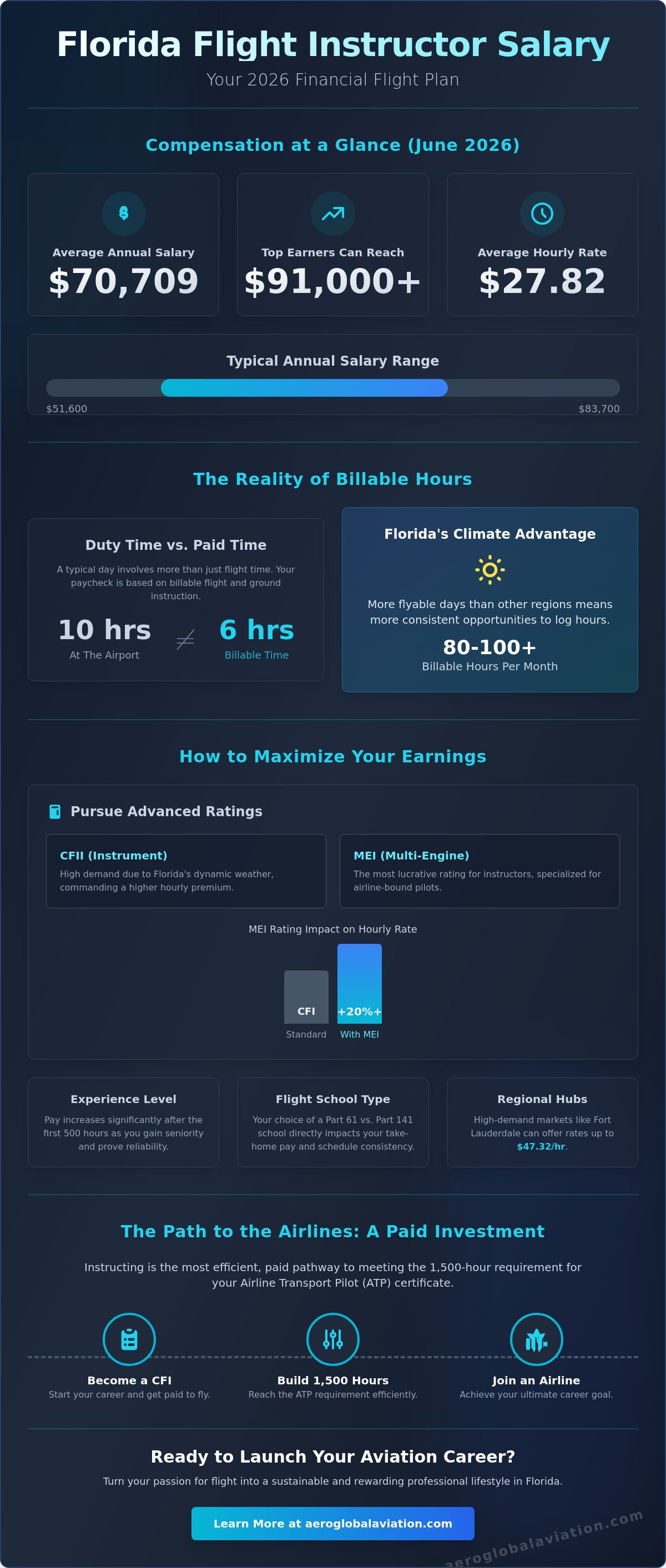
As you look toward the horizon of your aviation career, understanding the financial landscape is the first step in making an informed decision. For many pilots, the question of how much do flight instructors make in Florida is central to their timeline for reaching the airlines. Current data from June 2026 shows that the average annual pay for a Certified Flight Instructor (CFI) in the Sunshine State is $70,709. While this provides a helpful benchmark, the reality is more dynamic than a single number suggests. Most instructors find their earnings fall between $51,600 and $83,700, with top performers in major aviation hubs reaching over $91,000 annually.
Unlike a traditional office job, your income as a CFI is typically tied to billable hours. This means you're earning when you're in the cockpit with the engine running or sitting with a student during ground school. While the statewide average hourly rate is $27.82, rates in high-demand markets like Fort Lauderdale can reach as high as $47.32 per hour. This structure rewards those who are dedicated and available, especially in a state where the weather allows for consistent flight schedules throughout the year.
Entry-Level vs. Experienced CFI Pay
Your first 500 hours of instruction are a period of immense growth. At this entry-level stage, you're building the foundational skills described in the Flight Instructor Role and Requirements. Initially, you might start at the lower end of the pay scale as you gain experience and prove your reliability within a flight school. As you help students reach milestones like their first solo or successful checkride, your value to the academy increases. Experienced instructors who hold advanced ratings, such as CFII (Instrument) or MEI (Multi-Engine), often see a significant jump in their hourly rate. Seniority within a structured flight academy brings more than just a higher paycheck; it often provides first pick of student schedules and more consistent billable opportunities.
The Reality of Billable Hours in Florida
It's vital to distinguish between your duty time and your paid flight time. You might spend ten hours at the airport but only bill six hours of flight and ground instruction. This gap is part of the professional journey, but Florida's climate helps minimize it. Because we enjoy more flyable days than almost any other region, a busy instructor can realistically log 80 to 100 flight hours per month. Don't overlook the value of ground instruction. Pre-flight briefings and post-flight debriefings are essential parts of the learning process that add to your weekly paycheck. When you combine high student volume with Florida’s favorable weather, the billable hour model becomes a high-velocity engine for both your bank account and your flight time logbook.
Factors That Influence Your Earnings as an Instructor
While the statewide averages give you a baseline, your individual choices determine your actual earning velocity. When you evaluate how much do flight instructors make in Florida, you have to look at the specific variables that separate a standard paycheck from a top-tier income. Your earnings aren't just a result of your certificate; they're a reflection of your ratings, your environment, and your ability to leverage the local climate.
Florida is uniquely positioned as a global training hub because of our environment. While instructors in northern states might be grounded by snow or heavy ice for weeks at a time, you'll be logging hours under mostly clear skies. This consistency is the secret sauce for Florida CFIs. More flyable days mean you can consistently reach that 80 to 100-hour monthly sweet spot, turning the weather into a direct financial asset.
Specialized Ratings: CFII and MEI
Adding advanced ratings is like upgrading your professional toolkit. Florida's busy airspace and frequent afternoon thunderstorms mean there is a constant demand for Instrument (CFII) training, which often commands a higher hourly premium. Multi-engine instruction is even more lucrative because the aircraft are more complex and the training is specialized for those heading to the airlines. Adding an MEI rating can increase your hourly earnings by 20% or more compared to a standard single-engine instructor rate. These credentials make you more versatile, allowing you to take on a wider variety of students and fill your schedule more efficiently.
Flight School Type: Structured vs. Independent
Your work environment plays a massive role in your financial stability and long-term success. Independent instructors often spend significant unpaid time "hustling" for students and managing their own marketing or maintenance schedules. In contrast, training at a structured Part 141 academy provides a steady, reliable stream of students and often includes professional benefits like health insurance or 401k options. This stability is a key component of the airline pilot career path, as it allows you to focus entirely on teaching and building your hours. For a broader look at the industry, the Pilot Salary and Job Outlook data confirms that commercial aviation continues to be a high-growth field with robust demand.
High-volume environments ensure you aren't sitting around waiting for a student to show up. When you work at a busy academy, your student load remains consistent, which is vital for both your paycheck and your progression toward the 1,500-hour milestone. If you're ready to maximize your time in the air and your earning potential, you can explore our instructor certification options to see how we help you reach your professional goals faster.
Regional Pay Trends: Orlando, Kissimmee, and Beyond
Location is everything in aviation. Central Florida, particularly the Orlando and Kissimmee corridor, has established itself as a global epicenter for flight training. This density of schools and students creates a unique micro-economy for instructors. When you ask how much do flight instructors make in Florida, you'll find that while coastal cities like Fort Lauderdale offer the highest hourly rates at $47.32, Central Florida often provides a more consistent volume of work. This steady flow of students, many of whom travel internationally for high-quality instruction, ensures that your schedule remains full year-round.
The demand in this region is driven by a massive influx of aspiring pilots seeking the efficiency of Florida's training environment. Because Central Florida serves as a primary hub, you aren't just teaching; you're operating within a high-velocity professional ecosystem. This regional activity directly impacts your earning potential by reducing the "down-time" between students that can plague instructors in less active markets.
Central Florida’s Aviation Hub Advantage
Kissimmee Gateway Airport serves as a prime example of a strategic base for a growing career. It offers an active, professional airspace that prepares you for the complexities of commercial flight while keeping you close to major airline operations at Orlando International (MCO). This proximity is more than just convenient; it's a Strategic Career Investment that puts you in the same zip code as the recruiters you'll eventually want to impress. Living in the Orlando metro area also offers a more manageable cost of living compared to the steep rents of Miami or South Florida, allowing your instructor salary to stretch much further while you build your resume.
Top Paying Florida Cities for CFIs
Understanding where the money flows across the state helps you choose the right home base for your goals. While Orlando and Kissimmee boast impressive annual averages of $83,007 and $83,607 respectively, other cities offer competitive hourly compensation that rewards your expertise. According to current 2026 data, these are the top markets for instructor pay:
- Fort Lauderdale: $47.32 per hour
- Melbourne: $26.74 per hour
- Jacksonville: $24.78 per hour
- Sanford: $24.75 per hour
- Kissimmee: $23.59 per hour
These figures reflect the robust demand for commercial pilot training in these key regions. Secondary markets like Melbourne or Sanford often provide the best "take-home" pay because your earnings aren't immediately swallowed by high urban rent. By choosing a location that balances a strong hourly rate with a reasonable cost of living, you can focus on your students and your own steady progression toward the flight deck.
The Instructor Path: A Strategic Career Investment
It's easy to get caught up in the immediate numbers, but viewing the CFI role strictly through the lens of a starting salary misses the bigger picture. In the aviation industry, your time as an instructor is widely regarded as a "paid internship" for the major airlines. While you are researching how much do flight instructors make in Florida to manage your current expenses, remember that the true value of this position lies in the 1,500 flight hours you'll accumulate. This milestone is the legal requirement for your Airline Transport Pilot (ATP) certificate, and instructing is the most efficient way to reach it without paying for every hour out of your own pocket.
Teaching others to fly forces you to master the fundamentals in a way that solo time never could. You'll develop "Captain Authority" and sharpen your stick-and-rudder skills as you navigate the challenges of a busy training environment. Beyond the technical gains, working at a reputable flight school connects you with a network of professionals and airline recruiters. Many academies have established flow-through agreements or interview preferences with regional carriers, making your time on the flight line a direct bridge to a jet cockpit.
Building 1,500 Hours: Time is Money
When you evaluate your career path, consider the opportunity cost of slow hour-building. A pilot struggling to find hours in a less active state might take three or four years to reach airline minimums. In contrast, Florida's high student volume and consistent weather allow dedicated instructors to hit the 1,500-hour mark in just 12 to 18 months. This speed is a massive financial advantage, as it puts you into a high-paying airline seat years sooner. Investing in advanced flight training to earn your instructor ratings is the catalyst that accelerates this entire process, turning a year of hard work into a lifetime of professional earnings.
Soft Skills and Airline Readiness
Airlines don't just hire pilots who can fly; they hire leaders who can manage a crew. As an instructor, you're constantly practicing Crew Resource Management (CRM) and learning how to communicate complex information clearly under pressure. You'll gain experience in decision-making and risk mitigation that low-time pilots in other sectors simply don't encounter. By managing the cockpit and making split-second decisions for a student, the CFI role serves as the ultimate preparation for a Part 121 airline checkride. If you're ready to start this transformative journey, you can apply for our Airline Pilot Elite program and begin building your future today.
Launch Your Career with Aero Global Aviation Academy
Choosing where you train is the single most important decision you'll make for your financial future. While we've explored how much do flight instructors make in Florida, those top-tier salaries are rarely handed out by chance. High-earning instructors are built through rigorous, professional standards that mirror the airline environment from day one. At Aero Global Aviation Academy, we don't just teach you how to fly; we prepare you to lead, ensuring you enter the workforce with the technical proficiency and instructional polish that premium flight schools demand.
Our training philosophy focuses on creating "turn-key" professionals. When you graduate from our programs, you aren't just a pilot with a certificate; you're an educator who understands the high-stakes nature of commercial aviation. This distinction is vital because it positions you to secure roles at high-volume academies that offer the best compensation packages and the most stable student pipelines in the state.
The Airline Pilot Elite Track
Our Airline Pilot Elite program is specifically engineered for those who view flight training as a mission rather than a hobby. This structured path takes you from your first solo to advanced instructor certification with a focus on efficiency and excellence. By bundling Private Pilot, Commercial Pilot, and Instructor ratings into one cohesive journey, you eliminate the gaps in training that often slow down career progression. You can explore the details of our career pilot program to see how we've streamlined the route from the classroom to the cockpit.
Graduates of this track often find themselves at the front of the line for the most competitive CFI positions in Florida. Because our training emphasizes the same procedures and safety cultures found at the major airlines, you become a valuable asset for any training center. This preparation is why our alumni are consistently positioned to earn the higher-end hourly rates we discussed earlier, often securing roles that offer professional benefits and consistent flight hours.
Why Train and Work in Kissimmee?
Training at Kissimmee Gateway Airport places you at the heart of Florida’s aviation infrastructure. You'll operate in a professional airspace that demands precision, preparing you for the reality of airline life while you build your instructional hours. The proximity to Orlando’s world-class aviation hubs provides a constant reminder of your ultimate destination and offers networking opportunities that aren't available in more isolated regions. This environment ensures that your time spent as an instructor is as productive as possible.
We pride ourselves on being more than just a school; we're a dedicated local partner invested in your individual success. Our instructors aren't just building time; they're providing personalized attention to ensure every student reaches their professional milestones. This collaborative spirit creates a supportive environment where you can grow as a pilot and a professional. If you're ready to stop dreaming and start flying, contact us today to speak with a mentor and take the first step toward your professional pilot career.
Take Command of Your Aviation Future
Determining how much do flight instructors make in Florida is just the first step in mapping out your long-term success. You've seen that while hourly rates vary by region, the true value of the CFI role lies in its power to accelerate your career. By leveraging Florida's consistent sunshine and choosing high-volume hubs like Kissimmee, you can reach the 1,500-hour milestone with speed and precision. This path isn't just about a paycheck; it's about refining your skills and building the leadership necessary for a major airline flight deck.
At Aero Global Aviation Academy, we provide the expert mentorship and professional training environment you need at Kissimmee Gateway Airport. Our structured PPL to CFI curriculum ensures you don't waste time on your journey to the airlines, while our industry veterans guide you through every challenge. If you're ready to transform your passion into a professional reality, Apply for the Airline Pilot Elite Program and Start Your Career Today. The sky is waiting for you, and we're here to help you reach your destination with confidence.
Frequently Asked Questions
Is being a flight instructor in Florida a full-time job?
Yes, instructing is a full-time career for those aiming for the airlines. At busy schools, you'll manage a full roster of students, often spending 40 to 50 hours a week at the airfield. This commitment is what allows you to reach the 1,500-hour mark quickly. While some independent instructors work part-time, those in professional academies treat it as a standard, high-stakes job with a consistent schedule.
How many hours a day does a flight instructor actually fly in Florida?
A busy instructor in Florida typically logs between four and six flight hours per day. While you might be at the airport for eight or ten hours, your "engine-on" time is what builds your logbook fastest. Florida's clear skies allow for this high frequency, which is why instructors here often accumulate 80 to 100 hours a month. This pace is essential for anyone tracking their progress toward a commercial jet cockpit.
Do flight instructors get paid for ground school and pre-flight briefings?
Yes, professional flight instructors bill for ground instruction, pre-flight briefings, and post-flight debriefings. These sessions are critical for student success and ensure you're compensated for your expertise outside the cockpit. When calculating how much do flight instructors make in Florida, it's vital to include these ground hours in your earning projections. Ground school typically accounts for about 20% to 30% of an instructor's total billable time each week.
Can I live comfortably on a flight instructor's salary in Orlando?
Living comfortably in Orlando is attainable given the city's average instructor salary of $83,007 as of June 2026. While the cost of living in Central Florida has risen, it remains more affordable than coastal hubs like Miami or Fort Lauderdale. By managing your budget and taking advantage of high student volume at local airports, you can maintain a stable lifestyle while focused on your professional advancement.
What is the difference in pay between a CFI, CFII, and MEI?
Advanced ratings significantly boost your earning potential by allowing you to teach complex subjects. A standard CFI focuses on primary training, while a CFII (Instrument) often commands a higher hourly premium for specialized weather-flying instruction. Multi-Engine Instructors (MEI) typically see the largest jump, often earning 20% or more above base rates. These certifications make you more versatile and ensure your schedule stays full with diverse training missions.
Do flight schools in Florida offer benefits like health insurance?
Many large, structured Part 141 flight academies in Florida offer benefits like health insurance and 401k plans. This is a major advantage of working for an established school rather than as an independent contractor. While smaller operations might offer higher hourly "cash" rates, the total compensation package at a professional academy provides the long-term security you'll need as you build your hours for the airlines.
How long does it take to go from a student pilot to a paid instructor?
You can go from a student pilot to a paid instructor in approximately 10 to 14 months through an accelerated program. This timeline requires a full-time commitment to your training and checkrides. Once you earn your CFI certificate, you can immediately begin earning a paycheck. This rapid transition is one of the biggest draws for those asking how much do flight instructors make in Florida as they plan their career timeline.
What happens to my pay if the weather is bad and I can't fly?
Your income can fluctuate during periods of poor weather if you're paid strictly by the flight hour. However, Florida’s climate is exceptionally reliable, minimizing the "no-fly" days that instructors face in other regions. When storms do occur, you can often pivot to ground school or simulator sessions to maintain your earnings. This flexibility ensures that bad weather rarely causes a significant dent in your monthly take-home pay.


