Ground school isn't a classroom hurdle; it's the strategic blueprint for every safe decision you'll ever make in the cockpit. You might feel overwhelmed by dense FAA manuals or worried about passing the written exam before you've even touched the controls. It's natural to feel uncertainty about your timeline when you're staring at a mountain of technical data. We're here to help you turn that complexity into a clear path forward through your private pilot ground school training.
This guide will show you exactly what to expect and how to build a rock-solid foundation for your aviation career. You'll gain a clear understanding of the PPL syllabus and the confidence to master the FAA knowledge test using the current ACS-6C standards. We'll provide a roadmap to becoming a licensed pilot, covering everything from the $175 knowledge test fee to the milestones required for certification. Whether you're aiming for our Wings Foundation course or the full Career Pilot Program, you'll find the clarity and motivation you need to start your journey today.
Key Takeaways
- Understand why ground school serves as your strategic foundation for safe flight and professional decision-making in the cockpit.
- Explore the core syllabus topics, including aerodynamics and aircraft systems, that transform technical manuals into practical aeronautical knowledge.
- Compare the benefits of online, in-person, and integrated training formats to determine which private pilot ground school path fits your lifestyle and goals.
- Master the specific steps required to earn your instructor endorsement and approach the FAA knowledge test with total confidence.
- Discover how the Wings Foundation program creates a seamless transition from classroom theory to your first solo flight at our Kissimmee base.
What is Private Pilot Ground School and Why is it Essential?
Before you ever pull back on the yoke for your first takeoff, your journey as a pilot begins on solid ground. Understanding What is Private Pilot Ground School is the first step in your transformation. Simply put, it's the formal education that covers the theoretical knowledge required for a Private Pilot License (PPL). This training serves as the mandatory foundation for the "Aeronautical Knowledge" requirements under FAA Part 61 or Part 141. It's where you learn the language of the skies, the mechanics of flight, and the regulations that keep the National Airspace System safe.
Many students make the mistake of treating their private pilot ground school as a simple hurdle to clear before "real" training begins. In reality, ground school bridges the gap between technical manuals and real-world cockpit decision-making. By starting your studies early, you'll find that your actual flight hours become much more efficient. You won't spend expensive time in the aircraft learning what a stall is; instead, you'll be in the air practicing how to recover from one because you already mastered the physics on the ground.
The Legal Requirement vs. The Safety Standard
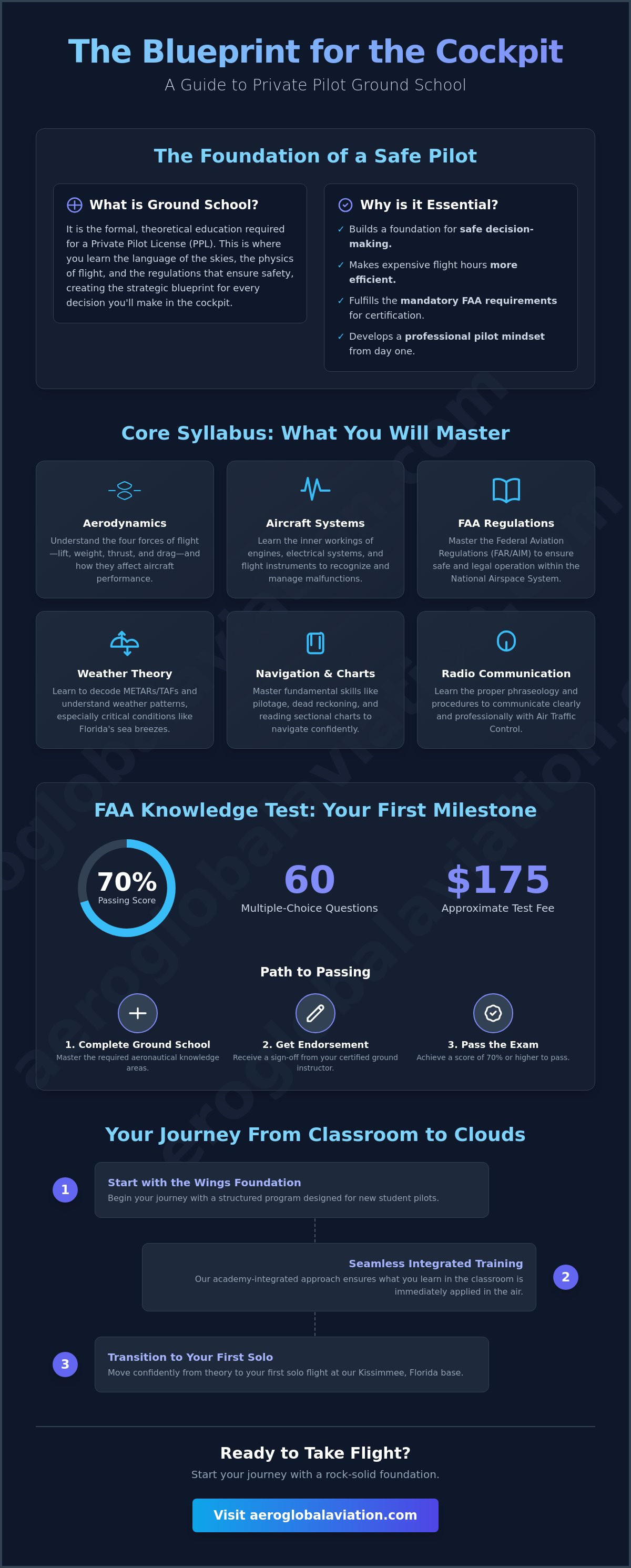
The FAA requires every private pilot candidate to pass a 60-question Knowledge Test with a score of 70% or higher. However, a safe pilot knows that "knowing the why" behind a rule is more important than just memorizing an answer for a test. For example, understanding weather theory helps you predict a dangerous front before you're trapped by it. Your ground instructor plays a critical role here, as they must provide a signed endorsement confirming you've completed a structured private pilot ground school and are prepared for the official FAA exam. This endorsement isn't just a signature; it's a professional guarantee of your readiness.
Ground School as the First Step to the Flight Deck
Whether you're starting with our Wings Foundation course or aiming for the full Career Pilot Program, the knowledge you gain today supports every future rating you'll earn. Foundational concepts like navigation and radio communication stay with you through Commercial and Instructor certifications. This period marks your emotional transition from an aviation enthusiast to a disciplined student pilot. You'll learn to approach flight with a professional mindset, treating every lesson as a building block for your future career. Ground school is the intellectual framework for flight safety.
The Private Pilot Ground School Syllabus: What You Will Learn
Stepping into your first classroom session is where the magic of flight meets the rigor of science. The Private Pilot Ground School Syllabus is a comprehensive curriculum designed to transform you from a passenger into a pilot in command. You'll move beyond simple curiosity to master the four forces of flight: lift, weight, thrust, and drag. Understanding how these interact with your aircraft allows you to predict how the plane will behave in every phase of flight, from a steep turn to a soft-field takeoff.
Your technical training also includes a deep dive into aircraft systems. You'll study the inner workings of reciprocating engines, electrical systems, and the flight instruments that provide critical data in the cockpit. This knowledge is vital for safety; it's how you'll recognize the subtle signs of a system malfunction before it ever becomes an emergency. We also cover the FAA regulations found in the FAR/AIM, ensuring you remain compliant and safe within the complex legal framework of United States aviation.
Navigation is another cornerstone of your private pilot ground school experience. While modern cockpits feature advanced GPS technology, we prioritize the fundamentals of dead reckoning and pilotage. You'll learn to read sectional charts, identify landmarks from the air, and calculate wind correction angles using a flight computer. This ensures you can always find your way home, even if your digital screens go dark. If you're ready to start building these skills, our Wings Foundation course offers the perfect entry point for new students.
Weather Theory and Florida Flight Conditions
Mastering weather theory is perhaps the most critical skill for any pilot flying in Central Florida. You'll learn to decode METARs and TAFs, but we go deeper by discussing the specific convective activity and sea breeze fronts that define the Kissimmee climate. Understanding how intense heat and moisture create rapid thunderstorms allows you to make safe go/no-go decisions. In our private pilot ground school, we emphasize that a pilot's best tool isn't just the engine; it's their ability to respect and predict the atmosphere.
Airspace and Communication
Navigating the "wedding cake" of controlled airspace requires precision and confidence. You'll learn to distinguish between Class A through E airspace and understand the specific entry requirements for each. Because we operate near the busy Orlando terminal area, proper radio etiquette and clear communication with Air Traffic Control (ATC) are essential. We'll guide you through the process of talking to controllers, ensuring you feel like a professional every time you key the mic in a high-traffic environment.
Online vs. In-Person vs. Academy-Integrated Ground School
Choosing how you complete your private pilot ground school is one of the most consequential decisions you'll make in your early training. Online courses offer undeniable flexibility for those balancing work or school, allowing you to study at your own pace. However, this path requires immense self-discipline to stay on track. Traditional in-person classrooms provide a structured schedule and immediate feedback, but they often lack the direct connection to what you're actually doing in the cockpit during your flight lessons.
Our academy-integrated approach at Aero Global Aviation Academy solves this disconnect by syncing your ground lessons directly with your flight syllabus. When you study weight and balance in the classroom, you're calculating it for a real aircraft that same afternoon. This creates a cohesive learning experience where theory and practice reinforce one another constantly. You can find many helpful FAA Pilot Training Resources to supplement your learning, but nothing replaces the synergy of a professional flight school environment. This integrated method ensures that every hour spent studying translates directly into better performance in the air.
The Pros and Cons of Self-Study
Self-study might seem like a convenient route, but many students find it difficult to maintain momentum when they hit complex topics like meteorology or electrical systems. Without a mentor to guide you, it's easy to skim over difficult sections. This often leads to "knowledge gaps" that only surface during a stressful checkride or, worse, an actual flight emergency. If you're curious about how ground study fits into the broader requirements for certification, check out our guide on private pilot license florida to see the full roadmap. Choosing a structured path helps ensure you don't just pass the test, but truly master the material.
Why a Professional Academy Environment Wins
Immersing yourself in a professional academy environment provides benefits that a computer screen simply can't replicate. The value of "hangar talk" is immense. Listening to senior students discuss their cross-country flights or hearing an instructor explain a recent weather event in Kissimmee provides context that makes theory come alive. You'll have direct access to experts who can clarify complex aerodynamic concepts in real-time. This isn't just about passing a test; it's about building a professional network from day one. Whether you're enrolled in our Wings Foundation or the Career Pilot Program, you're part of a supportive community that's as passionate about your success as you are.
Mastering the FAA Private Pilot Knowledge Test
Conquering the FAA written exam is a major milestone that proves you've absorbed the essential theory from your private pilot ground school. This 60-question test is more than just a box to check; it's a validation of your technical readiness. To navigate this process successfully, you should follow a structured four-step approach. First, you must complete your ground training to earn a signed endorsement from an authorized instructor. This endorsement is your legal ticket to sit for the exam. Next, use practice exams to pinpoint exactly where your aeronautical knowledge needs sharpening. Once you're consistently scoring in the 90s, it's time to schedule your appointment at an FAA-approved testing center, which typically carries a fee of approximately $175. Finally, after you pass, you'll review any missed questions with your Certified Flight Instructor (CFI) to ensure you're fully prepared for the oral portion of your practical checkride.
Study Strategies for Success
We recommend the "Three-Pass" method to manage your time effectively during the exam. On your first pass, answer only the questions you know immediately. This builds momentum and secures easy points. On the second pass, tackle questions that require the use of your E6B flight computer or sectional charts. Save the most complex or confusing questions for a final third pass. Throughout your preparation, keep the Airman Certification Standards (ACS) by your side. Specifically, ensure you're using version FAA-S-ACS-6C, which became effective on May 31, 2024. This document is the ultimate study guide because it outlines exactly what the FAA expects you to know. Remember, while the written test is a significant achievement, it's ultimately the gateway to the oral exam where you'll demonstrate your expertise to a DPE.
Managing Test Anxiety
Feeling a bit of pressure is normal, but being organized can calm those nerves. Make sure your flight bag is packed with your ID, a mechanical E6B or electronic flight computer, and a plotter. You're allowed to use these tools to solve navigation and performance problems. When you finish, you'll receive an Airman Knowledge Test Report (AKTR). This document contains learning statement codes for any questions you missed. These codes tell your instructor exactly which topics need more attention before you head to your checkride. Mastering these technical details brings you one step closer to the thrill of your first solo flight. If you're ready to start your journey with expert guidance, explore our professional pilot training programs today.
Starting Your Aviation Journey at Aero Global Aviation Academy
Choosing where to begin your flight training is just as important as the decision to fly itself. At Aero Global Aviation Academy, we've designed the Wings Foundation to be the definitive starting point for aspiring aviators. This program isn't just a collection of lessons; it's a dedicated path specifically tailored for Private Pilot candidates who want to master the skies with precision. Our private pilot ground school in Kissimmee is physically integrated with our operations, meaning you'll see our modern fleet on the ramp every time you walk into the classroom. This proximity creates a high-energy environment where the theory you study in the morning is visible in every takeoff and landing you witness throughout the day.
One of our greatest strategic assets is our location in Central Florida. Training here allows you to take advantage of year-round flying weather, which is essential for maintaining momentum in your training. While students in other regions might be grounded by snow or ice, you'll be consistent in your progress. This efficiency is a core part of why our students succeed. If your goals extend beyond a personal license, our private pilot ground school serves as the launchpad for the Career Pilot Program. We've structured our curriculum so that the transition from a beginner to a professional commercial pilot is a logical, attainable, and rewarding process.
Mentorship Beyond the Classroom
We pride ourselves on being practical mentors rather than a large, impersonal corporation. Our instructors don't just teach from a manual; they share real-world experiences that prepare you for the complexities of the flight deck. This personalized attention ensures you don't just pass your exams, but actually excel as a confident pilot. We believe in total transparency regarding your investment, which is why we encourage you to review our private pilot license Orlando cost breakdown. Understanding the financial roadmap early on allows you to focus entirely on your training and professional development.
Your Next Steps to the Cockpit
Enrolling in the Wings Foundation is a straightforward process designed to get you into the classroom and the cockpit without delay. During your first week at Aero Global, you'll meet your cohort of fellow students, receive your training materials, and begin your deep dive into aerodynamics and FAA regulations. You'll quickly see how our collaborative spirit makes a complex professional world feel within your reach. Don't let your dreams stay on the ground. Schedule a visit to our Kissimmee academy to see our ground school in action!
Your Journey to the Flight Deck Starts Today
Your transition from an aviation enthusiast to a licensed pilot depends on the strength of your foundational knowledge. Mastering private pilot ground school isn't just about checking off a regulatory box; it's about developing the professional judgment required to navigate real-world flight conditions with confidence. By integrating classroom theory with active flight training, you turn complex aerodynamics and navigation into practical skills that keep you safe in the air.
At Aero Global Aviation Academy, we offer professional mentorship from active industry pilots who are deeply invested in your individual success. Our campus at Kissimmee Gateway Airport (KISM) provides prime training access and a vibrant community of fellow aviators. With both structured Part 61 and Part 141 training options available, we provide the flexibility and excellence you need to reach your goals.
Start your aviation journey with the Wings Foundation at Aero Global and transform your passion for flight into a reality. The sky is waiting for you.
Frequently Asked Questions
How long does private pilot ground school typically take to complete?
Most students complete their private pilot ground school in four to eight weeks. This timeline depends heavily on your study frequency and whether you're enrolled in a structured academy program or self-studying. If you dedicate a few hours each week, you'll stay on track to meet the aeronautical knowledge requirements efficiently. Maintaining a steady pace ensures you retain complex information like weather theory and navigation before transitioning into more intensive flight training phases.
Do I have to finish ground school before I can start flying?
You don't need to finish ground school before you start flying. Many students find that flying while studying helps the theoretical concepts click faster. However, you must pass your written exam and receive an endorsement before you can solo or take your final checkride. We recommend staying ahead of your flight lessons with your ground studies to maximize your time in the cockpit and reduce the total number of flight hours needed for certification.
What is the passing score for the FAA Private Pilot Knowledge Test?
The minimum passing score for the FAA Private Pilot Knowledge Test is 70%. While this is the legal requirement, we encourage our students to aim for 90% or higher. A higher score demonstrates a deeper mastery of the material and often leads to a smoother oral exam during your practical checkride. Examiners use your written results to identify areas for deeper questioning, so a strong performance on the test builds immediate professional credibility.
Can I take the FAA written exam without an instructor endorsement?
You cannot take the official FAA written exam without a signed endorsement from an authorized instructor. This endorsement proves that you've completed a home-study course or a formal ground school and are prepared for the test. Whether you're using an online platform or attending our academy in Kissimmee, your instructor will review your practice test scores before providing the necessary sign-off. This process ensures you're set up for success and meet all legal requirements.
What materials do I need to buy for private pilot ground school?
Essential materials include a current copy of the FAR/AIM, the Pilot’s Handbook of Aeronautical Knowledge (PHAK), and an E6B flight computer. You'll also need a plotter and sectional charts for the Orlando area to practice manual navigation. Many students also invest in a quality headset and a flight bag to organize their gear. Having these tools early allows you to become proficient with manual calculations before you rely on digital systems in the aircraft.
How much does private pilot ground school cost on average?
On average, online ground school courses range from $200 to $500, while in-person classroom instruction typically costs between $500 and $1,000. These figures generally cover the curriculum and study materials but don't include the FAA knowledge test fee, which is approximately $175. While costs vary, investing in a high-quality program ensures you build a safe foundation. Check with your local flight school for specific enrollment details and any additional supply requirements.
Is the private pilot ground school valid for my entire life?
While the knowledge you gain lasts a lifetime, your FAA knowledge test results are valid for 24 calendar months. You must complete your practical checkride within this window, or you'll need to retake the written exam. This requirement encourages students to maintain momentum and complete their training while the theoretical information is still fresh. If you experience a delay, refreshing your studies ensures your skills remain sharp and compliant with current FAA standards.
How difficult is the FAA private pilot written exam compared to other tests?
The FAA written exam is challenging because it requires practical application rather than just rote memorization. You'll need to solve navigation problems, interpret weather charts, and apply regulations to specific flight scenarios. However, students who follow a structured private pilot ground school syllabus and use practice exams usually find the test very manageable. With the right mentorship and consistent study habits, you can approach the testing center with complete confidence in your success.


