Over 370,000 active student pilots are currently chasing the dream of flight in the United States, yet many feel grounded by the complex choices facing them. You might feel a mix of excitement and hesitation as you look at the differences between Part 61 and Part 141 programs or worry about the technical depth required. It's common to feel uncertain about the time commitment when the national average for completion sits between 60 and 75 hours. We understand that starting your PPL training is about more than just learning to fly; it's about building the professional habits that will define your entire career.
This guide provides the clarity you need to move forward with absolute confidence. You'll gain a clear roadmap from your initial third-class medical certificate to your first solo flight and eventually your checkride. We'll preview the essential steps of a professional training framework, helping you see how a Private Pilot License serves as the critical first milestone in a long-term aviation journey. By the end of this article, you'll know exactly how to evaluate modern flight schools and structure your training for maximum efficiency and skill.
Key Takeaways
- Understand why professional PPL training serves as the critical architectural foundation where your future career habits are formed.
- Evaluate the differences between Part 61 and Part 141 frameworks to determine which curriculum structure best aligns with your professional aspirations.
- Learn how to manage the three core pillars of ground school, flight maneuvers, and practical exams to ensure a smooth path to certification.
- Discover how a consistent schedule of three to four flights per week can optimize your learning and significantly reduce your total investment.
- See how starting with the Wings Foundation course provides a seamless transition into advanced career pilot programs for those aiming for the airlines.
What is PPL Training? Understanding the Private Pilot Foundation
PPL training is the definitive starting point for anyone who dreams of commanding the skies. It serves as the primary certification that allows you to act as pilot in command of single-engine aircraft. While some see it as a hobbyist's permit, professional schools treat it as the bedrock of an aviation career. The FAA maintains what many consider the gold standard for aviation safety, ensuring that every pilot who earns a Private Pilot Licence (PPL) meets rigorous practical and theoretical benchmarks. You aren't just learning to steer a plane; you're mastering the laws of aerodynamics, weather patterns, and complex navigation systems.
If you're aiming for a seat on a commercial flight deck, you must realize that this is your mandatory first step. There are no shortcuts to the airlines that bypass this foundational phase. While recreational flyers might focus on the simple thrill of a weekend trip, your PPL training should focus on precision and professional standards from day one. You're learning to operate a complex machine within a highly regulated global system. This distinction between "learning to fly" and "training for a career" is what separates successful professional pilots from the rest of the field.
The Scope of Your Private Pilot Privileges
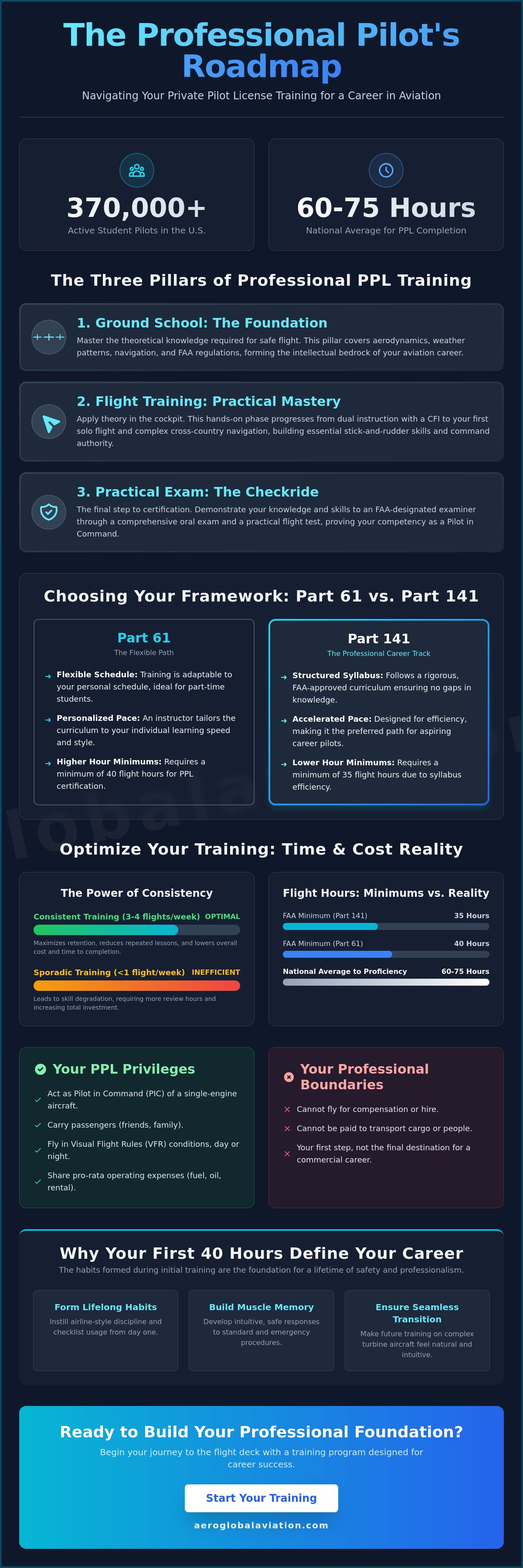
Earning your certificate unlocks a world of possibilities and responsibilities. You'll have the authority to fly in Visual Flight Rules (VFR) conditions, which means you can navigate during the day or night as long as the weather remains clear and you can see the horizon. One of the most rewarding aspects is the ability to carry passengers. You can take friends or family on cross-country trips and even share the pro-rata expenses of the flight, such as fuel and rental fees.
However, it's vital to understand the professional boundaries of this specific certificate. At this stage, you cannot fly for compensation or hire. This means you can't be paid to transport cargo or people. This certification is about building your command skills and gaining the experience necessary to move toward more advanced ratings. It's a period of growth where you prove you can safely manage an aircraft before the industry trusts you with commercial responsibilities.
Why Your First 40 Hours Define Your Career
The habits you form during your initial hours in the cockpit will stay with you for a lifetime. This is why choosing a professional environment for your training matters so much. A dedicated mentor will instill airline-style checklists and standardized procedures from your very first lesson. This disciplined approach ensures that when you eventually move into complex turbine aircraft, the transition feels natural rather than overwhelming. You're building muscle memory for safety and efficiency that will protect you and your future passengers.
Success in these early stages requires a clear plan and a structured environment. If you want to see exactly how these milestones look in practice, our private pilot license florida guide breaks down the FAA requirements into a manageable, step-by-step sequence. By treating every hour as a professional commitment, you're doing more than just passing a test; you're building a foundation for a long-term career in the cockpit.
The Core Components of a Professional PPL Syllabus
A professional PPL training syllabus is a structured progression designed to transform a beginner into a competent pilot command. It isn't just about logging hours; it's about mastering three distinct pillars: ground school, flight training, and the practical exam. Each phase builds upon the last, ensuring you meet the strict FAA eligibility requirements while developing the professional judgment required for safe flight operations.
Your journey begins with dual instruction, where a certified instructor sits beside you to teach the mechanics of flight. You'll learn essential maneuvers and, perhaps more importantly, how to respond to emergency procedures with calm precision. Once you've demonstrated consistent control, you'll move into the solo phase. This is a transformative milestone where you become the sole occupant of the aircraft, proving you can handle the responsibility of flight without a mentor by your side. Finally, the cross-country phase expands your horizons, teaching you to navigate to distant airports and manage complex airspace.
Mastering the Fundamentals in Ground School
Ground school provides the theoretical framework for everything you do in the cockpit. You'll dive deep into subjects like aerodynamics, weather theory, and FAA regulations to understand why the airplane behaves the way it does. This knowledge is vital for passing the FAA written knowledge test, which is a significant hurdle on your way to certification. If you're looking for strategies to manage the heavy technical load, our guide on private pilot ground school offers essential study tips for the 2026 curriculum.
Flight Proficiency and Maneuvers
In the air, you'll focus on developing "stick and rudder" skills through specific maneuvers. You'll practice steep turns to understand load factors, stalls to recognize the limits of lift, and slow flight to master low-speed handling. Much of your early training focuses on the "takeoff and landing" phase, which is the most demanding part of any flight. Mastering these patterns is your direct path to your first solo flight, an experience you'll never forget.
Modern PPL training often utilizes glass cockpit technology, featuring digital displays that mirror what you'll find in professional airliners. Learning on these systems early gives you a significant advantage if you're aiming for a career in the industry. To ensure you're getting the most out of every hour in the air, it's helpful to train in a professional training environment that prioritizes modern equipment and structured syllabi. This disciplined approach ensures that your transition from a student to a licensed pilot is both efficient and rewarding.
Part 61 vs. Part 141: Choosing the Right Training Framework
Deciding between Part 61 and Part 141 is one of the most significant choices you'll make in your early aviation journey. While both paths lead to the same certificate, the experience and professional preparation differ greatly. Part 61 is often characterized by its flexibility. It allows you to train at your own pace with any certified instructor, making it a popular choice for hobbyists or those with unpredictable schedules. You must still meet the FAA Part 61 PPL Requirements, which include a minimum of 40 flight hours. Many find this path approachable because it adapts to their lifestyle.
In contrast, Part 141 programs utilize a highly structured, FAA-approved curriculum. This framework is specifically designed for students who view PPL training as the first step toward a commercial career. Because of this rigid structure, the FAA allows for a lower minimum of 35 flight hours, though most students still require more time to reach proficiency. Airlines frequently prefer candidates who come from these structured environments. They know these pilots have a history of following standardized procedures and disciplined training schedules from the very beginning of their journey.
When to Choose a Structured Academy Environment
For those aiming for the flight deck of a major airline, a structured academy environment is almost always the superior choice. You'll benefit from a set schedule and a dedicated training fleet. This ensures you don't lose momentum due to aircraft or instructor unavailability. This environment mimics the operational reality of professional airlines, where adherence to a syllabus and standardized checklists is mandatory. At Aero Global, we enhance this structure with our "Practical Mentor" approach. We don't treat you like a number in a large corporation. Instead, we provide the personalized attention you need to master complex skills while maintaining professional standards.
Evaluating Flight School Infrastructure
The quality of your training depends heavily on the school's infrastructure. When evaluating potential schools, look closely at their maintenance standards and the average age of their aircraft. A school with modern equipment and high instructor availability will prevent the delays that often frustrate student pilots. Geography also plays a strategic role in your development. Training at a busy airport like Kissimmee Gateway provides invaluable experience with Air Traffic Control (ATC) in a high-traffic environment. This skill is essential for any professional pilot. To help you make an informed decision, we've developed a best flight schools in florida evaluation checklist to guide your search for the right partner.
Managing Time and Cost: The Reality of PPL Training
The financial and time commitment required for flight school is often the primary concern for prospective pilots. While the investment is significant, understanding the variables that drive these costs allows you to manage your budget effectively. One of the most effective ways to control your total spend is through the frequency of your flights. We recommend a schedule of three to four flights per week. This consistency keeps your skills sharp and prevents the "one step forward, two steps back" syndrome that occurs when long gaps between lessons require expensive retraining hours. By staying in the cockpit regularly, you move through the syllabus with momentum and minimize the total hours needed to reach proficiency.
Our geographic location provides a distinct strategic advantage known as the "Florida Advantage." With over 300 days of sunshine each year, you'll face far fewer weather cancellations than students in other regions. In many parts of the country, a week of bad weather can stall your progress and force you to spend extra time reviewing maneuvers you've already learned. Here, the consistent climate ensures your training remains on track, allowing you to maximize every dollar spent on aircraft and instruction. It's also vital to have your funds secured before you begin. Starting and then stopping due to financial gaps is the quickest way to inflate your total training cost.
Factors Influencing Your Total Training Investment
Your total investment is a combination of aircraft rental rates, instructor fees, and fixed costs like the FAA written knowledge test, which typically ranges from $175 to $200. You'll also need to budget for a third-class medical certificate, which generally costs between $100 and $300, and the final checkride fee, which can range from $600 to $1,000 depending on the examiner. Beyond these fees, your own aptitude and preparation play a massive role. Students who arrive for every lesson having already studied the material often complete their PPL training closer to the FAA minimums rather than the national average of 60 to 75 hours. For a detailed 2026 price breakdown, you can review our guide on private pilot license Orlando cost.
Accelerated vs. Traditional PPL Timelines
You have two primary paths when it comes to your timeline. An intensive, accelerated path can see you earn your certificate in approximately three months, while a more casual, traditional path may take six to 12 months. While the speed of an accelerated program is attractive, it comes with a high cognitive load. Some students find it feels like "drinking from a firehose," which can lead to burnout if not managed correctly. At Aero Global, we balance speed with deep technical mastery. We ensure you're moving quickly enough to retain information without sacrificing the professional habits that will serve you throughout your career. If you're ready to start your journey with a partner that prioritizes your success, we invite you to explore our professional pilot training programs today.
Aero Global Aviation Academy: Your Professional PPL Destination
Choosing where to conduct your PPL training is the most critical decision of your early career. At Aero Global Aviation Academy, we don't just provide lessons; we offer a professional mentorship designed to launch you toward the flight deck. Our Wings Foundation course is specifically built for those who demand excellence from day one. It focuses on creating the technical proficiency and safety mindset required for high-stakes aviation environments. We treat every student as a future colleague, ensuring the foundation you build today is strong enough to support a lifetime in the skies.
Our location at Kissimmee Gateway Airport serves as a strategic asset for your development. Training in the heart of the Orlando region means you'll gain consistent experience with Air Traffic Control and complex airspace operations from your very first hour. These are the exact environments you'll navigate as a professional pilot. Once you've mastered the fundamentals through our Wings Foundation, you'll have a clear, seamless transition path into our career pilot program. This progression ensures that your momentum never slows as you move from your private certificate toward commercial ratings and beyond.
The Wings Foundation: Built for Excellence
The Wings Foundation provides more than just flight hours. You'll benefit from personalized attention and a modern training fleet equipped with the latest glass cockpit technology. We integrate the "Airline Pilot Elite" mindset into every lesson, ensuring your foundational habits align with the standards of major carriers. You'll join a supportive network of instructors and fellow career-track students who share your passion and drive. This collaborative spirit transforms the technical challenge of flight school into a rewarding, shared journey where everyone is invested in your individual success.
Next Steps: From Discovery Flight to Solo
Taking the first step is simpler than you might think. Our enrollment process for 2026 is designed to be accessible and transparent, helping you move from zero hours to your first solo flight with absolute confidence. During a typical first lesson at our academy, you'll meet your dedicated instructor, tour our maintenance facilities, and get hands-on experience in the cockpit. You'll see firsthand how we balance technical rigor with a welcoming, student-centric atmosphere. There's no better way to understand the professional environment we've built than to experience it yourself. Start your aviation journey with a Discovery Flight at Aero Global Aviation Academy. We're ready to help you turn your aspirations into a tangible professional destination.
Take the First Step Toward Your Captain's Seat
Your journey into the clouds begins with a single, decisive step. You now understand that successful PPL training is built on a foundation of disciplined habits, a structured curriculum, and the strategic advantage of a favorable training climate. Whether you choose the flexibility of Part 61 or the career-focused rigor of an FAA Part 141 certified program, your commitment to consistency will determine your pace of progress. By mastering the fundamentals in a modern glass cockpit training fleet, you're doing more than just earning a license; you're preparing for the professional standards of the global airline industry.
At Aero Global Aviation Academy, we combine these essential elements with over 300 days of flying weather in Kissimmee, Orlando, to ensure your momentum never stalls. We invite you to join a community of dedicated aviators who are equally invested in your individual success. Don't let your aspirations wait any longer. Begin Your Professional Pilot Journey with the Wings Foundation and experience the difference that expert mentorship makes. The sky isn't just a destination; it's your future office. We're ready to help you take command.
Frequently Asked Questions
How long does PPL training typically take?
Most students complete their certificate in three to twelve months depending on their flight frequency and local weather conditions. Flying three to four times per week is the most efficient path to mastery because it keeps your skills sharp and reduces the need for costly review sessions. While the FAA minimums are lower, the national average for students to reach proficiency in PPL training is between 60 and 75 hours of flight time.
What are the medical requirements for a Private Pilot License?
You must obtain at least a third-class medical certificate from an FAA-authorized Aviation Medical Examiner (AME) before you can fly solo. This physical exam checks your vision, hearing, and general health to ensure you meet the safety standards required for flight operations. We recommend securing your medical certificate early in your journey to confirm your eligibility before you begin your formal flight lessons.
Can I start PPL training if I want to become an airline pilot?
Yes, earning your private pilot certificate is the mandatory foundational step for any commercial aviation career. Our Wings Foundation course is specifically designed to transition you into more advanced ratings like those found in our Career Pilot Program. Starting with a professional mindset during your initial training ensures you develop the disciplined habits and precision required by major airlines from your very first hour.
What is the minimum age to begin PPL training?
You can begin taking flight lessons at any age, but the FAA requires you to be at least 16 years old to operate an aircraft solo. To be eligible for the actual Private Pilot License issuance, you must be at least 17 years old. Many of our students start their training in their mid-teens to build a strong head start on their professional goals and gain valuable experience in complex airspace early on.
How many hours of flight time are required for the PPL checkride?
The FAA requires a minimum of 40 flight hours under Part 61 or 35 hours under a structured Part 141 approved curriculum. This time includes specific requirements for dual instruction, solo flight, and cross-country navigation to distant airports. Most pilots find they need additional hours beyond these minimums to reach the high level of proficiency and confidence required to pass the final practical test with an examiner.
Is ground school mandatory before I start flying?
You aren't required to finish ground school before you start flying, but studying the theory concurrently with your flight lessons is the most effective way to learn. Mastering aerodynamics and regulations on the ground allows you to apply those concepts directly in the cockpit, making your training more efficient. You must pass the FAA written knowledge test before you can take your final practical checkride.
What is the difference between a Discovery Flight and a regular lesson?
A Discovery Flight is a short, introductory session designed to give you a hands-on taste of piloting an aircraft without any long-term commitment. In contrast, a regular lesson is a structured part of your formal syllabus focused on achieving specific training milestones and maneuvers. Discovery flights are the perfect way to experience our modern fleet and professional atmosphere before you enroll in a full course.
Does Aero Global Aviation Academy offer financing for PPL training?
Prospective students should research independent aviation lenders or personal education loans to fund their PPL training and professional development. While we focus on delivering elite instruction through our Wings Foundation and Career Pilot programs, we encourage you to have a secure financial plan in place before starting. Having your funding finalized ensures you can fly consistently without the interruptions that often lead to increased costs and retraining requirements.


