

What if the long road to 1,500 flight hours wasn't a hurdle to clear, but the most strategic advantage of your entire airline career? You likely feel the pressure of rising training costs and the slow grind of building time in regions where poor weather keeps you grounded for weeks. Understanding the benefits of becoming a flight instructor in Florida is the first step toward overcoming these obstacles and securing your place in a professional cockpit. It's a common frustration to feel stuck, but the right environment can change everything.
This guide shows you why Central Florida is the premier strategic hub for your professional development. We will explore how the year-round flying weather accelerates your logbook and how complex airspace sharpens your technical proficiency. You'll learn how to build a powerful professional network in a global aviation center while mastering the skills that airline recruiters look for during interviews. By the end of this article, you'll understand why starting your career as a mentor in Kissimmee is the most effective way to reach your 1,500-hour goal and launch your future.
Key Takeaways
- Learn why the CFI rating is the gold standard for reaching the 1,500-hour airline requirement while mastering flight fundamentals through the "Learning Pyramid" effect.
- Discover the strategic benefits of becoming a flight instructor in Florida, including how 300+ days of annual flying weather and high-density airspace accelerate your career timeline.
- Explore the professional advantages of instructing, from developing advanced Crew Resource Management (CRM) skills to building a local network in a global aviation hub.
- Understand the essential prerequisites and certification steps required to transition from a student to a respected aviation mentor.
- Find out how the Airline Pilot Elite program at Kissimmee Gateway Airport offers a seamless, mentorship-focused path to your advanced instructor ratings.
Mastering the Skies: Why the Flight Instructor Path is the Gold Standard
The transition from a commercial pilot to a professional airline aviator is more than just a change in title; it's a transformation in responsibility. One of the most significant benefits of becoming a flight instructor in Florida is the ability to bridge the gap between your initial training and the flight deck of a major carrier. In the current 2026 aviation landscape, airlines have moved into a "normalization phase" where they prioritize quality experience over raw flight hours. This makes the Certified Flight Instructor (CFI) path the definitive choice for those who want to stand out in a competitive hiring market.
The 1,500-Hour Rule and Career Velocity
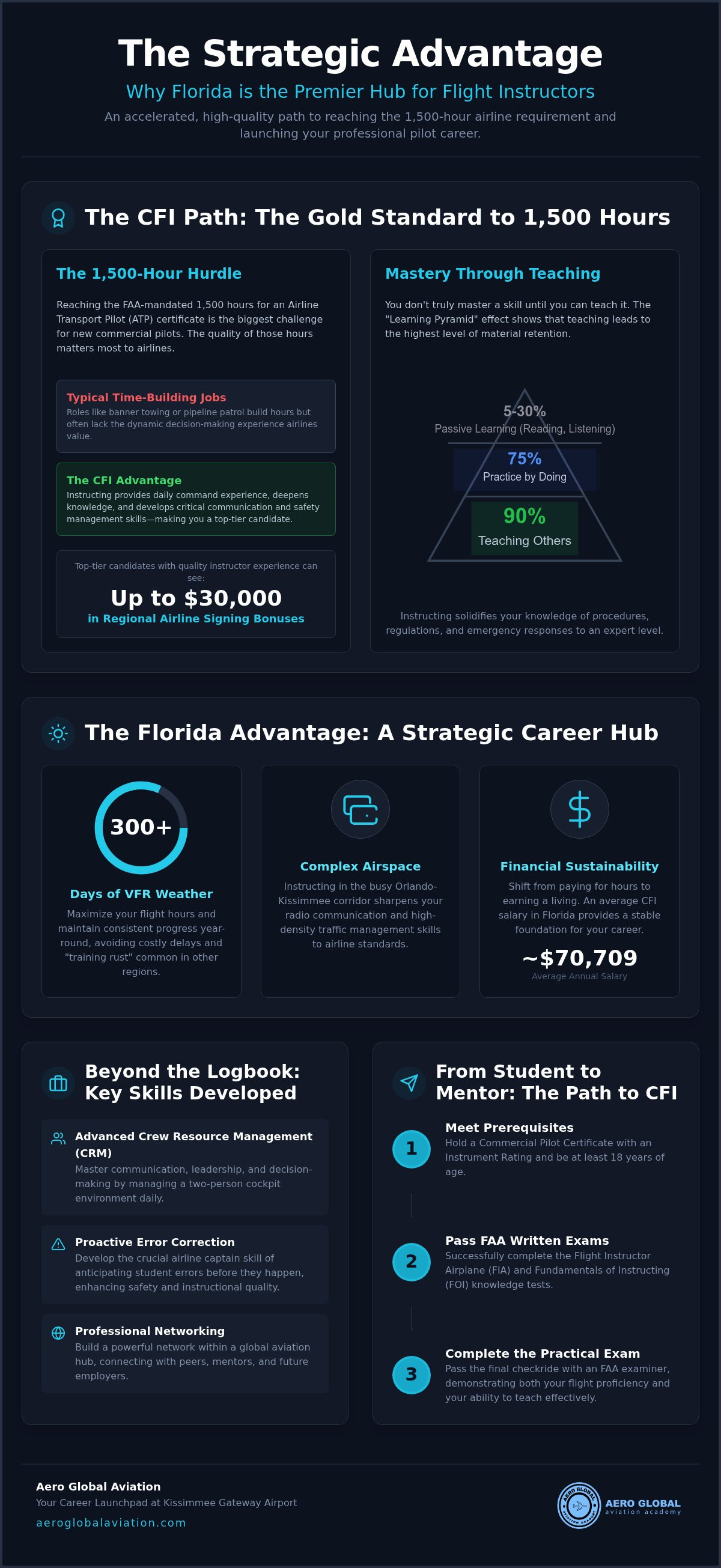
Reaching the FAA mandated 1,500-hour requirement for an Airline Transport Pilot (ATP) certificate can feel like a daunting climb. While some pilots choose "time building" jobs like aerial survey or pipeline patrol, these roles often lack the dynamic environment that recruiters value. Airlines recognize that Flight instructor certification represents a pilot who can manage a cockpit, communicate complex ideas, and make critical safety decisions under pressure.
By instructing, you accelerate your career velocity. You aren't just burning fuel; you're gaining command experience that makes you a safer, more employable candidate. With regional airlines offering signing bonuses as high as $30,000 in 2026 to attract top tier talent, arriving at your interview with hundreds of hours of dual instruction given puts you in a much stronger negotiating position than your peers.
Developing Mastery Through Instruction
There's an old aviation adage that you don't truly understand a maneuver until you have to teach it to someone else. This is known as the "Learning Pyramid" effect, where teaching others leads to a 90% retention rate of the material. As you monitor a student's steep turns or power-off stalls, your own stick-and-rudder skills become incredibly refined. You begin to anticipate errors before they happen, a trait that is essential for future captains.
Your technical knowledge of FAR/AIM regulations and weather theory deepens through daily application. To teach is to learn twice; this applies to emergency procedures because explaining the 'why' behind a forced landing or a systems failure forces you to visualize the solution before the problem even occurs. This mental discipline is exactly what evaluators look for during rigorous airline simulator checks.
Financial Sustainability and Resume Building
Instructing shifts the financial burden of flight training from your shoulders to your career. Instead of paying for every hour in the logbook, you begin earning a living. In Florida, the average flight instructor salary is approximately $70,709, providing a stable foundation while you build your resume. You'll enter the airline industry not just as a pilot, but as a mentor with a proven track record of professional reliability and leadership.
The Florida Advantage: Why Central Florida is the Strategic Hub for CFIs
Choosing where to build your career is just as important as the ratings you earn. Central Florida isn't just a sunny destination; it's a high-performance engine for your logbook. One of the primary benefits of becoming a flight instructor in Florida is the sheer density of opportunity found within the Orlando-Kissimmee corridor. Here, the environment acts as a silent partner in your professional development, providing the volume and variety of flight time necessary to reach the airlines ahead of schedule.
Unbeatable Weather and Flight Continuity
In many parts of the country, winter groundings can cause "training rust" that sets your progress back by months. Florida offers more than 300 days of VFR (Visual Flight Rules) flying weather per year. This consistency allows you to maximize billable hours as an instructor while keeping your students on a steady track toward their goals. You won't just fly in clear skies, though. You'll learn to navigate the unique interplay between coastal sea breezes and inland convection, building weather decision-making skills that are vital for safe, long-term operations. This year-round reliability ensures that your income remains stable and your proficiency stays at its peak.
Navigating Complex Airspace in Kissimmee and Orlando
Instructing near Orlando International (MCO) and Kissimmee Gateway (KISM) provides an education that rural airfields simply can't match. You and your students will regularly operate within or adjacent to Class B and Class C airspace. This requires gaining proficiency in high-traffic radio communications and precise ATC coordination. Mastering these FAA flight instructor requirements in a busy environment ensures you are teaching at the highest professional level. This exposure prepares your students for the "real world" of commercial aviation, making you a more effective and sought-after mentor.
Beyond the immediate airspace, the Florida peninsula offers diverse cross-country routes that stretch from the Atlantic coast to the Gulf of Mexico. You'll join a massive aviation community that serves as a natural networking engine, connecting you with pilots from every major airline. If you're ready to leverage these geographic advantages, exploring a structured flight training program in the heart of Florida is your next logical step. You'll find that the "Flight Training Capital" provides the perfect backdrop for turning your passion into a permanent career.
Beyond the Logbook: Professional and Financial Benefits of Instructing
While the 1,500-hour mark is the target, the professional growth you experience along the way is what truly prepares you for an airline cockpit. One of the key benefits of becoming a flight instructor in Florida is the access to a high-caliber networking community. When you work at the best flight schools in Florida, you aren't just building time; you're building a reputation among peers who will soon be your colleagues at regional and major carriers. This environment fosters a culture of standardization, ensuring you fly "by the book" every single day.
The 'Soft Skills' That Airlines Crave
Airlines look for more than just technical precision. They want leaders. Instructing forces you to develop conflict resolution and student management skills that serve as a direct precursor to captaincy. You'll learn to distill complex technical data into clear, actionable instructions for beginners, a skill that mirrors the communication required between a Captain and a First Officer. The professional benefits of instructing extend to your ability to manage a crew and maintain situational awareness while someone else is at the controls. CFI leadership directly translates to First Officer responsibilities because it requires you to anticipate errors and intervene effectively before a safety margin is compromised.
Financial Incentives and Industry Demand in 2026
In 2026, the financial landscape for instructors in Florida has become increasingly attractive. The average annual salary for a flight instructor in the state currently sits at approximately $70,709, with top earners reported as high as $108,732 in some regions. This provides a sustainable income while you accumulate hours, a sharp contrast to the massive debt often incurred through "wet" aircraft rentals. Beyond the base pay, many schools now offer retention bonuses and clear "flow-through" opportunities to regional partners. When you consider that starting bonuses at regional airlines have reached as high as $30,000, the ROI of instructing is undeniable. You're being paid to refine your craft in a local market that values your expertise.
Beyond the paycheck, the benefits of becoming a flight instructor in Florida include the ability to maintain a consistent local schedule. Unlike airline life, which can involve constant travel and nights away from home, instructing allows you to build your career while staying grounded in your community. You'll develop a professional rhythm that balances high-stakes training with a stable lifestyle, all while positioning yourself as a top-tier candidate for the next hiring wave.
Transitioning from Student to Mentor: The CFI Certification Process
Moving from the left seat to the right seat is a pivotal moment in any pilot's journey. One of the most rewarding benefits of becoming a flight instructor in Florida is the structured transition from being a student to becoming a mentor within a world-class training ecosystem. This process isn't just about passing another checkride; it's about fundamentally changing how you view aviation safety and communication. Before you can begin teaching, you must meet specific FAA requirements. These include being at least 18 years old, possessing a Commercial Pilot Certificate, and holding an Instrument Rating. You must also hold at least a third-class FAA medical certificate and have accumulated a minimum of 250 total flight hours.
Ground School and the FOI
Mastering the Fundamentals of Instructing (FOI) is your first major hurdle. This isn't your standard ground school. It focuses on educational psychology, exploring how students perceive information and retain new skills. You'll dive deep into the "PATE" method: Preparation, Presentation, Application, and Evaluation. This pedagogical foundation is essential for anyone pursuing advanced flight training. You'll also need to pass two knowledge tests with a score of 70% or better, proving you have the technical depth to guide others. Developing a comprehensive library of lesson plans and instructional aids during this phase ensures you are prepared for any classroom scenario.
The Practical Flight Test (Checkride)
The CFI checkride is widely considered one of the most rigorous tests in a pilot's career. You'll be expected to perform commercial maneuvers from the right seat, which provides a reversed perspective that can be surprisingly challenging at first. You aren't just flying; you're providing simultaneous verbal instruction while maintaining a high level of situational awareness. This dual-tasking is a core component of the benefits of becoming a flight instructor in Florida, as it builds the multi-tasking skills required in airline operations.
Common pitfalls often include failing to notice a student's mistake because you're too focused on your own flying. Successful candidates demonstrate they can manage the cockpit while teaching, a skill that serves as the ultimate preparation for a professional career. Recent FAA regulatory changes, effective December 2024, require enhanced qualifications for those training first-time CFI applicants, making it more important than ever to train at a school that stays ahead of industry standards. If you're ready to start this transition, you can apply for instructor certification training through our specialized programs at Kissimmee Gateway Airport.
Launching Your Career with Aero Global Aviation Academy
Choosing the right academy is the final piece of your professional puzzle. At Aero Global, we offer the Airline Pilot Elite program, which provides a seamless, structured path from your Private Pilot License through to your advanced instructor ratings. This ecosystem ensures you don't just earn a certificate; you join a professional network that is deeply invested in your individual success. By training within our facility, you move through a logical progression that eliminates the friction often found when switching between different flight schools.
One of the greatest benefits of becoming a flight instructor in Florida is the ability to train on modern equipment in a high-demand market. Our fleet features advanced glass cockpit technology, including the G1000 system, which mirrors the avionics found in modern regional jets. This ensures our instructors are future-ready from day one, mastering the systems they will eventually operate at the airlines. We prioritize hiring our own graduates into the Aero Global instructor network, providing a direct bridge to your 1,500-hour goal while maintaining the highest standards of safety and professionalism.
The Aero Global Edge in Kissimmee
Training at Kissimmee Gateway Airport (KISM) puts you in the heart of Florida’s most active aviation corridor. You receive personalized attention from experienced mentors who have actually walked the airline pilot career path themselves. They don't just teach maneuvers; they share the professional insights that only come from years of commercial experience. Our facility is designed to foster a collaborative spirit, where you can learn from those ahead of you and eventually guide those following in your footsteps. This mentorship-focused approach lowers the barrier to entry and builds the confidence you need to lead a classroom or a cockpit.
Ready to Lead the Next Generation?
If you're ready to transition from student to professional mentor, the time to act is now. You can start your journey with our career pilot program, which is specifically designed for rapid progression in the Central Florida hub. We invite you to contact an admissions counselor today to schedule a discovery flight or a tour of our Kissimmee facility. Seeing our operation in person is the best way to understand the quality, reliability, and value we bring to your training. Take the first step toward your 1,500-hour milestone and join a community that shares your passion for the skies.
Your Flight Path to the Major Airlines Starts Here
The journey to the flight deck is a demanding climb, but you don't have to navigate it alone. You've seen how Central Florida’s 300 days of annual sunshine and complex airspace turn the 1,500-hour requirement into a strategic period of professional growth. The benefits of becoming a flight instructor in Florida extend far beyond the logbook; they provide the financial stability and leadership skills that today's selective airlines demand. You aren't just building time; you're building the foundation of a lifelong career.
Aero Global Aviation Academy is ready to be your local partner in this transition. With our professional training at Kissimmee Gateway Airport and a structured PPL to CFI curriculum, you'll receive elite mentorship from industry veterans who are dedicated to your success. It's time to stop paying for flight hours and start getting paid to master them.
Apply for the Airline Pilot Elite Program and Start Your Instructor Career today. Your future in the skies is within reach, and we're here to help you clear for takeoff.
Frequently Asked Questions
Is becoming a flight instructor in Florida worth it in 2026?
Yes, it remains the most strategic path to the airlines. Despite a normalization phase in hiring, demand for high-quality candidates with instruction experience stays strong. One of the major benefits of becoming a flight instructor in Florida is the ability to maintain proficiency in a high-density aviation hub while others face hiring slowdowns. It's a reliable way to differentiate yourself and secure future regional airline bonuses.
How much do flight instructors make in Florida?
Florida flight instructors earn an average annual salary of approximately $70,709. Most salaries range between $51,600 and $83,700, though top earners in specific cities can reach over $108,000. This income makes the path to 1,500 hours financially sustainable compared to paying for aircraft rentals. It allows you to build a career while staying local, meeting your financial obligations, and gaining professional command experience.
How long does it take to get a CFI rating in Orlando?
Most students complete their initial CFI certification in six to twelve weeks, depending on their full-time or part-time status. The timeline is accelerated by Florida’s consistent flying weather, which prevents the delays common in northern states. Choosing a structured program like Airline Pilot Elite ensures you move through the ground school and practical training phases without unnecessary gaps in your schedule or training rust.
Can I build 1,500 hours in one year as a flight instructor?
Building 1,500 hours in a single year is a massive undertaking that requires flying roughly 80 to 100 hours per month. While difficult, the benefits of becoming a flight instructor in Florida include 300+ days of VFR weather, making this high-volume schedule more attainable than anywhere else. Most instructors reach their goal within 18 to 24 months while maintaining a professional balance and high training standards.
What are the FAA requirements to become a flight instructor?
You must be at least 18 years old, fluent in English, and hold a Commercial Pilot Certificate with an Instrument Rating. Candidates must also possess at least a third-class medical certificate and pass both the Fundamentals of Instructing (FOI) and Flight Instructor knowledge tests. These prerequisites ensure you have the technical foundation and legal eligibility to guide the next generation of pilots safely and effectively through their ratings.
Do airlines prefer pilots who were flight instructors?
Airlines highly value the CFI path because it demonstrates leadership, communication skills, and mastery of flight fundamentals. Instructors often perform better in airline interviews and simulator evaluations because they've spent hundreds of hours explaining complex procedures to others. This effect makes you a more reliable candidate for a First Officer position than those who built time through solo activities or less demanding flight roles.
What is the difference between CFI, CFII, and MEI?
A CFI teaches primary students, while a CFII focuses on instrument flight rules and navigation. An MEI is certified to teach in aircraft with more than one engine. Holding all three ratings makes you significantly more competitive in the job market. It allows you to provide a wider range of instruction and build complex multi-engine time faster, which is essential for your transition to regional jet operations.
Can I instruct while still training for my own advanced ratings?
Yes, many pilots begin instructing with their initial CFI rating while simultaneously working toward their CFII or MEI certifications. This approach allows you to earn an income and build total time while refining the specific skills needed for your next checkride. It creates a productive cycle where teaching fundamentals reinforces the advanced concepts you're currently studying for your own professional advancement and career progression.


