
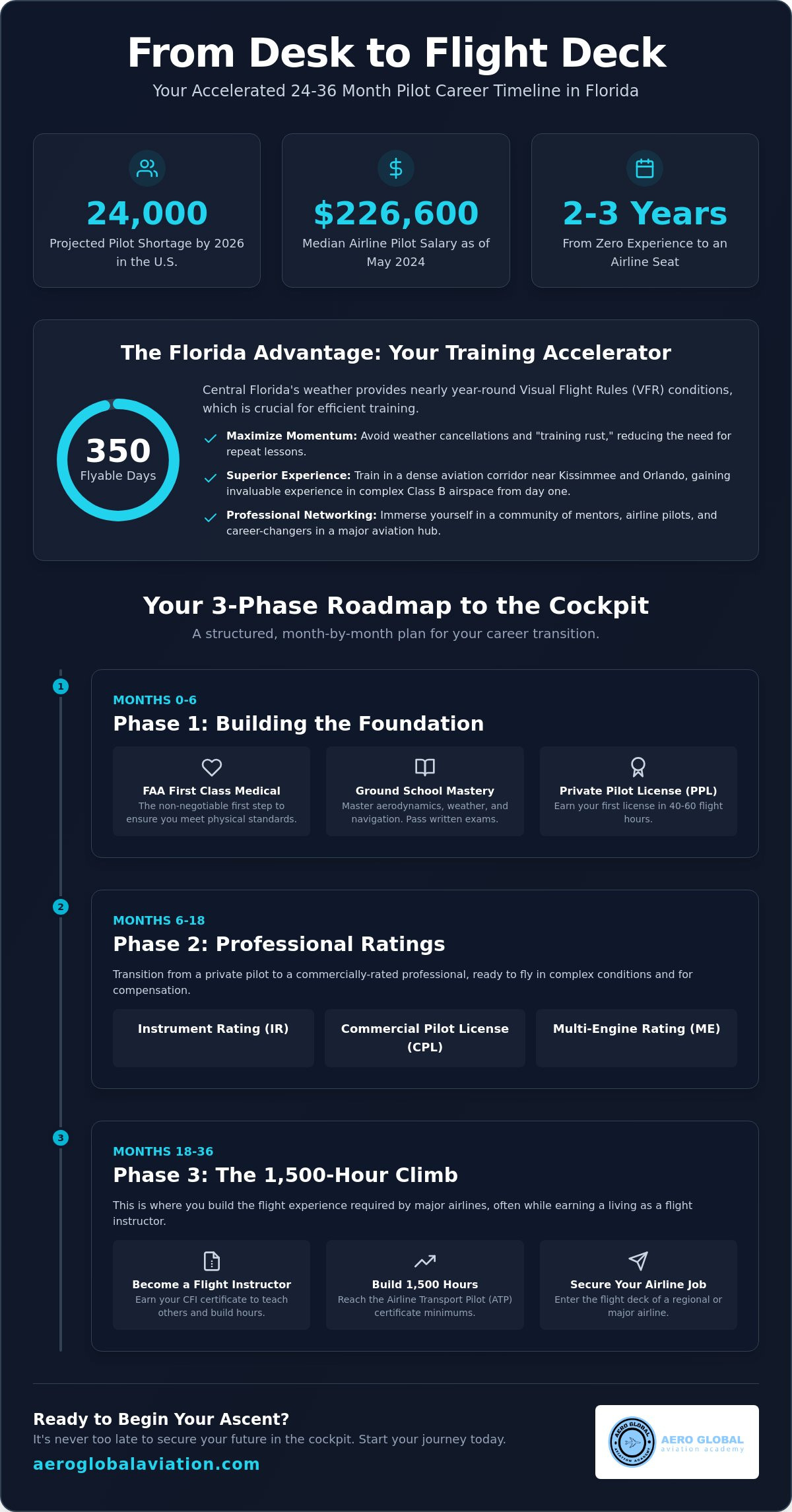
By the end of 2026, the United States is projected to face a shortage of nearly 24,000 pilots, which means the flight deck seat you've been dreaming of is currently waiting for someone to claim it. You might feel that starting a new chapter in your thirties or forties is too late, or that the complexity of the 1500-hour rule is an impossible barrier to clear. It's natural to feel hesitant about leaving a stable 9-to-5, but understanding the pilot career change timeline Florida provides can turn that uncertainty into a structured mission. With median airline pilot salaries reaching $226,600 as of May 2024, the path to the cockpit is more rewarding and attainable than ever before.
You're looking for a clear path forward, and we're here to provide it. This guide outlines the exact month-by-month roadmap to transition from your current career to a professional pilot seat using Florida's unique training advantages. We'll walk through a concrete two to three year plan that addresses your financial concerns and validates that your career transition is not only viable but strategically sound. From your first solo flight to earning your commercial ratings, you'll discover how a structured approach turns your aviation goals into a tangible destination.
Key Takeaways
- Discover how the pilot career change timeline Florida provides allows you to go from zero experience to a professional airline seat in just 24 to 36 months.
- Learn why Central Florida’s 350 flyable days per year accelerate your training and keep your skills sharp by avoiding weather-related cancellations.
- Master the three-phase approach to flight training, from your initial FAA Medical Certificate to the advanced 1,500-hour milestone.
- Explore the most efficient ways to earn a living as a flight instructor while building the hours required for major airline entry.
- Gain confidence with strategic insights on financing and age considerations, proving that it is never too late to secure your future in the cockpit.
The Florida Advantage: Why Kissimmee is the Hub for Rapid Career Changes
A pilot career change timeline in Florida typically spans 24 to 36 months from zero experience to a regional airline seat. This condensed timeframe is a significant departure from the national average, where winter weather and limited airport access can easily add another year to your journey. In 2026, the demand for new aviators is reaching a critical peak, with the US projected to be short by approximately 24,000 pilots. This shortage, combined with the fact that nearly 5,000 pilots will reach the mandatory retirement age of 65 this year, creates a window of opportunity that didn't exist a decade ago. Choosing the right location for your training is the most important decision you'll make after deciding to fly.
Weather and Training Efficiency
Central Florida is famous for its "350-day flying rule," offering nearly year round VFR (Visual Flight Rules) conditions that are vital for early training. In northern states, a single snowstorm can ground a student for two weeks, leading to "training rust" where you spend your next three lessons simply regaining lost proficiency. Florida's consistent climate ensures you maintain momentum. You'll fly more often, retain skills better, and reach your checkrides with higher confidence levels. Consistent Florida weather reduces the overall training cost by eliminating the need for repeat lessons caused by long gaps between flights. This reliability allows you to treat your training like a full time job, moving through the syllabus with professional precision.
The Local Aviation Ecosystem in Kissimmee
Training at Kissimmee Gateway Airport places you in the heart of one of the busiest aviation corridors in the world. You aren't just learning to fly in a vacuum; you're operating in a complex environment that mirrors the professional world you're about to enter. The density of airports in the Orlando area means you'll gain superior experience in cross country navigation and instrument procedures much faster than in isolated regions. Navigating the various FAA pilot certification levels becomes much more intuitive when you're immersed in an environment where professional aviation happens every single day.
Proximity to major hubs like Orlando International (MCO) provides invaluable exposure to complex Class B airspace. You'll learn to communicate with professional air traffic controllers and share the sky with major carriers from day one. This high stakes environment builds a level of "cockpit discipline" that regional airlines actively look for during their hiring process. Beyond the technical skills, the networking opportunities in the Central Florida pilot community are unmatched. You'll find yourself surrounded by mentors, current airline pilots, and fellow career changers who all share the same goal of reaching the flight deck as efficiently as possible. This collaborative spirit makes the pilot career change timeline Florida offers not just a schedule, but a supported professional journey.
Phase 1: Building the Foundation (Months 0–6)
The very first step in your pilot career change timeline Florida doesn't actually take place in a cockpit, but in a medical examiner's office. Before you invest significant time or capital, you must secure an FAA First Class Medical Certificate. This is a non-negotiable requirement that ensures you meet the physical standards necessary for a long-term career at the airlines. Many career changers in their 30s or 40s worry about this step, but most find that the standards are quite manageable with a healthy lifestyle. Once you have this certificate in hand, you've cleared the first major hurdle and can begin your training with total confidence.
During these first six months, you'll be balancing ground school mastery with your current professional responsibilities. This period is about building a deep theoretical understanding of weather, navigation, and aerodynamics. You'll spend your evenings and weekends absorbing the official FAA requirements and preparing for your first written exams. This transition from a 9-to-5 mindset to an aviator mindset requires discipline, but the reward is a Private Pilot License (PPL), which you'll typically earn after 40 to 60 hours of flight time. This isn't just about learning to fly; it's about learning to think like a captain from day one.
The Wings Foundation: Starting Your Journey
For many professionals, the Wings Foundation serves as a perfect, low-risk entry point. This program focuses on the PPL, allowing you to experience the reality of flight training before committing to a full career track. During your first 20 hours of dual instruction, you'll master the fundamentals of aircraft control. You'll learn to handle takeoffs, landings, and emergency procedures, often practicing in Florida's unique afternoon thermals. These atmospheric conditions provide excellent "stick-and-rudder" training, making you a more capable and resilient pilot right from the start.
Overcoming the First-Phase Hurdles
Adult students often hit a "learning plateau" around the 15-hour mark, where progress feels like it's stalling. This is a natural part of the process. The key to pushing through is a structured syllabus rather than a casual, "pay-as-you-go" flight club approach. A professional academy provides the mentorship and consistency needed to keep you moving forward. The ultimate emotional turning point in this phase is your first solo flight. Realizing you're the sole occupant of an aircraft, successfully navigating the Central Florida skies, is the moment your career change becomes a reality. If you're ready to take that first step, looking into a structured flight training program can help you set a solid foundation for your future.
Phase 2: Professional Ratings and the Commercial Pivot (Months 6–18)
Once you've earned your Private Pilot License, the most transformational stretch of your pilot career change timeline Florida begins. This phase, spanning months 6 to 18, is where you transition from a hobbyist to a professional aviator. It's a demanding period that requires intense focus; however, the pilot career outlook for 2026 remains incredibly strong, providing the motivation you need to stay the course. Integrating a structured Career Pilot Program during this time is essential. It streamlines your ratings and prevents the aimless "time-building" that often stalls independent students who struggle to reach the next milestone.
Mastering the Instrument Rating
The Instrument Rating (IR) is your first major step toward a professional flight deck. You'll learn to navigate the Florida clouds solely by reference to your flight instruments, a skill that's vital for airline operations. This phase is often considered the most challenging because it requires a complete shift in how you perceive aircraft motion. We utilize advanced G1000 glass cockpit technology to ensure you're training on the same systems found in modern airliners. Simulators also play a critical role here. They allow us to compress your training timeline by practicing complex approaches and emergency scenarios in a controlled, repeatable environment without the distractions of external traffic.
The Commercial Pilot Milestone
Reaching the 250-hour FAA threshold for your Commercial Pilot License (CPL) represents a massive achievement in your career pivot. This is where you refine your flight maneuvers to professional standards. You'll master advanced maneuvers like steep spirals and eights-on-pylons, proving you have total command of the aircraft. The commercial pilot training syllabus at Aero Global is designed to prepare you for the high-pressure environment of Phase 3. Once you hold this certificate, you've earned the legal privilege to get paid to fly. It's the moment your investment starts paying dividends.
Finally, you'll tackle the Multi-Engine Add-on. Learning to manage the speed and complexity of a twin-engine aircraft is vital for your future airline resume. It shows recruiters you can handle the increased workload and systems management of a sophisticated flight deck. By the end of month 18, you'll have a stack of professional ratings and the confidence to begin your final climb toward the 1,500-hour requirement.
Phase 3: The 1500-Hour Climb and Airline Entry (Months 18–36)
The transition from a commercial pilot to an airline first officer is defined by the "1500-Hour Rule." This FAA mandate requires pilots to accumulate substantial flight time before they're eligible for an Airline Transport Pilot (ATP) certificate. Within the pilot career change timeline Florida offers, these 18 months are often the most rewarding because you're finally earning a living while flying. You aren't just a student anymore; you're a professional building the experience necessary to command a regional jet. This phase is the bridge that turns your training into a lifelong career.
While the climb from 250 to 1,500 hours sounds daunting, Florida's high density of flight schools and year-round flyable weather make it the most efficient place to bridge this gap. Beyond instructing, Florida offers unique opportunities like aerial photography over the coast, pipeline patrol, or banner towing along the beaches. Each hour spent in the cockpit brings you closer to your final destination: the regional airline interview. Because you're training in such a busy aviation hub, you'll likely have your first interview lined up well before you hit your final hour requirement.
Becoming a Mentor: The Instructor Path
Most successful career changers choose the Certified Flight Instructor (CFI) path to build their hours. Teaching others is the most effective way to master complex aviation concepts and refine your own stick-and-rudder skills. Our Airline Pilot Elite program specifically focuses on these instructor ratings to ensure you're job-ready the moment you finish your commercial training. In the bustling Central Florida flight training hub, instructors can easily accumulate 80 to 100 flight hours per month. This high volume significantly shortens your path to the airlines compared to less active regions where winter weather can ground trainers for weeks at a time.
Multi-Engine Experience and the ATP-CTP
As you approach the 1,500-hour mark, your focus shifts toward multi-engine experience. Major airlines look for significant time in twin-engine aircraft to ensure you can handle the complexity of their fleets. You'll also prepare for the ATP-CTP (Airline Transport Pilot Certification Training Program), which is the final academic hurdle before your airline checkride. Transitioning from the familiar cockpit of a single-engine trainer to the high-speed, high-altitude environment of a regional jet represents the ultimate realization of your professional career change.
If you're ready to start your journey toward the captain's seat, apply for our Airline Pilot Elite program today and let our mentors guide you through every mile of the climb.
Strategic Planning: Financing and Age Considerations for 2026
The most common question we hear from prospective students is whether they've waited too long to start. In the current 2026 market, the answer is a resounding no. Starting a career change at 35 or even 45 is a viable, strategic move that still allows for a 20 to 30 year career in the flight deck. When you consider that the median annual wage for airline pilots was $226,600 as of May 2024, the financial incentive to pivot remains powerful. Your pilot career change timeline Florida is designed to maximize your remaining years of eligibility while getting you into a high-paying seat as quickly as possible.
Success in this industry is about seniority and timing. By starting your journey now, you're positioning yourself to enter the workforce as the pilot shortage reaches its projected peak of 24,000 open positions. Aero Global Aviation Academy supports career changers through flexible scheduling that respects your current professional obligations, allowing you to transition at a pace that maintains your financial stability. We act as your practical mentor, ensuring every dollar and hour spent is a direct investment in your future destination.
The 'Mature Student' Advantage
Financial Roadmaps for Pilot Training
Financing a career change requires a clear understanding of the return on investment. While interest rates for flight training loans in 2026 typically range from 11% to 18%, the starting pay for first officers at regional airlines ($65,000 to $90,000) provides a solid foundation for repayment. Many students explore merit-based scholarships or specialized lenders that offer interest-only payments during the training phase. We believe in total transparency, helping you budget for your journey from PPL to CPL without hidden costs or surprises. Ready to map your future? Schedule a Career Consultation at Aero Global today and let us help you navigate the financial and professional steps of your journey.
Take Command of Your Aviation Future
Your transition from the corporate office to the captain's seat is a strategic mission that we've mapped out from day one to year three. By leveraging the 350+ annual flying days in Central Florida and following our FAA Part 61 and 141 structured curriculums, you can bypass the delays that often ground students in less favorable climates. You've seen how the pilot career change timeline Florida provides turns a complex professional transition into a series of logical, rewarding milestones. From your foundation in our initial courses to your first day of CFI employment, every hour in the air brings you closer to your ultimate goal.
The flight deck is waiting for professionals who bring discipline and life experience to the cockpit. There's no better time to stop wondering about the "what if" scenarios and start building the seniority that defines a successful aviation career. We're here to provide the expert mentorship and the direct path to instructor roles you need to reach the 1,500-hour mark with confidence.
Book Your Discovery Flight in Kissimmee Today
The sky is your new workplace. We're ready to help you earn your wings and join the next generation of professional aviators.
Frequently Asked Questions
How long does it take to become a pilot in Florida if I work full-time?
If you maintain your current job, the pilot career change timeline Florida offers typically extends to three or four years. While full-time students can reach the airlines in 24 to 36 months, part-time training requires a disciplined schedule of at least three flights per week to maintain proficiency. Florida's consistent weather helps you avoid the seasonal setbacks that often extend this timeline in northern states, keeping your skills sharp between lessons.
Is 40 too old to start a career as an airline pilot in 2026?
Starting at 40 is not too late, as you still have 25 years of professional flying before the mandatory retirement age of 65. Airlines highly value the maturity and decision-making skills that career changers bring to the flight deck. With the projected shortage of 24,000 pilots peaking in 2026, recruiters are actively looking for dedicated professionals who can demonstrate reliability and professional discipline regardless of their starting age.
How much does it cost to change careers to a pilot in Florida?
The total investment depends on how quickly you progress and the specific ratings you choose to pursue. You should account for flight hours, ground school materials, FAA written exam fees, and designated examiner fees for each checkride. Many students find that Florida's high flying density actually lowers the total investment by reducing the need for remedial lessons caused by long gaps in training.
What is the fastest way to build 1500 flight hours?
Becoming a Certified Flight Instructor (CFI) is the most efficient way to build the 1,500 hours required for airline eligibility. Instructors in active aviation hubs like Kissimmee can often fly up to 100 hours per month due to the high demand for training. This role allows you to earn a salary while mastering advanced maneuvers and gaining the leadership experience that major carriers prioritize during the hiring process.
Do I need a college degree to fly for major airlines in 2026?
What is the difference between Part 61 and Part 141 for career changers?
Part 61 training offers maximum flexibility for students who need to balance flight lessons with a full-time professional life. Part 141 schools follow a more rigid, FAA-approved curriculum that is highly structured and often moves at a faster pace. Career changers typically prefer the structured environment of a professional academy to ensure they stay on track with their specific career transition goals.
Can I get a student loan for flight school in Kissimmee?
Yes, specialized aviation lenders offer financing options specifically designed for professional flight training programs. These loans often include provisions for interest-only payments while you are still in school or building hours as a flight instructor. Some lenders even offer merit-based financing that considers your previous professional success and academic background rather than just your credit score alone.
What happens if I fail my FAA medical exam during a career change?
Failing an initial medical exam does not necessarily mean your aviation career is over. Many medical conditions can be managed through the FAA Special Issuance process, which allows you to fly after providing additional documentation from your doctors. It's critical to work with a dedicated Aviation Medical Examiner (AME) who understands the specific requirements for professional pilots before you begin your formal training.


