The aviation industry needs 660,000 new pilots by 2044, making this the most opportune moment in decades to launch your professional career. Choosing a hub for your pilot training in Kissimmee is more than just a lifestyle choice; it's a strategic move to ensure you're learning in one of the world's most active aviation environments. You might feel anxious about the complexity of FAA certifications or the potential for hidden costs to ground your dreams before they take flight. It's common to feel overwhelmed by the maze of regulations and the pressure to choose the right career track, but those hurdles are much easier to clear with the right local partner.
This guide serves as your practical mentor to help you cut through the noise and take command of your future. We'll show you why the unique traffic mix at Kissimmee Gateway Airport and the reliable Florida sun create the perfect laboratory for rapid skill development. You'll gain a clear understanding of the timeline from your Private Pilot License to your Commercial Pilot License. This clarity gives you the confidence to start your journey with a roadmap that leads directly to the flight deck. Let's look at what makes this region the premier choice for your 2026 training goals.
Key Takeaways
- Discover why 300+ days of flyable weather and specialized infrastructure make this region a global capital for flight instruction.
- Learn how to navigate the FAA certification process and secure your medical certificate to kickstart your pilot training in Kissimmee with confidence.
- Master the unique advantages of the Kissimmee Gateway Airport environment, where the airspace is complex enough for professional growth but efficient enough for rapid progress.
- Identify the right training track for your ambitions, whether you're building a foundation with the Wings Foundation or aiming for the flight deck through the Airline Pilot Elite program.
Why Kissimmee is the Epicenter of Pilot Training in 2026
Kissimmee has solidified its position as a global epicenter for professional aviation, earning its reputation as a premier destination for pilot training kissimmee. While other regions in the country face seasonal shutdowns and unpredictable storms, this Central Florida hub provides the robust infrastructure and environmental consistency required for serious career development. You'll find that the density of resources at Kissimmee Gateway Airport (KISM) creates an immersive environment. With over 133,000 landings and takeoffs recorded in 2025 alone, learning happens both inside and outside the cockpit. It's a place where you aren't just a student; you're a junior member of a massive professional community that includes charter operators, maintenance experts, and veteran instructors.
Beyond the technical assets, the local economic landscape offers a distinct tactical advantage for students looking to maximize their investment. This specialized infrastructure is what makes pilot training in Kissimmee so effective for career-track students. Choosing this location allows you to focus your financial resources on your flight hours rather than inflated overhead. Living costs here remain significantly more manageable than in high-cost metros like Miami or New York, where housing and general expenses can often drain a training budget before you even reach your commercial checkride. By reducing these secondary costs, you can prioritize your time in the air, ensuring that your path from a beginner to a professional aviator is as efficient and focused as possible.
The Year-Round Flying Advantage
Success in flight training depends on momentum. Central Florida offers over 300 days of Visual Flight Rules (VFR) weather per year, which means your schedule stays on track. This consistency prevents skill fade, a common setback where students lose proficiency during long weather delays. In 2026, we're seeing a record number of international students flocking to the region because they can complete their ratings in record time. When you fly almost every day, the muscle memory becomes second nature, allowing you to master complex maneuvers with much higher confidence.
A Community Built for Aviators
Training here places you in a massive aviation ecosystem. Kissimmee Gateway operates in synergy with Orlando International (MCO), giving you access to one of the world's busiest airspaces. You'll learn to communicate with professional controllers while observing charter operations and maintenance hubs. This zip code is packed with advanced simulators and diverse aircraft fleets. It's an environment where networking happens at the hangar doors, connecting you to the industry leaders who need to fill 660,000 new pilot roles by 2044.
The 2026 Roadmap: From Student Pilot to Professional
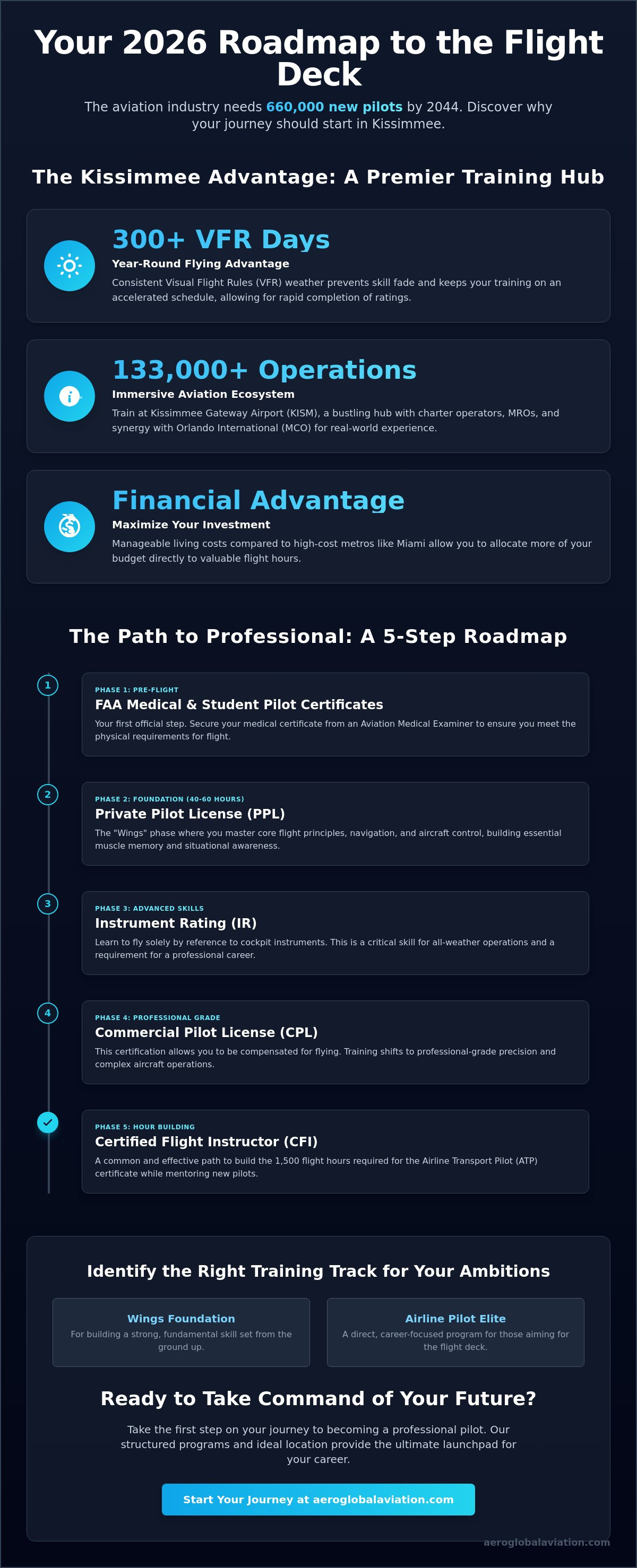
Your transition from a ground-based observer to a professional aviator requires a clear, logical sequence of milestones. In 2026, the path is more structured than ever, ensuring you meet rigorous safety standards while building the skill set required by major carriers. Launching your pilot training in Kissimmee gives you a front-row seat to this progression, moving you through five distinct phases of certification. Every step is designed to layer new skills on top of old ones, transforming you from a novice into a high-precision commander of the skies.
- Step 1: FAA Medical and Student Pilot Certificates – Your first move is a visit to an Aviation Medical Examiner to ensure you meet the physical requirements for flight.
- Step 2: Private Pilot License (PPL) – This is the foundational "Wings" phase where you learn the core principles of flight and navigation.
- Step 3: Instrument Rating (IR) – Here, you learn to fly solely by reference to your cockpit instruments, a vital skill for all-weather operations.
- Step 4: Commercial Pilot License (CPL) – This certification allows you to be compensated for your skills, shifting your focus to professional-grade precision.
- Step 5: Certified Flight Instructor (CFI) – Many graduates choose this path to build the 1,500 flight hours required for the Airline Transport Pilot certificate.
Phase 1: Building the Foundation (PPL)
Your first 40 to 60 hours in the air are about building muscle memory and situational awareness. You'll dive deep into the FAA private pilot certification requirements, which cover everything from basic aerodynamics to emergency procedures. Success here depends on a high-quality ground school to help you ace the FAA written exams. For those who want to master the basics without committing to a full career track immediately, our Wings Foundation course provides the perfect entry point to the world of aviation.
Phase 2: Mastering Complexity (IR & CPL)
Once you have your PPL, you'll move into mastering complexity. Instrument training is particularly rewarding in Central Florida; it prepares you to handle the afternoon summer showers with professional poise. As you transition into your commercial training, you'll stop "flying the plane" and start "commanding the aircraft." This involves learning advanced maneuvers and high-performance systems. For a deeper look at these requirements, explore our guide on Commercial Pilot Training. If your goal is the captain's seat at a major airline, our Airline Pilot Elite program is the most direct way to reach those advanced instructor ratings.
Following this roadmap ensures that no part of your education is left to chance. By choosing a structured environment for your pilot training in Kissimmee, you're investing in a career path that is both logical and rewarding. Whether you're starting with our Career Pilot Program or aiming for the very top, having a mentor to guide you through these steps makes all the difference in your professional maturity.
Navigating the Kissimmee Gateway Airport (KISM) Environment
When you choose pilot training in Kissimmee, you aren't just picking a flight school; you're choosing a high-performance training laboratory. Kissimmee Gateway Airport (KISM) features a sophisticated layout with two large intersecting runways and a dedicated 24-hour control tower. This environment offers what instructors often call "Goldilocks" airspace. It is complex enough to challenge you and build professional habits, yet it lacks the restrictive delays often found at massive international hubs like Orlando International (MCO). In 2025, KISM recorded 133,171 operations, proving it's a vibrant hub where you'll learn to manage real-world traffic patterns from your very first solo flight.
One of the most significant advantages of this location is its proximity to Class B airspace. Operating just beneath the "shelf" of MCO requires precision and sharp communication skills. You'll quickly become proficient at talking to Air Traffic Control (ATC) in a busy, multi-airport corridor. This early exposure to professional radio work is a vital component of the pilot career outlook, as it builds the confidence needed for the flight decks of major airlines. At KISM, you're surrounded by high-end Fixed Base Operators (FBOs) and student-friendly facilities that make the airport feel like a second home rather than just a place of business.
Airspace Mastery Near Orlando
Mastering the skies around Kissimmee involves more than just staying in the local pattern. You'll have the opportunity to practice at nearby satellite airports like Winter Haven or Lakeland, each offering different runway configurations and challenges. Training in this busy corridor ensures you're never bored and always learning. The KISM tower environment is specifically designed to prepare you for the pace of airline operations, forcing you to maintain situational awareness while navigating around other training aircraft and corporate jets.
KISM Facilities and Maintenance
The infrastructure at Kissimmee is built to keep you in the air. Having on-site maintenance at a flight school is a game-changer because it drastically reduces plane downtime, ensuring your training schedule stays on track. Aero Global maintains a significant footprint within the Kissimmee aviation ecosystem, offering modern hangars and dedicated briefing rooms where you can deconstruct your flights with your instructor. These professional spaces provide the quiet focus needed to master complex maneuvers before you ever turn the propeller.
By immersing yourself in the KISM environment, you're doing more than just logging hours. You're building the professional maturity that recruiters look for. Whether you're enrolled in our Career Pilot Program or the Airline Pilot Elite track, the airport itself serves as your first classroom for high-stakes aviation.
Academy vs. Casual Flight Schools: Choosing Your Path
Deciding where to invest your time and capital is the most critical decision you'll make after deciding to fly. When researching pilot training in Kissimmee, you'll encounter two primary training structures: Part 61 and Part 141. Part 61 offers a flexible, pay-as-you-go approach that works well for hobbyists or those with unpredictable schedules. However, if your goal is a seat in a commercial cockpit, the structured "Academy" environment of a Part 141 program often provides a more efficient trajectory. Academies operate with a level of professional discipline that mirrors the airline environment, preparing you for the rigors of a career from day one.
Choosing an academy over a casual flight school means you're joining a community of like-minded peers and mentors. While casual schools might offer individual ratings at seemingly lower entry points, the total cost often balloons due to lack of structure or plane availability. Bundled options like our Career Pilot Program provide a transparent, comprehensive path that covers everything from your first solo to your commercial checkride. This approach eliminates the guesswork and hidden fees that often ground aspiring aviators. You'll benefit from a dedicated support system where instructors are deeply invested in your individual success rather than just building their own hours.
The Career Pilot Program Advantage
A structured syllabus is the backbone of professional success. By following a proven curriculum, students often see higher checkride pass rates because every lesson builds logically on the last. Training on a standardized fleet, such as aircraft equipped with G1000 glass cockpits, ensures that your transition between different ratings is seamless. You won't waste valuable flight hours relearning instrument layouts. If you're ready to commit to a professional track, explore the enrollment specifics for our Career Pilot Program to see how we streamline your journey.
Evaluating Flight School Quality
Not every school for pilot training in Kissimmee is created equal. When conducting your audit, prioritize the student-to-instructor ratio; a school that is over-leveraged can't provide the personalized attention you deserve. You should also demand total transparency regarding "wet" versus "dry" aircraft rates. Wet rates include fuel and oil, while dry rates do not; failing to account for this can lead to massive budget overruns. For a full breakdown on how to vet potential schools, consult our Best Flight Schools in Florida audit guide.
The right choice depends on your ultimate destination. If you want to fly for a major airline, you need an environment that treats you like a professional from the moment you walk through the door. Take the first step toward your commercial career by joining our Career Pilot Program today.
Starting Your Journey at Aero Global Aviation Academy
Transitioning from an aspiring pilot to a certified professional requires more than just logged flight hours. It requires a dedicated partner who understands your individual goals and the specific demands of the modern flight deck. At Aero Global Aviation Academy, we embrace a "Practical Mentor" philosophy. We don't just teach you to fly; we guide you through the complexities of the aviation industry with personalized attention. Our location at the heart of Central Florida serves as a high-velocity launchpad, positioning you exactly where major airlines look for their next generation of talent. Your pilot training in Kissimmee begins with a foundation of excellence that prepares you for the high-stakes environment of commercial aviation.
For those with the highest ambitions, our Airline Pilot Elite program offers a comprehensive path from zero experience to advanced instructor certification. This program is designed for the career-track student who wants to maximize their efficiency and reach the 1,500-hour milestone as quickly as possible. By becoming a Certified Flight Instructor within our academy, you gain the leadership skills and aeronautical knowledge that distinguish elite aviators. It all starts with a Discovery Flight, an introductory experience that puts you in the pilot's seat and confirms that the sky is where you belong. This first hour in the air is often the moment a dream becomes a concrete career plan.
Personalized Training in a Professional Setting
We recognize that every student's journey is unique. If you're just testing the waters, our Wings Foundation course provides a tailored introduction to the Private Pilot License without the immediate pressure of a full career commitment. Our experienced instructors act as your personal advocates, helping you navigate the nuances of FAA checkrides with poise. We back this mentorship with a commitment to safety, utilizing a 2026 fleet equipped with modern glass cockpits and advanced avionics to ensure you're learning on the technology you'll use in the airlines.
Your Next 90 Days in Kissimmee
The first three months of your training are the most transformative. Your timeline starts with an introductory flight, quickly progressing through ground school and pre-solo maneuvers. By the end of your first 90 days, many students achieve their first solo flight, a milestone that forever changes your perspective on the world. If you're relocating for your pilot training in Kissimmee, our team can provide guidance on local logistics to ensure your transition is as smooth as your first landing. We understand the challenges of moving for school and are here to support your integration into the local aviation community.
Your professional future is waiting just beyond the horizon. The demand for skilled pilots is at an all-time high, and there's no better place to answer that call than right here in the flight training capital of the world. Take the definitive first step toward your new career. Schedule your tour of Aero Global Aviation Academy today and see firsthand how we turn students into professional aviators.
Take Command of Your Professional Aviation Future
Choosing the right environment for your flight education is the most significant investment you'll make in your career. By grounding your pilot training in Kissimmee, you're leveraging the strategic advantages of the Kissimmee Gateway Airport (KISM) and its professional aviation ecosystem. You've seen how structured PPL to CPL pathways eliminate the guesswork, allowing you to focus on mastering the aircraft rather than navigating administrative hurdles. Expert mentorship isn't just a luxury; it's the bridge that connects your initial student solo to a long-term career with the airlines.
The sky in 2026 is full of opportunity for those who approach their training with discipline and the right support system. Your journey from a beginner to a high-precision commercial pilot is a structured, attainable reality when you have a dedicated partner by your side. Don't let another season pass while you're still on the ground. It's time to turn your aspirations into a tangible professional destination.
Ready to fly? Explore the Career Pilot Program at Aero Global Aviation Academy. We're ready to help you reach your destination and look forward to seeing you on the flight line.
Frequently Asked Questions
Is Kissimmee a good place for international students to learn to fly?
Kissimmee is an excellent destination for international students because of its globally recognized training standards and high density of aviation resources. You must be able to read, speak, and understand English to meet FAA requirements. Many students travel here specifically for the 300 days of flyable weather, which allows them to complete their training much faster than in many other countries.
How much does it cost to get a Private Pilot License in Kissimmee in 2026?
The investment for a Private Pilot License depends on your individual learning pace and the frequency of your flight lessons. Total costs are influenced by aircraft rental, instructor fees, and FAA examination requirements. You can explore our Wings Foundation course for a structured approach that focuses on building essential foundational skills with maximum efficiency.
Can I work while attending flight school in Orlando?
You can work while attending flight school, but your success depends on the intensity of your chosen program. A flexible schedule accommodates part-time employment well for those taking a slower pace. Students in the Airline Pilot Elite program often find that a full-time commitment allows them to progress through ratings much faster and reach their career goals sooner.
What is the difference between Part 61 and Part 141 flight training?
Part 61 training offers a flexible approach where you work one-on-one with an instructor at your own pace. Part 141 training follows a highly structured, FAA-approved curriculum with specific milestones and rigorous oversight. Career-oriented students often choose the Part 141 environment because it mirrors the discipline and standardized procedures found in professional airline operations.
How long does the Career Pilot Program take to complete?
Completing a full pilot training kissimmee program like the Career Pilot Program typically takes between six and ten months. This timeline assumes a consistent training schedule of several flights per week. Your individual progress depends on your dedication to ground school and how quickly you master the required flight maneuvers for your commercial checkride.
Do I need prior experience to join an aviation academy in Kissimmee?
You don't need any prior flying experience to join an aviation academy. Most professional programs are designed to take you from zero time to a fully certified commercial pilot. Your journey begins with obtaining an FAA medical certificate and a student pilot certificate, which are the only legal prerequisites to start your formal training.
What happens if the weather is bad during my flight training?
Florida's 300 plus days of flyable weather mean that cancellations are rare, but safety always comes first. If the weather is unsuitable for flying, we shift focus to ground school or advanced simulator sessions. This ensures that your learning momentum continues and you stay on track for your certification goals regardless of the conditions outside.
How do I choose between the different flight schools at Kissimmee Gateway Airport?
Choosing the right school requires looking past the marketing and evaluating the actual training environment. Prioritize schools with a low student-to-instructor ratio and a standardized fleet of modern aircraft. We recommend visiting Kissimmee Gateway Airport in person to meet the instructors and experience the practical mentor philosophy that defines our approach to student success.


