Did you know that the aviation industry is facing its most severe pilot shortage right now, with a projected shortfall of 24,000 pilots in 2026 alone? You've likely felt the pull of this massive career opportunity, but you're also probably worried about hidden training costs or the confusing maze of certificates. It's natural to feel overwhelmed when you're searching for a professional pilot track that actually delivers on its promises. We believe your training should be a strategic partnership in mentorship, not just a checklist of certifications.
We'll help you clear the fog and reach your destination. You'll discover exactly how to transition from a student pilot to a commercial airline aviator with total confidence. We'll explore the structured milestones of elite career programs, the unique training advantages of our Florida skies, and how to maximize your return on investment as you aim for a career where the median annual wage for airline pilots has reached $226,600. Your journey to the flight deck starts with a clear roadmap, and this guide provides the exact coordinates you need to succeed.
Key Takeaways
- Understand why major airlines prefer a structured professional pilot track over recreational training to ensure you meet rigorous industry standards from day one.
- Map out your career progression from earning your Private Pilot License to mastering Instrument Flight Rules, creating a clear path to the commercial cockpit.
- Discover why training in Kissimmee, Florida, provides a strategic advantage through year-round flying weather and exposure to complex, professional airspace.
- Compare accelerated fast-track programs with flexible modular options to determine which training pace aligns best with your personal timeline and career goals.
- Identify the specific training course, such as our Career Pilot Program or Wings Foundation, that fits your current experience level and long-term airline aspirations.
What is a Professional Pilot Track? Defining Your Career Destination
Choosing a professional pilot track isn't just about learning to fly; it's about committing to a highly structured career path designed for the modern flight deck. Unlike recreational flying, which focuses on local weekend trips or personal travel, a professional track builds a foundation for long-haul responsibility. It's a strategic partnership between you and your flight school, focusing on the specific skills that regional and major airlines demand from their first officers.
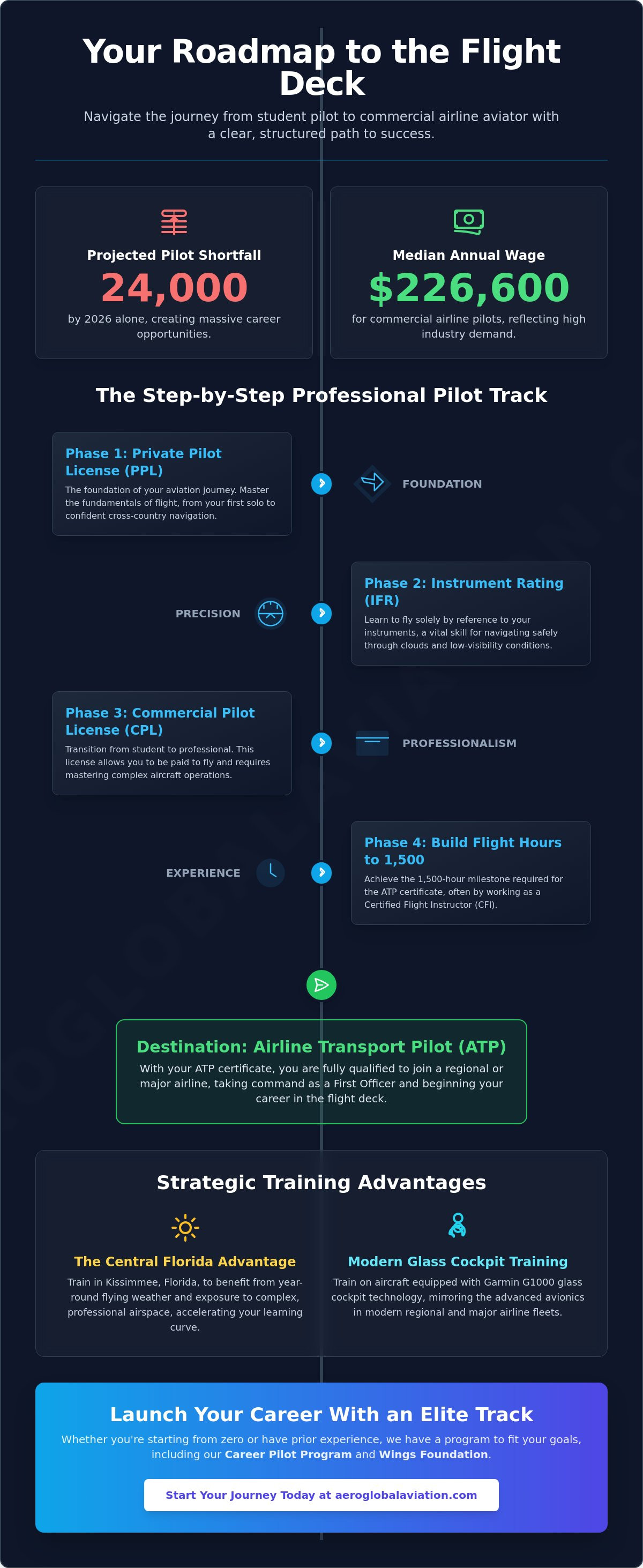
Major airlines prioritize candidates who have followed a standardized pilot licensing and certification process. This structure proves you can handle the discipline of a professional cockpit. Your journey typically begins with the Private Pilot License (PPL), where you learn the fundamentals of flight. From there, you move into the precision of an Instrument Rating (IFR), which allows you to fly in varied weather conditions. The path continues through the Commercial Pilot License (CPL) and often includes instructor ratings to help you reach the 1,500-hour milestone required for an Airline Transport Pilot certificate. Programs like our Career Pilot Program are designed to guide you through these milestones without the guesswork.
Beyond the certificates, you'll experience a profound psychological shift. You're training to be the pilot-in-command (PIC). This means moving from a passive observer to the final authority responsible for the safety of the aircraft. It's a rewarding transition that builds the confidence and leadership skills needed to lead a crew in a commercial environment.
The Core Components of a Professional Program
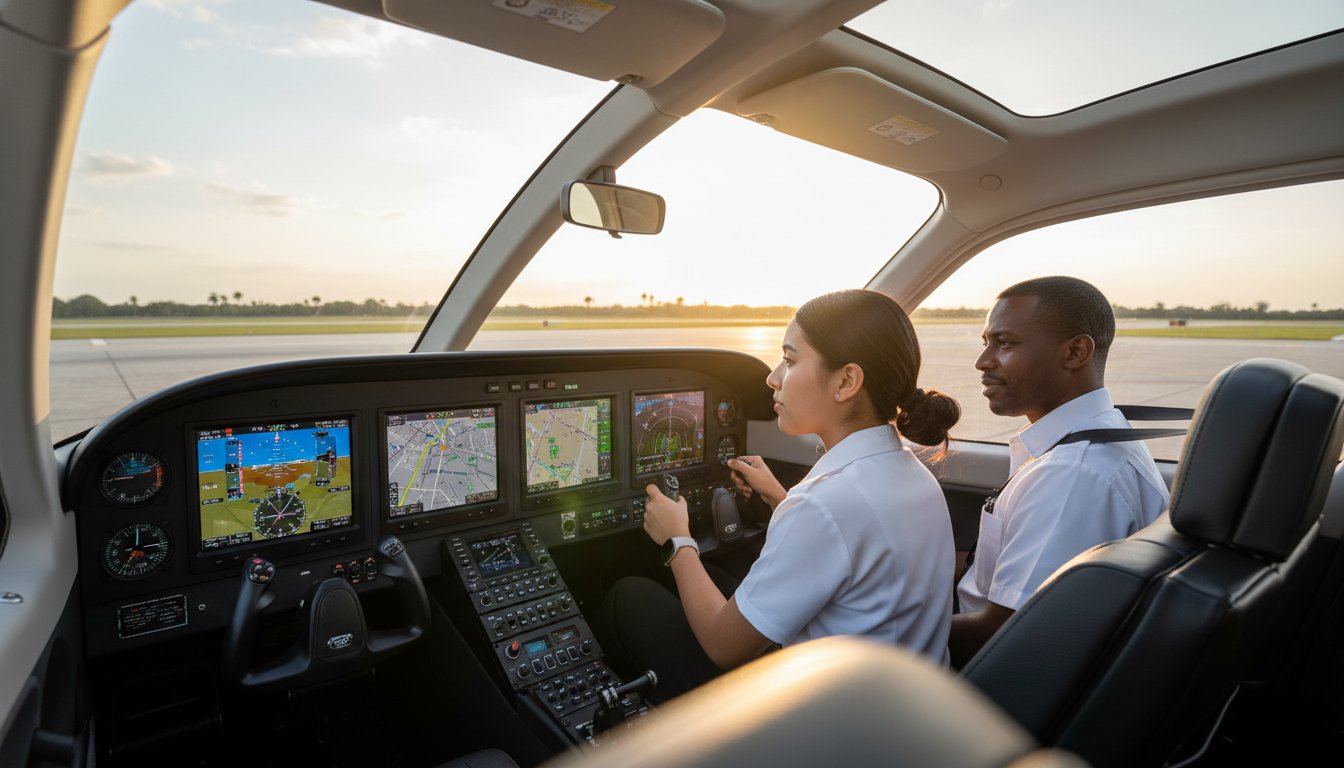
A successful career track balances intensive ground school with practical flight hours. You don't just memorize facts; you apply theory in real-time. Modern programs utilize high-performance aircraft equipped with glass cockpit technology, such as the Garmin G1000. Training on these systems early is vital because it mirrors the advanced avionics you'll find in regional jets. This consistency ensures your transition to an airline is as smooth and logical as possible.
Why 2026 is the Ideal Year to Start Your Journey
The industry is currently facing its most acute pilot shortage, with a predicted shortfall of 24,000 pilots in 2026. As thousands of senior captains reach the mandatory retirement age, major carriers like American Airlines and Delta are hiring aggressively to maintain their schedules. Starting your training now puts you in a prime position to benefit from rapid career advancement and improved working conditions. The current landscape of regional airline flow-through programs means your path to a major carrier is more direct than ever before.
The Step-by-Step Roadmap: From First Solo to the Flight Deck
The journey to the commercial cockpit is a structured evolution of skill and responsibility. You won't just learn to fly; you'll learn to manage a complex machine with absolute precision. A dedicated professional pilot track ensures that each hour you spend in the air contributes directly to your ultimate goal. By following a logical progression of ratings, you transform from a curious student into a disciplined aviator ready for the demands of the airline industry.
Phase 1 & 2: Building the Essential Skills
Your foundation begins with the Private Pilot License (PPL). This is where you experience the thrill of your first solo and master the art of takeoffs and landings. You'll also tackle cross-country navigation, learning to move between airports with confidence. Once you've secured your PPL, you move into the precision phase: Instrument Flight Rules (IFR). During this stage, you learn to fly solely by reference to your instruments, or "the gauges." This skill is vital because it allows you to navigate safely through clouds and low-visibility conditions. These early hours are critical for your long-term safety record, as they establish the habits you'll carry for the rest of your career. You can review the official FAA pilot requirements to see how these certifications fit into the broader regulatory landscape.
Phase 3 & 4: Transitioning to Professional Employment
Transitioning to professional employment requires a significant shift in mindset. Achieving your Commercial Pilot License (CPL) involves mastering complex aircraft operations and high-performance maneuvers. You'll learn to operate at a higher standard of accuracy, preparing you for the professional environment of a regional or major carrier. However, the biggest challenge for many is the "Time Building" phase. To fly for a U.S. airline, you typically need to reach 1,500 total flight hours.
Many students find that earning their Certified Flight Instructor (CFI) ratings is the most efficient way to bridge this gap. Teaching others forces you to master every concept yourself. It's the ultimate way to sharpen your skills while gaining the experience airlines look for in new hires. If you're looking for a comprehensive path that takes you from zero experience to advanced instructor certification, our Airline Pilot Elite track provides the mentorship you need to reach the flight deck. By becoming an instructor at Aero Global, you don't just build hours; you build the leadership qualities that define a successful captain.
The Central Florida Advantage: Why Kissimmee is a Global Training Hub
Success in aviation often comes down to your environment. While many students focus solely on the aircraft or the curriculum, your geographic location is a powerful lever that can accelerate your career. Central Florida has established itself as a global epicenter for flight training for several tactical reasons. When you enroll in a professional pilot track in this region, you're placing yourself in a high-density learning environment that mirrors the reality of professional airline operations. It's about more than just flying; it's about training where the industry lives and breathes.
Training near Orlando International (MCO) provides an immediate advantage in airspace complexity. You'll learn to communicate with air traffic control in one of the busiest terminal areas in the country. This isn't just practice; it's a daily masterclass in situational awareness and professional radio etiquette. These skills are essential for the high-level responsibilities outlined in the pilot career outlook, where precision and communication are the pillars of a successful career. You'll also find yourself surrounded by major airline maintenance hubs and crew bases, providing a natural networking ground that simply doesn't exist in more isolated locations.
Kissimmee Gateway Airport (KISM) as a Training Asset
Kissimmee Gateway Airport serves as the ideal base for your training. It offers the perfect balance of professional infrastructure and operational efficiency. Unlike major international hubs where you might spend thirty minutes idling on a taxiway, KISM allows for frequent takeoffs and landings. This efficiency means you spend your time and budget on actual flight maneuvers rather than waiting for clearance. With diverse runway configurations and multiple instrument approach options, it provides a comprehensive classroom for any pilot training kissimmee program. You get the complexity you need to grow without the congestion that slows you down.
Training Efficiency in the Florida Climate
The Florida climate is perhaps your greatest asset for staying on schedule. With over 350 flyable days per year, you won't have to worry about your progress stalling due to weeks of winter weather or persistent ice. This consistency is vital for maintaining your muscle memory and "flight feel." While you'll enjoy plenty of sunshine, you'll also gain valuable experience navigating tropical weather patterns and convective activity. Learning to respect and navigate these conditions under the guidance of a mentor makes you a safer, more capable pilot. Choosing a location with year-round reliability ensures that your transition from student to professional stays on a fast, predictable timeline.
Evaluating Your Options: Fast-Track vs. Modular Pilot Training
Deciding on the right professional pilot track is a personal milestone that requires honest self-reflection. You'll need to weigh the benefits of speed against the flexibility of your current lifestyle. In Florida, you generally choose between accelerated programs and modular training. Accelerated tracks are designed for full-time immersion, moving you through ratings quickly to capitalize on the 2026 pilot shortage. Modular tracks allow you to progress at a steadier rhythm, which is ideal if you're balancing flight school with a full-time job or family commitments.
The regulatory environment in Florida also offers choices between Part 61 and Part 141 training. Part 141 programs follow a rigid, FAA-approved syllabus that often appeals to airline recruiters because of its high level of structure. Part 61 is more instructor-driven and flexible, allowing you to tailor the lessons to your specific needs. Both paths lead to the same destination, but your choice of professional pilot track should consider the long-term return on investment. With the median annual wage for airline pilots reaching $226,600 in 2024, the initial commitment to your training pays dividends quickly once you reach the captain's seat.
Choosing the Right Pace for Your Success
Before you dive in, ask yourself if you're ready for the mental demands of daily flying. High-intensity programs require total focus to avoid burnout. You should look for a partner that offers mentorship rather than just a fast-track factory environment. When researching the best flight schools in florida, check if their curriculum matches your learning style and provides the supportive atmosphere you need during challenging phases like instrument training.
The Financial Picture of a Professional Track
Your financial strategy is just as important as your flight hours. Many students explore student pilot loans or specialized financing partnerships to cover their training. While pay-as-you-go modular training helps avoid large upfront debts, all-inclusive program structures often provide better long-term value by bundling essential costs. Be sure to account for expenses like FAA written exam fees, examiner checkride fees, and required flight materials. If you're ready to start with a solid foundation, our Career Pilot Program offers a targeted path that streamlines your progression from PPL to CPL.
Launch Your Career with Aero Global Aviation Academy’s Elite Tracks
Choosing a professional pilot track is the most significant decision you'll make in your aviation career. At Aero Global Aviation Academy, we don't just provide flight hours; we offer a structured environment where mentorship and technical excellence meet. Our training center in Kissimmee is designed to transform your passion into a professional reality through programs tailored to your specific goals. We believe that your success is our success, and our practical mentor approach ensures you never feel like just another number in a logbook.
If you're just starting, our Wings Foundation course focuses exclusively on the Private Pilot License (PPL). It's the bedrock of your training, where you'll gain the fundamental skills and confidence needed to command an aircraft safely. For those ready to move toward professional employment, our Career Pilot Program provides a targeted path from PPL to the Commercial Pilot License (CPL). This track is ideal for students who want to focus on the essential commercial ratings required for entry-level pilot roles while maintaining a clear focus on the flight deck.
The Airline Pilot Elite Difference
Our most comprehensive offering is the Airline Pilot Elite track. This program takes you from zero experience all the way through your advanced instructor certifications. We address the industry gap by positioning the instructor phase as the ultimate career launchpad rather than just a hurdle. By teaching others, you solidify your own knowledge and build the leadership skills that major airlines value most. This track covers the full spectrum of ratings, ensuring you're "airline ready" by the time you finish. We prioritize high commercial pilot training standards that align with 2026 industry expectations. One of the most significant advantages is the potential for instructor placement within Aero Global Aviation Academy, allowing you to build your 1,500 hours in a familiar, professional environment.
Your Next Steps to the Cockpit
Your journey begins with a simple, exciting step: booking a discovery flight. This allows you to meet our instructors, see our fleet, and experience the Kissimmee training environment firsthand. Before you start your formal training, you'll need to obtain an FAA medical certificate and meet TSA requirements for flight training. We're here to guide you through every administrative hurdle so you can focus on the sky. The demand for pilots is at a historic high, and there's never been a better time to commit to your future. Join the next generation of professional pilots and take control of your destination today.
Take Command of Your Future in the Skies
The path to the airline flight deck is more attainable than ever before. You've explored the technical milestones and the environmental advantages that make Central Florida a global training hub. Choosing a professional pilot track is about more than just logging hours; it's about building a legacy of safety and leadership under the guidance of those who understand the industry's highest standards. By synthesizing a structured curriculum with the strategic benefits of our local airspace, you're positioning yourself for a career defined by both stability and adventure.
Aero Global Aviation Academy is committed to your individual success, offering the expert mentorship and modern, glass-cockpit fleet necessary to bridge the gap between student and captain. From our comprehensive PPL to CFI curriculum to our high-intensity training environment in Kissimmee, every element of your education is optimized for a seamless transition to the airlines. Take the final step toward your commercial career and join a community dedicated to excellence. Apply for the Aero Global Aviation Academy Professional Pilot Track Today and prepare to reach your ultimate destination. The sky is no longer the limit; it's your new office.
Frequently Asked Questions
How long does a professional pilot track typically take to complete?
You can expect to complete the initial certifications of a professional pilot track in 10 to 12 months if you train on a full-time schedule. However, the total journey to the flight deck usually requires about two years to reach the 1,500-hour requirement for an Airline Transport Pilot certificate. Your specific timeline depends on your training frequency and the local weather conditions in your region.
Can I start a professional pilot track with zero flight experience?
Yes, you can begin your training with absolutely zero flight experience. Most of our students start from the ground up, beginning with the Wings Foundation course to earn their Private Pilot License. We provide a structured environment that guides you through every technical milestone, ensuring you build a safe and professional foundation from your very first hour in the cockpit.
What is the difference between a career pilot program and a standard flight school?
A professional pilot track offers a structured, goal-oriented curriculum specifically designed to meet rigorous airline hiring standards. Unlike standard flight schools that might focus on recreational flying, career programs prioritize proficiency in advanced avionics and complex airspace operations. This approach ensures you build the specific resume credentials and leadership skills that regional and major carriers look for in new first officers.
Is Florida the best place for professional pilot training?
Central Florida is widely considered a premier location for flight training because it offers over 350 flyable days per year. This consistent weather allows you to maintain momentum and complete your ratings without the long seasonal delays common in other states. Additionally, training near busy hubs like Orlando prepares you for the high-intensity communication and situational awareness required in professional airline environments.
What are the medical requirements for a professional pilot track?
To pursue an airline career, you must obtain an FAA First-Class Medical Certificate from an authorized aviation medical examiner. This exam evaluates your vision, which must be correctable to 20/20, as well as your hearing and overall cardiovascular health. It's a smart move to secure this certificate before starting your professional pilot track to ensure you meet all regulatory health standards for commercial employment.
How do I build the 1,500 hours required for the airlines?
Most pilots build their 1,500 hours by working as a Certified Flight Instructor (CFI) after they complete their commercial training. This path allows you to earn a professional income while gaining valuable leadership experience and sharpening your technical skills. Other options include aerial photography or pipeline patrol, but flight instruction remains the most common and effective way to reach the cockpit of a major carrier.
What is the job outlook for professional pilots in 2026?
The job outlook for 2026 is exceptionally strong, with the industry facing a predicted shortfall of 24,000 pilots this year alone. The U.S. Bureau of Labor Statistics projects about 18,200 annual openings for airline and commercial pilots through 2034. With median annual wages reaching $226,600 in 2024, the return on your training investment is higher than it has been for decades.
Does Aero Global Aviation offer financing for the professional pilot track?
You should explore specialized aviation lenders that offer financing specifically for professional flight training programs. Many students secure loans that cover the full cost of their path from Private Pilot through Commercial certification with flexible repayment terms. While you should check with our admissions team for current resources, we can point you toward the most common financial partnerships that help students manage their training budget effectively.


