
What if the secret to a successful checkride isn't just memorizing a sequence, but truly mastering the energy of your aircraft? Transitioning from the intuitive feel of a private pilot to the surgical precision required for commercial pilot maneuvers is the defining moment of your professional journey. You've likely felt the frustration of a Power-off 180 that just won't land on the numbers, or the confusion of calculating Pivotal Altitude while battling Florida's midday thermals. It's a high-stakes transition, especially when Boeing's 2023 outlook projects a global need for 649,000 new pilots over the next two decades.
We understand that the shift to the FAA-S-ACS-7B standards demands more than just flying skills; it requires a deep grasp of risk management and technical accuracy. This article provides a clear, actionable checklist to help you master every requirement and gain the confidence needed to excel. You'll find pro-tips for navigating Florida's unique wind patterns and a breakdown of the 2026 digital testing environment. Whether you're moving through our Wings Foundation or preparing for the final stages of the Career Pilot Program, these insights will ensure you're ready to turn your professional aspirations into a rewarding reality.
Key Takeaways
- Discover how to bridge the precision gap by mastering the tighter +/- 50-foot altitude tolerances expected of a professional aviator.
- Unlock the secrets to Eights-on-Pylons with our simplified 2026 formula for calculating pivotal altitude during your commercial pilot maneuvers sessions.
- Master the art of energy management with specific checklists for the Chandelle and Lazy Eight to ensure smooth, constant-radius performance.
- Gain a tactical advantage for the Power-Off 180-Degree Accuracy Approach with expert tips designed for Florida’s unique wind and thermal conditions.
- Learn why verbalizing your steps and executing thorough clearing turns are the essential habits that build immediate rapport with your Designated Pilot Examiner.
The Precision Gap: Why Commercial Pilot Maneuvers Matter
Most student pilots view the jump to a commercial certificate as just another rating to check off. It's actually a complete transformation of your identity as an aviator. Commercial pilot maneuvers aren't just "tricks" or fancy flight patterns; they are high-precision tasks designed to prove you have total mastery over the aircraft's energy state. While a private pilot focuses on the safe completion of a task, a commercial pilot must execute with surgical accuracy. This shift is what separates a recreational flyer from a professional who is ready to carry passengers for hire.
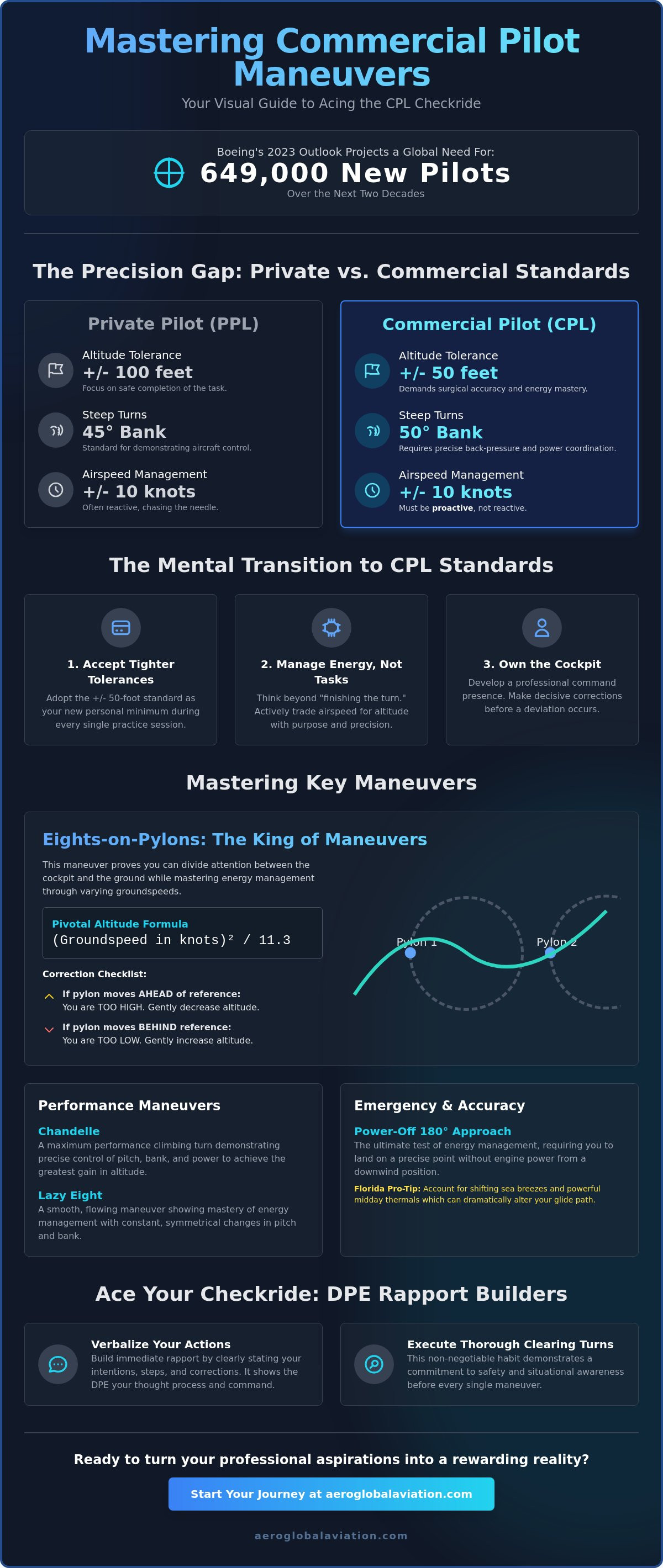
The most visible change is the "Precision Gap." You're moving from the Private Pilot tolerance of +/- 100 feet to a much tighter Commercial tolerance of +/- 50 feet. In 2026, even as flight decks become more automated, the FAA's ACS-7B standards double down on these core stick-and-rudder skills. Mastery of a Chandelle maneuver or a Lazy Eight shows you can manage lift, drag, and power without letting the aircraft get ahead of you. These skills are the bedrock of our career pilot program, where we help you transition from a "feel" based approach to one of absolute technical discipline.
Why does this 50-foot difference matter so much? It's about the passengers in the back and the safety of the national airspace. A pilot who can't hold altitude within 50 feet during a maneuver might struggle with complex IFR clearances or high-density traffic environments. By focusing on the precise interplay between pitch, bank, and power, you'll find that these commercial pilot maneuvers become second nature rather than a source of checkride anxiety. It's a high bar, but you can meet it.
Checklist: The Mental Transition to CPL Standards
- Accept Tighter Tolerances: Adopt the +/- 50-foot standard as your new personal minimum during every practice session.
- Manage Energy, Not Just Tasks: Stop thinking about just "finishing the turn." Start thinking about how you're trading airspeed for altitude at every degree of bank.
- Own the Cockpit: Develop a professional "command presence." You're the pilot in command, which means making decisive corrections before a deviation occurs.
Comparison: Private vs. Commercial Maneuver Standards
Understanding the specific data points helps clarify the level of excellence required for your CPL checkride. While the tasks may look similar, the expectations for coordination and smoothness are significantly higher.
- Altitude: PPL allows for +/- 100 feet; CPL requires staying within +/- 50 feet.
- Airspeed: While both standards often cite +/- 10 knots, CPL examiners look for proactive power management rather than reactive chasing of the needle.
- Bank Angles: Steep turns increase from a 45-degree bank in PPL to a precise 50-degree bank for CPL, requiring much more back-pressure and power coordination.
Ground Reference Mastery: Eights-on-Pylons Checklist
Eights-on-pylons stands as the "King of Maneuvers" for a reason. It demands that you divide your attention between the cockpit and the ground while maintaining a precise line of sight with almost subconscious effort. Unlike private pilot tasks, these commercial pilot maneuvers require you to understand the purpose of commercial maneuvers as a way to master energy management through varying groundspeeds. In the flat terrain around Kissimmee, you don't have hills to worry about, but you do have the midday Florida thermals and the shifting sea breeze. These environmental factors can easily bump you off your pivotal altitude or change your groundspeed mid-turn, making the pylon feel like a moving target.
The core of this maneuver is the pivotal altitude. While your 2026 flight computer can give you a digital readout, the classic formula remains groundspeed squared divided by 11.3 (for knots). A frequent mistake is trying to "force" the pylon into position with the elevator by chasing it. If the pylon moves ahead of your reference point, you're too high; if it moves behind, you're too low. Instead of fighting the controls, focus on how your groundspeed changes as you turn from downwind to upwind. This level of technical coordination is exactly what we refine in our Career Pilot Program to ensure you're ready for the professional stage.
Pylon Selection Checklist for Central Florida
Finding the right spot is half the battle. Our local environment offers plenty of options, but you must choose wisely to satisfy the DPE's expectations for safety and planning.
- Identify Isolated Landmarks: Look for two prominent, isolated points like a specific barn or a lone intersection, ideally spaced 1/2 to 1 mile apart.
- Check Wind Alignment: Ensure landmarks are crosswind from each other so you can enter the pattern on a 45-degree downwind.
- Noise Abatement: Avoid active residential areas or livestock. Maintaining a "Good Neighbor" policy is part of your professional responsibility.
Execution Checklist: Maintaining the Line of Sight
Once you've picked your pylons, the real work begins. Your goal is to keep that wingtip pinned to the target through varying bank angles and altitudes.
- The Entry: Enter at your calculated pivotal altitude on a 45-degree angle toward the midpoint between your two pylons.
- Crab Awareness: Use crabbing to stay on your intended ground track. Don't let the wind push you too far from your pylon.
- Pylon Movement: Watch the pylon's movement relative to your wingtip reference. If it drifts ahead, descend; if it lags behind, climb.
- Stay Coordinated: Keep the ball centered. Uncoordinated flight during commercial pilot maneuvers is an immediate red flag for any examiner.
Performance Maneuvers: Chandelles and Lazy Eights
Performance maneuvers represent the pinnacle of technical aircraft control. While ground reference tasks teach you to focus on external points, Chandelles and Lazy Eights require you to internalize the airplane's limits. These commercial pilot maneuvers serve as the ultimate test of your ability to maintain coordination while airspeed and bank angles are in constant flux. Developing this level of mastery is essential for those moving into advanced flight training, where managing high-performance systems becomes the daily standard. You aren't just flying a pattern; you're demonstrating that you can command the aircraft at the very edges of its flight envelope.
The Chandelle is often described as a maximum performance climbing turn. It’s a test of patience and rudder coordination. As your airspeed decays during the climb, you'll feel the overbanking tendency try to pull the aircraft into a steeper turn. You've got to use precise, proactive rudder and aileron pressure to keep that bank locked at 30 degrees during the first half. By the time you reach the 180-degree point, the 2026 ACS standards expect your airspeed to be just above stall speed and your heading to be within ±10 degrees of your target. It's a delicate dance between lift and drag that requires your full attention.
Lazy Eights are perhaps the most beautiful maneuvers in the CPL syllabus, but they are also the most demanding. It’s the only task where every variable, including pitch, bank, and airspeed, is changing at every single moment. There is no "steady state" here. You must hit specific milestones at the 45, 90, and 135-degree points of each turn. Success means crossing the 180-degree point at your entry altitude (within ±100 feet) and airspeed (within ±10 knots). This rhythm proves you have the "stick-and-rudder" soul of a professional pilot.
The Chandelle Execution Checklist
- Step 1: Establish your entry speed (Va) and ensure the aircraft is in a clean configuration.
- Step 2: Roll into a coordinated 30-degree bank, then initiate a smooth, maximum-climb pitch.
- Step 3: Maintain a constant 30-degree bank for the first 90 degrees of the turn while steadily increasing pitch.
- Step 4: Begin a constant rate of rollout for the second 90 degrees, aiming to reach level wings and a near-stall airspeed exactly at the 180-degree point.
The Lazy Eight Flow Checklist
- Reference Point: Identify a clear 90-degree reference point on the horizon before beginning.
- Quadrant 1: Start a simultaneous climb and roll. You should reach your maximum pitch up and a 15-degree bank at the 45-degree point.
- Quadrant 2: Gradually decrease pitch and increase bank. You should reach level pitch and your maximum 30-degree bank exactly at the 90-degree point.
- Quadrant 3: Allow the nose to slice through the horizon. Reach your maximum pitch down and 15-degree bank at the 135-degree point.
- Verify: Ensure you are crossing the 180-degree point at your original entry altitude and airspeed before starting the turn in the opposite direction.
Emergency & Accuracy Maneuvers: Steep Spirals and the Power-Off 180
While performance maneuvers test your finesse, emergency and accuracy tasks test your judgment under pressure. These commercial pilot maneuvers are designed to simulate real-world scenarios where precision isn't just about a score; it's about safety. Mastering these skills is a core requirement of commercial pilot training because they prove you can handle an engine failure or a rapid descent while maintaining absolute control over your landing spot. You're moving beyond basic stick-and-rudder skills into the realm of professional energy management.
In Central Florida, particularly around Kissimmee, the afternoon thermals add a layer of complexity to these tasks. During a steep spiral or a Power-Off 180, rising air from the heated pavement can unexpectedly extend your glide. If you're practicing over the flat fields south of Orlando, you've got to be ready to adjust your bank or use a slip to keep your aircraft on the intended profile. It's this ability to adapt to the environment that marks you as a professional. You aren't just flying a checklist; you're responding to the atmosphere in real time to achieve a specific, high-stakes result.
The Power-Off 180-Degree Accuracy Approach is often called the "Checkride Killer" because it leaves zero room for error. Once the throttle hits idle, you become a glider pilot. You have one shot to manage your descent and configuration to touch down within 200 feet of your specified point. If you're ready to master these high-precision skills with a dedicated mentor, our Career Pilot Program provides the structured environment you need to succeed.
Steep Spiral Checklist: Wind Correction Mastery
- Pick your spot: Select a small, distinct ground reference like a crossroads or a lone silo that is easily visible from 3,000 feet AGL.
- Adjust bank angle: Your bank must be constantly changing. Use your steepest bank (up to 60 degrees) when you have a tailwind and your shallowest bank when facing the wind.
- Monitor the radius: The goal is a constant radius. If you drift away from your spot, you haven't corrected enough for the wind's push.
- The Finish: Complete at least three 360-degree turns and roll out on a specified heading or altitude as directed by the examiner.
Power-Off 180 Accuracy Landing Checklist
- The Start: When you're abeam the "thousand-footers" on downwind, pull the power to idle immediately. Don't hesitate.
- Pitch for Vg: Establish your best glide speed (Vg) and maintain it religiously. Any deviation in airspeed will change your touchdown point.
- Strategic Configuration: Don't dump your flaps all at once. Use them as "altitude brakes" to fine-tune your glide path as you turn base and final.
- The Slip: If you find yourself high and fast, use a forward slip to lose altitude without gaining airspeed. If you're low, square your base turn slightly to cut the distance, but always stay mindful of your stall margins.
- The Goal: Your wheels must touch the pavement at or within 200 feet beyond your designated landing spot.
Checkride Readiness: Your Final CPL Maneuvers Checklist
The day of your commercial checkride is the culmination of every hour spent in the practice area. While your technical ability to fly commercial pilot maneuvers is vital, your professionalism and "command presence" often carry the most weight with a Designated Pilot Examiner (DPE). Many students possess the skill but fail on simple procedural oversights. The most common pitfall? Forgetting to clear the area. Failing to perform thorough clearing turns before starting a maneuver is a leading cause of immediate disqualification. It shows a lack of situational awareness that a professional pilot simply cannot afford.
One of the best ways to build rapport with your examiner is to verbalize the maneuver. Don't just fly; lead. By "calling your shots" and explaining exactly what you're doing, you show the DPE that you're ahead of the airplane. For example, during a Chandelle, announce your 30-degree bank and your rollout point. If you notice you've exceeded a tolerance, like dipping 60 feet below your altitude, don't freeze. Acknowledge it immediately and initiate a calm, professional correction. The ACS-7B standards allow for minor deviations if you demonstrate the judgment to recognize and fix them promptly. This shows you're ready for the responsibility of a CPL license.
Once you've mastered these final steps, you're ready to transition from a student to a professional. The road doesn't end at the checkride; it's the beginning of a lifelong journey in the flight deck. Whether you're aiming for a regional carrier or corporate aviation, the precision you've built here is your foundation for our Career Pilot Program and beyond.
Pre-Maneuver 'Flow' Checklist
Consistency is the hallmark of a professional. Use this flow before every single task to ensure you never miss a safety step.
- Clearing Turns: Perform two 90-degree turns or one 180-degree turn. Scan above, below, and behind.
- Configure the Aircraft: Turn the fuel pump ON, set the mixture to RICH, and switch the landing light ON.
- Digital Verification: Check your G1000 or ADS-B display for nearby traffic, but keep your "eyes outside" as your primary source of safety.
- Altitude and Area: Confirm you're at a safe altitude for recovery and that you aren't over a congested area or under a cloud deck.
The Aero Global Aviation Academy Advantage in Kissimmee
Training in Central Florida provides a unique edge that few other locations can match. At Aero Global Aviation Academy, our instructors act as "Practical Mentors" who understand that passing the checkride is just the first step. We utilize Orlando's complex, high-volume airspace to sharpen your professional awareness and communication skills, ensuring you're comfortable in any environment. This real-world experience is why so many of our graduates successfully transition into the industry. Are you ready to take the next step toward the flight deck? Join our Airline Pilot Elite program today and start your journey with a team dedicated to your individual success.
Launch Your Professional Flight Career with Confidence
Mastering commercial pilot maneuvers is the final hurdle that transforms a skilled student into a disciplined professional ready for the airlines. Throughout this guide, we've broken down the precision required for the ACS standards and explored how to navigate the unique environmental factors of Central Florida. By applying these checklists, you aren't just preparing for a checkride; you're building the surgical accuracy needed for a safe, lifelong career in aviation.
At Aero Global Aviation Academy, our training base at Kissimmee Gateway Airport offers the ideal setting to refine these skills. With our G1000 equipped training fleet and expert instructors who bring real-world airline experience to every lesson, we provide the mentorship necessary to excel. We pride ourselves on being a dedicated local partner invested in your individual success, ensuring your transition to the professional flight deck is both structured and rewarding.
Master your maneuvers in the Florida sun—Apply for the Career Pilot Program today! We look forward to helping you reach your destination.
Frequently Asked Questions
What is the most difficult commercial pilot maneuver?
Most pilots consider the Power-Off 180-degree accuracy approach the most challenging task because it requires perfect energy management without the safety net of a throttle. You must judge wind, sink rates, and glide distance with zero room for error. Mastering this proves you can handle an engine failure with professional composure and hit your touchdown point every time.
How many hours of training are required for commercial maneuvers?
While the FAA requires 250 total flight hours for a Part 61 certificate, the time dedicated specifically to commercial pilot maneuvers varies by student. Most applicants spend between 10 and 20 hours specifically refining these high-precision tasks to meet ACS standards. Consistency is more important than total hours, so we recommend focused, frequent practice sessions to build muscle memory.
Can I fail my checkride for exceeding one ACS tolerance during a maneuver?
Exceeding a tolerance doesn't always result in an immediate failure if you recognize and correct the deviation promptly. The ACS evaluates your overall judgment and risk management throughout the entire flight. If you notice an altitude slip and verbalize your correction while returning to the standard, the examiner often views this as a sign of professional situational awareness.
Why is the Power-Off 180-degree accuracy landing so important?
This maneuver is vital because it simulates a real-world engine failure on the downwind leg of a landing pattern. It forces you to understand the aircraft's glide performance and configuration limits under pressure. Successfully hitting your landing spot confirms that you can safely bring the airplane home when power is no longer an option, which is a critical professional skill.
What is 'Pivotal Altitude' and how do I calculate it in flight?
Pivotal altitude is the specific height where the aircraft's groundspeed allows the line of sight to remain fixed on a ground point. To calculate it in flight, square your groundspeed in knots and divide by 11.3. Since groundspeed changes with the wind, you'll need to adjust your altitude throughout the maneuver to stay pivoted on your pylon without using the elevator to force the point.
How do Florida thermals affect my Lazy Eights?
Florida's midday thermals can create unexpected lift or sink that disrupts the constant rhythm of a Lazy Eight. Rising air from heated pavement can make the aircraft float during the downward slice, potentially causing you to overshoot your exit altitude. You must stay proactive with your pitch control to maintain the required symmetry despite these local atmospheric changes during your descent.
What are the specific ACS bank angle requirements for a commercial steep turn?
The ACS requires a 50-degree bank angle for commercial steep turns, which is a significant increase from the 45-degree bank used in private pilot training. This steeper angle increases the load factor and requires more aggressive power and back-pressure coordination. You must maintain this bank within plus or minus 5 degrees while holding your altitude within a tight 50-foot window.
Do I need to perform these maneuvers in a complex or high-performance aircraft?
You don't strictly need a complex aircraft with retractable gear and a constant-speed propeller to take your commercial checkride anymore. The FAA now allows the use of Technically Advanced Aircraft (TAA) equipped with modern glass cockpits for commercial pilot maneuvers. Many of our students prefer our G1000-equipped fleet because it provides the digital precision and situational awareness needed to excel.


