Did you know that Florida offers over 300 flyable days every year, making it the fastest launchpad for a professional aviation career in the country? You've likely felt that incredible rush of adrenaline after earning your Private Pilot License, only to immediately face a wall of questions about what happens next. It's completely normal to feel a bit lost when looking at the jump from leisure flying to a professional cockpit, especially when you're trying to decode the commercial pilot license requirements Florida flight schools expect you to master.
We understand that the sequence of advanced ratings can feel like a complex puzzle. This guide provides the clarity you need by laying out a definitive 2026 roadmap for your career advancement. You'll discover the most efficient sequence for your instrument and multi-engine ratings, learn how to build your flight hours strategically, and see exactly how to transition into a professional pilot program. Whether your goal is the captain's seat at a major airline or a local corporate gig, your journey from a PPL holder to a career aviator starts right here in the Sunshine State.
Key Takeaways
- Learn the immediate rights your PPL grants you, from commanding aircraft as Pilot-in-Command to sharing the joy of flight by splitting pro-rata expenses with friends and family.
- Discover how to leverage Central Florida's 300+ flyable days to efficiently build the flight hours needed to reach the next stage of your professional career.
- Understand why the Instrument Rating is the essential bridge to professional aviation, allowing you to navigate complex weather and expand your operational limits safely.
- Get a clear, step-by-step breakdown of the commercial pilot license requirements Florida pilots must meet to transition from recreational flying to a professional career.
- Explore how a structured, airline-oriented environment like the Career Pilot Program can streamline your path from a local aviator to a commercial flight deck.
Immediate Privileges: What Can You Do with a PPL Today?
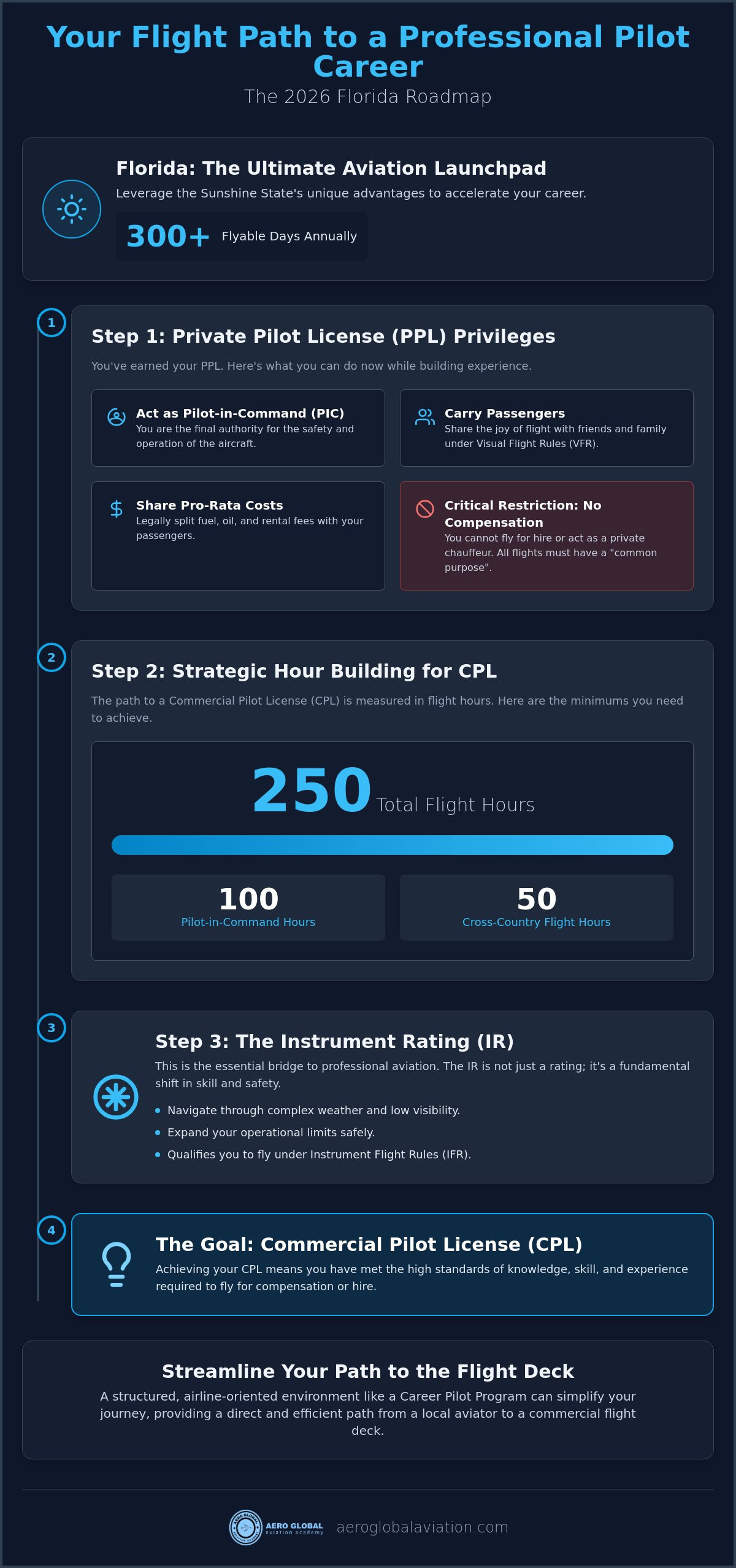
Earning your Private Pilot License (PPL) is a transformative milestone that changes your relationship with the sky forever. You're no longer a student following an instructor's lead; you're now the Pilot-in-Command (PIC). This means you hold the final authority and responsibility for the operation and safety of your aircraft. According to the standards for Pilot certification in the United States, you're legally authorized to fly solo or carry passengers anywhere in the country under Visual Flight Rules (VFR). It's a thrill that never gets old, whether you're taking your family for a sunset tour over the coast or flying a cross-country trip to a new city for the weekend.
Beyond the personal satisfaction, your PPL allows you to share the joy of aviation with others. You can split pro-rata flight expenses with your passengers, which includes costs like fuel, oil, airport expenditures, and rental fees. This makes building experience much more affordable as you begin looking toward the future. These early hours are essential. Every minute you spend in the cockpit helps you build the confidence and stick-and-rudder skills necessary to eventually meet the commercial pilot license requirements Florida aviators must achieve for a professional career.
The "No Compensation" Rule
While your new license offers incredible freedom, you must remember that you cannot yet fly for hire. The FAA is very strict about the "no compensation" rule. To share costs, you must have a "common purpose" for the flight. This means you and your passengers should be traveling to the destination for a shared reason, such as a business meeting or a vacation, rather than you simply acting as a private chauffeur. Maintaining strict logbook discipline during this phase is critical. Accurate records of your PIC time ensure that every flight counts toward your next rating, moving you closer to the professional standards expected in our Career Pilot Program.
Exploring Florida from the Air
Florida is a premier training ground because of its unique geography and diverse airspace. With your PPL, you can fly from our base in Kissimmee down to the Florida Keys for a day trip or even head across the water to the Bahamas with the proper endorsements. You'll gain vital experience navigating through everything from quiet Class G strips to the complex Class B airspace surrounding major hubs like Orlando and Miami. These first 50 hours of PIC time are often the most formative. They challenge your decision-making and prepare you for the structured environment you'll encounter as you work through the commercial pilot license requirements Florida flight schools demand for advanced certification.
Strategic Hour Building: Why Florida is the Ultimate Launchpad
Earning your PPL is an incredible achievement, but if your goal is a professional flight deck, you're now entering the "time-building" phase. To transition to a commercial level, you need to reach a minimum of 250 total flight hours. While this sounds like a daunting climb, Florida pilots have a distinct competitive advantage. With over 300 flyable days each year, the Sunshine State allows for a level of consistency that's impossible to find in the snowy north or the foggy coastlines. You won't spend weeks grounded by weather; instead, you'll be in the air, refining your skills and building momentum.
The FAA commercial pilot requirements specify that you need 100 hours of pilot-in-command time and 50 hours of cross-country flight. In Central Florida, this isn't just about "boring holes in the sky." The Orlando-Kissimmee corridor offers some of the most complex and rewarding airspace in the world. Navigating around Class B airspace and communicating with busy controllers prepares you for the high-stakes environment of commercial aviation. It's the perfect place to master the commercial pilot license requirements Florida examiners expect to see during your future checkride.
Cross-Country Flight Strategies
To satisfy FAA requirements, a cross-country flight must involve a landing at an airport more than 50 nautical miles from your point of origin. Using Kissimmee Gateway Airport (KISM) as your hub, you have access to an incredible variety of destinations. You can plan missions to the coastal breezes of Vero Beach, the busy patterns of Tampa, or the unique island-hopping feel of the Florida Keys. These varied routes expose you to different terrain and coastal weather patterns, which builds the resilience and decision-making skills required of a professional aviator.
While building your cross-country hours, you might even consider a long-distance trip to the famous red rocks of the Southwest. In such a scenic locale, you can discover Wine Tours of Sedona for a private, customizable tasting experience that makes the journey even more memorable.
Splitting Time and Networking
Building hours doesn't have to be a solitary or prohibitively expensive journey. Many pilots utilize "safety piloting" to split the cost of aircraft rentals. One pilot flies "under the hood" to practice instrument maneuvers while the other acts as a safety observer; in many cases, both can log the time. This phase is also your first real opportunity to network within the Orlando aviation community. By connecting with fellow aviators, you'll find time-building partners who share your professional ambitions. If you're ready to move beyond casual flying, exploring a structured pilot training path can ensure every hour you log serves a specific career goal.
The Instrument Rating (IR): Your Bridge to Professional Aviation
Once you've secured your PPL and started building hours, the next logical step toward the flight deck is the Instrument Rating. This certification allows you to fly under Instrument Flight Rules (IFR), which means you're no longer restricted to clear skies and perfect visibility. While a private pilot relies on external visual cues to maintain orientation, an instrument-rated pilot relies on the aircraft's internal panels to navigate through clouds, fog, and rain. This skill is a fundamental piece of the AOPA Commercial Pilot Certificate roadmap, as it transforms you from a fair-weather flyer into a versatile professional capable of operating in a wide range of environments.
Meeting the commercial pilot license requirements Florida examiners look for requires more than just time in the seat; it requires extreme precision. In our Career Pilot Program, we emphasize IR training because it forces you to maintain strict altitude and heading tolerances. You'll learn to master advanced avionics like the Garmin G1000 glass cockpit, which closely mirrors the technology you'll find in modern regional jets. By learning these systems early, you're not just getting a rating; you're developing the technical fluency required for a lifelong career in the airlines.
Mastering IFR Procedures and Technology
During your IR training, you'll spend significant time "under the hood," learning to fly solely by reference to your instruments without any external visual help. You'll dive deep into IFR clearances, standard instrument departures, and precision approaches that guide you safely to the runway. This phase of training is where your discipline truly shines. The Instrument Rating serves as the essential bridge between recreational flying and the high-precision world of professional aviation.
The Value of IFR in Central Florida
In the Orlando area, afternoon thunderstorms and morning haze are common occurrences. Having your IR isn't just a career checkbox; it's a critical safety tool that allows you to navigate these unpredictable patterns with confidence. Airlines and insurance companies prioritize pilots with strong IFR foundations because it demonstrates a high level of situational awareness and technical proficiency. If you're looking for a deeper dive into how this fits into your overall progression, check out our Advanced Flight Training: The Complete Guide to Professional Pilot Ratings. Mastering these skills early ensures you stay on track to meet all commercial pilot license requirements Florida flight schools demand for professional graduation.
Commercial Pilot License Requirements: The 2026 Roadmap
Transitioning from a private pilot to a commercial professional is less about learning to fly and more about learning to operate an aircraft with absolute mastery. While your PPL was your "license to learn," the Commercial Pilot License (CPL) is your credential to earn. In Florida, this transition happens faster because our consistent weather keeps you in the cockpit while students in other states wait for the clouds to clear. This momentum is vital for maintaining your skills and reaching the checkride with confidence.
The roadmap to your CPL involves a structured progression that builds on your previous training. Following these steps ensures you meet the commercial pilot license requirements Florida flight schools and the FAA demand:
- Step 1: Complete the Instrument Rating (IR). This expands your operational envelope and is almost always a prerequisite for commercial employment.
- Step 2: Accumulate Flight Hours. You'll need 250 total hours under Part 61, including specific PIC and cross-country milestones.
- Step 3: Master Commercial Maneuvers. You'll refine high-performance maneuvers like lazy eights, chandelles, and the challenging power-off 180 degree accuracy approach.
- Step 4: Pass the Exams. This includes the FAA commercial knowledge test and the final practical checkride with an examiner.
- Step 5: Add a Multi-Engine Rating. This final add-on is what makes you truly eligible for regional airline positions.
Meeting the 250-Hour Threshold
There's a significant difference between "flying" for fun and "operating" as a professional. During this 250 hour journey, you'll focus on precision, from maintaining exact airspeeds to executing flawless radio communications. The requirements include 100 hours of PIC time and 50 hours of cross-country flight. By training in the busy Central Florida corridor, you'll naturally encounter the complex scenarios that sharpen your pilot instincts. For a deeper look at the curriculum, explore our Commercial Pilot Training: Your 2026 Guide to Professional Flight Certification.
The Multi-Engine Add-On
If you're aiming for the airlines, the Multi-Engine Rating is your golden ticket. Most regional carriers require experience in aircraft with more than one engine to even consider your application. Training at Kissimmee Gateway Airport (KISM) gives you the perfect environment to learn engine-out procedures and advanced systems in a multi-engine trainer. This rating doesn't just change your license; it changes your entire career trajectory and significantly increases your starting salary potential. When you're ready to commit to this path, our Career Pilot Program provides the structured environment you need to succeed.
Transitioning to the Flight Deck with Aero Global Aviation Academy
Many pilots experience what instructors call the "post-PPL slump." It's that period of uncertainty that follows the high of your initial checkride, where the path to the airlines suddenly looks like a daunting mountain of regulations and expensive flight time. At Aero Global Aviation Academy, our mentors are specifically trained to help you bridge this gap. We don't just provide an aircraft and an instructor; we offer a professional culture that keeps your career goals on track. By transitioning from our Wings Foundation into the Career Pilot Program, you move from recreational learning into a mission-oriented environment that mirrors the training departments of major airlines.
Our facility at Kissimmee Gateway Airport (KISM) serves as the perfect home base for this transition. You'll have access to a modern fleet and advanced flight simulators that allow you to practice complex procedures in a controlled, cost-effective setting. This combination of high-tech tools and local expertise ensures that you don't just meet the commercial pilot license requirements Florida examiners expect, but that you exceed them. Our goal is to turn you into a pilot who is ready for the technical and mental demands of a professional cockpit from day one.
The Career Pilot Program Advantage
The Career Pilot Program is our flagship track for those ready to turn their passion into a paycheck. It provides a structured timeline that moves you through your instrument and commercial ratings with maximum efficiency. Because you're training in the Orlando Class B airspace, you'll naturally develop the high-level communication skills and situational awareness required to operate at the world's busiest hubs. Every flight is a lesson in professional standards. If you want to see how this structure accelerates your timeline, explore The Ultimate Career Pilot Program in Kissimmee, Orlando: Your Path to the Flight Deck.
Reaching the Elite Airline Level
For students who want the most comprehensive training available, the Airline Pilot Elite track takes you all the way through your advanced instructor certifications. This is a strategic move, as becoming a Certified Flight Instructor (CFI) is the most effective way to build the 1,500 hours required for an Airline Transport Pilot certificate. By teaching others, you master the commercial pilot license requirements Florida pilots need while earning a living in the sky. To map out your long-term future, read The Airline Pilot Career Path: A Comprehensive 2026 Guide and start your journey toward the major carriers today.
As you work toward a role with major airlines, you'll be joining a profession that facilitates vital travel for everyone, including those who need medical support in the cabin; to see how these services are integrated into the industry, learn more about RN MEDflights.
Take the Next Step Toward Your Professional Wings
You've already conquered the initial challenge of earning your PPL, and now the path to a professional career is wide open. By leveraging Florida's 300 plus flyable days and focusing on the essential Instrument Rating, you can move from recreational flying to a commercial cockpit with incredible speed. Navigating the specific commercial pilot license requirements Florida demands is much simpler when you have a structured plan and a dedicated team behind you.
At Aero Global Aviation Academy, we offer both structured Part 141 and flexible Part 61 training options at Kissimmee Gateway Airport (KISM). Our expert mentors bring real world airline industry experience to every lesson, ensuring you don't just pass your checkride but truly excel in the professional environment. We're here to help you bridge the gap between leisure flying and a lifelong career in the sky.
The sky isn't just a place to visit anymore; it's your future office. Ready to turn your PPL into a career? Explore our Career Pilot Program in Kissimmee today! We can't wait to see you reach the flight deck.
Frequently Asked Questions
Can I fly for money immediately after getting my PPL in Florida?
No, you cannot fly for compensation or hire with only a Private Pilot License. Your PPL allows you to share pro-rata expenses with passengers, but you aren't legally allowed to make a profit. To start earning a paycheck in the cockpit, you must first complete the specific commercial pilot license requirements Florida examiners mandate during a CPL checkride.
What is the most important rating to get after the Private Pilot License?
The Instrument Rating (IR) is the most critical next step for any aspiring professional. It allows you to fly in low visibility and clouds, which is essential for safety in Florida's changing weather. Most professional pilot programs require this rating before you can begin commercial training because it instills the precision needed for airline operations.
How long does it take to go from PPL to Commercial Pilot in Florida?
A full-time student can often transition from PPL to a Commercial Pilot License in six to twelve months. This timeline depends heavily on your frequency of flight and how quickly you build the required 250 hours. Florida's consistent sunshine helps you stay on schedule, avoiding the long weather delays common in other regions.
Do I need a college degree to become an airline pilot after my PPL?
You don't need a college degree to earn your commercial license or to work for many regional airlines. While some major legacy carriers still prefer a four-year degree, the current pilot shortage has led many companies to prioritize flight experience and advanced ratings over a traditional diploma. Your focus should be on high-quality training and building a clean flight record.
How many hours do I need to build after PPL for a career in aviation?
You'll need to reach a total of 250 flight hours to qualify for your Commercial Pilot License under Part 61. After that, most pilots work as flight instructors to reach the 1,500-hour mark required for an Airline Transport Pilot certificate. Strategic hour building in busy airspace ensures every hour helps you master the commercial pilot license requirements Florida employers look for.
Is Florida weather actually better for flight training than other states?
Florida is widely considered the best state for flight training due to its 300 plus flyable days per year. This incredible consistency allows you to fly multiple times a week without being grounded by snow or persistent fog. The flat terrain and abundance of airports also provide a safe and varied environment for practicing everything from emergency landings to complex cross-country navigation.
What happens if I fail my Instrument Rating checkride?
Failing a checkride is a setback, but it isn't the end of your career. You'll receive a notice of disapproval that outlines exactly which maneuvers need improvement. After some remedial training with your instructor, you can re-apply for the checkride and demonstrate your proficiency. Many successful airline captains have a checkride failure in their past; it's how you bounce back that matters.
Can I use my PPL to fly to the Bahamas from Florida?
Yes, your PPL allows you to fly internationally to the Bahamas, provided you and the aircraft meet specific customs and equipment requirements. You'll need to carry a valid passport, have a radio station license, and file the correct international flight plans. It's an amazing way to use your new privileges while building the cross-country time required for your professional ratings.


