
What if the only thing standing between your current office desk and a professional flight deck was a single, focused season in the Florida sun? You might feel like you've waited too long to start or worry that a total career pivot is a financial gamble. By choosing accelerated flight training for career changers Florida, you can bypass the confusion of training paths and focus on a structured route to the cockpit. It's completely normal to feel hesitant about a mid-life shift, but the right environment makes this professional leap both logical and rewarding.
This guide shows you how to earn your commercial certification in as little as six to nine months. You'll discover how to transition from your current job to a professional pilot seat in record time using a premier training environment. We'll explore why Florida's 300 plus flyable days and a mentor-led environment provide the ultimate strategic advantage. With average pilot salaries in the state reaching up to $161,801 as of 2026, we'll help you gain the confidence to turn your aviation aspirations into a tangible, rewarding reality.
Key Takeaways
- Leverage Florida’s nearly 350 annual flyable days to maintain the momentum needed for a full-time, immersive professional commitment.
- Map out a realistic 6-to-9-month timeline that utilizes accelerated flight training for career changers Florida to move you from your current desk to the flight deck.
- Turn your previous corporate experience into a competitive advantage by applying professional communication and leadership skills to Cockpit Resource Management.
- Analyze the return on investment for your career pivot by comparing 2026 commercial pilot salaries and signing bonuses against the cost of training.
- Explore structured pathways like the Airline Pilot Elite program that offer personalized mentorship and a clear route to advanced instructor certifications.
Why Florida is the Strategic Hub for Accelerated Flight Training in 2026
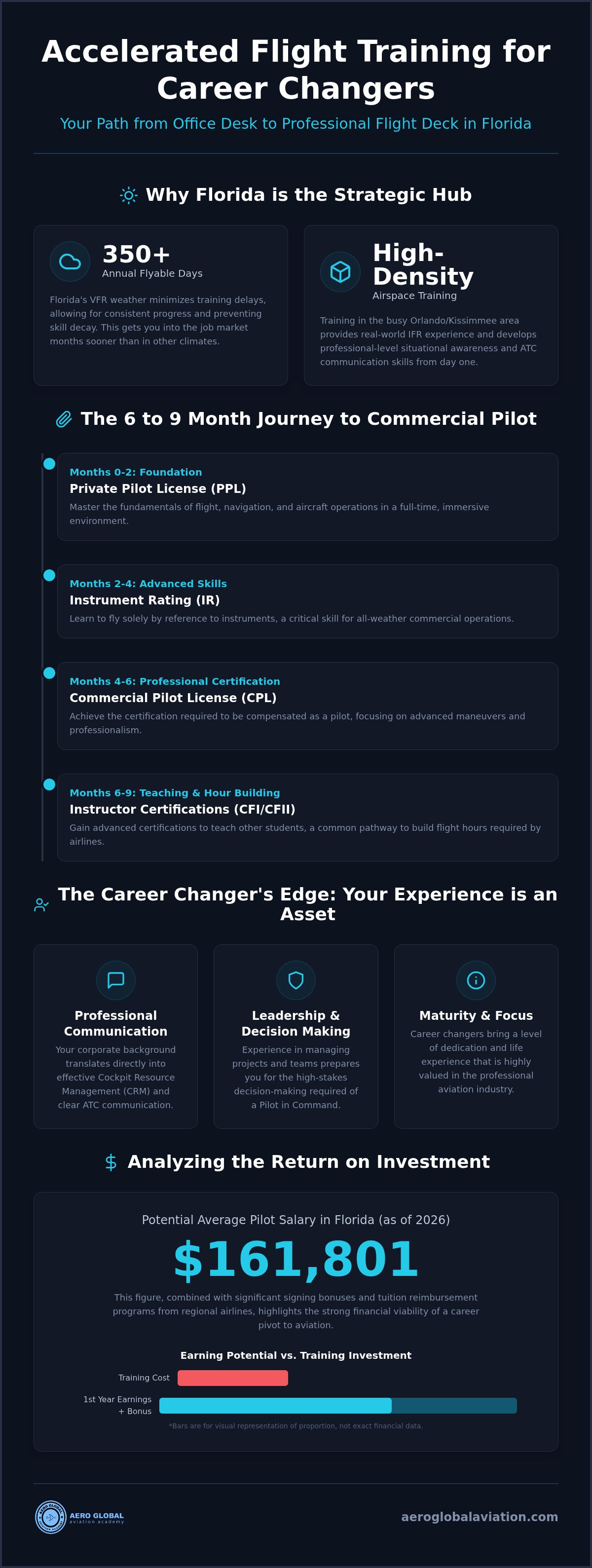
Accelerated flight training is far more than just a condensed schedule; it's a full-time, immersive professional commitment that mirrors the pace and intensity of a major airline’s own training department. For those investigating accelerated flight training for career changers Florida, the state serves as a massive, open-air classroom. While students in northern climates might spend weeks grounded by seasonal storms, Florida offers nearly 350 days of VFR weather annually. This consistency allows you to stack your hours day after day, ensuring that your progression through the various FAA pilot certification levels remains on a strict, predictable track.
The economic efficiency of this approach is undeniable. By finishing your training months ahead of students in less favorable climates, you enter the professional job market sooner. In 2026, with regional airlines offering significant signing bonuses and tuition reimbursement programs, every month you aren't in the cockpit represents a missed opportunity for earnings. Training in the high-density Orlando-area airspace also prepares you for the high-stakes environment of commercial aviation. You’ll learn to navigate complex traffic and communicate with air traffic control with a level of precision that quieter rural airports simply can’t replicate. This immersion builds a level of confidence that's hard to find elsewhere. You aren't just a student; you're a professional in training, and Florida's infrastructure supports that identity from your very first solo flight.
The Kissimmee Advantage: Optimal Training Conditions
Kissimmee Gateway Airport sits at the heart of Florida’s aviation infrastructure, providing a perfect balance of professional traffic and accessibility. It's a sophisticated environment that offers the challenges of a busy airport without the stifling taxi delays of a major international hub. Because of its proximity to Orlando International and Sanford, you’ll gain real-world instrument flight rules (IFR) experience in some of the busiest airspace in the country. This regional density means you aren't just flying; you're developing the professional situational awareness required of a modern commercial pilot. You'll be surrounded by a network of maintenance facilities, fuel services, and fellow professionals that only a premier aviation hub can provide.
Maximizing Your Training Hours with Year-Round Flying
One of the biggest hurdles for adult learners is skill decay. When you're forced into a "winter pause," you don't just stop progressing; you actually lose proficiency. Avoiding these gaps prevents the need for expensive retraining hours and keeps your momentum high. There's a powerful psychological benefit to seeing tangible progress every single week. It keeps the dream of the flight deck feeling reachable and real. In the context of Florida’s 2026 climate trends, VFR weather refers to conditions where visibility remains at three miles or more and the cloud ceiling stays above 1,000 feet, allowing you to fly primarily by visual reference to the horizon.
The 2026 Accelerated Timeline: From Your Current Job to the Flight Deck
Transitioning from a stable office environment to a dynamic cockpit requires a shift in mindset as much as a shift in schedule. While some flight schools promote three-week "sprints" for individual certificates, these often lead to burnout for mature learners who value depth and retention. A realistic, high-performance timeline for accelerated flight training for career changers Florida spans approximately six to nine months. This window provides the necessary time to achieve total immersion without the counterproductive stress of cramming. By treating your training as a full-time professional commitment, you mirror the exact environment you’ll eventually encounter in airline initial operating experience.
The true power of this timeline lies in the synergy between consecutive ratings. Instead of taking breaks between certificates, you move immediately from one milestone to the next, ensuring your flying skills remain sharp and your momentum stays high. Choosing a structured career pilot program is far more effective than piecemeal training because the curriculum is designed to be cohesive. This approach is particularly strategic given the current career outlook for airline pilots, which shows sustained demand for well-trained candidates through the end of the decade. If you are curious about how your specific professional background fits into this schedule, consider starting a conversation with a mentor to map out your journey.
Step 1: The Wings Foundation (Private Pilot License)
Step 2: Instrument and Commercial Certification
Once your foundation is solid, you’ll enter the commercial pilot training phase. This is where you develop the technical precision required for professional maneuvers and learn to fly solely by reference to instruments. You’ll master modern glass cockpit systems, such as the Garmin G1000, which are standard in today's regional and major airliners. Adding a multi-engine rating during this stage acts as a final speed boost for your resume, proving you can handle the complexity of larger, faster aircraft. This structured progression ensures you graduate not just with a license, but with the professional polish airlines expect.
The Career Changer’s Edge: Why You Are the Ideal Candidate
Many prospective students worry they've missed their window to enter the cockpit. In reality, the 2026 airline landscape favors mature, reliable pilots who bring professional discipline to the flight deck. If you're investigating accelerated flight training for career changers Florida, your previous life experience is often your greatest asset. Airlines aren't just looking for technical proficiency; they want leaders who can manage a crew and maintain situational awareness under pressure. This maturity is exactly why mature learners often excel in high-intensity training environments.
Industry experts and organizations like AOPA provide excellent guidance on choosing a flight school that respects this professional background. Unlike younger students, you likely already possess the "soft skills" that take years to develop. In aviation, this is referred to as Crew Resource Management (CRM). It involves effective communication, leadership, and team coordination. Your ability to navigate complex workplace dynamics translates directly to the collaborative environment of a modern airliner cockpit.
Leveraging Transferable Skills in Aviation
Your previous project management skills play a massive role in flight planning and execution. Every flight is essentially a project with a set timeline, fuel budget, and safety deliverables. Decision-making under pressure is another area where career changers have a distinct edge. Whether you handled boardroom crises or managed logistical chains, those experiences have forged a temperament that is invaluable on the flight deck. Airlines value "second career" pilots because they understand the nuances of professional responsibility and bring a level of stability to the workforce that is highly sought after in 2026.
Mental Preparation for Intensive Training
To succeed in an accelerated environment, you must treat flight school like a standard 9-to-5 job. This professional mindset ensures you stay on track for a nine-month completion goal and helps you manage the cognitive load of ground school. While returning to the classroom can feel daunting, your established study habits and organizational skills will help you overcome the learning curve. It's also vital to build a support network of family and fellow students during this transition. The airline pilot career path rewards those who approach training with focus and humility, turning your prior career success into a launchpad for your new life in the sky.
Logistics of the Pivot: Financing and Planning Your Transition
Making a clean break from your current industry requires a tactical approach to both your schedule and your finances. When you evaluate the return on investment for accelerated flight training for career changers Florida, the numbers in 2026 are compelling. With average pilot salaries in Florida ranging from $97,833 to $161,801 as of July 2026, the initial cost of training acts as a gateway to a high-earning profession. While the upfront commitment is significant, the speed of an accelerated program allows you to reach these salary tiers months or even years faster than traditional, slower-paced routes.
Financing this transition often involves a combination of personal savings, merit-based loans, and future airline partnerships. Many students utilize specialized aviation loans from providers like Sallie Mae, which currently offer APRs between 2.89% and 17.64% depending on credit history. Additionally, regional airlines like SkyWest and Republic are increasingly offering tuition reimbursement and signing bonuses to secure qualified talent. To prepare for this shift, you should create a "clean break" checklist that includes securing your FAA First Class Medical certificate, finalizing your financing, and arranging housing in the Kissimmee area. If you're ready to see how these logistics fit your specific situation, contact our admissions team for a personalized career roadmap.
Budgeting for Your Accelerated Journey
Beyond tuition, you must account for essential "hidden" costs that are standard across the industry. FAA knowledge tests typically cost between $175 and $200 per exam, while practical checkrides can range from $600 to $1,200 depending on the certificate level. You'll also need to budget for professional gear, such as a high-quality headset and an iPad for electronic flight bags. While a slower-paced school might seem cheaper on a month-to-month basis, the skill decay caused by gaps in training often leads to extra remedial hours that inflate the total cost. In the competitive world of aviation, time-to-seniority is the most important financial metric because every month saved in training translates to higher lifetime earnings and better schedule control at the airlines.
The Discovery Flight: Your Final "Go/No-Go" Decision
Before you resign from your current position, schedule a professional discovery flight at your chosen academy. This isn't just a fun ride; it's a critical evaluation of the school’s culture and the "Practical Mentor" vibe of the instructors. Use this time to observe how the facility operates and how the aircraft are maintained. It's also the perfect opportunity to ask current students about their experience with the best flight schools in florida to see if the environment matches your professional expectations. If the instructors treat you as a future colleague rather than just another student number, you've likely found the right home for your transition.
Launching Your New Career with Aero Global Aviation Academy
Aero Global Aviation Academy serves as your dedicated partner in this life-changing transition. When you choose accelerated flight training for career changers Florida, you're looking for a path that respects your time and your professional maturity. Our Airline Pilot Elite program provides a total solution that takes you from your very first discovery flight all the way to advanced instructor certifications. This comprehensive track is specifically designed for those who want to move beyond the basics and secure a position as a Certified Flight Instructor (CFI). This role allows you to build the 1,500 flight hours required for major airline positions while earning a professional income.
We maintain a modern fleet equipped with the same glass cockpit technology you'll find in regional jets. Training on the equipment the industry demands ensures that your transition from our Kissimmee base to an airline cockpit is seamless. We take immense pride in our local roots at Kissimmee Gateway Airport. Being a local partner in your global career means we're invested in your success long after you complete your final checkride. Choosing accelerated flight training for career changers Florida at Aero Global means you aren't just another student number; you're a future colleague entering a collaborative community.
The Aero Global "Practical Mentor" Philosophy
Our instructors understand that adult learners process information differently. We focus on the "why" behind every "how," ensuring you grasp the underlying principles of aerodynamics and systems management. This "Practical Mentor" approach fosters a collaborative spirit where your previous professional insights are valued. As you work toward your 1,500-hour goal, we provide the networking opportunities and post-graduation support needed to navigate the hiring process at major carriers. Our Kissimmee training center functions as a hub where experienced pilots and newcomers share knowledge, creating an environment that encourages constant professional growth.
Next Steps: Your First 30 Days
The journey to the flight deck begins with small, decisive actions. Within your first month, you can set the stage for a successful nine-month pivot. Focus on these three critical milestones:
- Secure Your FAA Medical Certificate: This is your first true professional milestone. Visit an Aviation Medical Examiner to obtain a First Class Medical certificate, which confirms you meet the health standards required for commercial flying.
- Enroll in the Wings Foundation: Start building your knowledge base immediately. This program covers the Private Pilot License fundamentals, providing the essential ground school and flight hours needed to launch your career.
- Request Your Roadmap: Contact our admissions team for a customized career-change roadmap. We'll help you align your personal timeline with our training cycles to ensure a smooth transition from your current role.
Your Path to the Cockpit Starts in the Florida Skies
You've seen that a career pivot into aviation is more than just a dream; it's a structured, attainable reality for those ready to commit. By leveraging accelerated flight training for career changers Florida, you can transition from your current role to a professional pilot seat in record time. You aren't just starting over; you're building upon your existing professional maturity while utilizing a structured PPL-to-CPL career track designed specifically for high-performance learners.
Are you ready to trade your desk for a flight deck? Book Your Career-Change Discovery Flight in Kissimmee Today and take the first step toward your new life in the clouds. We're here to guide you through every mile and every milestone as you launch this exciting new chapter.
Frequently Asked Questions
Is 40 too old to start accelerated flight training for a career change?
Absolutely not. In the 2026 aviation market, airlines actively seek mature pilots who bring professional discipline and leadership experience to the flight deck. While the mandatory retirement age for airline pilots is 65, starting at 40 still allows for a 25-year career in a high-earning field. Many students in our accelerated flight training for career changers Florida programs find that their life experience helps them master complex decision-making and Crew Resource Management faster than younger peers.
How much does accelerated flight training in Florida cost in 2026?
The total investment for flight training varies based on the pace of your progression and the specific certificates you pursue. Industry-wide costs have seen an upward trend of nearly 18% since 2024, reflecting the increased value of professional pilot certifications. You'll need to budget for tuition, FAA examination fees, and professional gear like headsets and iPads. Many students offset these costs by utilizing airline tuition reimbursement programs or signing bonuses, which have reached as high as $30,000 at some regional carriers as of July 2026.
Can I work a part-time job while enrolled in an accelerated pilot program?
We generally recommend treating an accelerated program as a full-time, 40 to 50 hour per week commitment. The intensity of the ground school and the frequency of flight lessons require your total focus to maintain a 6 to 9 month completion timeline. Attempting to balance outside employment often leads to fatigue and slower progress, which can ultimately increase your total training costs. Immersing yourself completely in the environment ensures you stay sharp and graduate on schedule.
What is the difference between Part 61 and Part 141 for career changers?
The primary difference lies in the structure and flexibility of the training curriculum. Part 141 schools follow a rigid, FAA-approved syllabus that can sometimes reduce the minimum hour requirements for certain certificates, making it ideal for full-time students. Part 61 training offers more flexibility for those who prefer a customized pace or have unique scheduling needs. For those pursuing accelerated flight training for career changers Florida, a structured approach is often the most efficient way to reach the flight deck quickly.
How long does it take to go from zero experience to a Commercial Pilot License?
In an accelerated environment, you can realistically achieve your Commercial Pilot License in 6 to 9 months. This timeline assumes you're flying consistently and dedicating full-time hours to your ground school and flight prep. This pace is significantly faster than traditional part-time training, which can often take two years or more. By stacking your ratings consecutively, you maintain the "flying to learn" momentum that's crucial for professional proficiency and long-term skill retention.
Why is Florida considered the best place for accelerated flight training?
Florida's primary advantage is its consistent weather, offering nearly 350 days of flyable conditions annually in regions like Kissimmee and Orlando. This reliability prevents the "winter pauses" that cause skill decay in northern states and allows you to finish your ratings months ahead of schedule. Additionally, the complexity of Florida’s airspace provides a superior classroom. You'll gain experience navigating high-traffic environments and communicating with air traffic controllers from your very first weeks of training.
What are the medical requirements for becoming a professional pilot?
You must obtain an FAA First Class Medical Certificate to fly as a professional airline pilot. This examination, performed by an Aviation Medical Examiner, evaluates your vision, hearing, and general cardiovascular health. It's the most stringent medical standard in aviation, so we recommend securing this certificate before you commit to a full training program. Ensuring you meet these health requirements early provides peace of mind as you begin your professional career pivot.
Do I need a college degree to fly for the airlines in 2026?
A four-year degree is no longer a strict requirement for many regional airlines, though it can still be a competitive advantage at major legacy carriers. Many airlines have shifted their focus toward high-quality flight training and professional experience. For career changers who already hold a degree in another field, your existing education combined with accelerated flight training makes you a highly attractive candidate. The industry currently prioritizes your technical ratings and your ability to lead a crew effectively.


