
Did you know that by the end of 2026, the U.S. pilot shortage is projected to reach a staggering peak of 24,000 open positions? While the demand for new aviators is at an all-time high, you might feel like the 1,500-hour ATP requirement is a mountain you can't afford to climb. It's frustrating to watch your flight hours stagnate because of high rental costs or confusion over which pathway from flight school to airlines Florida offers the most efficiency. We understand that the transition from paying for every minute in the air to finally getting paid as a professional pilot feels like the biggest challenge of your career.
This guide reveals the strategic steps needed to bridge the flight hour gap and accelerate your journey into a major airline cockpit. We'll explore how leveraging the year-round VFR conditions at Kissimmee Gateway Airport and choosing a structured track like our Airline Pilot Elite program can turn the 1,500-hour hump into a manageable milestone. From earning your R-ATP to securing a first officer seat at a regional carrier, we're here to show you that a professional flying career is closer than you think. It's time to stop worrying about the requirements and start planning your arrival at the gate.
Key Takeaways
- Understand the specific 2026 FAA requirements for the Commercial Pilot License and the 1,500-hour ATP certificate to map out your career timeline.
- Discover why the Central Florida climate and complex airspace create the fastest pathway from flight school to airlines Florida by maximizing your flyable days.
- Learn how to slash training costs using the safety pilot mechanism and block-time commitments to reach your hour goals sooner.
- Transition from paying for flight time to earning a paycheck by utilizing the Airline Pilot Elite track to become a certified instructor.
- Explore how professional mentorship at a strategic hub like Kissimmee Gateway Airport prepares you for the high-stakes environment of a major airline cockpit.
Understanding the 'Hour Hump': FAA Milestones for 2026
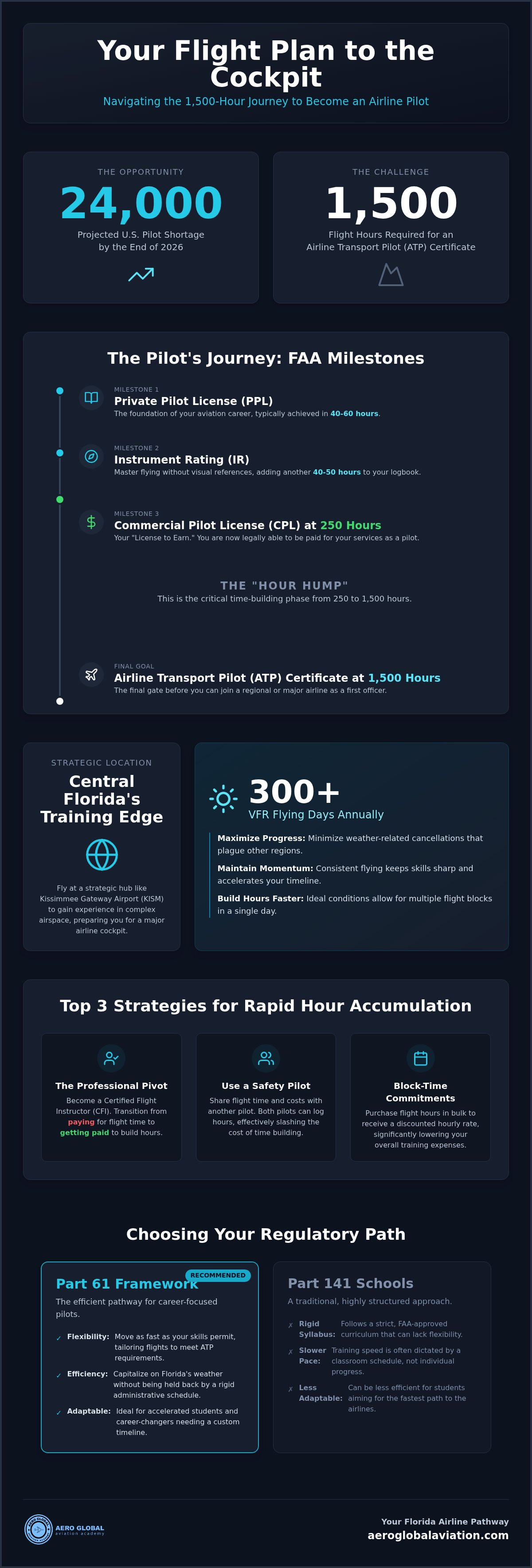
2026 represents a historic window for aspiring aviators. With a projected peak pilot shortage of 24,000 positions in the U.S. this year, the demand for qualified first officers is unprecedented. However, understanding the specific regulatory requirements for pilot certification in the United States is the essential first step in mastering your own pathway from flight school to airlines Florida. You aren't just logging time; you're meeting federal mandates designed to ensure you're ready for the heavy responsibility of a commercial cockpit.
The first major milestone is the 250-hour Commercial Pilot License (CPL). We often call this your "license to earn." Once you reach this mark, you're legally allowed to be paid for your services as a pilot. It's a pivotal moment because it fundamentally changes the financial dynamic of your training. Instead of only spending money on rentals, you can finally start looking for entry-level commercial work to continue building your experience.
The second, more daunting milestone is the 1,500-hour Airline Transport Pilot (ATP) certificate. This federal mandate requires a significant time commitment, but it's the final gate before you can join a regional or major airline. In 2026, airlines are facing a "captain crunch," meaning they need well-trained first officers who can quickly upgrade. This makes the quality of your early hours just as important as the quantity.
The Math of Professional Time Building
Success in aviation requires a clear-eyed look at the numbers. After you complete your Private Pilot License through a program like our Wings Foundation, you'll likely have between 40 and 60 hours in your logbook. To reach the CPL milestone, you'll need to bridge a gap of nearly 200 hours. The good news is that the 40 to 50 hours you spend earning your Instrument Rating (IR) count directly toward this total. The "hour hump" is the transition phase where you move from being a student pilot to a professional aviator authorized to fly for compensation. Mapping these hours early prevents you from reaching the end of your training with a "time gap" that keeps you grounded.
Regulatory Efficiency: Part 61 vs. Part 141
When choosing how to build these hours, you'll encounter two primary regulatory paths. Part 141 schools follow a rigid, FAA-approved syllabus that can feel like a traditional classroom. While structured, it often lacks the flexibility that career-changers or accelerated students need. Choosing structured flight training within a Part 61 framework allows you to move as fast as your skills permit. This flexibility is often the most efficient pathway from flight school to airlines Florida because it lets you capitalize on Central Florida's perfect flying weather without being held back by a slow-moving administrative schedule. You can tailor your cross-country flights to build the specific night and instrument time required for your ATP while staying on a timeline that fits your career goals.
Orlando as a Strategic Training Laboratory
Where you choose to log your hours is just as important as the certificate you're pursuing. Central Florida serves as a world-class training ground, offering a unique mix of environmental and operational advantages that you won't find in other regions. When you're building your pathway from flight school to airlines Florida, the Orlando area provides a strategic edge that turns every hour in the logbook into a masterclass in professional aviation. It's not just about flying; it's about flying in the right place to build the proficiency that major carriers demand.
The most immediate benefit is the climate. With over 300 days of VFR (Visual Flight Rules) weather annually, your schedule remains predictable and productive. This reliability is crucial for maintaining the momentum required to move through your ratings without the frustration of constant cancellations that plague other parts of the country. By minimizing no-fly days, you keep your timeline on track and your skills sharp, ensuring you reach your professional goals sooner.
Weather as a Catalyst for Progress
Consistent flying is the secret to mastery. In Orlando, the 2026 winter season is widely considered the golden window for time building because the air is stable and the skies are remarkably clear. This allows you to schedule multiple flight blocks in a single day, which is essential for building muscle memory and reaching your goals on an accelerated timeline. You'll find that the predictability of the local weather allows for a level of training intensity that simply isn't possible in more volatile climates, making your progression feel both logical and rewarding.
Quality of Hours vs. Quantity
Airlines don't just want to see a specific number in your logbook; they want to see proficiency in high-traffic environments. Training near major hubs like Orlando International (MCO) and Sanford (SFB) forces you to communicate with professional controllers and navigate complex Class B and C airspace from your very first flights. This level of exposure makes meeting the Airline Transport Pilot certificate requirements feel like a natural progression rather than a sudden leap in difficulty. You aren't just logging time; you're building the situational awareness required for a major airline cockpit.
Operating out of Kissimmee Gateway Airport (KISM) offers the perfect balance for your professional development. You avoid the heavy airline traffic and long taxi delays of MCO while remaining deeply embedded in the professional Orlando airspace. It's a high-tempo environment where you can refine your skills during commercial pilot training while building cross-country time to coastal destinations like Daytona or Naples. If you're ready to start your journey, our team at Aero Global Aviation Academy can help you map out a training schedule that takes full advantage of our Florida home.
Top 3 Strategies for Rapid Flight Hour Accumulation
To navigate the 1,500-hour requirement successfully, you need more than just a flight schedule; you need a tactical plan for time building. With the airline pilot shortage continuing to squeeze regional carriers, the speed at which you accumulate hours directly impacts your career trajectory. By implementing specific cost-sharing and scheduling tactics, you can transform your pathway from flight school to airlines Florida into a high-speed lane toward your first officer position. It's about being smart with your resources while you keep your eyes on the flight deck.
Another essential strategy is the block-time commitment. Most flight schools offer discounted hourly rates when you purchase flight hours in upfront increments, such as 50 or 100-hour blocks. This approach doesn't just save money; it creates a psychological commitment to your training. When your hours are already paid for, you're much more likely to fly during those early morning or late evening windows when the air is smoothest and the training environment is most productive. This consistency is what builds the proficiency airlines expect from new hires.
Mastering the Safety Pilot Strategy
The safety pilot mechanism is arguably the most powerful tool in a pilot's arsenal for slashing costs. By pairing up with another student, you can effectively double your progress for the price of a single rental. One pilot flies under "the hood" to practice instrument maneuvers while the other serves as the safety pilot, ensuring the flight remains clear of other traffic. Under Federal Aviation Regulation 61.51, both pilots may log pilot-in-command time simultaneously when one is operating in simulated instrument conditions and the other acts as the required safety pilot. At Aero Global, we help you find reliable partners who share your professional drive, making it easier to maintain a consistent time-building schedule.
Maximizing Cross-Country Efficiency
Florida’s geography is perfect for multi-stop cross-country planning. Instead of flying a simple out-and-back route, you can plan legs that touch the Atlantic coast, the Gulf, and the inland lakes in a single afternoon. This variety exposes you to different wind patterns and coastal weather shifts, providing the kind of advanced flight training experience that recruiters value. Integrating specific maneuvers during these long-distance trips ensures that your stick-and-rudder skills remain sharp while you log the cross-country time required for your Commercial Pilot License. Additionally, building this time in Garmin G1000-equipped aircraft bridges the technological gap between a trainer and a regional jet deck, ensuring you're comfortable with glass cockpit systems long before your airline interview.
The Professional Pivot: Getting Paid to Reach 1,500 Hours
Reaching your 250-hour commercial milestone is a major achievement, but it's only the beginning of the most rewarding phase of your journey. This is where you stop paying for flight time and start collecting a paycheck. Finding the right pathway from flight school to airlines Florida means identifying the roles that build your experience while providing financial stability. It's a professional pivot that turns your passion into a career long before you reach a major carrier. You aren't just a student anymore; you're a working aviator with a professional logbook.
Becoming a Certified Flight Instructor (CFI) is the industry standard for a reason. When you teach a student how to recover from a stall or navigate a complex approach, you're forced to master the fundamentals in a way that solo flying simply can't match. This level of mastery is exactly what airline recruiters look for during the technical interview. Our Airline Pilot Elite program is designed specifically for this transition, taking you from a Private Pilot all the way to advanced instructor certifications. It's the most reliable way to bridge the gap between your commercial license and the airline flight deck.
The Transition to Flight Instruction
To become a competitive instructor in 2026, you'll need to earn your CFI rating, and most pilots choose to add a CFII (Instrument) and MEI (Multi-Engine) to maximize their hiring potential. The timeline from earning your CPL to your first paid hour of instruction is often shorter than you might expect. At Aero Global, we prioritize our own graduates for instructor positions, providing a seamless transition into a professional role right here in Kissimmee. You can build those final 1,250 hours in a familiar environment while earning a professional salary. This mentorship role doesn't just build hours; it builds the leadership skills required of a future airline captain.
Alternative Paid Pathways in Florida
While instruction is the most common route, Central Florida's vibrant aviation industry offers other unique ways to log time. Aerial survey companies often hire pilots for seasonal work, and the region's many skydiving centers require skilled pilots for jump runs. Our career pilot program provides the networking opportunities needed to secure these niche roles. Whether you're ferrying aircraft across the state or conducting survey flights over the coast, every hour is a step closer to your regional airline interview. If you're ready to start getting paid to fly, apply to join our academy and take the next step in your professional journey.
Aero Global Aviation Academy: Your Florida Airline Pathway
Choosing where to complete your training is the most significant career decision you'll make. At Aero Global Aviation Academy, we view ourselves as your dedicated local partner, providing the personalized mentorship necessary to turn a complex professional requirement into a structured, attainable reality. Our instructors are active career pilots who have navigated the same regional and major airline pathways you're preparing for today. This professional guidance ensures that every rating you earn is a tangible destination on your map to the flight deck.
Our presence at Kissimmee Gateway Airport is a deliberate choice for students who value their time and professional development. We've built an operational environment that mirrors the tempo of a professional airline while maintaining the supportive intimacy of a dedicated training hub. This ensures you're building high-quality hours in a setting where you're a name, not a number, allowing you to focus entirely on your progression without the administrative delays found at larger institutions.
Tailored Training for Modern Pilots
We understand that the 2026 aviation market demands a high level of proficiency and flexibility. Our private pilot license florida track is designed to integrate seamlessly into our professional programs, ensuring no hours are wasted during your transition from student to professional. You'll have access to a modern fleet maintained to the highest airline standards, with scheduling flexibility that adapts to your life as a working professional or full-time student. This collaborative approach makes the path to certification feel both logical and rewarding.
Join the Aero Global Aviation Academy Community
Success in this industry is built on the connections you make during your training. By joining our academy, you're plugging into a network of alumni currently flying for major and regional carriers across the United States. This community provides the real-world insight and professional support that helps you navigate the final steps of your journey with confidence. It's time to stop researching and start flying. Contact Aero Global Aviation Academy today to schedule your discovery flight and begin your custom timeline to a professional pilot career.
Ready to Take Command of Your Aviation Career?
Navigating the journey to a major airline cockpit requires more than just a passion for flight; it demands a tactical approach to every milestone. You now understand that the most efficient pathway from flight school to airlines Florida involves maximizing Central Florida's unique environment and transitioning quickly into paid roles like flight instruction. By focusing on the quality of your hours in complex airspace, you're building the exact proficiency that regional carriers are looking for in 2026. Every flight is an opportunity to refine the professional habits that will define your career.
At Aero Global Aviation Academy, we're dedicated to your individual success through expert mentorship from active career pilots who've walked this path before. Our strategic base at Kissimmee Gateway Airport (KISM) and our comprehensive Airline Pilot Elite track provide the structure you need to bridge the hour gap with confidence. Don't let the federal requirements feel like a barrier to your dreams. Start Your Professional Pilot Journey with Aero Global today and take the first step toward your seat in the flight deck. The sky isn't the limit; it's your new office.
Frequently Asked Questions
What is the fastest way to build flight hours in Florida?
Becoming a Certified Flight Instructor (CFI) is the most efficient method for rapid hour accumulation. This role allows you to log between 60 and 100 hours of flight time every month while earning a professional salary. Unlike other entry-level jobs, instruction provides a steady stream of students and consistent flying opportunities. This ensures your skills stay sharp while you progress toward the 1,500-hour requirement on an accelerated timeline.
Can two pilots log PIC time simultaneously in Florida?
Yes, two pilots can log PIC time simultaneously using the FAA’s safety pilot rule under FAR 61.51. This occurs when one pilot is operating in simulated instrument conditions while wearing a view-limiting device. The second pilot acts as the required safety pilot to maintain visual separation from other aircraft. This strategy is a highly effective way to slash your training costs in half while building the time needed for your commercial certificate.
How many flight hours do I need for an airline job in 2026?
In 2026, most pilots need 1,500 total flight hours to earn a full Airline Transport Pilot (ATP) certificate. However, you may qualify for a Restricted ATP with 1,000 hours if you graduate from a qualifying four-year university program or 1,250 hours with a two-year associate degree. You'll also need to meet specific sub-requirements; these include 500 hours of cross-country time and 100 hours of night flying before you can sit in an airline cockpit.
Why is Orlando/Kissimmee considered the best place for flight training?
Orlando and Kissimmee are premier training hubs because they offer over 300 days of VFR weather annually. This climate minimizes cancellations and keeps your training on a strict schedule. Additionally, the proximity to major airports like MCO provides exposure to complex Class B and C airspace. Operating out of Kissimmee Gateway Airport (KISM) gives you the benefit of a professional towered environment without the long taxi delays associated with larger international hubs.
Is it cheaper to rent an airplane or join a flying club for time building?
Choosing block-time rentals at a dedicated flight school is often more efficient for professional students than joining a flying club. While clubs might offer lower base rates, they frequently require monthly dues and have limited aircraft availability that can stall your progress. A professional academy provides a well-maintained fleet and prioritized scheduling. This ensures you can fly consistently to build your pathway from flight school to airlines Florida without waiting for a shared aircraft.
How long does it take to go from a private pilot to 1,500 hours?
Transitioning from a private pilot to 1,500 hours usually takes between 18 and 24 months of full-time effort. You'll spend the first few months earning your instrument and commercial ratings, which brings you to about 250 hours. The remaining 1,250 hours are typically built over the next year and a half while working as a flight instructor. This timeline can vary based on your personal dedication and the number of flight blocks you schedule each week.
What is the Airline Pilot Elite program at Aero Global?
The Airline Pilot Elite program is our most comprehensive training track; it's designed to take you from your Private Pilot License (PPL) all the way to advanced instructor certifications. This program focuses on creating professional instructors who are ready to be hired by our academy to build their final 1,500 hours. It's a structured framework that emphasizes mentorship and technical mastery, ensuring you're fully prepared for the high-stakes environment of a regional airline interview.
Can I build flight hours while working a full-time job in Orlando?
You can build flight hours while working a full-time job by taking advantage of our flexible scheduling and Florida’s reliable weather. Many of our students fly during early morning or evening blocks and use weekends for longer cross-country trips. This modular approach allows you to maintain your current income while making steady progress toward your professional goals. It's a practical way to manage the financial transition into a pathway from flight school to airlines Florida while working.


