
The lowest sticker price on a flight training brochure might actually be the most expensive path to your commercial license. You're likely feeling the pressure of 2026's climbing interest rates and the fear that hidden fees or training delays will turn your dream into a lifelong debt trap. It's a common concern, especially when a cost comparison of flight training programs Orlando reveals a wide gap between basic rental rates and the final price of an airline-ready certification.
I want to show you that a professional pilot career is still an attainable, high-ROI destination if you approach it with a strategic mindset. This guide provides a clear roadmap to minimize your out-of-pocket expenses by focusing on training density and geographic efficiency. You'll learn how to use Central Florida’s 300-plus days of flying weather to your advantage and why choosing a school at a high-efficiency location like Kissimmee Gateway can save you thousands in taxi time alone. We will break down how to spot transparent pricing structures and select a program that moves you from the classroom to the cockpit without the financial turbulence.
Key Takeaways
- Maximize the "Sunshine Dividend" by leveraging Orlando's 300 plus annual flying days to finish your training faster and avoid the cost of weather-related delays.
- Conduct a cost comparison of flight training programs Orlando to understand how structured environments provide a higher ROI than piecemeal training.
- Reduce your total flight hours and expenses by completing ground school early and utilizing high-fidelity simulators for procedure practice.
- Select a strategic training base like Kissimmee Gateway Airport to minimize expensive taxi times and maximize your actual time in the air.
- Discover how a seamless transition between ratings in programs like the Airline Pilot Elite pipeline helps you enter the workforce sooner to start earning.
The Reality of Flight School Debt in 2026
Entering the cockpit as a professional pilot is a high-stakes investment that requires a clear-eyed look at the financial finish line. Flight school debt isn't just the price of your flight hours; it's the sum total of tuition, specialized gear like headsets and iPads, and the interest-bearing loans used to fund the journey. In 2026, the landscape of aviation financing has shifted. With private loan interest rates sitting higher than in previous decades, every extra hour you spend in the air due to poor planning adds a significant weight to your future monthly payments. You aren't just paying for fuel and instruction; you're paying for time.
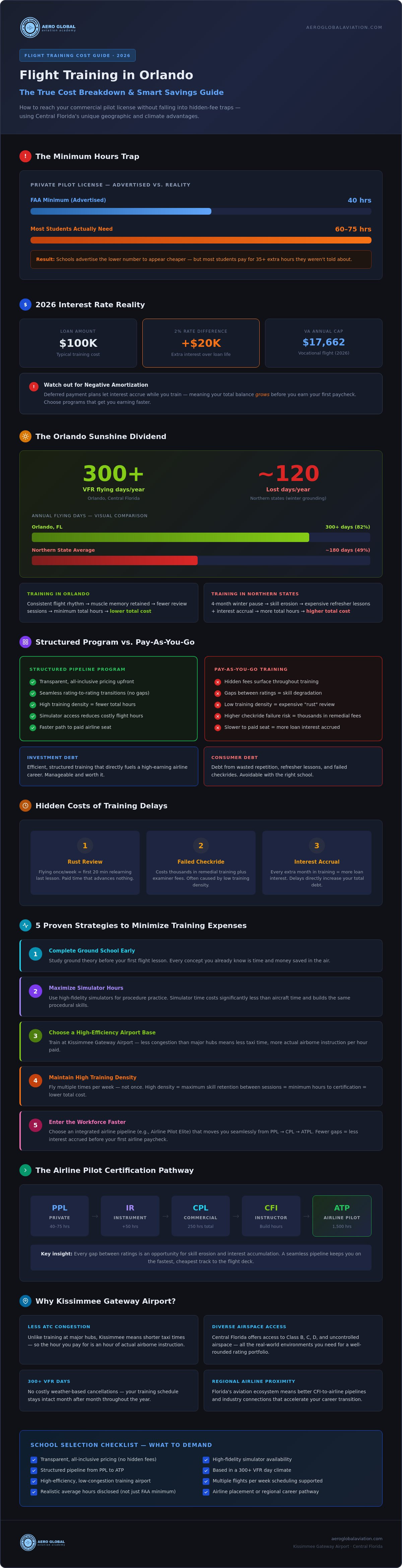
When you conduct a cost comparison of flight training programs Orlando, you'll see many schools advertising the FAA minimum of 40 hours for a Private Pilot License. This is the "Minimum Hours Trap." Most students actually require 60 to 75 hours to reach proficiency, yet schools often lead with the lower number to make their programs look more affordable. Distinguishing between "Investment Debt," which fuels a high-earning career path like our Career Pilot Program, and "Consumer Debt," which results from inefficient training and repeated lessons, is the first step toward financial freedom in the sky.
The Hidden Costs of Training Delays
Inconsistent training is a primary driver of ballooning debt. If you only fly once a week, you'll spend the first twenty minutes of every lesson relearning what you forgot since the last flight. This "rust" forces expensive review sessions that don't advance your syllabus. Furthermore, inconsistent frequency often leads to FAA checkride failures. A single failed checkride doesn't just hurt your pride; it costs thousands in remedial training and additional examiner fees. Training density is the frequency of flight lessons within a set period that ensures maximum skill retention and minimizes total hours to certification.
This principle of professional oversight and training density is a hallmark of any quality vocational education. For those exploring career paths in other licensed fields, you might discover 5T Beauty Academy to see how their structured approach to beauty and wellness training mirrors the efficiency required for success in the cockpit.
2026 Interest Rates and Loan Terms
The type of loan you secure can change your career trajectory before you even hit your first thousand hours. While the VA academic year cap for vocational flight training is $17,662 as of August 2026, many students must turn to private lenders to cover the gap. A 2% difference in interest might feel like a minor detail during your initial paperwork. It isn't. On a $100,000 loan, that small spread can easily translate to $20,000 in additional interest over the life of the repayment.
Gaining a deeper perspective by understanding aircraft finance helps you see why lenders structure aviation loans with specific milestones in mind. Be wary of deferred payments that allow interest to accrue while you're still in school. This "negative amortization" means your balance grows while you're training, making it harder to pay off the principal once you start your first job at a regional airline. Focus on high-efficiency programs that get you into a paid seat as quickly as possible to mitigate these long-term costs.
Why Orlando’s Climate is Your Best Debt-Reduction Tool
A thorough cost comparison of flight training programs Orlando usually focuses on hourly rates, but it often misses the "Sunshine Dividend." In Central Florida, we enjoy over 300 VFR (Visual Flight Rules) days per year. This isn't just a perk for your weekend plans; it's a critical financial advantage. When you can fly consistently, you maintain "flight feel," which is the intuitive muscle memory required to master complex maneuvers. Students in Northern states often face a four month winter pause where snow and low ceilings ground flights. During those gaps, skills erode, and interest on your loans continues to accrue while you're stuck on the couch.
Every time you return to the cockpit after a long break, you spend the first few hours merely regaining your previous proficiency. These "refresher" lessons are essentially wasted capital. By training in Orlando, you stay in a rhythm of constant progress. Meeting the FAA pilot certification requirements becomes a streamlined process rather than a stop-and-start struggle. This consistency ensures you reach your checkride in the fewest possible hours, keeping your total debt as low as possible.
Year-Round Training Efficiency
Speed is your greatest ally against rising interest rates. Finishing your private pilot license florida in four months of immersive, daily training is significantly cheaper than stretching that same syllabus over a year. Daily immersion allows you to move quickly through the basics and into advanced ratings. We recommend utilizing Central Florida’s predictable morning weather windows. By scheduling early, you avoid the afternoon convective activity common in the summer, ensuring your training schedule remains uninterrupted and your budget stays on track.
Strategic Location: Kissimmee Advantages
Where you fly matters as much as how often you fly. Kissimmee Gateway Airport (KISM) offers a strategic middle ground between quiet rural strips and congested international hubs. At a major airport, you might spend twenty minutes idling on a taxiway waiting for commercial jet traffic. You're paying for that time, but you aren't learning. At KISM, you get to the runway faster. This means more landings, more maneuvers, and more value for every billable hour.
The cost of living in the Kissimmee area also remains more accessible than other major US aviation hubs like Miami or New York. This allows you to funnel more of your resources into the cockpit rather than into high rent. If you're ready to see how a high-efficiency environment can change your career trajectory, come visit us at Aero Global Aviation Academy to speak with a mentor.
Structured Programs vs. Pay-As-You-Go: The Math of Savings
Many aspiring pilots begin their journey by hunting for the lowest hourly rental rate at a local flying club. While a lower "wet" rate looks appealing on a spreadsheet, it often hides the true financial burden of an unguided path. A realistic cost comparison of flight training programs Orlando reveals that pay-as-you-go students often fly 20% to 30% more hours than those enrolled in a structured syllabus. Without the accountability of a professional curriculum, training often becomes fragmented. You might find yourself "just flying" without hitting specific milestones, which leads to a ballooning total cost that far exceeds the initial savings of a cheaper hourly rate.
Securing stable funding for an ad-hoc training path is also a significant hurdle. Most lenders prefer the predictability and proven track records of established academies over piecemeal training. If you're looking for ways to fund your journey, AOPA's guide to financing flight training offers a comprehensive look at how to align your budget with professional goals. By choosing a structured Career Pilot Program, you gain guaranteed access to aircraft and instructors. This eliminates the scheduling gaps that force independent students to spend thousands on "refresher" flights just to maintain their proficiency.
The True Cost of 'Slow' Training
If you take two weeks off between lessons, your next flight will likely involve thirty minutes of reviewing old material before you can learn anything new. Over the course of a Private Pilot certification, these "refresher" periods can accumulate into 10 to 15 extra flight hours. At 2026 rental and instruction rates, that’s a massive amount of avoidable debt. Structured schools optimize your investment by integrating pre-flight ground briefings and post-flight debriefs into a tight, daily schedule. This momentum is why students in organized pipelines have a much higher completion rate; they see tangible progress every week rather than stalling out in a cycle of review.
ROI: Professional Ratings as Income Generators
The secret to managing flight school debt is reaching the point where you stop paying for fuel and start earning a paycheck. Moving through your commercial pilot training with speed and precision is the only way to shift the financial scales in your favor. Once you earn your Commercial Pilot License and move toward instructor certifications, you transition from a consumer to a professional. In the current aviation market, the fastest time-to-airline comes from programs that eliminate the "dead time" between ratings, allowing you to begin your career and start paying down your investment with a professional pilot's salary.
5 Proven Strategies for Minimizing Training Expenses
Reducing the total cost of your flight training requires more than just finding a competitive hourly rate. It demands a tactical approach to how you spend every minute of your billable time. While a cost comparison of flight training programs Orlando helps you identify the right partner, your own preparation dictates the final balance on your student loan. By treating your education as a high-stakes professional operation, you can slash thousands from your total expenditure before you ever leave the ground.
One of the most effective ways to protect your budget is through the strategic use of high-fidelity simulators. Modern flight training devices allow you to master complex procedures, emergency checklists, and instrument approaches at roughly 25% of the cost of an actual aircraft rental. Practicing a difficult maneuver in a simulator five times before attempting it in the air ensures that your flight hours are spent refining skills rather than introducing them. Additionally, don't overlook the power of peer-to-peer learning. Forming or joining a study group allows you to talk through maneuvers and regulations with fellow students, reducing your dependency on one-on-one instructor time for basic conceptual questions.
Ground School: The Debt-Killer
The cockpit is an incredibly expensive classroom. If you show up to a flight lesson without having mastered the theoretical concepts behind the day’s maneuvers, you're essentially paying aircraft rental rates to have a conversation you could have had on the ground. While free online resources exist, a paid, structured ground school often offers better value by ensuring no gaps in your knowledge that could lead to a checkride failure. Maintaining a three-to-one Ground-to-Flight Ratio ensures you arrive at the hangar with the theoretical knowledge already mastered, allowing your billable airtime to be spent on practical application rather than basic definitions.
Scholarships and Alternative Funding
For the 2026 to 2027 academic year, the annual cap for vocational flight training through the Post-9/11 GI Bill is $17,662, effective August 1, 2026. Veterans should look for schools that are VA-approved for Part 141 training to maximize these benefits. Beyond federal aid, niche aviation scholarships from organizations like Women in Aviation International (WAI), the Organization of Black Aerospace Professionals (OBAP), and AOPA provide millions in funding annually. Many local Central Florida flying clubs also offer smaller grants that can cover the cost of a checkride or a set of charts. If you're ready to start your journey with a team that prioritizes your financial success, explore our efficient training modules today.
Finally, make every minute in your logbook count. Strategic hour building means choosing cross-country routes that satisfy multiple requirements for future ratings. Instead of just flying in circles to build time, plan missions that challenge your navigation and communication skills. This proactive mindset ensures that when you finally perform a cost comparison of flight training programs Orlando, your personal efficiency makes you the most cost-effective student in the hangar.
The Aero Global Advantage: Strategic Training in Orlando
Choosing a flight school is one of the most significant financial decisions you'll ever make. At Aero Global Aviation Academy, we recognize that your goal isn't just to fly; it's to launch a professional career without the burden of inefficient spending. When you perform a cost comparison of flight training programs Orlando, the true value of a school isn't found in the hourly rate of the aircraft, but in the speed and quality of the training pipeline. Our advanced flight training modules are built on a foundation of time efficiency, ensuring that every hour you spend in the cockpit moves you closer to your commercial goals.
Our structured pathways, ranging from the "Wings Foundation" for initial private pilot training to the "Airline Pilot Elite" certification track, are designed to eliminate the costly transition gaps that plague independent students. By keeping you within a single, mentor-led ecosystem, we ensure that your progress never stalls. You won't waste money re-learning procedures or waiting for instructor availability. Instead, you'll follow a logical, aggressive schedule that leverages our strategic location at Kissimmee Gateway Airport to maximize your actual flight time and minimize expensive idling on the ground.
Mentorship as a Financial Strategy
In many large, impersonal academies, students often find themselves "over-training" on tasks they've already mastered because the syllabus is too rigid to adapt. We take a different approach. Our instructors act as practical mentors who are deeply invested in your individual success. We focus on "checkride readiness" the first time, using high-fidelity simulations and targeted briefings to ensure you're fully prepared before you ever pay an examiner's fee. Before you start, we help you create a personalized financial roadmap that accounts for your specific goals, helping you understand your "all-in" number and avoiding the hidden cost surprises that often derail training.
Your Next Steps Toward the Flight Deck
The best way to evaluate our commitment to your efficiency is to experience it firsthand. We invite you to book a Discovery Flight at our Kissimmee facility, where you can inspect our fleet and meet the mentors who will guide your journey. This isn't just a flight; it's an opportunity to see how our professional environment and strategic location work together to protect your investment.
Navigating the 2026 financial landscape requires expert guidance. Our financial aid advisors are available to discuss current 2026 loan options and help you identify the most cost-effective way to fund your training. Don't let the fear of debt keep you on the ground when a strategic path to the cockpit is within reach. Start your journey with Aero Global Aviation Academy today and take command of your professional future.
Take Command of Your Aviation Investment
The path to the flight deck shouldn't be defined by financial stress. By prioritizing training density and leveraging Orlando's unique environmental advantages, you can significantly reduce the total cost of your education. A detailed cost comparison of flight training programs Orlando proves that efficiency is the ultimate debt-reduction tool. Whether you're maximizing your time in the cockpit at Kissimmee Gateway Airport or mastering procedures in high-fidelity simulators, every strategic choice you make today brings you closer to a high-ROI career.
Our mentorship-driven training model is built to keep you on schedule and under budget. We provide the structure you need to move seamlessly through each rating without the gaps that lead to skill erosion. It's time to turn your aspirations into a tangible destination with a team that values your success as much as you do. The sky is waiting for you; let's make sure you reach it with the financial freedom you deserve.
Secure your financial future and start your Career Pilot Program today at Aero Global.
Frequently Asked Questions
Is flight school debt worth it in 2026?
Flight school debt is a strategic investment in your future earning potential. With commercial pilot salaries at major airlines reaching historic levels, the return on investment often outweighs the cost of interest; however, this only holds true if you finish your training efficiently. By entering the workforce sooner, you start earning a professional salary that allows you to pay down your loans much faster than a student who takes years to complete their ratings.
Can I work while attending flight school in Orlando?
You can work while training, but it requires careful time management. Students in our Wings Foundation or pay-as-you-go paths often maintain part-time jobs to help cover living expenses. If you choose an accelerated Career Pilot Program, the schedule is much more demanding. We usually recommend focusing entirely on your studies during these intensive months to ensure you don't waste money on extra flight hours caused by a lack of preparation.
What are the best scholarships for Florida flight students?
The best opportunities for local students include grants from the Florida Aviation Trades Association and niche awards from organizations like Women in Aviation International (WAI) or the Organization of Black Aerospace Professionals (OBAP). AOPA also offers significant flight training scholarships annually. We encourage our students to apply for these early; even a small $2,500 grant can cover the entire cost of your FAA checkrides and training materials.
How much can I save by using a flight simulator?
Using a high-fidelity simulator can reduce your hourly training costs by approximately 75% compared to a standard aircraft rental. Simulators allow you to pause the lesson to discuss a mistake or repeat a specific procedure ten times in an hour without wasting fuel or taxi time. Mastering your instrument approaches and emergency checklists on the ground means you'll need fewer expensive hours in the air to reach proficiency.
What is the difference between Part 61 and Part 141 for debt management?
Part 141 schools follow an FAA-approved, highly structured curriculum that is often required for students using VA benefits or certain private loans. This structure helps keep you on a tight timeline, which is excellent for debt management. Part 61 training is more flexible and allows you to learn at your own pace. While Part 61 can feel cheaper upfront, a cost comparison of flight training programs Orlando often shows that the lack of structure can lead to more total hours flown.
How does Orlando's weather actually save me money on training?
Orlando's 300 plus days of flyable weather per year prevent the "training rust" that occurs during long seasonal breaks in the North. When you fly consistently, you don't have to spend money on refresher lessons to regain lost skills. This high training density ensures you meet your milestones in the minimum required time, which keeps your total loan balance as low as possible. A cost comparison of flight training programs Orlando highlights this geographic advantage as a primary factor in overall savings.
What happens if I run out of money halfway through pilot training?
If you face a funding gap, it's best to communicate with your flight school immediately to adjust your training frequency rather than stopping entirely. Pausing for months can be expensive because you'll need remedial hours to get back to your previous skill level. Our mentors can help you create a revised financial roadmap or identify secondary funding sources to keep your momentum alive while you secure more capital.
How do I avoid 'hidden fees' at Orlando flight schools?
To avoid surprises, always ask for an "all-in" quote that includes fuel surcharges, insurance, FAA examiner fees, and ground school materials. Some schools advertise a low hourly rate but add significant surcharges that aren't visible on the brochure. We pride ourselves on transparent pricing models so you know exactly what your investment looks like before you ever touch the throttle of one of our aircraft.


