
Florida offers over 300 days of VFR flying weather every year; this means your path to the flight deck moves faster here than almost anywhere else in the country. While many students focus only on the hourly rental rate, the true PPL to CPL program cost Florida flight schools quote often overlooks the "weather tax" that stalls progress in gloomier climates. You might feel frustrated by "bait and switch" pricing or confused by the gap between quoted minimums and the actual hours needed to master the aircraft. It's a common concern for anyone looking to turn a passion for aviation into a professional career.
We understand that financing a career change is a high-stakes decision that requires absolute clarity and a steady hand. This guide provides a transparent breakdown of the 2026 investment landscape, including often-overlooked expenses like DPE checkride fees and medical certifications. You'll discover how our Career Pilot Program is designed to streamline your journey from private pilot to commercial professional by using our Kissimmee location as a strategic asset. We'll show you how to minimize unnecessary costs and build a financial roadmap that leads directly to your first airline job.
Key Takeaways
- Learn how Florida’s 300+ annual flying days accelerate your training timeline and significantly lower your long-term investment.
- Get a transparent breakdown of the PPL to CPL program cost Florida schools offer, distinguishing between fixed tuition and variable flight hour expenses.
- Identify the "Hidden Four" expenses for 2026, including FAA checkride fees and medical certificates, to ensure your budget remains accurate from start to finish.
- Discover why adding instructor ratings through the Airline Pilot Elite track is the most efficient way to build hours while getting paid to fly.
- Explore how professional mentorship and structured training at our Kissimmee base provide a clear, high-ROI path to a commercial cockpit.
Understanding the PPL to CPL Journey in Florida
The journey from a student pilot to a professional captain begins with a clear, actionable roadmap. This path follows the structured process of Pilot certification in the United States; it starts with the Private Pilot License (PPL) and culminates in the Commercial Pilot License (CPL). While the PPL to CPL program cost Florida flight schools list on their websites varies, the underlying value remains the same. You're not just buying flight hours; you're investing in the foundation of your future career. Most students begin their training with our Wings Foundation course to master the basics before moving into the high-tempo environment of the Career Pilot Program. This transition is where our "Practical Mentorship" shines, as instructors guide you through the increased complexity of professional flight operations.
Florida has earned its reputation as the global hub for flight training because it offers more than just sunshine. The state provides a dense network of airports and advanced aviation infrastructure that allows you to practice diverse approaches and landings within a single flight hour. This efficiency is why "Time-to-Certificate" is the most critical factor in your total investment. The faster you can progress through your ratings without long breaks, the less you spend on "refresher" flights to regain forgotten skills. We leverage the Orlando climate for efficient training, ensuring that every dollar you spend pushes you closer to your professional goals.
The Florida Advantage: How Weather Impacts Your Wallet
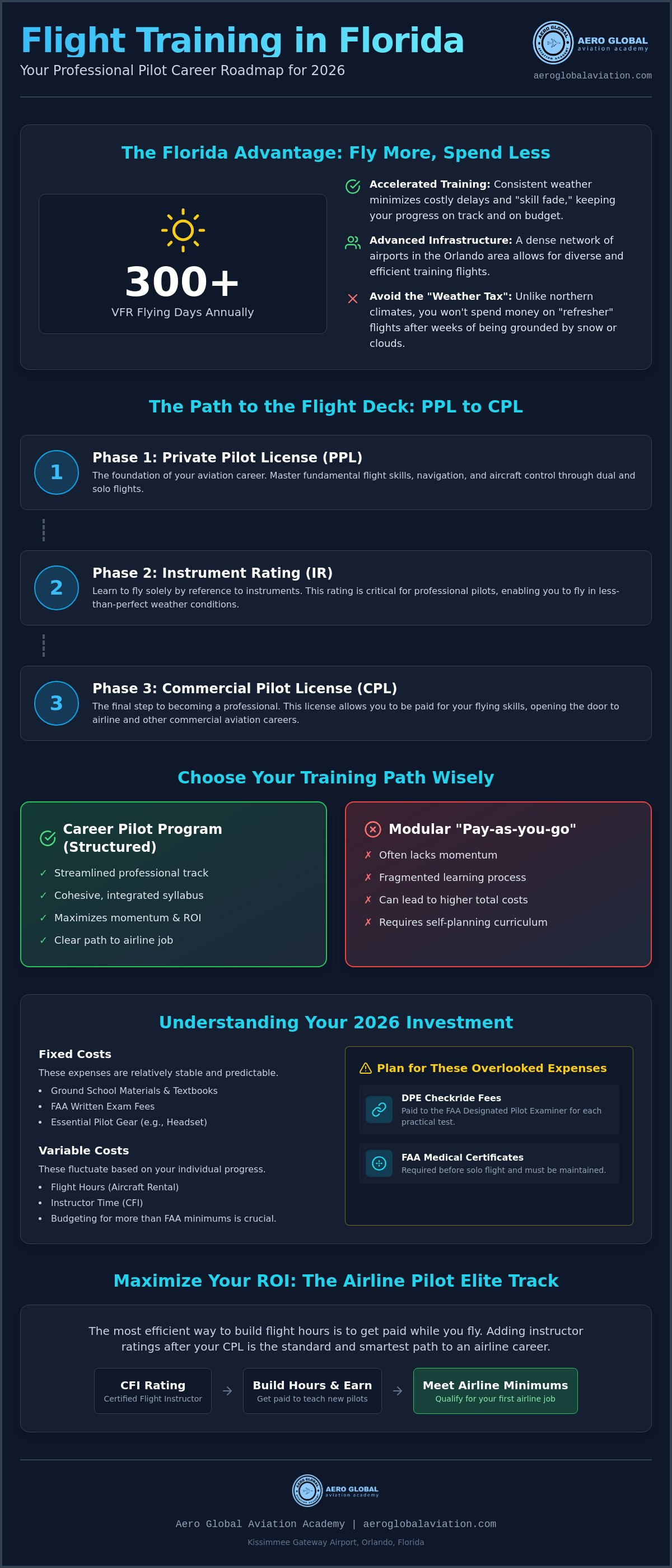
Training in a region with over 300 days of Visual Flight Rules (VFR) weather isn't just about the view from the cockpit. It's a strategic financial decision. In northern climates, winter storms can ground students for weeks; this leads to "skill fade" where you must spend extra money re-learning maneuvers you already knew. At our base at Kissimmee Gateway Airport near Orlando, the consistent climate ensures you stay on your timeline. This geographic advantage means you spend your money on moving forward, not on repeating lessons delayed by snow or persistent low clouds. By avoiding these costly training gaps, you keep your total PPL to CPL program cost Florida manageable and predictable.
Career Pilot Program vs. Modular Training
Choosing a structured path offers distinct financial benefits over a modular, "pay-as-you-go" approach. Modular training often lacks the momentum required for professional development, leading to higher total costs over time due to fragmented learning. In contrast, the Career Pilot Program is a streamlined professional track that integrates Private, Instrument, and Commercial stages into one cohesive syllabus. This integrated approach ensures that every hour you spend in the air directly contributes to your next rating, maximizing your return on investment. By following a structured timeline, you eliminate the confusion of planning your own curriculum and focus entirely on mastering the skills needed for the flight deck.
Detailed Cost Breakdown of the Career Pilot Program
Calculating the total PPL to CPL program cost Florida students face requires a look at both fixed and variable expenses. Fixed costs include your ground school materials, textbooks, and FAA written exam fees. These remain relatively stable, but the variable costs are what truly shape your budget. Flight hours and instructor time fluctuate based on how quickly you master specific maneuvers. While Part 141 schools offer a highly structured syllabus that can sometimes reduce required hours, Part 61 training provides the flexibility many career-changers need. It's vital to budget for realistic flight hours rather than just the FAA minimums. Most students find that following an AOPA flight training cost guide helps them set a more accurate financial expectation for the journey ahead.
Phase 1: The Private Pilot Foundation (PPL)
Your journey starts with earning your Private Pilot License. This phase involves a mix of dual instruction, where you fly with a CFI, and solo requirements where you're the sole occupant of the cockpit. Beyond the aircraft rental, you'll need to invest in essential gear like a quality noise-canceling headset and digital charting subscriptions. To see a detailed roadmap of this first step, check out our guide on How to Get Your Private Pilot License in Florida. Mastering these fundamentals early prevents expensive remedial training later in the program.
Phase 2: Instrument Rating (IR) and Time Building
The Instrument Rating is arguably the most critical addition for professional employability. It teaches you to fly solely by reference to instruments, a skill required by every major airline. To keep costs down during this phase, we utilize advanced simulators that allow you to practice complex procedures at a fraction of the cost of an actual aircraft. Between earning your IR and starting your commercial training, you'll enter the "time building" phase. This is an excellent opportunity for cross-country flying. You'll explore Florida's vast airport network while meeting the 250-hour requirement for a Commercial Pilot License. Understanding the total PPL to CPL program cost Florida helps you plan for these hours effectively.
Phase 3: The Commercial Pilot Certificate (CPL)
The final hurdle is the Commercial Pilot Certificate. This phase focuses on precision and professional-level mastery of the aircraft. Precision is key here. You'll need to log hours in complex or high-performance aircraft, which typically carry a higher rental rate. Many students choose to start with a Single-Engine Commercial rating to save on initial costs before adding a Multi-Engine rating later. For a deep dive into these requirements, read our Commercial Pilot Training: Your 2026 Guide. If you're ready to start this transition, our Career Pilot Program offers the structured support you need to succeed.
Estimating Total Real-World Expenses in 2026
When you calculate the total PPL to CPL program cost Florida schools present, it's easy to focus solely on aircraft rental and instructor time. However, the sticker price rarely tells the whole story. To build a truly accurate budget, you must account for "The Hidden Four": checkride fees, medical certificates, insurance, and personal equipment. These aren't optional extras; they're essential requirements for your professional journey. Most students also find a gap between FAA minimum hours and the actual time needed to reach proficiency. Budgeting for 10% to 15% more than the minimum flight hours is a smart way to ensure you don't run out of funds just before your final checkride. Our "Practical Mentorship" approach helps minimize these overages by keeping your training focused and efficient.
Fuel surcharges are another variable that can impact your bottom line. In the Florida market, these surcharges fluctuate based on the current price of Avgas. While many schools quote a "wet" rate that includes fuel, significant spikes in energy costs may result in additional hourly fees. You should also consider the cost of re-training. If you don't pass a stage check or a checkride on the first attempt, you'll need to pay for additional remedial flights and instructor time. Investing in quality gear early, like a high-end noise-canceling headset and a dedicated iPad for Electronic Flight Bag (EFB) subscriptions, is usually more cost-effective than renting or using outdated equipment.
FAA Fees and Administrative Costs
Administrative expenses are a mandatory part of the process. In 2026, Designated Pilot Examiner (DPE) fees in the Orlando and Kissimmee region typically range between $600 and $1,300 per practical exam. Some specialized examiners may charge up to $1,800 for commercial multi-engine checkrides. You'll also need an FAA First-Class Medical certificate to exercise your commercial privileges; this exam generally costs between $75 and $200. If you're an international student, remember to budget for TSA processing and fingerprinting fees, which are required before you can begin your flight training.
Living Expenses While Training in Orlando
If you're relocating to the Kissimmee area, housing will be a significant portion of your non-flight budget. Orlando is a major metropolitan area, so costs can vary depending on how close you stay to the airport. Many of our students choose shared housing to keep expenses low. You'll also need reliable transportation, as getting to the airport for early morning flights is crucial for taking advantage of the best weather. Choosing an accelerated track like our Career Pilot Program can actually save you thousands of dollars in living expenses by reducing the number of months you need to pay for rent and utilities while you're out of the workforce.
Maximizing Your Flight Training ROI
Viewing your flight training as a simple expense is a common mistake that can cloud your financial planning. Instead, you should frame the PPL to CPL program cost Florida schools present as a strategic capital investment in a high-earning career. In 2026, the aviation industry continues to see strong salary growth for regional first officers, which makes the initial "speed-to-market" more valuable than ever. Every month you spend in training is a month of professional seniority you're missing. By choosing an efficient path, you aren't just saving on tuition; you're accelerating your timeline to a six-figure income bracket.
One of the most effective ways to maximize your return on investment is by choosing our Airline Pilot Elite track. This path focuses on adding Certified Flight Instructor (CFI) ratings immediately after you earn your commercial certificate. This is the "secret sauce" for professional growth because it allows you to stop paying for flight hours and start getting paid to build them. Instead of self-funding the gap between 250 and 1,500 hours, you earn a paycheck while mentoring the next generation of aviators. To understand how this fits into the bigger picture, read our guide on The Airline Pilot Career Path: A Comprehensive 2026 Guide.
Financing Options and Payment Plans
Navigating the financial side of training requires a solid plan. Many students utilize specialized aviation loans from lenders like Sallie Mae or Meritize, which offer repayment structures designed specifically for the pilot career trajectory. While "pay-as-you-go" options offer flexibility, upfront block-hour discounts often provide a lower total PPL to CPL program cost Florida flight schools can offer. Don't forget to explore scholarship opportunities through organizations like WAI or OBAP; these can significantly offset your out-of-pocket expenses while you're still in the Wings Foundation stage.
Efficiency Hacks: How to Study to Save Money
Your habits on the ground directly impact your bank account in the air. Arriving prepared for every lesson is the easiest way to save money. "Chair flying," or practicing your cockpit flows and checklists at home, ensures that you don't waste expensive engine time on basic memory items. We also encourage students to complete their ground school and FAA written exams before the flight phase begins. This prevents training delays and allows you to focus entirely on aircraft mastery. Using our modern flight simulators for procedural training also helps you master complex maneuvers at a fraction of the hourly aircraft rate. Choosing a school with a "Practical Mentor" philosophy prevents the "instructor hopping" that often adds unnecessary hours and costs to your logbook.
If you're ready to turn your aviation dreams into a profitable reality, explore our Career Pilot Program and start your journey today.
Aero Global Aviation Academy: Your Path to the Flight Deck
Choosing the right environment for your professional development is just as important as the syllabus you follow. At Aero Global Aviation Academy, we've designed our Career Pilot Program to be the most efficient and transparent path to the flight deck. We understand the anxieties surrounding the total PPL to CPL program cost Florida students face; this is why we prioritize "Practical Mentorship" above all else. We aren't a large, impersonal training factory. Instead, we act as your dedicated local partner, deeply invested in your individual success. Our instructors work closely with you to ensure you hit every milestone on schedule, which prevents the costly delays and repetitive lessons that often plague less structured programs.
Whether you're starting from scratch or transitioning from our Wings Foundation course, our approach remains student-centric and goal-oriented. We don't just teach you how to pass a checkride; we prepare you for the lifestyle and responsibilities of a professional aviator. By maintaining a steady, inviting rhythm in our training, we make the complex world of commercial aviation feel within reach. We help you navigate the financial roadmap with confidence, ensuring that your investment leads directly to a rewarding career in the cockpit.
Why Our Kissimmee Training Center?
Our base at Kissimmee Gateway Airport offers a strategic advantage that few other locations can match. By training just outside the busy Orlando Class B airspace, you get the perfect balance of complex operations and efficient flight time. You won't waste your budget idling on a taxiway for thirty minutes waiting for a clearance. Our well-maintained fleet and modern facilities provide a professional atmosphere that mirrors the environment of a regional airline. This proximity to Orlando’s world-class aviation infrastructure means you're always in the heart of the industry. For a closer look at what makes our base special, explore The Ultimate Career Pilot Program in Kissimmee.
Take the First Step Toward Your Commercial License
If you already hold a Private Pilot License, we offer comprehensive transcript evaluations to see how your previous hours apply toward our professional tracks. We invite you to book a consultation with one of our senior mentors to receive a personalized estimate of your PPL to CPL program cost Florida. Whether you're aiming for the baseline Career Pilot Program or looking to reach the major airlines faster through our Airline Pilot Elite track, we provide the roadmap you need. Your transition from a beginner to a professional is a structured, attainable process when you have the right guide by your side. Start your journey with Aero Global Aviation Academy today and turn your passion for flight into a lifelong career.
Your Flight Deck Journey Starts Here
Securing your future in the cockpit requires more than just passion; it demands a clear financial plan and a partner who values transparency. We've explored how the PPL to CPL program cost Florida flight academies offer is influenced by everything from weather efficiency to the strategic use of simulator time. By focusing on actual flight hours rather than just the bare minimums, you can build a realistic roadmap that leads directly to your first professional rating. This clarity helps eliminate the anxiety of a career change and replaces it with a structured path to success.
Our Kissimmee-based training center leverages over 300 flyable days per year to keep your momentum high and your total investment predictable. With a 100% FAA compliant structured curriculum and Red Dot Design Award level training facilities, we provide the professional environment you need to excel. You've seen the roadmap; now it's time to take the first step toward your new career with confidence and the support of a practical mentor.
Download Our 2026 Career Pilot Program Cost Guide to get a detailed breakdown of your investment and see how we help you reach the flight deck faster. We're ready to help you transition from a student to a professional pilot. Your future in aviation is bright, and we can't wait to see you earn your wings.
Frequently Asked Questions
How much does a PPL to CPL program cost in Florida in 2026?
The total investment for a full professional pilot program in Florida typically ranges from $80,000 to $130,000 as of July 2026. This range accounts for differences in aircraft types and whether you already hold a Private Pilot License. When evaluating the PPL to CPL program cost Florida schools advertise, remember that your personal pace and the number of flight hours you need to reach proficiency will ultimately determine your final total.
Can I work while completing my commercial pilot training?
You can certainly work while training, especially if you choose a flexible Part 61 program that allows for a self-paced schedule. However, many students in accelerated tracks find that treating flight school like a full-time job helps them finish faster and save on total living expenses. Balancing work and flight hours requires disciplined time management to ensure you arrive at every lesson prepared and mentally sharp for the cockpit.
What are the hidden costs of flight school that aren’t in the tuition quote?
FAA written knowledge tests and digital subscriptions are the most common hidden costs not included in tuition quotes. You should budget around $175 for each FAA knowledge exam and plan for Electronic Flight Bag (EFB) subscriptions like ForeFlight. Other common expenses include noise-canceling headsets and specialized aviation insurance for renters. Many schools also apply fuel surcharges that fluctuate with market prices, so it's wise to ask how these are calculated before starting.
Is it cheaper to do Part 61 or Part 141 for a commercial license?
Neither path is universally cheaper, but Part 141 schools often have lower FAA hour requirements for the Commercial Pilot License, which can reduce total costs for some students. Conversely, Part 61 offers more flexibility to use cost-saving strategies like time-building with a partner. Your total PPL to CPL program cost Florida will often depend more on your individual dedication and the consistency of your training schedule than the specific regulatory framework.
How long does it take to go from zero hours to a commercial pilot license?
An accelerated program in Florida can take you from zero experience to a commercial pilot in approximately 6 to 12 months. Florida’s 300+ days of annual VFR weather significantly reduce the risk of weather-related cancellations that often stall progress in other states. This consistent flying schedule allows you to maintain momentum and master complex maneuvers much faster than a student training in a seasonal climate where winter delays are common.
What financing options are available for flight school in Florida?
Most students fund their professional training through specialized aviation loans from lenders like Sallie Mae or Meritize, which offer deferred payment options. If you're a veteran, the Post-9/11 GI Bill provides an annual cap of $17,662 for vocational flight training starting August 1, 2026. Many local organizations also offer scholarships specifically for Florida-based students to help offset the costs of ground school and essential flight gear.
Do I need a college degree to be a commercial pilot in 2026?
You don't need a college degree to earn a Commercial Pilot License or work for regional airlines and charter companies in 2026. While some major legacy carriers still prefer a four-year degree for competitive hiring, the current pilot demand has led many airlines to prioritize flight experience and leadership skills. Focusing on earning your CFI ratings through our Airline Pilot Elite track is often a more direct path to employment than a traditional university degree.
Are checkride fees included in the flight school tuition?
Checkride fees are almost never included in a flight school's quoted tuition because they are paid directly to a Designated Pilot Examiner (DPE). In Central Florida, you should plan to pay between $600 and $1,300 per practical exam depending on the rating. Since these are third-party fees, they are subject to change, so we always recommend keeping a dedicated "checkride fund" separate from your primary training budget to avoid surprises.


