

What if the biggest obstacle to your airline career isn't the complexity of the cockpit, but the rigid clock of your 9-5? Many aspiring pilots in Central Florida feel stuck, fearing that their professional training will stall if they can't commit to a grueling, full-time pace. It's a valid concern, especially when you're balancing a 40-hour work week with the high-stakes environment of aviation. However, securing a flexible flight training schedule in Kissimmee is the strategic solution that allows you to maintain your income while steadily building the hours needed for your commercial certificate.
You don't have to choose between financial stability and your seat on the flight deck. In this article, you will learn how to leverage Kissimmee’s unique weather patterns and high airport density to prevent the training rust that often plagues part-time students. We provide a clear look at how modular academy programs, such as our Airline Pilot Elite track, offer a realistic timeline for career advancement. We'll explore practical strategies to help you navigate your training milestones with confidence, ensuring your transition from a dedicated professional to a commercial pilot is both structured and rewarding.
Key Takeaways
- Discover why Kissimmee Gateway Airport is the premier hub for career-changers who need to protect their current income while pursuing professional certification.
- Learn how to maintain a flexible flight training schedule in Kissimmee by utilizing the region's 300 plus flyable days to prevent skill stagnation.
- Master the "First Light" strategy to log critical flight hours before your workday begins, ensuring consistent progress without professional burnout.
- Evaluate the financial benefits of a pay-as-you-go training model to avoid high-interest debt while you build your professional flight hours.
- Explore how modular programs like Airline Pilot Elite adapt to your specific timeline, turning your aviation goals into a manageable reality.
Can You Really Balance a Job While in Flight School?
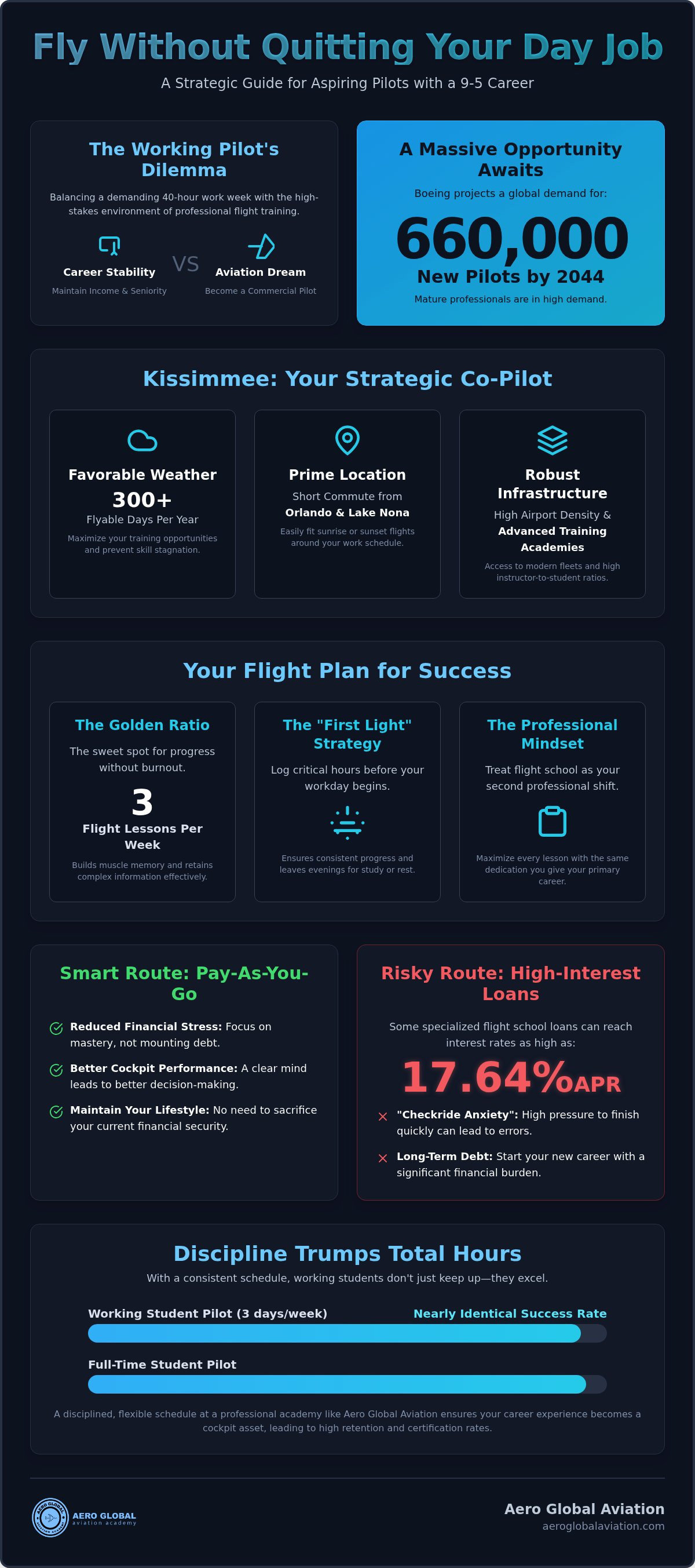
The "Working Pilot" is a specific breed of student who recognizes that a professional career and aviation dreams aren't mutually exclusive. In 2026, this path has become the preferred route for savvy career changers. With the 2025 Boeing Pilot and Technician Outlook projecting a global demand for 660,000 new pilots through 2044, the industry is hungry for mature professionals. You aren't just squeezing in lessons between meetings. You're executing a calculated career pivot. Securing a flexible flight training schedule in Kissimmee is the smart move for anyone who wants to enter the cockpit without sacrificing their current financial security.
It's vital to distinguish between "slow training" and "flexible professional training." Slow training is erratic and lacks a goal. Professional training, even on a part-time basis, follows a rigorous syllabus. To succeed, you must treat flight school as your second professional shift. This psychological shift ensures that when you arrive at the airport, your mind is clear and ready for the technical demands of the pilot certification process.
The Pros and Cons of Working During Training
Financial freedom is the most immediate benefit of staying employed. With some specialized flight school loans reaching interest rates as high as 17.64% APR in 2026, the pressure to finish quickly can lead to "checkride anxiety." Maintaining your 9-5 income allows you to pay as you go, which keeps your focus on mastery rather than debt. However, you must find the "Golden Ratio" of training. We've found that three flight lessons per week is the sweet spot for working professionals. This frequency is enough to build muscle memory and retain complex information without causing total exhaustion.
- Pro: Reduced financial stress leads to better performance in the cockpit.
- Pro: Professional experience often translates to better cockpit resource management.
- Con: Progress may feel slower compared to full-time cadets.
- Con: Requires high levels of personal discipline and time management.
Success Rates for Working Student Pilots
Discipline often trumps total available hours when it comes to earning your wings. Working students at Aero Global Aviation Academy frequently show higher retention rates because they approach their flexible flight training schedule in Kissimmee with the same dedication they give their primary careers. They don't have time to waste, so every ground school session and every hour in the Piper Warrior is maximized. A typical success story involves a student who logs hours at sunrise, works their corporate job, and finishes the day with distance learning modules.
Working student pilots who maintain a consistent three-day-a-week schedule achieve certification at a rate nearly identical to full-time students while maintaining their professional seniority and income.
Choosing a Flexible Flight School in Kissimmee
Finding the right training environment is just as critical as the hours you log in the cockpit. Kissimmee Gateway Airport (KISM) stands out as a strategic choice for professionals because of its proximity to Central Florida's major business districts. If you work in Downtown Orlando or the Lake Nona Medical City, your commute to the tarmac is short enough to make a sunset flight a reality. A flexible flight training schedule in Kissimmee depends on more than just the airport's location; it requires a school with a robust fleet and a deep roster of instructors who understand the demands of a corporate career.
You should prioritize schools that invest in digital scheduling software and maintain a high instructor-to-student ratio. This infrastructure ensures that you can book your sessions from your desk without the back-and-forth of phone tags. More importantly, evaluate the school's culture. Some academies prioritize high-volume international contracts, which can leave local working students fighting for plane availability. You deserve a partner that respects your professional timeline and views your career experience as an asset to your pilot development. If you're ready to see how a professional academy can work around your calendar, you can explore our modular training options to find a path that fits.
Part 61 vs. Part 141 for the Working Student
When you evaluate schools, you'll encounter two primary training structures. Understanding the FAA requirements for pilots is the first step in deciding which path fits your life. Part 61 training offers the ultimate freedom for those with unpredictable work hours, allowing you to move at your own pace and adjust your lesson frequency week by week. Conversely, Part 141 provides a highly structured curriculum for those who can commit to specific blocks. At Aero Global, our programs like the Wings Foundation and Airline Pilot Elite bridge this gap. We offer the rigorous structure needed for airline readiness while maintaining the adaptability that your 40-hour work week requires.
Questions to Ask Your Kissimmee Flight Instructor
Before beginning your journey, sit down with your prospective instructor to ensure your goals align. A "Practical Mentor" will be honest about the challenges of balancing a job and flight school. Use these specific questions to gauge their level of support for your flexible flight training schedule in Kissimmee:
- How do you handle last-minute work cancellations or rescheduling? Look for an instructor who has a clear, fair policy that doesn't penalize you for unavoidable professional conflicts.
- Can we conduct ground school sessions virtually or in the evenings? Modern training should leverage technology to save you a trip to the airport for theory lessons.
- What is the average PPL timeline for your students who work 40 hours a week? An experienced instructor will give you a realistic estimate based on their history with other working professionals.
Strategic Time Management: The Kissimmee Advantage
Success in the cockpit doesn't require 40 hours of free time a week; it requires a strategic use of the hours you do have. Kissimmee's geography is a secret weapon for the working pilot. While students in other regions lose weeks to overcast skies, Central Florida provides over 300 flyable days per year. For part-time students, "training rust" is the primary enemy. When you only fly twice a week, a single weather cancellation can mean a ten-day gap between lessons, forcing you to spend your next hour relearning what you forgot. Mastering a flexible flight training schedule in Kissimmee means aligning your lessons with this predictable climate to ensure consistent, forward momentum.
We often recommend the "First Light" strategy to our professional students. By scheduling your pre-flight for 6:30 AM and being wheels up by 7:00 AM, you can complete a high-quality lesson and be at your desk by 9:30 AM. This early morning air is usually the smoothest, providing an ideal learning environment for maneuvers. While you're calculating the time commitment, you should also be Financing your flight training strategically to ensure your budget supports your pace. To maximize efficiency, implement the 48-Hour Rule: review your lesson plan and local NOTAMs two days in advance. This preparation ensures you spend your expensive "engine-on" time performing, not just reading.
Building a 2026 Flight Training Schedule
Creating a sustainable routine is about energy management, not just time slots. Follow these three steps to build a schedule that lasts:
- Step 1: Audit your energy levels. If your Wednesday afternoons are drained by board meetings, don't schedule a complex cross-country flight for that evening. Pick times when you are mentally sharp.
- Step 2: Reserve standard blocks. Work with your instructor to book the same slots three weeks in advance. Consistency helps you maintain a flexible flight training schedule in Kissimmee even during busy work quarters.
- Step 3: Integrate chair flying. Spend 15 minutes at home visualizing your cockpit flow. This simple habit reduces the time needed for "re-learning" once you're actually in the Piper Warrior.
Utilizing Local Kissimmee Resources
Kissimmee Gateway Airport (KISM) offers technical advantages that save you both time and money. Unlike busier international hubs where you might spend 20 minutes idling on a taxiway, KISM’s multiple runway configuration allows for rapid departures. This efficiency is vital when you're trying to squeeze a lesson into a lunch break. Additionally, the Orlando area is home to a vibrant community of career-changers. Networking with other working pilots can provide the moral support needed to push through the more demanding phases of your training. If you're just starting, check out our guide on How to get your private pilot license in Florida for a detailed roadmap.
Financing Your Career: Working vs. Flight Loans
Choosing how to fund your aviation journey is a pivotal decision that shapes your professional stress levels for years to come. In 2026, many students feel pressured to take out massive loans, but with Sallie Mae fixed interest rates reaching as high as 17.64% APR, the debt burden can be overwhelming. This is where the "Pay-As-You-Go" model shines. By maintaining your current career, you can fund your ratings in real-time, effectively bypassing the heavy interest of traditional flight school loans. A flexible flight training schedule in Kissimmee allows you to treat your training costs as a manageable monthly investment rather than a mounting debt obligation.
A smart ROI analysis compares the cost of loan interest against the "cost" of a slightly slower training pace. While finishing six months earlier might get you into a commercial seat sooner, the thousands of dollars saved in interest often provide a more stable financial foundation. Additionally, you should explore employer tuition reimbursement. Major carriers like SkyWest offer up to $17,500 in tuition reimbursement, and some corporate employers in non-aviation sectors provide professional development funds that can be applied to technical certifications. Before committing to debt, check if your current HR policy supports your transition. If you want to see how these financial paths align with your goals, you can book a career consultation with our team to discuss your options.
Budgeting for the Career Pilot Program
When you plan your monthly budget, aim for a consistent 10 hours of flight time per month. This pace keeps your skills sharp without draining your savings. It's also essential to establish a "Checkride Fund" early on. Setting aside funds specifically for FAA examiner fees and the extra prep hours before a milestone ensures that you don't face a progress stall when you're most ready to succeed. For a deeper look at the specific requirements you'll be funding, see our commercial pilot training guide.
Transitioning to a Full-Time Aviation Career
Most working professionals reach a crossroads at the 250-hour milestone. This is typically when you earn your commercial certificate and can begin earning money as a pilot. The "CFI Pivot" is a popular strategy where you leave your 9-5 to become a Certified Flight Instructor, allowing you to build the 1,500 hours required for the airlines while getting paid. Understanding the airline pilot career path helps you time this jump perfectly. Students often find that once they reach 250 hours, the momentum of their new career makes the transition to full-time aviation both logical and financially viable.
The Aero Global Approach to Working Students
At Aero Global Aviation Academy, we recognize that your professional background is a strength, not a distraction. We don't operate like a massive, impersonal pilot factory. Instead, our "Practical Mentor" philosophy ensures that we treat every student as a future colleague. We understand the specific pressures of a high-stakes corporate environment, and we've built our academy to support those who are balancing existing responsibilities with new aspirations. By providing a flexible flight training schedule in Kissimmee, we empower you to maintain your career momentum while you methodically check off your aviation milestones.
Our location at Kissimmee Gateway Airport is specifically chosen to benefit Orlando-area professionals. We've optimized our operations to ensure that your time at the airport is spent in the cockpit or the classroom, not waiting for an instructor or a plane. This efficiency is the cornerstone of our approach. We want your transition to the flight deck to feel like a logical, rewarding progression rather than a chaotic scramble. Whether you are coming from Lake Nona or Downtown Orlando, our academy serves as a dedicated hub where your professional goals become tangible destinations.
Modular Training for Busy Professionals
We've structured our programs to grow with you. The Wings Foundation is our premier PPL course, designed for those who want to master the fundamentals of flight without the pressure of an accelerated timeline. It allows you to build a rock-solid foundation of stick-and-rudder skills at a pace that respects your work-life balance. Once you've secured your private pilot certificate, you can seamlessly transition into advanced flight training as your schedule allows. For those with their sights set on the airlines, the Airline Pilot Elite track provides a comprehensive path from PPL to advanced instructor certifications, all while maintaining the adaptability you need.
Join the Aero Global Community in Kissimmee
One of the most valuable assets we offer is our community. When you train with us, you're surrounded by other professional career-changers who share your drive and your challenges. This network provides a unique support system where you can exchange study tips, share resources, and build professional connections that last long after you've earned your ratings. We believe that a flexible flight training schedule in Kissimmee should also include the opportunity to collaborate with like-minded peers who are on the same journey.
Your path to the cockpit starts with a single, manageable step. We invite you to book a Discovery Flight at a time that fits your current work week. This hands-on experience allows you to meet our mentors, see our fleet, and feel the controls for yourself. If you're ready to see how your professional life and aviation dreams can coexist, explore The Ultimate Career Pilot Program in Kissimmee and let us help you map out your future in the sky.
Take Command of Your Aviation Future
You've seen that the path to the flight deck doesn't require you to walk away from your current professional success. By choosing a flexible flight training schedule in Kissimmee, you can leverage the strategic advantages of the Kissimmee Gateway Airport (KISM) to build hours without the weight of high-interest debt. Our Wings Foundation provides a specialized PPL path that prioritizes mastery over speed, ensuring you develop the sharp skills required for a lifelong career as you progress toward your commercial certificate.
The transition from the office to the clouds is a structured and attainable process when you have the right mentor by your side. We're here to help you navigate every milestone with confidence and precision. Ready to see the view from the cockpit for yourself? Start your modular pilot journey with a Kissimmee Discovery Flight today. Your seat in the cockpit is waiting, and we can't wait to help you reach it.
Frequently Asked Questions
Is it better to fly once a week or three times a week while working?
Aiming for three lessons per week is the ideal frequency for working students. This cadence ensures you retain muscle memory and technical knowledge without having to spend your next hour relearning previous maneuvers. Flying once a week often leads to stagnation; as a result, your total training hours might increase. A consistent, flexible flight training schedule in Kissimmee helps you reach your milestones with greater efficiency.
How many hours a week do I need to study for ground school while working full-time?
You should plan to dedicate approximately five to ten hours per week to ground school study while working full-time. Breaking this into smaller, daily blocks of 45 to 60 minutes is often more effective than attempting marathon sessions on your days off. This approach keeps the material fresh in your mind and allows you to integrate theory with your practical flight lessons more effectively.
Can I use my vacation days for intensive flight training blocks in Kissimmee?
Yes, using vacation days for intensive training blocks is a highly effective strategy to push through challenging milestones like cross-country requirements. This allows you to immerse yourself in the environment without the distractions of your professional life. We can coordinate with you to schedule multiple flights per day during these blocks, maximizing your progress while you are away from the office.
Does working a full-time job slow down my progress toward a Commercial Pilot License?
While working a full-time job may extend the chronological time it takes to reach your Commercial Pilot License, it doesn't have to diminish your proficiency. In fact, many professional students develop superior discipline and time management skills. By following a structured, modular path, you can maintain steady progress toward the 250-hour FAA requirement while protecting your financial stability and career seniority.
What are the best times of day to fly at Kissimmee Gateway Airport for working students?
The "First Light" period around 7:00 AM is the most advantageous time for working students at Kissimmee Gateway Airport. The air is typically smoother and the traffic is lighter, allowing for more focused maneuver practice. Late afternoon sessions are also excellent for logging sunset or night hours, ensuring you meet all certification requirements without interfering with standard business hours.
Are there financing options available if I choose to keep my current job?
Several financing options exist for students who maintain their employment, including specialized flight school loans and pay-as-you-go models. While interest rates for some aviation loans can be high, keeping your job allows you to fund your training in manageable increments. This strategy reduces your reliance on debt and provides a clear, debt-free path to the cockpit for those who prefer financial independence.
How do I handle flight training burnout when balancing work and school?
Managing burnout requires open communication with your instructor and a realistic assessment of your energy levels. If you feel overwhelmed, it's better to take a short, planned break than to push through and lose focus. We advocate for a "Practical Mentor" approach where we adjust your flexible flight training schedule in Kissimmee to ensure your aviation journey remains an exciting pursuit rather than a source of stress.
Can I complete my instrument rating while working a 9-5 job?
Completing your instrument rating while working a 9-5 job is entirely achievable and very common among our students. Instrument training focuses heavily on procedures and precision, which can often be practiced in simulators during evening hours. This flexibility allows you to master the complexities of IFR flight while remaining fully committed to your professional responsibilities during the day.


