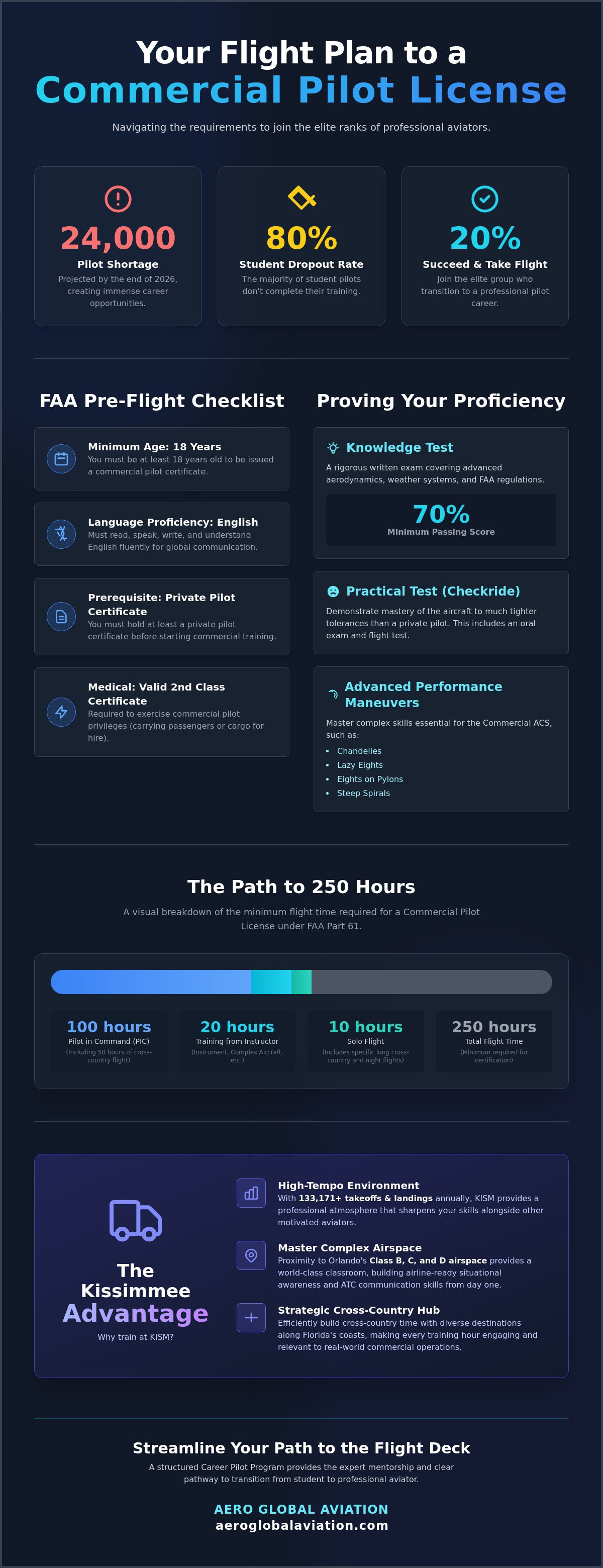
Did you know that the aviation industry is facing a projected shortage of 24,000 pilots by the end of 2026? While the demand for professional aviators has never been higher, roughly 80% of student pilots hang up their headsets before reaching the finish line. Mastering the specific commercial pilot license requirements Kissimmee flight schools demand is the first step to ensuring you stay on track to join the ranks of the elite 20% who succeed.
It's natural to feel some anxiety when looking at the 250-hour flight time hurdle or trying to decode the technical differences between Part 61 and Part 141 training. You deserve a path that balances professional rigor with the personal mentorship required to truly thrive in the cockpit. This guide will help you transition from a student pilot to a career-ready professional by providing a clear, step-by-step checklist of FAA requirements and explaining why Kissimmee is a strategic powerhouse for your flight training. We'll explore the milestones you need to hit and show you how Central Florida's unique environment turns complex technical training into an attainable, rewarding professional lifestyle.
Key Takeaways
- Identify the core FAA eligibility standards, ensuring you meet the age and language proficiency requirements before launching your professional career.
- Master the specific commercial pilot license requirements Kissimmee aviators face, including the strategic breakdown of your 250 total flight hours.
- Explore the unique advantages of training at Kissimmee Gateway Airport, where proximity to complex airspace builds airline-ready communication skills.
- Learn which advanced performance maneuvers, such as Chandelles and Lazy Eights, are essential for meeting the precise tolerances of the Commercial ACS.
- Discover how a structured Career Pilot Program can streamline your transition from a private pilot to a professional aviator through expert mentorship.
Core FAA Commercial Pilot License Requirements for 2026
Earning your wings as a professional aviator is a transformative journey that begins with a clear understanding of the regulatory baseline. To fly for compensation or hire, you must align your training with the FAA pilot certification process. Meeting the commercial pilot license requirements Kissimmee flight schools prioritize ensures you aren't just a pilot, but a professional ready for the demands of the modern flight deck. You're stepping into a role where precision is your currency and safety is your primary product.
The FAA establishes several fundamental criteria for every applicant before they can transition into commercial operations:
- Age: You must be at least 18 years old to be issued your certificate.
- Language: You must be able to read, speak, write, and understand English fluently.
- Prerequisites: You must already hold at least a private pilot certificate.
- Medical: You need a valid second-class FAA medical certificate to exercise your commercial privileges.
Eligibility and Medical Standards
While a third-class medical is sufficient for recreational flying, the second-class medical certificate is the baseline for commercial operations. It proves you meet the specific physical and mental health standards required to carry passengers or cargo for pay. If you've already completed your initial training through the Wings Foundation, you've already seen how vital health is to flight safety. At the commercial level, the scrutiny is naturally higher. Your license will also feature an "English Proficient" endorsement; this is a global requirement that ensures seamless communication with Air Traffic Control across international borders, making your skills marketable worldwide.
Knowledge and Practical Testing
Before you climb into the cockpit for your checkride, you have to prove your technical expertise on the ground. The FAA Commercial Pilot Knowledge Test is a rigorous exam covering advanced aerodynamics, complex weather systems, and federal regulations. You'll need a score of 70% or higher to pass. Once you've mastered the theory, your instructor will provide the necessary endorsements for your practical test. Understanding these commercial pilot license requirements Kissimmee instructors emphasize will prepare you for the high-stakes environment of the oral exam. This checkride is where the standards shift. While a private pilot is expected to fly safely, a commercial pilot must fly with mastery. You'll be held to much tighter tolerances, demonstrating that you can manage the aircraft with the confidence of a seasoned professional.
The Kissimmee Advantage: Why Train at KISM?
Choosing the right base for your flight training is just as critical as the hours you log in the cockpit. Kissimmee Gateway Airport (KISM) serves as a premier training hub, offering a professional atmosphere without the overwhelming congestion of Orlando International (MCO). You'll find yourself operating in a high-tempo environment that recorded 133,171 landings and takeoffs in 2025, providing ample opportunity to refine your skills alongside other motivated aviators. By training here, you aren't just checking boxes for the commercial pilot license requirements Kissimmee schools follow; you're building a foundation for a career that can take you anywhere.
The strategic location of KISM allows you to maximize every flight hour. Whether you're heading to Florida's coastal airports for cross-country time or practicing maneuvers in the practice area, the efficiency of this location is unmatched. While you work toward the official FAA requirements, the regional geography acts as your greatest teacher, offering diverse destinations that keep your training engaging and relevant to real-world commercial operations.
Mastering Complex Airspace
The proximity to Orlando's Class B airspace isn't a hurdle; it's a world-class classroom. Training at KISM requires you to develop commercial-grade situational awareness from day one. You'll regularly practice transitions through Class B, C, and D airspaces in a single training flight, which is an experience many pilots in remote areas never get. This constant interaction with Air Traffic Control (ATC) in high-traffic environments builds a level of radio communication confidence that is essential for any professional pilot. You'll graduate with the ability to navigate busy terminal areas with ease, a skill that airline recruiters value immensely.
Weather and Training Efficiency
Central Florida provides over 300 days of flyable weather annually, ensuring your training timeline remains consistent and predictable. This is why pilot training in Kissimmee often moves at a pace Northern schools simply can't match. Beyond the sunshine, you'll also learn to manage convective weather patterns. Safely navigating around afternoon buildup is a critical skill for professional pilots in the Southeastern United States. Mastering these conditions under the guidance of a mentor prepares you for the decision-making challenges of a commercial career. If you're ready to start your journey in this ideal environment, you can explore our program options to see which path fits your goals.
Total Flight Hour Breakdown: The Path to 250 Hours
The road to your commercial certificate is paved with hours logged in the sky. To meet the commercial pilot license requirements Kissimmee flight schools follow under Part 61, you must accumulate a minimum of 250 total flight hours. This isn't just about quantity; it's about the quality and variety of your experience. The FAA breaks this down into specific categories to ensure you're a well-rounded pilot. You'll need 100 hours of pilot-in-command (PIC) time, with at least 50 of those in airplanes. Additionally, you must log 50 hours of cross-country flight time as PIC.
You'll also complete 20 hours of dual training with an instructor in specific areas of operation. This includes 10 hours of instrument training to sharpen your ability to fly solely by reference to instruments and 10 hours in either a complex aircraft or a Technically Advanced Airplane (TAA). These TAA hours are vital in 2026, as they introduce you to the glass cockpit technology used by modern airlines. These requirements transform you from a basic pilot into a professional capable of handling sophisticated machinery with confidence.
PIC and Cross-Country Strategy
Building your flight hours for CPL requires a strategic approach to your time in the air. For commercial requirements, a cross-country flight is defined as a flight to a landing point more than 50 nautical miles straight-line distance from your original departure point. Central Florida is an ideal playground for this. You can fly from Kissimmee to coastal gems like Vero Beach or Naples, gaining experience with different weather patterns and coastal winds. Balancing your solo time with dual instruction is key. While solo time builds independence, dual time ensures you aren't picking up bad habits before your checkride.
Instrument and Night Requirements
Professionalism doesn't stop when the sun goes down or the clouds move in. You must log 10 hours of instrument training, which prepares you for the precision required in commercial maneuvers. Night requirements are equally specific. You'll need 10 hours of night flight, including a night cross-country flight and at least 10 takeoffs and landings at an airport with an operating control tower. Navigating the Florida peninsula at night is a breathtaking experience that also builds vital situational awareness. Many of Florida's top aviation programs emphasize this night proficiency because it mirrors the schedules you'll eventually fly for airlines or charter companies. Mastering these hours ensures you meet the commercial pilot license requirements Kissimmee mandates while becoming a truly versatile aviator.
Mastering Commercial Maneuvers and Professional Standards
Transitioning to the commercial level is where your flying becomes an art form. While your private pilot training focused on basic safety and aircraft control, the commercial pilot license requirements Kissimmee examiners look for in 2026 center on absolute mastery and finesse. You're no longer just avoiding mistakes; you're executing every move with the smooth, deliberate intent of a professional. This shift in standards is what separates a weekend hobbyist from a career aviator who is ready to be trusted with the lives of passengers.
Developing a "Commercial Pilot Mindset" means prioritizing passenger comfort and operational efficiency in every phase of flight. It's about more than just the stick-and-rudder skills; it's about the poise you maintain when the pressure is on. By training in the dynamic environment of Central Florida, you'll learn to embody these standards long before you sit for your checkride.
The Commercial Pilot ACS
The Airman Certification Standards (ACS) for commercial pilots demand much tighter tolerances than you experienced during your initial training. You'll need to maintain your altitude within 100 feet and your headings within 10 degrees during advanced maneuvers. Mastery of performance maneuvers like Chandelles and Lazy Eights demonstrates your ability to manage aircraft energy and coordination at the very edge of the flight envelope. Eights-on-Pylons, perhaps the most challenging commercial task, requires intense concentration on ground references while maintaining a precise pivotal altitude through varying wind conditions.
At KISM, you can utilize advanced flight training simulators to perfect your entries and sight pictures before burning fuel in the sky. This technology is particularly useful for practicing steep spirals and the high-stakes Power-Off 180-degree accuracy landing. The Power-Off 180 is a signature commercial maneuver where you must glide from the downwind leg to a specific spot on the runway without using the engine, proving you can handle an emergency with absolute precision and grace.
Aeronautical Decision Making (ADM)
Mental discipline is just as critical as physical skill in the professional world. ADM is the systematic approach to the mental process used by pilots to determine the best course of action. As a commercial pilot, you'll face unique pressures, such as "get-there-itis" or the perceived need to complete a mission for a client or employer. You have to learn to evaluate risks as a commercial operator rather than a hobbyist. This means managing commercial pressure and prioritizing safety over the schedule. If you're ready to elevate your skills and adopt a truly professional approach to flight, apply for our Career Pilot Program today and start training with mentors who live these standards every day.
The Aero Global Career Pilot Program: Your Kissimmee Solution
Transitioning from a student pilot to a professional aviator is a high-stakes evolution that requires more than just a logbook full of hours. It demands a structured environment that mirrors the standards of the airlines you hope to fly for. Our Career Pilot Program is specifically designed to help you navigate the commercial pilot license requirements Kissimmee examiners expect, moving you efficiently from your Private Pilot License through to your commercial rating. We don't just teach you how to fly; we prepare you to lead a crew and manage a professional flight deck with absolute confidence.
Achieving this level of proficiency is a collaborative effort. At Aero Global, you'll have access to a modern fleet of aircraft optimized for commercial training, including Technically Advanced Airplanes (TAA) that bridge the gap between light trainers and regional jets. This technical edge, combined with our strategic location at Kissimmee Gateway Airport, ensures your training is relevant, rigorous, and respected by industry recruiters. For those targeting a seat at a major carrier, our program offers a seamless integration into the Airline Pilot Career Path, providing the roadmap you need for long-term success.
Why Choose Our Career Pilot Program?
We believe in professional development that goes far beyond the minimum FAA requirements. While other schools might focus solely on the checkride, our "Practical Mentor" philosophy ensures you're developing the situational awareness and leadership skills required for real-world commercial operations. You'll receive personalized mentorship from instructors who bring genuine commercial experience to every lesson, helping you refine your decision-making in the complex Central Florida airspace. Training in Kissimmee's high-standard environment means you'll graduate with a level of career readiness that sets you apart in a competitive job market. We take regional pride in our ability to turn local students into world-class pilots through a mix of technical excellence and supportive, individual attention.
Next Steps: Enrolling in Kissimmee
Your journey toward the flight deck starts with a single, decisive step. We invite you to visit our Kissimmee facility to meet our team, tour our modern fleet, and see our training environment in action. Scheduling a discovery flight is the best way to experience our mentorship style firsthand and confirm that the professional pilot lifestyle is the right fit for you. During your visit, we can also review various financing and payment plans tailored to the Career Pilot Program, ensuring that the path to your goals is as clear financially as it is operationally. Don't let the complexity of the industry hold you back from your aspirations. You can start your journey toward a Commercial Pilot License at Aero Global Aviation Academy today and take command of your professional future.
Launch Your Professional Aviation Career in Kissimmee
Mastering the commercial pilot license requirements Kissimmee flight examiners demand is the gateway to a lifelong career in the skies. You've seen how the path to 250 hours isn't just about logging time; it's about refining your precision through advanced maneuvers and navigating the complex airspace around Central Florida. By choosing a training base at Kissimmee Gateway Airport (KISM), you gain a competitive edge that prepares you for the high standards of the airline industry. This geographic advantage, combined with a structured curriculum, ensures you graduate with the confidence of a seasoned professional.
Our structured PPL to CPL career tracks are led by FAA-certified instructors who bring real-world airline experience directly into the cockpit. This personalized mentorship transforms technical requirements into tangible career milestones. If you're ready to take command of your future, you can Enroll in the Career Pilot Program in Kissimmee to begin your transition from student pilot to professional aviator. The flight deck is waiting for you. Let's make your dream of a professional aviation career a reality.
Frequently Asked Questions
How many flight hours do I need for a Commercial Pilot License in Kissimmee?
You need a minimum of 250 total flight hours to earn your certificate under FAA Part 61 regulations. This total includes specific milestones such as 100 hours of pilot-in-command time and 50 hours of cross-country flight. While these are the legal minimums, your focus should be on achieving the high level of proficiency required to meet the commercial pilot license requirements Kissimmee examiners expect during your checkride.
What is the difference between Part 61 and Part 141 commercial training?
The primary difference lies in the level of structure and the FAA-approved syllabus used during your instruction. Part 141 programs are highly regulated and can sometimes allow you to graduate with as few as 190 hours due to their rigid curriculum. Part 61 training offers more flexibility for students who need to balance their flight schedule with other commitments while still mastering the same professional standards.
Can I get my CPL if I only have a third-class medical?
You can complete the training and take the checkride with a third-class medical, but you must hold at least a second-class FAA medical certificate to exercise commercial privileges. This means you cannot legally fly for compensation or hire without the second-class certification. It's a smart move to secure your second-class medical early in your training to ensure you meet all physical requirements for your future career.
How long does it take to complete the Career Pilot Program?
Most dedicated students transition from a private pilot to a commercial certificate in approximately six to twelve months. Your individual timeline depends on your flight frequency and how effectively you utilize Kissimmee's 300 plus days of flyable weather each year. A structured Career Pilot Program is designed to maintain your momentum and help you reach your professional goals as efficiently as possible.
Is Kissimmee a good place for flight training compared to other Florida cities?
Kissimmee offers a unique strategic advantage by providing a professional environment without the extreme congestion of airports like Miami or Orlando International. You'll gain vital experience navigating complex Class B airspace while benefiting from lower traffic delays on the ground. This balance makes KISM an ideal location for building the sharp situational awareness and radio communication skills that define a professional aviator.
What can I do for work once I have my Commercial Pilot License?
Do I need a multi-engine rating for my CPL?
You aren't required to have a multi-engine rating to earn your initial commercial certificate, as you can complete the requirements in a single-engine aircraft. However, most commercial employers and airlines require multi-engine experience for their flight crews. Adding a multi-engine rating to your commercial pilot license requirements Kissimmee plan is a strategic way to make your resume stand out to recruiters.
What is the cost of commercial pilot training in Kissimmee?
The total investment for your commercial training depends on your current flight hours and the specific aircraft you choose for your time-building phase. Your costs will include aircraft rental, instructor fees, and specialized ground school materials. We recommend reviewing our program outlines and discussing our various financing options to create a personalized plan that fits your professional aspirations and budget.


