

What if the biggest obstacle to your pilot's license isn't the 700-page textbook, but the way you're trying to memorize it? Most students feel buried under a mountain of information, worried that a single low score on their knowledge test will delay their checkride and stall their career. Finding effective FAA written exam prep tips Florida pilots can trust means moving beyond simple rote memorization; it's about connecting complex regulations to the actual Central Florida skies you'll fly every day.
We understand that the transition from ground school to the cockpit can feel overwhelming, but it doesn't have to be. You've worked hard to start this journey, and you deserve a study plan that respects your time and your professional goals. This survival guide promises to help you master the FAA knowledge test with Florida-specific strategies designed to move you toward your Career Pilot Program milestones faster.
We will explore how to navigate the $175 exam fee, manage testing anxiety, and apply book knowledge to Florida's unique airspace. From understanding the 2026 Advanced Air Mobility Act to mastering coastal weather patterns, you'll gain the confidence to pass on your first attempt with a score that sets a strong foundation for your entire aviation career.
Key Takeaways
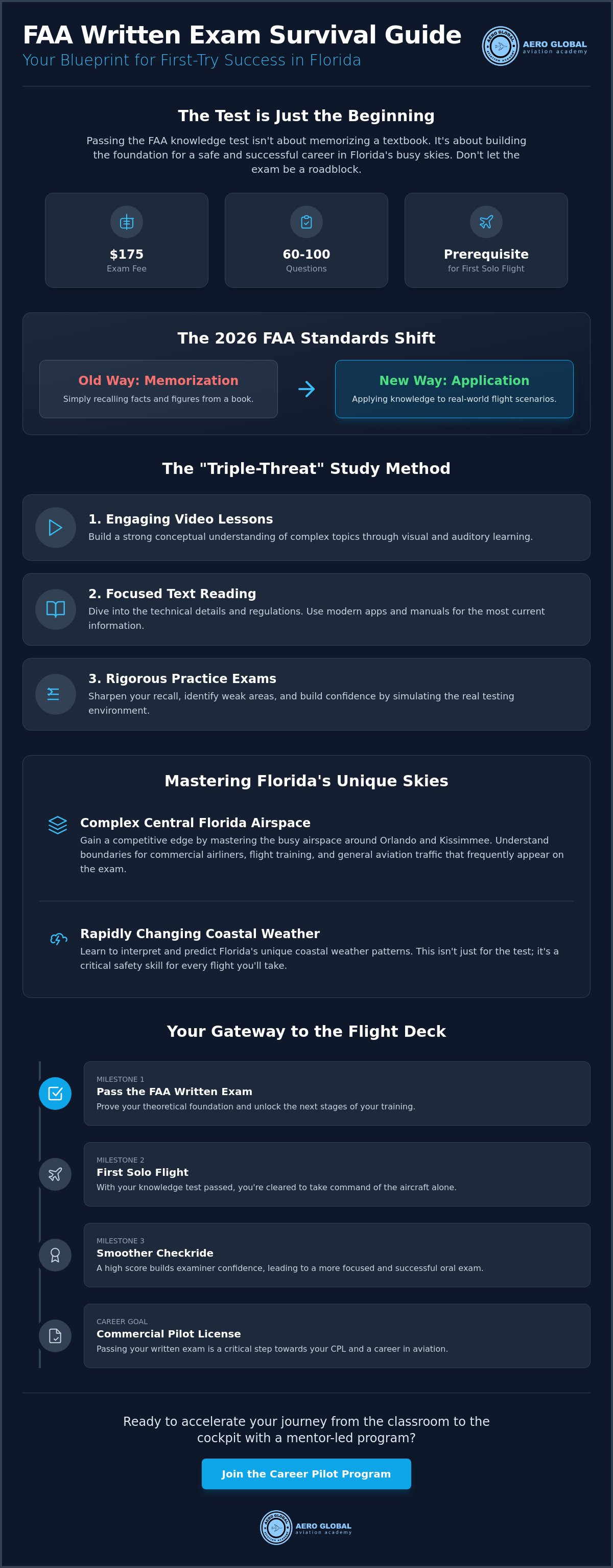
- Learn why the 2026 FAA standards require a shift from simple test-taking to deep knowledge application for your solo flight and checkride success.
- Discover the "Triple-Threat" study method and other essential FAA written exam prep tips Florida students use to set firm deadlines and pass on the first try.
- Understand how to avoid the common memorization trap by focusing on the FAA's hierarchy of learning to stay ahead of evolving question banks.
- Gain a competitive edge by mastering complex Central Florida airspace boundaries and local weather patterns that frequently appear on your knowledge exam.
- See how integrating your written preparation into a mentor-led Career Pilot Program can streamline your journey from the classroom to the flight deck.
The FAA Written Exam in Florida: A Career Milestone
Passing your knowledge test is the first major victory on your path to the cockpit. While many students view it as a hurdle to clear, it's actually the official prerequisite for your first solo flight and your final checkride. In the context of Pilot certification in the United States, this exam serves as the legal proof that you possess the aeronautical knowledge necessary to operate safely in our national airspace. For those seeking the best FAA written exam prep tips Florida has to offer, the first step is recognizing that this test isn't just about a score; it’s about building the professional foundation you'll use for the rest of your life.
The 2026 standards have shifted significantly. The FAA now prioritizes knowledge application over simple rote memorization. This change is especially relevant here in Central Florida. Our skies are some of the busiest in the country, featuring a complex mix of commercial airliners, flight training traffic, and rapidly changing weather patterns. Understanding the "why" behind a regulation or a weather report isn't just for the test; it is a critical safety requirement for every flight you take from Kissimmee or Orlando. Successfully navigating this exam sets a high standard for your entire airline pilot career path, proving you have the discipline required for professional flight deck operations.
The Gateway to the Career Pilot Program
Completing your written exam early in your training is a strategic move that accelerates your timeline toward a Commercial Pilot License (CPL). When you have the "written" out of the way, you can focus entirely on your stick-and-rudder skills. High scores also pay dividends later. A strong performance on the computer-based test often leads to a much smoother oral portion of the checkride because the examiner already trusts your theoretical foundation. At Aero Global, our philosophy is that ground school isn't just a class. It is the foundation of the Elite pilot mindset, where you learn to think like a captain before you even start the engine.
2026 FAA Testing Standards in Florida
Today's testing environment is governed by the Airman Certification Standards (ACS), which link specific knowledge areas directly to flight proficiency. The FAA written exam is a 60 to 100 question computer-based assessment of aeronautical knowledge that covers everything from navigation to federal regulations. Before you can sit for the exam at a Florida testing center, you must receive a formal endorsement from a certified flight or ground instructor. Utilizing modern FAA written exam prep tips Florida instructors recommend ensures that you are prepared for the specific ways the ACS evaluates your decision-making abilities.
Essential FAA Written Exam Prep Tips for 2026 Students
Studying for the knowledge test doesn't have to be a lonely grind through a dusty manual. To succeed in today's environment, you need a "Triple-Threat" study approach. This method combines engaging video lessons for conceptual understanding, focused text reading for technical details, and rigorous practice exams to sharpen your recall. By engaging multiple senses, you'll retain information longer and move through ground school with much more confidence. It's one of the most effective FAA written exam prep tips Florida students can use to stay on track for their checkride.
The importance of a structured, proprietary approach to high-stakes testing is recognized in many fields; for example, law students often discover Jackson-Wagner LLC to prepare for the rigors of the California Bar Exam using specialized study methods.
Start by setting a firm deadline. By committing to a date at a Florida PSI center at least 30 days in advance, you transform a vague goal into a concrete mission. During your study sessions, prioritize the "Big Three" topics: Airspace, Weather, and Regulations. These areas make up the bulk of the exam and are the most critical for safe operations in Central Florida. To speed up your performance calculations, leverage a digital E6B flight computer. These modern tools reduce the margin for error on weight and balance or cross-country planning questions, allowing you to focus your mental energy on more complex theory. If you find yourself struggling with specific concepts, don't hesitate to join a mentor-led ground school. Learning in a collaborative environment often clarifies difficult topics faster than studying in isolation.
Choosing the Right Study Materials
Modern 2026 apps offer interactive features that traditional ASA or Gleim manuals can't match, though those classic texts remain excellent for deep dives. Our Wings Foundation course emphasizes structured ground training to ensure you aren't just memorizing but actually learning. Always verify that your supplements are for the current year. The FAA frequently updates figures and charts, and using outdated materials is a quick way to lose easy points on your exam. For the latest official resources and standards, you can always consult the FAA Airman Testing portal.
The Power of Practice Exams
Use practice exams as a diagnostic tool rather than just a rehearsal. When you miss a question on a cross-country planning problem, go back to the source material to understand the underlying principle. You should aim for a consistent 90% on at least three consecutive practice tests before you book your official exam. This buffer accounts for testing center nerves and ensures you truly know the material. Be careful not to fall into the trap of "recognizing" the correct answer based on the shape of the paragraph; the FAA often tweaks the wording in the real exam to catch students who rely on visual memory alone. If you're looking for a supportive community to help you reach these milestones, exploring a professional flight training partner can provide the structure you need.
Overcoming the "Memorization Trap" in Ground School
Many students fall into the trap of thinking the written exam is just a high-stakes trivia contest. They spend hours staring at question banks, hoping to recognize the correct answer on test day. While rote memorization might get you a passing grade, it often fails you the moment you step into the cockpit. The FAA understands this tendency and frequently changes question wording or rearranges answer choices specifically to expose students who don't truly understand the core principles. When looking for effective FAA written exam prep tips Florida pilots can use, the most valuable advice is to move past rote memory and climb the hierarchy of learning toward true understanding.
Building a deep conceptual foundation saves you more than just stress; it saves you money. When you understand the "why" behind aerodynamics or weather theory, you spend fewer remedial hours in the air trying to grasp why the aircraft behaves a certain way in a Florida summer afternoon. This level of mastery is essential as you transition from a private pilot to more advanced commercial pilot training. Professional flight certification requires you to correlate different pieces of information quickly, a skill that starts with how you handle your first ground school textbook.
A 4-Step Framework for Deep Learning
To ensure you're actually learning the material, try this structured approach to every major topic:
- Step 1: Read the specific chapter in the Pilot’s Handbook of Aeronautical Knowledge (PHAK) to get the technical details.
- Step 2: Watch a visual demonstration or animation of the concept, such as how high density altitude affects your takeoff roll.
- Step 3: Explain the concept out loud to a peer or your instructor without looking at your notes. If you can't teach it, you don't know it.
- Step 4: Apply the knowledge to a local Florida scenario, like calculating your fuel burn for a cross-country flight from Kissimmee to Naples.
Why the Oral Exam Depends on Your Written Prep
The written exam is only half the battle. During your checkride, the Designated Pilot Examiner (DPE) will review your written test results. If you missed questions on weather or systems, the examiner is legally required to probe those specific weaknesses during the oral exam. A high score on the written test doesn't just look good; it signals to the examiner that you're a disciplined student. This often leads to a shorter, more conversational oral exam because you've already demonstrated your competence. Having a mentor to bridge the gap between book knowledge and the cockpit ensures you walk into that room with the Elite pilot mindset.
Mastering Florida Airspace and Weather Knowledge for the Test
Many students study for the written exam in a vacuum, but the most successful pilots treat the material as a roadmap for their local environment. Integrating the FAA written exam prep tips Florida students need involves visualizing the complex airspace boundaries you see on the Orlando sectional chart every time you fly. When you can relate a theoretical Class B boundary to the actual skyline you see from the cockpit, the information sticks. This regional mastery doesn't just help you pass; it ensures you're a safer pilot in one of the busiest flight training corridors in the world.
Central Florida is a unique classroom where the "Disney TFR" (Temporary Flight Restriction) is a daily reality rather than just a textbook example. You'll frequently encounter questions regarding restricted or prohibited areas, and knowing the specific coordinates and altitudes of local TFRs gives you a significant advantage. Additionally, you must master performance calculations. Florida’s high humidity and summer temperatures often create high density altitude conditions that significantly impact takeoff and climb data. The exam will test your ability to use performance charts to account for these "thick" air conditions, a skill that is vital for every departure from Kissimmee Gateway Airport (KISM).
Decoding the Orlando Sectional
The Orlando Class B airspace is often described as an upside-down wedding cake, and mastering its various floors and ceilings is essential for the exam. A common mistake is miscalculating the floor of the Class B shelf when it overlaps with the Kissimmee Class D surface area. Training at KISM gives you a head start because you're already operating within these complex boundaries. Practice identifying VFR corridors and reporting points on your chart; the FAA often uses these as landmarks for navigation questions. If you can navigate the Orlando sectional with ease, you'll find the chart-based questions on the test much less intimidating.
Florida Weather on the FAA Exam
Weather theory is a major component of the knowledge test, and Florida’s micro-climates provide perfect real-world examples. A stable air mass is characterized by stratiform clouds and steady precipitation, while an unstable air mass features cumuliform clouds, showery precipitation, and good visibility outside of storms. You'll need to relate the "Thunderstorm Life Cycle" to the actual afternoon storms we see in Central Florida, specifically identifying the mature stage as the most hazardous due to simultaneous updrafts and downdrafts. Pay close attention to METAR and TAF questions, as they often simulate the rapid changes in visibility and ceiling height common during our humid summer months. Ready to master these concepts with a mentor by your side? Start your flight training journey in Central Florida today.
How Aero Global Aviation Academy Streamlines Your Path to Certification
Choosing the right flight school is about more than just finding an airplane; it's about finding a mentor who can translate complex regulations into actionable skills. At Aero Global Aviation Academy, we don't treat ground school as a secondary task. Our Career Pilot Program integrates written exam preparation into every phase of your flight training. This means you aren't just reading about aerodynamics in a vacuum. You're discussing those principles with your instructor while pre-flighting your aircraft. By weaving the best FAA written exam prep tips Florida instructors can offer into your daily routine, we ensure that the knowledge stays fresh and relevant for your checkride.
One of the greatest advantages we offer is our deep connection to the local environment. Our instructors fly the Orlando Class B and Kissimmee Class D airspace every single day. They understand the nuances of the "Disney TFR" and the specific weather patterns that the FAA loves to include on the knowledge test. This real-world expertise helps you bridge the gap between a multiple-choice question and a safe, professional flight. Mastering these basics now is the most effective way to prepare for advanced flight training later in your career. When you have a rock-solid foundation in private pilot theory, you'll find that earning your instrument and commercial ratings becomes a much more attainable process.
The Aero Global Aviation Academy Difference
Our "Safety-First" culture begins long before you pull back on the yoke. We believe that a truly professional pilot is a master of the books. If you find yourself struggling with specific sections of the exam, such as cross-country planning or complex weather theory, our academy provides personalized tutoring to help you push through. We don't just want you to pass; we want you to achieve the "Elite" standard of knowledge that airline recruiters look for. This commitment to excellence ensures that you walk into the testing center with the confidence of a pilot who knows the material inside and out, rather than someone who just memorized a question bank.
Next Steps: From Ground to Flight
Once you've consistently hit those 90% scores on your practice exams, you can receive your official instructor endorsement right here at our Kissimmee training center. This endorsement is your ticket to the testing center and the final step before you can legally solo. Moving from the classroom to your first solo flight is a transformative experience, and we are here to support you through every milestone. Your success is our priority, and we've designed our curriculum to get you into the cockpit faster and with greater skill. Ready to ace your FAA written? Join our Career Pilot Program today.
Take Command of Your Aviation Future
Mastering the FAA knowledge test is the first major victory in your journey to becoming a professional pilot. By applying these FAA written exam prep tips Florida students can transform a daunting academic requirement into a strategic career advantage. You now have the tools to move beyond simple memorization and toward a deep understanding of the regulations, weather patterns, and airspace complexities that define our regional skies. Finishing this milestone early doesn't just clear your schedule; it builds the professional discipline required for the checkride and beyond.
At Aero Global Aviation Academy, we are dedicated to helping you reach these goals through our mentor-led ground school for both PPL and CPL students. Located at Kissimmee Gateway Airport (KISM), our career-oriented Airline Pilot Elite curriculum is designed to prepare you for the high standards of the modern aviation industry. We provide the personalized attention and regional expertise you need to move from the classroom to the cockpit with confidence.
Start your professional pilot journey with Aero Global Aviation Academy today. The horizon is wide open, and with the right preparation, your dream of flight is well within reach.
Frequently Asked Questions
What is the passing score for the FAA written exam in 2026?
The passing score for the FAA written exam in 2026 is 70%. While this is the legal minimum, we encourage students to aim for 90% or higher during their practice sessions. Achieving a high score is one of the best FAA written exam prep tips Florida students can follow, as it builds immediate credibility with your examiner during the oral portion of the checkride.
How long is the FAA private pilot written exam valid for?
Your FAA knowledge test results remain valid for 24 calendar months from the date you pass the exam. You must complete your practical flight test, or checkride, within this two-year window. If the 24-month period expires before your checkride, you'll be required to retake the written exam to prove your theoretical knowledge is still current.
Can I take the FAA written exam online from my home in Florida?
No, you cannot take the FAA written exam from your home. All FAA knowledge tests must be administered at an authorized, proctored PSI testing center to ensure the security and integrity of the process. You can easily schedule your appointment through the official PSI portal and select a testing location that fits your training schedule in Central Florida.
Where are the best PSI testing centers located near Orlando and Kissimmee?
There are several convenient PSI testing centers located throughout the Orlando, Sanford, and Melbourne areas. When you book your exam, the PSI website will provide a list of locations with real-time availability. Training at a central hub like Kissimmee Gateway Airport (KISM) puts you within a short drive of multiple testing facilities, making it easy to coordinate your test day.
What documents do I need to bring to my FAA knowledge test appointment?
You must bring a valid, government-issued photo ID that includes your current residential address, signature, and photograph. You also need to provide proof of age, as you must be at least 15 years old to take the private pilot written test. Finally, you must present a formal endorsement from an authorized flight or ground instructor certifying that you're prepared for the exam.
How much does it cost to take the FAA written exam in Florida?
The standard fee for the FAA written exam is $175 as of 2026. This fee is paid directly to the testing provider, PSI, when you schedule your appointment. Just as Woloyem helps you to learn and master projet and service management by breaking down the financial commitment of high-stakes professional credentials, using effective FAA written exam prep tips Florida mentors provide can help you pass on your first try, ensuring that this $175 investment leads directly to your next training milestone without the need for a costly retake.
How many times can I retake the FAA written exam if I fail?
There is no limit on the number of times you can retake the exam, but you cannot simply walk back in and try again. After a failure, you must receive additional remedial training from an authorized instructor on the areas you missed. Once the instructor is confident in your knowledge, they will provide a new endorsement that allows you to reschedule the test.
Does Aero Global Aviation Academy provide the endorsement needed for the written test?
Yes, Aero Global Aviation Academy provides the required endorsement for all students enrolled in our structured training programs. Our instructors act as practical mentors, reviewing your practice test scores and clarifying difficult concepts to ensure you're fully prepared. We take pride in signing off students who are ready to excel, helping you move from ground school to the cockpit with absolute confidence.


