What if your desire for a career change isn't a mid-life crisis, but a tactical pivot toward one of the most rewarding professions in the sky? If you feel stuck in a stagnant 9-5, the dream of the flight deck often feels out of reach due to financial risks or confusion over training timelines. We understand that walking away from a stable paycheck is a big step. That’s why accelerated pilot training for career changers Kissimmee is designed to turn your ambition into a professional reality without wasting years in a classroom.
You deserve a clear path to a six-figure airline salary and the freedom of a life spent above the clouds. We promise to show you exactly how to navigate the transition from your current role to a commercial career using Kissimmee’s premier training infrastructure and favorable flying weather. This 2026 guide previews the efficient journey from your first solo flight to advanced commercial certification, backed by the professional mentorship you need to succeed. Let’s explore how you can trade your office chair for a cockpit and reclaim your professional horizon.
Key Takeaways
- Learn why Kissimmee Gateway Airport offers the ideal environment for training, providing complex airspace experience without the congestion of major commercial hubs.
- Discover how accelerated pilot training for career changers Kissimmee streamlines your path from the classroom to a high-paying airline career.
- Understand why starting your aviation journey later in life is a strategic advantage and how the long-term return on investment justifies the transition.
- Identify the differences between Part 61 and Part 141 training structures to choose the curriculum that best fits your schedule and professional aspirations.
- Explore tailored mentorship options like the Airline Pilot Elite track, which guides adult learners through every milestone from their private license to instructor certification.
Launching Your Second Act: Why Kissimmee is the Hub for Career Changers
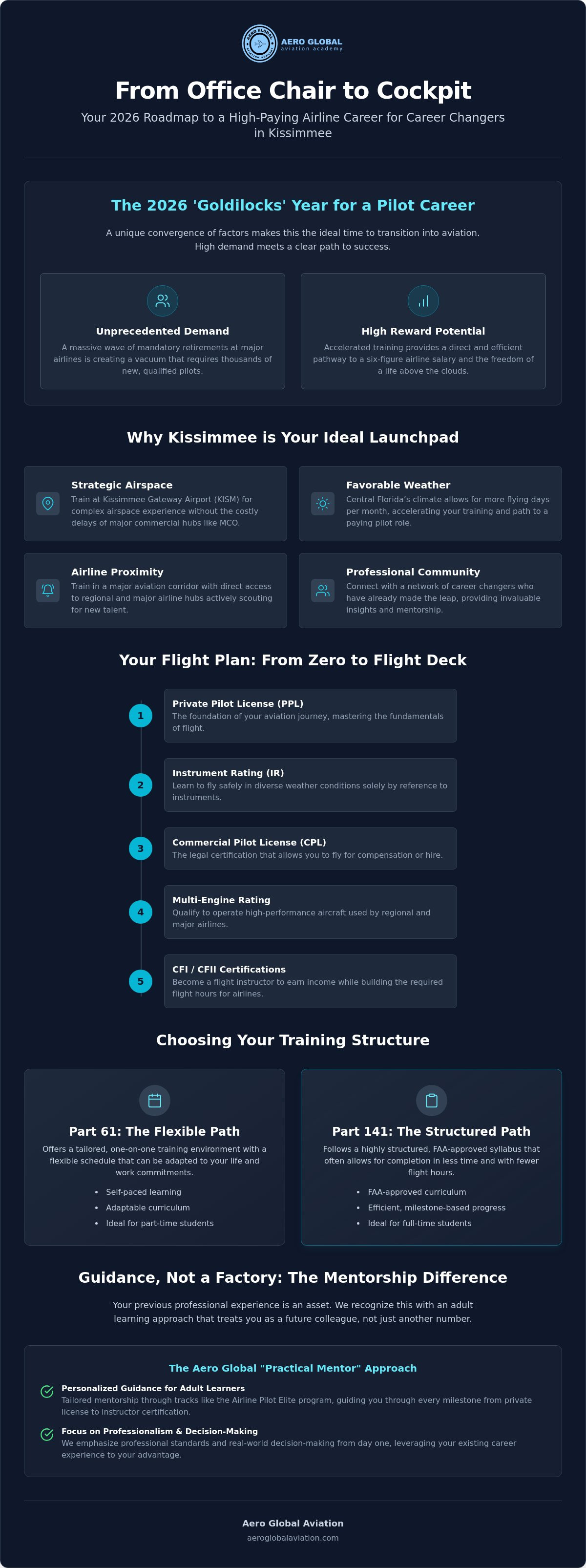
Choosing to start a new professional chapter is a bold decision. In 2026, the aviation industry faces a unique convergence of factors that make this the "goldilocks" year for entry. A massive wave of mandatory retirements is hitting major carriers; this creates a vacuum that requires thousands of new pilots to fill. For those seeking accelerated pilot training for career changers Kissimmee, this local hub offers the most efficient environment to capitalize on this high demand. While major airports like MCO are bogged down by heavy commercial traffic, Kissimmee Gateway Airport (KISM) provides the complex airspace experience you need without the frustrating ground delays that eat into your training budget.
The Central Florida aviation corridor is more than just a training ground. It's a strategic launchpad. By training here, you gain direct proximity to major airline hubs and regional carriers that are actively scouting for new talent. You can also leverage the local climate to your advantage. Florida’s consistent flying weather allows for a higher volume of flight hours per month compared to northern states. This means you can complete your ratings faster and transition into a paying role sooner than you might elsewhere. It’s about working smarter, not just harder.
The Kissimmee Advantage for Professional Students
Training at KISM places you in the heart of Orlando’s vibrant aviation community. This proximity is vital for networking and staying informed about the latest industry shifts. Understanding the pilot certification requirements in the U.S. is your first step toward the flight deck. At KISM, you benefit from a multi-runway configuration that allows for specialized maneuver training regardless of wind direction. This infrastructure is a strategic asset for anyone following the airline pilot career path, as it prepares you for the high-stakes environment of professional aviation from day one. You'll learn to manage complex radio communications and traffic patterns that mirror what you'll encounter at major airlines.
A Community of Like-Minded Professionals
One of the biggest hurdles for career changers is the feeling of being an outsider. In Kissimmee, you'll find a community of professionals who have already made the leap. Networking with these individuals provides invaluable insights into how to manage the transition successfully. At Aero Global, our "Practical Mentor" approach beats the impersonal "Pilot Factory" model often found at larger schools. We focus on adult learning methodologies, recognizing that your previous professional experience is an asset, not a distraction. You’ll work with local instructors who treat you as a future colleague, emphasizing professional standards and decision-making from your very first hour in the cockpit. This collaborative spirit ensures you aren't just another number on a flight schedule; you're a pilot in training with a clear destination.
The 2026 Professional Pilot Roadmap: From Zero to Flight Deck
Transitioning to a new career requires a clear, logical sequence of milestones. You aren't just learning to fly; you're building a professional foundation designed for long-term success. The journey begins with the Wings Foundation, where you earn your Private Pilot License (PPL). This is the base upon which every other rating rests. From there, you'll move to the Instrument Rating (IR), which allows you to fly in diverse weather conditions by relying solely on your instruments. This is a critical skill for any airline-bound pilot who needs to operate safely in all environments. For a detailed regulatory overview of these initial stages, the FAA guide to becoming a pilot provides essential foundational information.
Once you've mastered instrument flight, the next major milestone is the Commercial Pilot License (CPL). This is the legal threshold that allows you to fly for compensation. To increase your marketability to major carriers, you'll add a Multi-Engine Rating, preparing you for the high-performance aircraft used by regional airlines. Finally, most career changers pursue CFI and CFII certifications. This allows you to work as an instructor, earning a paycheck while building the flight hours required for an Airline Transport Pilot certificate. This structured progression ensures that every hour you spend in the cockpit moves you closer to your ultimate professional destination.
Accelerated Timelines for Dedicated Career Changers
Time is your most valuable asset. Many students worry that a career pivot will take years before they see a return on their investment. However, our structured approach allows you to move from PPL to CPL in as little as 6 to 10 months. This is made possible through accelerated pilot training for career changers Kissimmee, which utilizes block scheduling to maximize your time in the air. If you're coming in with previous hours, we offer finish-up programs to get you across the finish line efficiently. Balancing these demands with your personal life is much easier when you have a predictable, professional schedule that respects your time.
Mastering 2026 Technology: Glass Cockpits and G1000
The modern airline industry has moved past traditional "steam gauges." To be competitive in the current hiring market, you must train on modern avionics from the very beginning. We utilize a glass-cockpit fleet, specifically the Garmin G1000 system, to ensure your training mirrors the environment of a modern regional jet. This technical familiarity reduces your transition time during airline indoctrination training later in your career. It’s about training for the job you want, not just the license you need today. You might find that starting your journey with modern equipment makes the learning curve feel much more logical and rewarding.
Overcoming the 'Career Changer' Hurdles: Age, Finance, and ROI
Transitioning to a new industry often brings a wave of hesitation, especially regarding age and financial stability. If you're considering accelerated pilot training for career changers Kissimmee, you might worry that the window for a successful second act is closing. It isn’t. In fact, airlines are increasingly recognizing that candidates coming from management, engineering, or tech backgrounds bring a level of professionalism and decision-making maturity that younger students often lack. Your previous experience in high-pressure environments translates directly into effective Cockpit Resource Management. You already know how to lead and how to follow; these are the exact soft skills needed on a professional flight deck.
Financing this transition is a significant consideration, but it’s manageable with the right strategy. Many students utilize a mix of personal savings and specialized aviation loans, while others prefer a pay-as-you-go approach to maintain financial flexibility. When you look at the career outlook for commercial pilots, the data supports a robust demand that justifies the initial investment. You aren't just paying for a license; you're investing in a career where senior captains at major carriers earn some of the highest salaries in the transportation sector. The long-term growth potential far outweighs the temporary cost of the pivot.
This commitment to specialized education is a hallmark of successful career pivots; just as pilots seek elite flight schools, those entering specialized fields like heavy equipment operation often turn to A1 Crane Academy for the expert-led certification training required to excel in high-stakes industrial environments.
Similarly, for those exploring the lucrative field of real estate investment, you can check out Countrywide Property Academy to discover how their AI-guided platform simplifies property sourcing and deal packaging in the UK.
Is 40 Too Old to Become a Pilot?
The short answer is a resounding no. With the mandatory FAA retirement age currently at 65, starting at 40 still gives you a solid 25-year career window. Airlines value the reliability of career changers. You've already navigated the professional world and understand the importance of punctuality, safety, and responsibility. For those entering our career pilot program, we focus on leveraging your existing strengths to speed up the learning process. You don't need to be 18 to master the flight deck; you just need the discipline to follow the roadmap we provide.
The Economics of Flight Training in Florida
The opportunity cost of staying in a job that no longer fulfills you is often higher than the cost of training. By 2026, salary trends for regional first officers have remained highly competitive, often including signing bonuses that help offset initial training expenses. The timeline to reach a major airline has also compressed, meaning your earning potential peaks much sooner than in previous decades. Most graduates see a full return on their training investment within the first five years of professional employment at a commercial carrier. Choosing accelerated pilot training for career changers Kissimmee ensures you spend less time in training and more time earning that airline salary.
Selecting the Right Flight Training Structure in Central Florida
Choosing a training structure is about finding the right fit for your learning style and life commitments. In Central Florida, you'll encounter two main FAA-regulated paths: Part 61 and Part 141. While Part 141 schools follow a rigid, government-approved syllabus, Part 61 schools offer a level of flexibility that many adult learners find superior. Accelerated pilot training for career changers Kissimmee often thrives under a Part 61 structure because it allows you to leverage your existing professional discipline to progress at your own speed. You aren't held back by a group; you move as fast as your skills allow.
Beyond the regulations, the physical state of the flight school matters just as much. Fleet quality directly impacts your graduation date. If a school relies on aging aircraft with frequent maintenance issues, your training will stall. Look for a partner that prioritizes modern maintenance and has on-site mechanics. At Kissimmee Gateway Airport, we also benefit from high examiner availability. This means you won't wait weeks for a checkride after you've finished your training hours. It’s about maintaining momentum so you can reach the flight deck as quickly as possible.
The culture of the school is the final, vital piece of the puzzle. You shouldn't feel like a "student number" in a pilot factory. As a career changer, you bring valuable life experience to the table. You deserve to be treated as a professional colleague. A mentor-based approach ensures that your instructors are invested in your individual success rather than just checking boxes on a syllabus. This collaborative spirit makes the high-stakes environment of aviation feel both welcoming and attainable.
Flexible vs. Structured Training Paths
Part 61 training is highly personalized. If you master a maneuver quickly, you move on. This efficiency is perfect for those with clear advanced flight training goals. It allows you to tailor your schedule around family or existing work obligations without sacrificing the quality of your education. You get the same certifications, but on a timeline that respects your maturity and prior experience.
Financing Your New Career
Managing the cost of a career pivot requires a solid financial plan. Many students utilize student loans specifically designed for vocational flight training. For veterans, VA benefits can be a powerful tool to transition into aviation careers here in Central Florida. If you prefer to avoid debt, self-funding strategies allow you to pay as you go while maintaining a steady training rhythm. Whatever your path, we are here to help you navigate these options. You can explore our training programs today to find the best financial fit for your new professional horizon.
Aero Global Aviation Academy: Personalized Mentorship for Your New Career
At Aero Global Aviation Academy, we recognize that a career pivot is a monumental life event. You aren't just looking for a school; you're looking for a dedicated partner to guide you through the complexities of the aviation industry. Our accelerated pilot training for career changers Kissimmee is built on the "Practical Mentor" philosophy. This means our instructors treat you like a future captain from your very first day in the cockpit. We focus on the decision-making skills and professional standards that airlines demand, ensuring your transition from the office to the flight deck is seamless and rewarding.
Our programs are specifically designed for adult learners who value efficiency and high-level instruction. For those with their sights set on the major airlines, our Airline Pilot Elite track offers the most comprehensive route. It takes you from zero experience all the way to advanced instructor certification. This structure allows you to build the necessary flight hours while earning a paycheck, all while staying connected to our network of regional airline partners. We leverage our location at KISM to provide you with a competitive edge, turning the local environment into a strategic asset for your training momentum.
The Career Pilot Program: PPL to CPL
The Career Pilot Program is the core of our professional training. This curriculum is meticulously designed to meet airline standards while respecting your timeline. We integrate ground school and flight hours to ensure maximum retention, which is a key factor in checkride success. You'll master the technical requirements of the Private and Commercial certificates in an environment that prizes safety and precision. By the time you reach your Commercial checkride, you'll possess the confidence and technical proficiency of a seasoned professional, ready to take on the responsibilities of a paid pilot role. This program isn't just about passing a test; it's about preparing for a lifelong career.
Your First Step: The Wings Foundation
If you're still testing the waters of a career change, the Wings Foundation is the smartest way to begin. This program focuses exclusively on the Private Pilot License (PPL), allowing you to experience the reality of flight training before committing to a full career track. During your first 40 to 60 hours at KISM, you'll learn the fundamentals of aerodynamics, navigation, and aircraft control. It’s a practical way to validate your passion for aviation while gaining a valuable credential. When you're ready to see the Aero Global difference for yourself, you can book a discovery flight to get in the air and meet your future mentors. Your new professional horizon starts with a single takeoff.
Claim Your Seat on the Flight Deck
Transitioning from a 9-5 to a professional aviation career is a structured, attainable goal when you have the right partner. You’ve discovered that your professional maturity is a strategic advantage and that the 2026 hiring environment offers unprecedented opportunities for growth. By choosing accelerated pilot training for career changers Kissimmee, you’re opting for an efficient path that respects your time and your prior experience. It’s about more than just earning a license; it’s about securing a high-paying future in an industry that needs your skills.
At Aero Global, we provide a professional transformation tailored to your goals. You’ll train in a modern glass cockpit fleet featuring Garmin G1000 systems at Kissimmee Gateway Airport (KISM), ensuring you’re prepared for the technical demands of modern regional jets from your very first flight. Our personalized professional mentorship is designed specifically to support adult learners through every milestone of this journey. Don't let another year pass in a career that has reached its ceiling. Start Your Career Pivot Today - Explore Our Career Pilot Program and reclaim your professional horizon. The sky is waiting for you.
Frequently Asked Questions
Is Kissimmee a good place for flight training if I have a full-time job?
Yes, Kissimmee is an excellent choice because local Part 61 schools offer the flexible scheduling necessary to train around a professional career. You can book flight blocks in the evenings or on weekends, allowing you to maintain your current income while building hours. This adaptability is why accelerated pilot training for career changers Kissimmee is so effective; it respects your existing commitments while keeping you on a steady path toward your commercial ratings.
What is the age limit for starting a career as a pilot in 2026?
There is no upper age limit to begin flight training, though the FAA mandates a retirement age of 65 for Part 121 airline operations. If you start your journey at 40 or 45, you still have a 20-year career window ahead of you. Airlines value the maturity and life experience that older students bring to the cockpit, making this a strategic time to pivot regardless of your current decade.
How long does it take to go from zero experience to a commercial pilot in Florida?
You can reach your commercial pilot certificate in approximately 6 to 10 months through a full-time accelerated program. Florida’s favorable climate allows for more flyable days per year, which prevents the seasonal delays common in other regions. While the entire process from zero experience to a major airline role is estimated to take 5 to 8 years, the initial transition to a professional license happens quickly in the Kissimmee corridor.
Do I need a college degree to become an airline pilot after a career change?
No, a college degree is not a legal requirement to become a pilot, though some major airlines still prefer one for competitive hiring. Many regional airlines and cargo carriers focus primarily on your flight hours, certifications, and professional conduct. If you already have a degree in another field, it fulfills the requirement for most major carriers, allowing you to focus your energy entirely on your flight training and certifications.
How much does flight school in Kissimmee cost for a career changer?
The total investment for a zero-to-commercial track in Florida typically ranges between $70,000 and $100,000. This covers your Private Pilot License, Instrument Rating, and Commercial certificates. While costs vary based on how quickly you progress, choosing accelerated pilot training for career changers Kissimmee helps control expenses by minimizing the time spent in the training phase and maximizing your efficiency in the air through modern, reliable aircraft.
Can I get financing for my pilot training if I am already over 30?
Yes, many lenders offer specialized aviation loans regardless of your age, provided you meet their credit and financial criteria. Some schools also partner with financing companies to provide deferred payment options or structured loan programs. Since aviation is a high-ROI career, lenders often view professional students as reliable candidates for vocational training loans designed to bridge the gap to an airline salary and a new professional horizon.
What is the difference between Part 61 and Part 141 for professional students?
Part 61 offers a flexible, student-centric approach, while Part 141 follows a more rigid, FAA-approved syllabus. For career changers, Part 61 is often the preferred choice because it allows you to progress based on your individual mastery rather than a fixed group schedule. This flexibility makes it easier to accelerate your training if you learn quickly or have prior professional experience that helps you grasp technical concepts faster.
What happens if I fail my FAA medical exam as an older student?
If you don't pass your initial medical exam, it doesn't necessarily mean your career is over before it starts. Many medical issues can be managed through a "Special Issuance" authorization from the FAA. We always recommend that career changers secure a First-Class Medical Certificate before starting their training to ensure they meet the health standards required for long-term airline operations. This proactive step provides peace of mind before you invest in your training.


