What if the most challenging part of your aviation career isn't the checkride you just passed, but the silence that follows it? Many new pilots in Central Florida hit a "post-PPL plateau" where motivation dips and the path forward feels hazy. It's common to feel a bit of anxiety when looking at the busy Orlando and Kissimmee radio frequencies without an instructor by your side. Understanding your next steps after PPL Orlando is essential if you want to capitalize on a year where major airlines are forecasted to hire around 8,000 new pilots.
We're here to help you regain that momentum and move toward a professional flight deck with confidence. This guide gives you a clear timeline to reach your Commercial Pilot License (CPL) while navigating the unique challenges of the Florida landscape. You'll learn whether to prioritize your Instrument Rating or Multi-engine training next, and how to find a professional mentor who knows these local skies inside and out. Your transition from a private pilot to a career aviator starts with a structured plan, and we've built that roadmap for you right here.
Key Takeaways
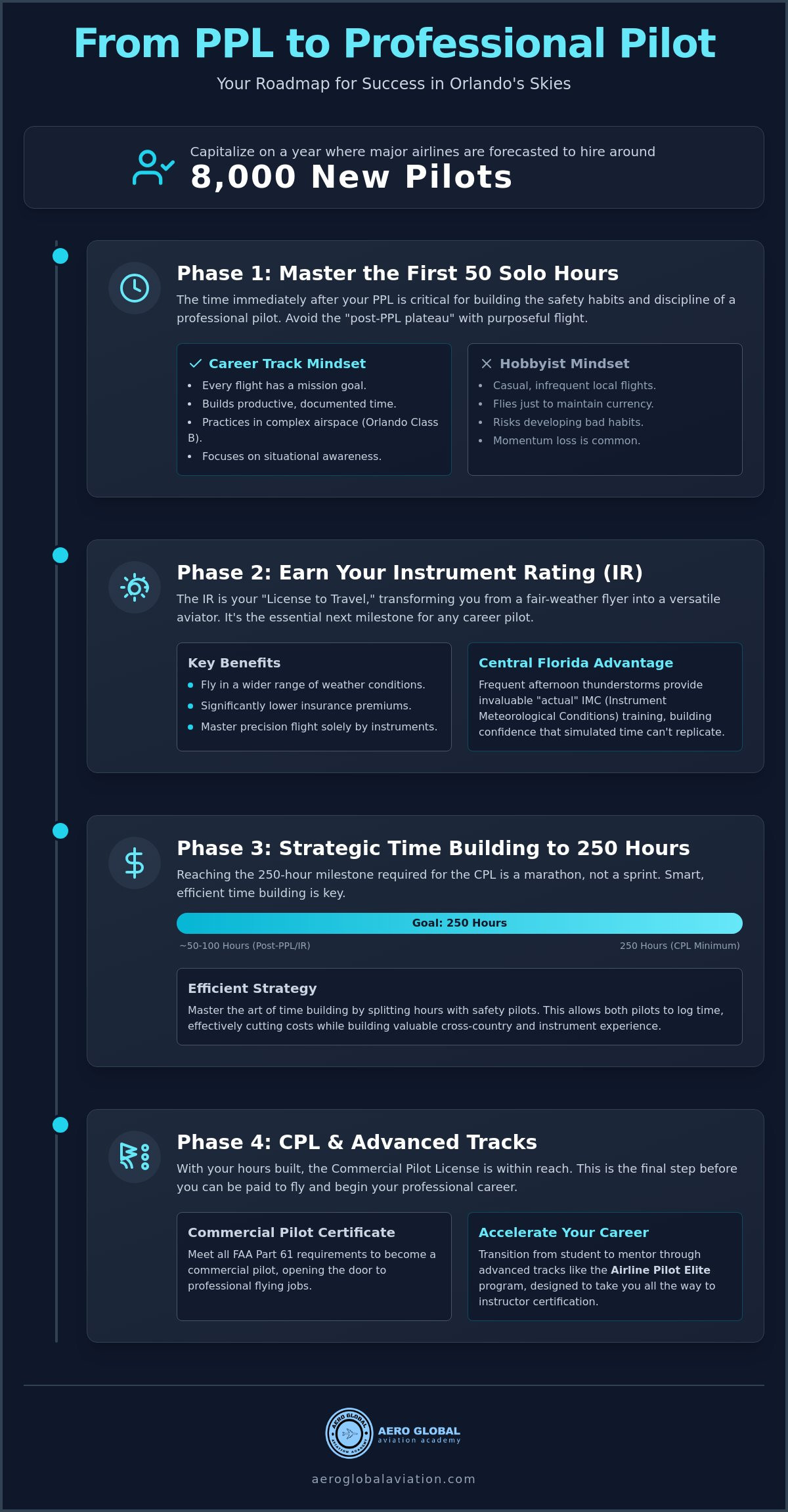
- Beat the post-checkride slump by focusing on the first 50 hours of solo flight, which are vital for building the safety habits you'll need as a professional.
- Secure your "license to travel" by prioritizing an Instrument Rating, an essential tool for safely navigating Central Florida’s frequent afternoon thunderstorms.
- Identify the exact next steps after PPL Orlando to ensure you're meeting FAA Part 61 requirements for your Commercial Pilot Certificate.
- Master the art of strategic time building by splitting hours with safety pilots to reach the 250-hour milestone more efficiently.
- Transition from student to mentor through advanced tracks like the Airline Pilot Elite program, designed to take you all the way to instructor certification.
Overcoming the Post-PPL Plateau in Orlando
Achieving your Private Pilot License is a monumental milestone, but for many, the weeks following the checkride bring an unexpected dip in momentum. This "Post-PPL Plateau" happens when the structured pressure of a syllabus disappears, leaving you with a license to fly but no immediate mission. If your goal is the flight deck of a major carrier, understanding your next steps after PPL Orlando is vital during this transitional phase. Instead of treating your new privileges as a reason to coast, see them as the foundation for the professional discipline required in the FAA pilot certification process. Orlando’s complex Class B airspace serves as a world-class training asset here. Every radio call to Orlando Approach and every departure from Kissimmee Gateway prepares you for the high-stakes environment of commercial aviation.
Why the Next 50 Hours Matter
The 50 hours of flight time immediately following your PPL are some of the most critical for your long-term safety and skill development. Without an instructor in the right seat, you're now the sole decision-maker for every weather deviation and fuel calculation. It's easy to fall into a routine of casual local flights, but professional candidates set a specific "mission goal" for every hour. Whether it's practicing short-field landings at a new airport or refining your dead reckoning skills, purposeful flight prevents the bad habits that often lead to solo incidents. Many new pilots in the Kissimmee area struggle with task saturation in busy corridors; using these 50 hours to master situational awareness is a key step toward becoming a captain.
Hobbyist vs. Career Track Mindset
There's a significant difference between a "Sunday flyer" and someone on a professional trajectory. While a hobbyist might fly once a month to maintain basic currency, a career-minded pilot views every flight as a building block toward their Commercial Pilot License. Mapping out your next steps after PPL Orlando means choosing between a casual hobby and a dedicated career path. This is where a structured environment like Aero Global Aviation Academy makes a difference. Programs such as our Airline Pilot Elite track are designed to keep you moving forward with professional-grade standards from day one. By immersing yourself in an academy setting rather than a casual flying club, you ensure that your time building is productive, documented, and aligned with what airline recruiters expect in 2026. Transitioning to this mindset early ensures you don't just build hours, but you build the experience that matters.
The Instrument Rating (IR): Your Next Essential Milestone
Once you have your PPL, the sky feels open, but you're still tethered to the ground by visibility and cloud ceilings. The Instrument Rating is often called the "License to Travel" because it transforms you from a fair-weather flyer into a versatile aviator. For anyone mapping out next steps after PPL Orlando, this rating is the logical and professional progression. It significantly lowers insurance premiums and triples the utility of any aircraft you rent or own. While it's widely considered the most academically and technically demanding phase of training, the rewards are unmatched. You'll move beyond looking out the window and learn to trust your flight deck with absolute precision.
Central Florida presents a unique classroom for instrument students. Our legendary summer afternoon thunderstorms provide a masterclass in weather decision-making and tactical routing. Learning to fly under IFR here ensures you don't just understand the theory; you gain the confidence to handle dynamic environments safely. If you're serious about a career as a commercial pilot, mastering these skills in a high-traffic area like Kissimmee is an invaluable asset. It sets the stage for everything that follows in your professional development.
Mastering IFR in Central Florida Weather
Training in Florida offers a distinct tactical advantage. You'll frequently encounter "actual" instrument meteorological conditions (IMC), which is far more beneficial than spending all your time under a "hood" or foggles. Navigating through real clouds with a professional instructor helps you develop the spatial orientation and trust in your instruments that simulated time simply can't replicate. It's about developing a feel for the aircraft when the horizon disappears. For a deeper look at how this fits into your overall development, check out our guide on Advanced Flight Training: The Complete Guide to Professional Pilot Ratings.
IR Requirements and Checkride Prep
To earn your rating, the FAA requires 50 hours of cross-country flight time as pilot in command and 40 hours of actual or simulated instrument time. This phase demands a "precision" mindset that goes far beyond your initial training. While the PPL checkride focuses on general safety and maneuvers, the IR checkride is about staying within tight tolerances on headings, altitudes, and approach paths. The Instrument Rating serves as the essential bridge between private flying and the professional standards of a commercial certificate. Preparing for this milestone requires a dedicated environment where technical excellence is the norm. You can start your journey toward this rating today by exploring our Career Pilot Program, which integrates instrument training into a seamless professional path.
Strategic Time Building in Central Florida Airspace
Building your first 250 hours is more than a box-ticking exercise; it's a strategic investment in your future career. Airline recruiters look closely at how you spent your solo time, and they value pilots who challenged themselves in complex environments. If you are planning your next steps after PPL Orlando, you have a distinct advantage. Kissimmee Gateway Airport (KISM) serves as a premier hub for high-quality time building, positioned perfectly between some of the most diverse flight environments in the country. Instead of flying repetitive patterns, you can gain experience by navigating Class B airspace and planning long-distance cross-country flights that prove your readiness for professional operations.
One of the most effective ways to manage costs during this phase is by "splitting time" with a safety pilot. Under FAA rules, when one pilot flies under simulated instrument conditions while wearing a view-limiting device, the other pilot acts as a safety pilot. Both individuals can often log Pilot in Command (PIC) time, effectively cutting the cost of an hour in half. This collaborative approach doesn't just save money; it builds the crew resource management (CRM) skills you'll eventually need on a professional flight deck.
Quality vs. Quantity: Building Professional Hours
Not all flight hours carry the same weight. Flying into busy hubs like Orlando International (MCO) or Tampa International (TPA) requires advanced planning and crisp communication. These experiences build a level of confidence that "circle-to-land" flying at rural strips cannot provide. We encourage students to utilize "Glass Cockpit" G1000 systems early in their training. Mastering advanced avionics now makes the transition to regional jets much smoother later. It's also vital to maintain a meticulous logbook. Whether you're pursuing an Instrument Rating or preparing for a Part 121 interview, a clean, detailed record of your cross-country trips to destinations like St. Augustine, Cedar Largo, or the challenging over-water approach into Key West will set you apart from other candidates.
As you build experience flying into these coastal hubs, you'll also learn the importance of coordinating ground logistics; for example, many professional pilots in the region rely on 305 VIP to ensure their passengers receive top-tier luxury transportation upon landing.
Beyond passenger service, many pilots find rewarding careers in the air cargo sector; keeping up with industry shifts through Perimeter Global Logistics (PGL) is a great way to stay informed about the logistical demands of global trade.
Cost-Effective Strategies for Orlando Pilots
To reach the 250-hour mark required for a Part 61 Commercial certificate, you need a structured plan. Ad-hoc rentals can become expensive and unpredictable. Many successful students opt for structured time-building packages that offer more favorable rates than standard hourly rentals. Integrating simulator sessions is another smart way to maintain proficiency. Simulators allow you to practice emergency procedures and instrument approaches at a fraction of the cost of burning avgas. Our Career Pilot Program is specifically designed to integrate these time-building milestones into a seamless path toward your commercial goals. By following a structured roadmap for your next steps after PPL Orlando, you ensure that every hour in the air brings you closer to a professional paycheck.
Mapping the Path to Your Commercial Pilot Certificate
Moving from the time-building phase into formal commercial training is where your professional identity truly takes shape. If you are identifying the next steps after PPL Orlando, the Commercial Pilot Certificate (CPL) is your primary objective. Under FAA Part 61 rules, you must accumulate 250 total flight hours. This includes 100 hours of pilot-in-command (PIC) time and 50 hours of cross-country flight. While the numbers are fixed, the quality of your training during this period determines your readiness for the airlines. You aren't just flying for yourself anymore; you are learning to operate with a commercial mindset that prioritizes safety, passenger comfort, and operational efficiency.
The standards for flight maneuvers increase significantly during CPL training. You'll master advanced maneuvers like Chandelles, Lazy Eights, and Eights-on-Pylons. These aren't just for show; they demonstrate a high level of coordination and energy management. For those aiming at a major carrier, adding a Multi-Engine Rating is often the final essential step in this phase, as it prepares you for the complex systems of regional jets. Mastering these skills in the busy Florida corridor ensures you are ready for the high-tempo environment of professional aviation.
The 250-Hour Milestone: What to Expect
Reaching that 250-hour mark requires consistent discipline. If you fly between 20 and 30 hours per month in the favorable Florida weather, you can expect to transition from your PPL to your commercial checkride in roughly six to eight months. During this time, you must also pass the Commercial Pilot Knowledge Test. This written exam covers advanced topics like Part 135 regulations and high-altitude operations. For a detailed breakdown of this process, see our Commercial Pilot Training: Your 2026 Guide to Professional Flight Certification.
Transitioning to High-Performance and Complex Aircraft
To become a truly marketable pilot, you should pursue high-performance and complex aircraft endorsements. A high-performance aircraft features an engine with more than 200 horsepower, while a complex aircraft includes retractable landing gear, flaps, and a controllable pitch propeller. Training across varied airframes shows recruiters you can adapt to different systems and flight characteristics. To qualify for the commercial checkride under FAA Part 61, you must specifically have 20 hours of training in the areas of operation required for the certificate, including 10 hours of instrument training and 10 hours in a complex or technically advanced aircraft. You can start this transition today by enrolling in our Career Pilot Program, which provides the structured environment you need to succeed.
Accelerating Your Career with Aero Global’s Professional Tracks
Passing your commercial checkride is a significant victory, but it isn't the finish line for a career aviator. For those evaluating their next steps after PPL Orlando, the choice of training environment becomes the most important factor in long-term success. While a local flying club is excellent for weekend hobbyists, a professional academy provides the mentorship, networking, and high-tempo structure required for a major airline career. Our Airline Pilot Elite program is specifically designed as the ultimate path, guiding you from your private pilot beginnings all the way to advanced instructor certification. This structured training is the fastest path to a high-paying airline seat; it eliminates the guesswork and provides a direct roadmap that ad-hoc training simply can't match.
In the heart of the Kissimmee aviation community, you'll find more than just airplanes. You'll find a network of experienced professionals who understand the regional and major airline landscapes. Mentorship is a cornerstone of our approach, ensuring that you aren't just building hours, but building the professional reputation and connections that lead to job offers. When you train in a professional environment, you're surrounded by peers who share your drive, creating a collaborative spirit that pushes everyone to reach their highest potential.
From Private Pilot to Flight Instructor (CFI)
Reaching the 1,500-hour requirement for an Airline Transport Pilot (ATP) certificate is the most significant hurdle for most aspiring captains. Becoming a Certified Flight Instructor (CFI) is the most effective way to bridge this gap. As an instructor, you build those critical hours while getting paid to fly, all while refining your own knowledge to an expert level. Our Career Pilot Program acts as a comprehensive career solution, preparing you for the transition from student to teacher. It's essential to see your PPL as just the beginning of a larger journey; the real growth happens when you are responsible for guiding another student through their first solo. Identifying these next steps after PPL Orlando early allows you to align your time building with the skills you'll eventually need as a professional instructor.
Join the Next Generation of Airline Pilots
The timing for your professional transition couldn't be better. The 2026 hiring climate is exceptionally favorable, with major airlines forecasted to hire between 7,672 and 8,000 pilots this year alone. Retirement-driven demand ensures that this need for qualified, well-trained pilots will remain consistent for years to come. We invite you to visit our Kissimmee facility to see our fleet and meet our team. You don't have to navigate this complex career path alone. Schedule your career strategy session at Aero Global Aviation Academy today.
Chart Your Course Toward the Flight Deck
Your Private Pilot License is a powerful key, but it's only the first step in a much larger professional journey. By prioritizing your Instrument Rating and approaching your time building with strategic intent, you've already set yourself apart from the casual flyer. Navigating the next steps after PPL Orlando requires more than just hours in a logbook; it requires a commitment to the precision and safety standards that airline recruiters demand in 2026. This transition is about moving from a student mindset to a professional one.
Choosing a professional academy environment in Kissimmee provides the structured path you need to move efficiently from PPL to CFI. With mentorship from experienced airline-oriented instructors, you'll gain the tactical insights and networking opportunities that turn a certificate into a career. Upgrade your skills with our Airline Pilot Elite program in Orlando and take the next step toward your future today. The sky is waiting, and with the right plan, your seat in a major cockpit is closer than you think.
Frequently Asked Questions
What is the very first thing I should do after getting my PPL?
Set a specific mission goal for your next 50 hours of flight time. Instead of just flying for fun, start planning your instrument training or identifying your next steps after PPL Orlando to maintain your momentum. This proactive approach prevents the common post-checkride slump and ensures you're building the safety habits required for a professional career.
How long does it take to go from PPL to Commercial Pilot in Orlando?
Most full-time students complete this transition in six to eight months. This timeline assumes you fly between 20 and 30 hours per month and remain consistent with your instrument and commercial syllabi. Florida’s favorable weather allows for more frequent flight dates compared to northern states, helping you reach the 250-hour requirement much faster.
Should I get my Multi-Engine or Instrument Rating first?
You should almost always obtain your Instrument Rating first. It's the most technically demanding rating and provides the essential foundation for all professional flying. Most airline tracks require an IR before you ever step into a multi-engine aircraft, as it ensures you can safely handle complex procedures and navigation in actual instrument meteorological conditions.
Is it better to build hours in a flying club or a professional flight school?
A professional flight school is the better choice for career-minded pilots. While local clubs offer cheaper rates, they often lack the structured environment, advanced simulators, and professional mentorship found at an academy. Training at a professional facility ensures your time building meets the high standards and discipline expected by airline recruiters during your future interviews.
How many hours do I need to fly each week to stay on a professional career track?
Aim for five to seven hours of flight time per week to stay on a competitive track. This pace ensures you reach the 250-hour commercial milestone within a year while keeping your proficiency at a high level. Consistency is more important than occasional long flights; flying three times a week helps you retain complex radio and navigation skills.
What are the best cross-country airports to visit from Kissimmee?
St. Augustine (KSGJ) and Key West (KEYW) are excellent choices for building professional experience. St. Augustine offers a great mix of traffic and historical charm, while the over-water flight to Key West provides valuable experience in fuel planning and weather monitoring. These routes are perfect next steps after PPL Orlando for building high-quality pilot-in-command time.
Can I start my Instrument Rating training immediately after my PPL checkride?
Yes, you can and should start your instrument training as soon as possible. Many professional students begin their ground school or simulator sessions the very next week to keep their minds in "learning mode." Diving straight into IFR training helps you master the flight deck early and move toward your commercial goals without losing technical proficiency.
Why is Orlando considered one of the best places for advanced flight training?
Orlando offers a unique combination of complex airspace and reliable year-round flying weather. Navigating the Class B airspace around Orlando International builds a level of radio confidence that you simply can't get at rural airports. This high-traffic environment prepares you for the realities of the airline industry by teaching you to operate in busy, professional corridors.


