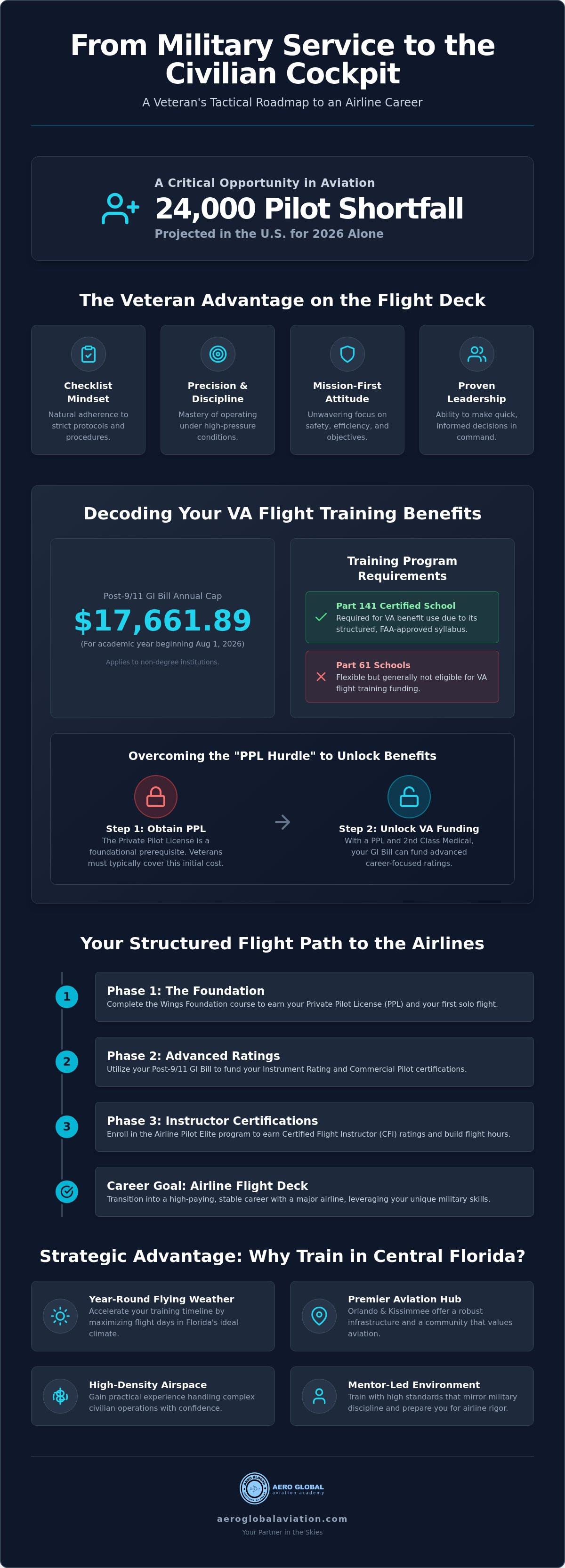
Did you know that the U.S. is facing its most significant pilot shortage in history right now, with a projected shortfall of 24,000 pilots in 2026 alone? It's a massive opportunity for those with the right background, but moving from military service to a civilian cockpit often feels like navigating through heavy fog. You've already mastered the discipline and precision required for high-stakes missions. However, the bureaucratic maze of VA funding and the out-of-pocket costs of obtaining a Private Pilot License can make the transition feel unnecessarily difficult. If you're looking for Orlando pilot training for veterans, you deserve a partner that speaks your language and respects your service.
We understand the frustration of trying to maximize your benefits while aiming for a professional standard that matches your military experience. This guide provides a clear tactical roadmap to help you launch your aviation career in Central Florida's ideal flying weather. Discover how to navigate the 2026 GI Bill annual flight training cap of $17,661.89, bridge the gap for your initial ratings, and follow a structured path from your first solo to the flight deck of a major airline. By leveraging your entitlement correctly, you can transition into a high-paying career that values your unique skills and dedication.
Key Takeaways
- Learn how to navigate the 2026 VA funding caps and the specific prerequisites for using your Post-9/11 GI Bill to fund advanced flight ratings.
- Discover the structured roadmap from your first solo in the Wings Foundation course to earning advanced instructor certifications through the Airline Pilot Elite program.
- Explore why Orlando pilot training for veterans provides a strategic advantage by leveraging Florida's year-round flying weather to accelerate your career timeline.
- Understand the "PPL Hurdle" and how to efficiently secure your initial license to unlock further government-funded training for your commercial career.
- See how a mentor-led training environment can mirror the high standards of military discipline to prepare you for the professional rigors of an airline flight deck.
Transitioning from Service to the Cockpit in Orlando
Transitioning from military service to a civilian career is more than just a job change; it's a new mission that requires the same level of dedication you gave in uniform. In 2026, the aviation industry is facing a critical need for skilled professionals, with a projected shortfall of 24,000 pilots in the U.S. alone. This massive gap creates a perfect landing spot for veterans who are ready to trade their tactical gear for a commercial pilot's uniform. When you search for Orlando pilot training for veterans, you're entering a region that respects your background and offers the robust infrastructure needed to support your success. The Orlando and Kissimmee area has evolved into a premier aviation hub where the local community understands the value of your service and the precision you bring to the table.
While you may be moving toward a civilian aviation career, keeping your tactical skills sharp is often a part of the transition; for veterans interested in professional safety and defense education, delrayfirearmstraining.com provides a familiar, high-standard training environment.
The Veteran Advantage in Flight Training
Veterans bring a unique set of skills to the flight school environment that many civilian students have to learn from scratch. You've spent years operating under high pressure and adhering to strict protocols. This checklist oriented mindset is exactly what flight instructors look for during evaluations. While some students struggle with the rigid structure of flight operations, veterans often find it familiar and comforting. Your ability to lead and make quick, informed decisions translates directly to the flight deck. Airlines actively recruit former military members because they know you're reliable and possess the "mission first" attitude required for safety and efficiency. To understand the full scope of your educational support, it's helpful to review the history and structure of GI Bill benefits for veterans, which have paved the way for thousands of successful transitions into the civilian workforce.
Setting Your Sights on the Flight Deck
Moving from tactical military operations to commercial flight involves a significant shift in perspective. You're moving from a world of mission objectives to one of passenger safety and scheduled efficiency. Establishing a clear timeline for your 2026 career transition is the first step toward your new office at 35,000 feet. You can start by exploring the airline pilot career path to see how your training milestones align with industry hiring cycles. Orlando pilot training for veterans allows you to train in high density airspace, giving you the practical experience needed to handle complex civilian operations with the same confidence you had in uniform. It's about taking that military discipline and applying it to a rewarding, lifelong profession that offers both stability and adventure.
Navigating VA Flight Training Benefits (GI Bill & Post-9/11)
Securing the funding for your aviation career requires a tactical approach to your earned benefits. For the academic year beginning August 1, 2026, the Post-9/11 GI Bill annual cap for flight training at non-degree institutions is set at $17,661.89. While this support is substantial, many veterans encounter the "PPL Hurdle" early in their journey. The Department of Veterans Affairs typically considers the Private Pilot License (PPL) a foundational requirement rather than a vocational one. This means you must possess your PPL and a valid second-class medical certificate before you can access VA flight training benefits for advanced ratings like Instrument or Commercial certifications.
Choosing the right school structure is critical for eligibility. To use your benefits, you must train at an FAA-certified Part 141 flight school. Unlike Part 61 schools, which offer more flexible but less regulated timelines, Part 141 programs follow a rigid, VA-approved syllabus that mirrors the structured environment you experienced in the military. When exploring Orlando pilot training for veterans, verify that the program is specifically approved for veteran benefits to ensure your entitlement is processed correctly. If you're ready to start this process, you can speak with a mentor about aligning your training timeline with the latest VA fiscal year caps.
Maximizing Your GI Bill Entitlement
Strategic planning allows you to stretch your benefits across multiple ratings. Since the VA refreshes its funding cap every August, many successful veteran students time their Instrument Rating and Commercial Pilot License (CPL) phases to span across two benefit years. This minimizes out-of-pocket costs for advanced training. Always ensure your medical certificate remains current. The VA will not reimburse training hours logged while your medical is expired, so treat your FAA physical as a high-priority deployment readiness task.
Alternative Financing for the PPL Phase
Because the initial license is usually self-funded, finding a bridge to your advanced ratings is essential. You can utilize personal savings as a tactical investment or explore specialized aviation scholarships for former service members. Our Wings Foundation program is designed to get you through this initial phase efficiently, providing the high-standard training required to unlock VA-funded courses later. Some veterans also leverage the Montgomery GI Bill, which reimburses 60% of approved flight fees directly to the student, offering an alternative path if the Post-9/11 structure doesn't fit your specific financial mission.
The Civilian Pilot Career Path for Veterans
Your transition into the cockpit follows a structured progression that mirrors the rank and qualification systems you've already mastered. While the military focuses on tactical objectives, the civilian world prioritizes safety, efficiency, and standardized procedures. Your journey begins with the Wings Foundation, where you'll earn your Private Pilot License (PPL). This initial phase is like the civilian version of boot camp; it's about building a rock-solid foundation in stick-and-rudder skills and basic aviation theory. Because this is the only phase typically not covered by VA flight training benefits, it’s your chance to demonstrate your commitment before unlocking government support for the more technical stages of Orlando pilot training for veterans.
From Zero Hours to Commercial Certification
Once you’ve secured your PPL, the mission shifts toward professional standards. A structured commercial pilot training syllabus is essential for keeping your progress on track and within budget. In the busy airspace of Central Florida, you'll learn to handle high-density traffic and complex communications with the same precision you used in the field. Building your first 250 hours isn't just about time in the logbook. It’s about preparing for the FAA checkride with military-grade discipline. You'll move through your Instrument Rating, which allows you to fly in low visibility, and eventually reach the Commercial Pilot License (CPL) milestone, making you eligible for professional employment and high-paying aviation roles.
Advanced Ratings: The Key to Airline Eligibility
To reach the flight deck of a major carrier, you need more than just a basic commercial certificate. The Instrument Rating is often the most challenging hurdle, as it requires you to trust your dials over your senses. Following this, you'll tackle Multi-Engine training, where you'll learn to manage larger, faster aircraft and engine-out procedures. For those aiming for the top tier of the industry, our Airline Pilot Elite track provides the advanced flight training and instructor certifications necessary to bridge the gap to the 1,500-hour airline requirement. This "Elite" path transforms you from a commercial pilot into a seasoned instructor, allowing you to build time while mentoring the next generation of aviators. It’s a proven strategy for veterans who want to reach their professional destination with minimal debt and maximum experience.
Why Central Florida is the Strategic Choice for Veterans
Choosing where to train is a tactical decision that directly impacts how quickly you reach the flight deck. While the curriculum is standardized, the environment is not. Central Florida stands out as a premier destination for Orlando pilot training for veterans because it removes many of the external obstacles that slow down progress in other regions. You've spent your military career adapting to different environments; now, it's time to choose one that works in your favor. The combination of world class infrastructure and a massive veteran population creates a support system that feels both familiar and professionally motivating.
Geography is one of your greatest assets here. In many parts of the country, flight students lose weeks of training to snow, ice, or persistent low clouds. In Orlando, we leverage the "Aviation Weather Perk" of more than 300 days of sunshine each year. This consistent VFR (Visual Flight Rules) weather means you can fly more often, retain your skills better, and complete your ratings on a much tighter schedule. When you're aiming for a 2026 career start, every flyable day counts toward your 1,500-hour goal.
Kissimmee Gateway Airport: A Training Powerhouse
Training at Kissimmee Gateway Airport offers a distinct advantage over larger, congested international hubs. You get the benefit of a professional, towered environment without the hour-long delays on the taxiway often found at Orlando International (MCO). This efficiency allows you to maximize every minute of your paid instruction time. The surrounding airspace is a diverse training ground, offering everything from quiet practice areas to complex transitions through busy airline corridors. It's the perfect place to hone the precision and situational awareness you developed in the service. If you're ready to see this environment for yourself, you can book a tour of our facilities and meet the team.
Networking and Post-Training Opportunities
Proximity to major airline operations is a significant career catalyst. Orlando is a major hub and focus city for several carriers, including those with aggressive 2026 hiring targets. United Airlines plans to hire approximately 1,700 pilots this year, while American Airlines is on track to bring on around 1,500 new aviators. Being in the heart of this activity means you're constantly surrounded by networking opportunities, from local aviation organizations to veteran-specific meetups. Central Florida's strong veteran community provides a sense of peer support that makes the transition to civilian life feel seamless. You aren't just joining a flight school; you're entering a professional ecosystem designed to help you succeed.
Aero Global Aviation Academy: Your Partner in the Skies
Choosing the right flight school is the most critical decision you'll make after hanging up the uniform. You've spent your career in environments where high standards and clear communication weren't just encouraged; they were required for survival. At Aero Global Aviation Academy, we provide professional mentoring that mirrors the rigor of military instruction. We don't just teach you how to fly; we train you to lead in a commercial cockpit. Our Kissimmee facility is specifically designed to support the unique needs of those looking for Orlando pilot training for veterans, offering a mission-oriented atmosphere where your prior experience is respected and utilized as a foundation for your new career.
Our training philosophy centers on the idea that every hour in the air should bring you closer to a professional flight deck. Whether you are starting from scratch or looking to finish advanced ratings, we act as your tactical partner. We understand the complexities of the 2026 aviation landscape and the specific challenges veterans face when transitioning to civilian operations. By providing a structured, disciplined environment—much like the tactical training offered at the Boynton Beach Martial Arts Academy—we ensure that you aren't just another student in a logbook, but a future captain preparing for a high-stakes career.
The Airline Pilot Elite Difference
One of the biggest gaps in standard flight training is the lack of a clear path to the 1,500-hour airline requirement. While many schools leave you to figure out the "time building" phase on your own, our Airline Pilot Elite program is designed to solve this problem directly. This comprehensive track takes you from your Private Pilot License all the way through to advanced instructor certifications. For veterans, becoming a Certified Flight Instructor (CFI) is often the fastest and most financially sound way to bridge the gap to the airlines. It allows you to gain valuable experience while mentoring others, all while operating professional-grade equipment maintained to the highest safety standards. This program is the ultimate mission for any veteran serious about reaching the top tier of the industry.
Taking the First Step: Discovery and Enrollment
Your journey from the field to the flight deck begins with a single decision. We invite you to book a discovery flight to experience our training environment firsthand and see why our Kissimmee location is the preferred choice for Orlando pilot training for veterans. If you're ready to commit to a full professional track, the enrollment process for our career pilot program is straightforward and transparent. You'll be paired with veteran-focused advisors who can help you craft a personalized training plan that accounts for your benefits and your professional goals. Don't let bureaucratic confusion hold you back; let us help you navigate the path to your new office at 35,000 feet.
Launch Your Next Mission in the Skies
Your military service has already provided the discipline and tactical mindset required for success in the airline industry. By choosing Orlando pilot training for veterans at our Kissimmee facility, you're positioning yourself in a region with over 300 flyable days per year, ensuring your training stays on schedule. You've learned how to navigate the complexities of the 2026 GI Bill caps and the "PPL hurdle"; now it's time to execute the plan. The transition from the field to the flight deck is a structured process, and we're here to guide you through every rating and certification.
Our Career Pilot Program offers a professional, airline-oriented track with mentorship-driven instruction that honors your background and prepares you for the rigors of commercial aviation. Don't let the transition feel like an unguided flight. Take the first step toward your new career today and apply for the Career Pilot Program at Aero Global Aviation Academy. The flight deck is a tangible destination, and we're dedicated to helping you reach it. Your future in aviation starts with a single takeoff, and we're ready to clear you for departure.
Frequently Asked Questions
Can I use my Post-9/11 GI Bill for my Private Pilot License?
No, the Post-9/11 GI Bill does not cover the initial Private Pilot License (PPL) for non-degree flight training programs. You must obtain your PPL out-of-pocket before you can access VA benefits for advanced ratings. Many students use our Wings Foundation program to bridge this gap efficiently. Once you have your license and a second-class medical certificate, you can begin utilizing your earned benefits for the technical ratings that follow.
How much of my flight training will the VA cover in 2026?
For the academic year beginning August 1, 2026, the VA will cover up to $17,661.89 for vocational flight training at non-degree institutions. This cap resets annually, allowing you to strategically plan your ratings across different benefit years. When looking for Orlando pilot training for veterans, it's important to coordinate with your school to ensure your training milestones align with these funding limits to minimize your personal investment.
Is there an age limit for veterans starting a pilot career?
There is no official age limit to start flight training, though airline pilots currently face a mandatory retirement age of 65. Many veterans begin their second careers in their 30s or 40s and enjoy two decades of professional flying. Your maturity and leadership experience are highly valued by commercial carriers. As long as you can pass the FAA medical exam, your path to the flight deck remains open regardless of when you start.
Do I need to be a full-time student to use my VA benefits?
You don't need to be a full-time student to utilize your flight training benefits, but your enrollment status affects your monthly housing allowance. To receive the full MHA, you must maintain a rate of pursuit greater than 50 percent. Most veterans find that a full-time training schedule allows them to complete their certifications faster while maximizing their living stipends. This structured approach helps you maintain the momentum needed to reach your career goals quickly.
What is the difference between Part 61 and Part 141 for veterans?
The primary difference lies in the structure and VA eligibility of the training program. Part 141 schools follow an FAA-approved syllabus with strict oversight, which is a prerequisite for using GI Bill benefits. Part 61 programs offer more flexibility and are often student-led, but they generally don't qualify for VA funding in non-degree settings. Veterans typically prefer the Part 141 environment because it mirrors the disciplined, milestone-based training found in the military.
How long does it take for a veteran to go from zero hours to an airline job?
Most veterans go from zero hours to an airline flight deck in approximately two to three years. This timeline includes roughly one year of intensive training to earn commercial and instructor ratings, followed by eighteen to twenty-four months of time building. Working as a flight instructor is the most common way to reach the 1,500-hour requirement. Our Orlando pilot training for veterans leverages Florida's consistent weather to keep you flying year-round and minimize delays.
Can I transfer helicopter flight hours to a fixed-wing commercial certificate?
Yes, you can transfer a portion of your helicopter flight hours toward the total time required for a fixed-wing commercial certificate. The FAA allows some rotary-wing experience to count toward the 250-hour commercial requirement, but you must still meet specific category and class requirements for airplanes. This includes solo time, cross-country flights, and instrument training performed in a fixed-wing aircraft. It's a common and efficient transition for former military helicopter pilots.
What medical requirements must a veteran meet for flight training?
You must obtain at least a second-class FAA medical certificate to utilize your VA benefits for flight training. While a third-class medical is sufficient for a Private Pilot License, the VA requires a higher standard of physical readiness for vocational training. If you plan to fly for a major airline, you will eventually need a first-class medical certificate. It's a good practice to secure this highest level of clearance early to ensure no underlying conditions will affect your long-term career.


