

Did you know that first-time pass rates for advanced practical tests can reach 90% in structured programs while dropping to 75% in less regulated environments? In the complex airspace of Central Florida, the person sitting in the right seat does more than just monitor your altitude; they shape your entire professional trajectory. You likely feel the pressure of rising training costs and the fear of hiring an instructor who is simply "time-building" for their own career. Learning how to choose a flight instructor Orlando students can truly rely on is the most critical step you'll take before ever leaving the ground.
We're here to help you find a dedicated mentor who views your success as their primary mission. This guide reveals the critical criteria for selecting an instructor who aligns with your professional goals and maximizes your training efficiency. We'll preview the latest 2026 FAA experience requirements and explain how to leverage the unique Kissimmee flying conditions to your advantage. You'll gain the clarity needed to find a partner who helps you pass checkrides on the first attempt and moves you steadily toward a Career Pilot Program.
Key Takeaways
- Recognize your CFI as a career strategist whose instructional style significantly impacts your total training hours and overall budget.
- Master the "Orlando Factor" by selecting an instructor with deep expertise in navigating local Class B airspace and Central Florida's unique weather patterns.
- Evaluate the benefits of structured Part 141 training versus Part 61 flexibility to find the path that best aligns with your professional pilot aspirations.
- Learn exactly how to choose a flight instructor Orlando based on their current student load and their commitment to mentorship over personal time-building.
- Use our five-question interview framework to assess a potential instructor's professionalism and long-term availability before you commit to a training program.
Why Your Flight Instructor is the Most Critical Variable in Your Training
When you begin your journey, your Certified Flight Instructor (CFI) becomes the single most influential person in your aviation life. They are more than just a teacher; they serve as your primary mentor, safety officer, and career coach during every hour spent in the cockpit. Understanding Flight Instructor qualifications is a vital starting point, but the human element is what truly dictates your progress. If you are researching how to choose a flight instructor Orlando has to offer, you must look for someone who treats your training as a professional obligation rather than a personal logbook-building exercise.
An instructor’s teaching style directly impacts your total training cost and your time to solo. A disorganized instructor might repeat lessons unnecessarily, leading to hundreds of dollars in wasted wet rental fees and instruction rates. Conversely, a focused CFI uses every minute of engine-run time to sharpen your skills. This efficiency builds the psychological confidence you need to handle the aircraft alone. Effective communication in the cockpit reduces anxiety, allowing you to focus on the technical precision required for a career pilot program. Starting with a professional mindset from day one isn't just helpful; it's essential for anyone aiming for the flight deck of a major airline.
The Difference Between Teaching and Mentoring
Identifying instructors who follow a structured syllabus rather than "winging it" is essential for your 2026 career goals. A teacher simply imparts knowledge, but a mentor prepares you for the lifestyle and demands of the airline industry. At professional flight academies, mentorship is a core pillar of the curriculum. Your instructor should understand the specific milestones you need to reach to be competitive in the current hiring market. When you evaluate how to choose a flight instructor Orlando flight schools provide, look for someone who asks about your long-term aspirations before you even step into the plane.
How CFI Quality Affects Your Checkride Success
Your CFI plays a decisive role in your pre-checkride evaluations. They conduct rigorous mock exams to ensure you are ready for the high stakes of an FAA practical test. Statistics from early 2026 indicate a clear trend: first-time pass rates for the CFII practical test can reach 90% in structured Part 141 programs that utilize simulators, compared to just 75% in less structured Part 61 environments. This gap often comes down to the quality of pre-exam preparation provided by the instructor. The CFI's endorsement serves as a legal guarantee of proficiency for the FAA, confirming you are safe to operate within the national airspace system.
Evaluating the 'Orlando Factor': Local Expertise You Need
Orlando's sky is a classroom like no other. While tourists look at the theme parks below, student pilots must manage some of the most complex airspace in the United States. When you are deciding how to choose a flight instructor Orlando offers, you must prioritize someone who treats the surrounding Class B and C airspace not as a hurdle, but as a strategic advantage for your future career. Local expertise is non-negotiable here. According to official FAA advice on choosing an instructor, assessing the training environment is just as vital as checking certifications.
Choosing an instructor based at Kissimmee Gateway Airport (KISM) provides a distinct edge. KISM serves as a premier training hub that offers the complexity of a towered airport without the grueling taxi delays found at Orlando International (MCO). A veteran instructor knows how to use this high-density traffic to sharpen your radio skills and situational awareness from your very first flight. This regional pride isn't just about the scenery; it's about building a superior professional foundation. If you want to see how we integrate this local advantage into our curriculum, explore the programs at Aero Global Aviation Academy.
Navigating Central Florida Airspace
The Orlando corridor requires constant vigilance and a "busy but manageable" mindset. Your instructor must teach you to navigate transitions between Class B, C, and D airspace with absolute precision. Mastering local landmarks and specific shoreline reporting points is essential for maintaining safety in this high-traffic environment. A great mentor ensures you remain ahead of the aircraft, anticipating ATC instructions before they are even issued. This level of situational awareness is what separates a standard pilot from a professional candidate.
Weather Mastery in the Sunshine State
Florida's climate offers incredible benefits, including nearly 360 days of flying weather, but it also presents unique challenges. A local expert will teach you to read convective activity and identify the early signs of afternoon thunderstorms before they become a safety risk. You'll also learn to manage density altitude challenges. High heat significantly reduces aircraft performance, and understanding these safety protocols is critical for summer operations. This mastery ensures you maintain training momentum year-round while developing the weather-decision skills required for professional flight decks.
Part 61 vs. Part 141: How Instructors Fit Into Your Path
Your training environment dictates how your instructor manages your progress. Before you commit, you must decide between the flexible world of FAA Part 61 and the highly structured oversight of Part 141. While both paths lead to the same pilot certificate, the daily experience varies wildly. For those pursuing commercial pilot training, the rigid structure of a Part 141 program often yields faster, more consistent results. This isn't just about rules; it's about a standardized framework that ensures every lesson builds logically on the last. When researching how to choose a flight instructor Orlando academies provide, remember that a Part 141 instructor works within a system designed for professional accountability.
Standardization is the hidden engine of a successful flight school. In a structured academy, instructors follow a specific syllabus that has been vetted by the FAA. This means that even if your primary CFI is unavailable for a day, another instructor can step in and know exactly where you left off. When you begin interviewing a flight instructor, ask which regulatory path they specialize in. Matching your personal learning style to the school's organizational framework is a vital step in maximizing your training efficiency.
The Role of a Standalone Part 61 Instructor
Independent instructors operating under Part 61 offer a high degree of flexibility, which is often ideal for hobbyist pilots or those with unpredictable schedules. However, this path carries the risk of "instructor hopping." If your independent CFI leaves for a regional airline job, your progress might stall as you search for a replacement. Without a formal support network, you're responsible for managing your own record-keeping and syllabus progression. It's a balance between total freedom and the potential for inconsistent training milestones.
The Structured Advantage of Academy Instruction
Academy-based instruction provides a safety net that independent paths often lack. Junior CFIs in these environments are overseen by Chief Flight Instructors who ensure every student meets high proficiency standards. This multi-instructor environment is particularly beneficial during stage checks, where a different set of eyes evaluates your skills before you move to the next phase. Academies like Aero Global prioritize a professional pilot track, ensuring that every instructor is focused on preparing you for the 2026 airline industry. This collaborative spirit fosters a culture of reliability and technical excellence that is hard to replicate in a solo setting.
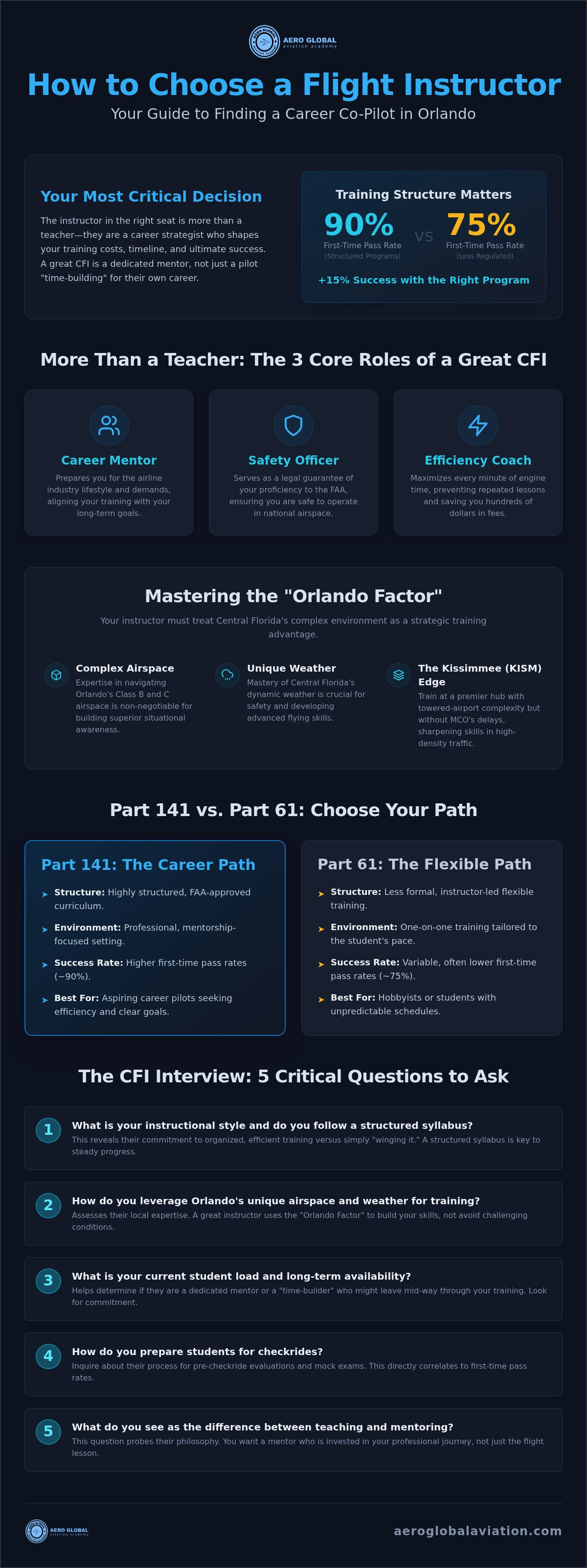
The CFI Interview: 5 Critical Questions for Orlando Students
Selecting your mentor is a significant business decision. Treat it with the same scrutiny you would any professional partnership. When you're determining how to choose a flight instructor Orlando academies provide, don't just book a flight; book a face-to-face meeting. This conversation is your opportunity to assess professionalism and personality before you invest thousands of dollars into your training. A true "Practical Mentor" will welcome your questions and provide transparent, direct answers that help you feel confident in your choice.
Start your interview with these four essential questions to gauge their commitment and organizational skills:
- What is your current availability and how many students do you manage? In 2026, high demand for training can lead to overbooked instructors. You need a CFI who can fly with you at least three times a week to maintain training momentum.
- What is your syllabus for the Wings Foundation or PPL track? A structured plan prevents aimless flying. Ask to see their lesson tracking system to ensure every dollar you spend is tied to a specific milestone.
- How do you handle student plateaus or learning difficulties? Every pilot hits a wall at some point. You want an instructor who uses diverse teaching methods and remains patient during the "steep" parts of the learning curve.
- What are your personal 2026 aviation goals? It's common for CFIs to be "time-building" for the airlines, but you need someone who is deeply invested in your success during their tenure at the school.
Assessing Technical Knowledge and Teaching Style
Ask the instructor to give you a brief, three-minute explanation of a complex topic like lift or stalls. If they can't make it simple on the ground, they'll likely struggle to explain it while you're managing an aircraft in a busy cockpit. Evaluate their use of technology and modern flight decks; an instructor who embraces Garmin G3X systems and digital logbooks is better prepared to train you for modern airline standards. Always treat your "Discovery Flight" as a chemistry test. If you don't feel comfortable or supported during that first hour, it's okay to keep looking.
Red Flags to Watch For During the Interview
Watch for frequent cancellations or a lack of a clear, written training schedule during your first few interactions. A negative attitude toward FAA regulations or safety checklists is a major warning sign that could compromise your checkride success. Poor communication is the #1 reason students switch instructors. If they don't respond to your initial inquiries promptly or clearly, they likely won't be there when you need them for critical pre-flight briefings. If you're ready to meet a team of dedicated professionals who prioritize your career, book a consultation with our instructors today.
Mentorship at Aero Global: Why Our Instructors Are Different
At Aero Global Aviation Academy, we believe that the person in the right seat should be a gateway to your future, not a bottleneck. Our "Practical Mentor" philosophy shifts the focus from simple instruction to comprehensive career preparation. We train pilots specifically for the demands of the 2026 airline industry, ensuring that every lesson translates into professional readiness. When you are finalizing how to choose a flight instructor Orlando academies offer, look for a team that treats your training as a collaborative mission. Our instructors don't just teach you how to fly; they show you how to think like a captain from your very first hour.
Our Airline Pilot Elite program is a cornerstone of this approach. It produces CFIs who are prepared for professional careers by emphasizing technical mastery and instructional excellence. By training within our community of like-minded, career-oriented students, you benefit from a culture of shared ambition and technical rigor. Based in the heart of Kissimmee, our academy provides access to a modern fleet and advanced technology that mirrors the equipment you'll eventually operate for major carriers. This regional pride and commitment to quality ensure that your transition from a beginner to a professional is a structured, attainable process.
Aero Global’s Standard of Instruction
We prioritize personalized attention through student-centric scheduling that respects your time and training momentum. Our advanced flight training resources support our instructors by providing the data and tools necessary for precise skill development. We take immense pride in the success of our graduates. Many students who started with zero flight time have successfully transitioned through our ratings to become elite instructors themselves. These testimonials reflect our commitment to excellence and our belief that a dedicated local partner is the best asset a student pilot can have.
Start Your Journey in Orlando Today
The path to the flight deck begins with a single, decisive step. We invite you to visit our Kissimmee facility for a personal tour and an instructor meet-and-greet. Seeing our operation firsthand allows you to experience the professional yet approachable atmosphere that defines our academy. Whether you are interested in the foundational Wings Foundation course or the comprehensive Career Pilot Program, our team is ready to guide you through the enrollment process. Don't leave your career to chance. Book your discovery flight and meet our team of professional instructors to see how we can maximize your training efficiency and help you reach your professional destination.
Take Command of Your Aviation Career
Selecting the right mentor is the most significant decision you'll make as a student pilot. Your instructor's professionalism and local expertise determine how quickly you transition from a beginner to a certified commercial pilot. Prioritizing structured PPL-to-CPL career tracks and vetting your CFI for a commitment to your success protects your training investment. It also accelerates your progress toward the airlines. Mastering the technical nuances of Central Florida’s airspace becomes a strategic advantage when an experienced professional guides your every move. Knowing how to choose a flight instructor Orlando students can truly rely on is the first step toward the flight deck.
At Aero Global Aviation Academy, our experienced professional flight mentors provide personalized attention at our Kissimmee-based facility near the complex Orlando Executive airspace. We are ready to help you turn your aspirations into a tangible reality through our proven training frameworks. Schedule a Discovery Flight at Aero Global Aviation Academy today and experience the difference that expert mentorship makes. The sky is waiting for you; it's time to start your journey with confidence.
Frequently Asked Questions
Can I change flight instructors if we aren't a good match?
Yes, you can change flight instructors at any time if you feel your learning styles aren't compatible. Aviation is a significant investment; you shouldn't feel obligated to stay with a mentor who doesn't help you progress efficiently. A professional academy will facilitate this transition smoothly to ensure your training stays on track without any awkwardness or lost momentum.
How much should I expect to pay for a flight instructor in Orlando in 2026?
You should expect to pay between $60 and $85 per hour for a Certified Flight Instructor in the Orlando and Sanford area based on April 2026 data. These rates cover the instructor's time during both flight and ground sessions. Remember that these fees are separate from the "wet" rental rate of the aircraft, which typically ranges from $180 to $220 per hour for a Cessna 172.
Is it better to have one instructor or multiple instructors during my PPL?
Having one primary instructor is generally best for maintaining a consistent rhythm and deep understanding of your progress. However, flying with a different instructor for a "stage check" provides a valuable second opinion on your skills. This is a common practice in structured programs where standardization ensures that every instructor follows the same professional curriculum.
What is the difference between a CFI and a CFII?
A CFI is a Certified Flight Instructor who can teach you the fundamentals of flight for your Private and Commercial licenses. A CFII has an additional "Instrument" rating, allowing them to provide the specialized training required to fly solely by reference to cockpit instruments. When you're deciding how to choose a flight instructor Orlando schools offer, check if they hold both ratings to support your long-term advancement.
How many hours a week should I fly to stay proficient with my instructor?
Flying three to four times per week is the ideal frequency to maintain proficiency and build muscle memory. If you fly less than twice a week, you'll likely spend a portion of each lesson relearning what you forgot since the last flight. Consistent scheduling helps you move through the syllabus faster and ultimately reduces your total training costs.
What qualifications should I look for in an instructor for a Career Pilot Program?
Look for an instructor who prioritizes professional mentorship and has extensive experience navigating the high-density traffic of Central Florida. They should be well-versed in modern avionics and follow a structured syllabus that aligns with airline hiring standards. A mentor who focuses on career readiness will help you develop the decision-making skills needed for a successful transition to the flight deck.
How do I know if an instructor is just using me to build their own flight hours?
You can tell an instructor is dedicated to your success if they use a formal syllabus and provide detailed briefings before and after every flight. If a CFI is frequently distracted, lacks a clear lesson plan, or cancels often, they might be prioritizing their own time-building. Understanding how to choose a flight instructor Orlando students can trust involves finding someone who treats your checkride pass as their own professional milestone.
Do Orlando flight instructors provide ground school as well as flight training?
Yes, flight instructors provide personalized ground instruction to cover the aeronautical knowledge required for your FAA written and oral exams. While many students use online courses for self-study, one-on-one time with your CFI is essential for clarifying complex topics like weather theory or federal regulations. This ground time ensures you are fully prepared for the rigorous questioning during your practical checkride.


