

Imagine sitting on the taxiway at Kissimmee Gateway Airport, the Florida heat rising off the pavement while your heart races faster than the RPM gauge. You've spent months preparing, yet the thought of a "pink slip" and the $1,200 DPE fee can make even the most seasoned student feel grounded by nerves. It's a high-stakes environment where physical stress during steep turns or a mental block during the oral exam can feel like an insurmountable ceiling. We understand that checkride anxiety isn't a sign of poor skill; it's a natural response to the professional transition you're about to make. By focusing on specific FAA checkride preparation tips Kissimmee pilots use to stay sharp, you can replace that uncertainty with the calm authority of a Pilot in Command.
This guide provides the mental and tactical strategies you need to navigate our local airspace with professional confidence and secure your certificate on the first attempt. You'll learn how to transform nervous energy into precise execution while meeting the rigorous 2026 Airman Certification Standards. We'll preview how to utilize local environmental factors to your advantage, manage cockpit stress effectively, and maintain total control of the aircraft from the initial preflight to the final shutdown.
Key Takeaways
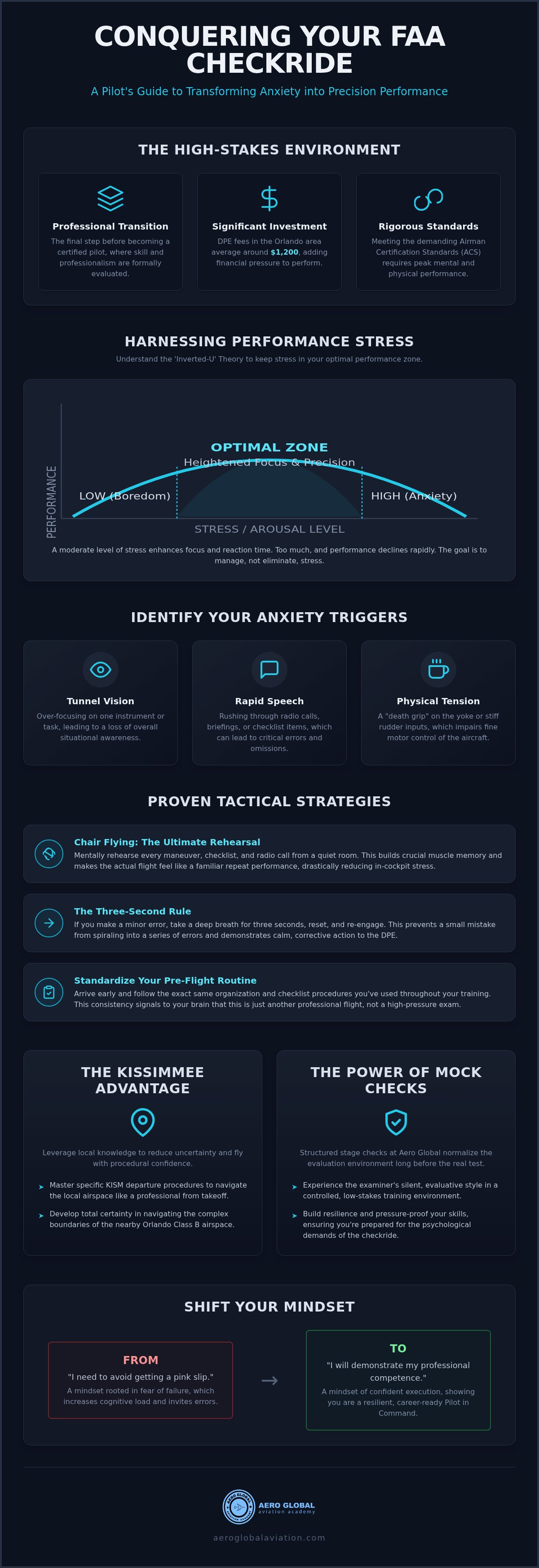
- Understand how to harness the "inverted-U" theory to turn performance-based stress into a tool for heightened focus during your FAA evaluation.
- Learn the "Three-Second Rule" for recovering from minor maneuver errors and how chair flying builds the muscle memory required to stay calm in the cockpit.
- Master the specific FAA checkride preparation tips Kissimmee pilots use to navigate KISM departures and the nearby Orlando Class B boundaries with total procedural certainty.
- Discover how structured stage checks at Aero Global simulate the examiner's silent evaluation style to normalize pressure well before your actual checkride.
- Shift your mindset from simply avoiding a "pink slip" to demonstrating the professional resilience and confidence of a career-ready pilot.
Understanding Checkride Anxiety: Why Even Elite Pilots Feel the Pressure
Checkride anxiety isn't a sign of weakness or a lack of skill; it's a natural, performance-based stress response to a high-stakes FAA evaluation. Whether you're a student pilot at Kissimmee Gateway Airport or an experienced aviator adding a new rating, that tightening in your chest is your body's way of acknowledging the importance of the moment. In the 2026 aviation environment, the pressure is real. With Designated Pilot Examiner (DPE) fees in the Orlando area reaching approximately $1,200, the financial and professional stakes of the FAA pilot certification process can feel heavy on any student's shoulders.
Psychologists often point to the 'inverted-U' theory to explain how this stress impacts performance. A controlled amount of pressure actually improves your focus and reaction times, keeping you sharp during a cross-wind landing or a complex systems question. However, when that stress crosses the peak of the curve, it becomes debilitating. Seeking out effective FAA checkride preparation tips Kissimmee instructors recommend is the first step in ensuring your stress remains a tool for success rather than a barrier to safety. You need to distinguish between normal pre-flight jitters, which keep you alert, and the kind of anxiety that causes you to freeze or overlook critical checklist items.
The Psychology of the FAA Evaluation
Many students struggle because they view the DPE as an adversary rather than an evaluator. This "all-or-nothing" mindset creates an immense cognitive load, making it difficult to process ATC instructions or maintain altitude within ACS standards. When your brain is occupied with the fear of failure, you have less "bandwidth" available for flying the airplane. Professional training environments help normalize this pressure by treating every lesson like a professional flight, reducing the psychological weight of the actual exam day.
Identifying Your Specific Anxiety Triggers
Anxiety often manifests differently during the oral exam than it does in the cockpit. You might breeze through the ground portion only to find your "rudder feet" feel heavy and unresponsive once the engine starts. Performance anxiety in the context of the Airman Certification Standards (ACS) is defined as a physiological and psychological state that impairs a pilot's ability to demonstrate required knowledge, risk management, and flight skills. Watch for these common physical cues during your training:
- Tunnel Vision: Focusing so hard on one instrument that you lose situational awareness.
- Rapid Speech: Rushing through radio calls or checklist items.
- Physical Tension: A "death grip" on the yoke or stiff legs on the rudder pedals.
Recognizing these early signs allows you to use FAA checkride preparation tips Kissimmee experts suggest, such as deep breathing or momentary "re-sets," to stay in command of the aircraft.
Proven Tactical Strategies to Master Your Nerves Before the Big Day
Preparation is the ultimate antidote to anxiety. When you have a structured plan, your brain shifts from a state of fear to a state of execution. One of the most effective, zero-cost tools in your arsenal is chair flying. By sitting in a quiet room and mentally rehearsing every move, from the engine start to the final tie-down, you build the muscle memory needed to reduce cockpit stress. Visualizing the specific landmarks around Kissimmee Gateway Airport while you practice your flows ensures that the actual flight feels like a repeat performance rather than a new challenge. Implementing these FAA checkride preparation tips Kissimmee students rely on can significantly lower your heart rate before you even reach the hangar.
Standardizing your pre-flight routine also creates a powerful sense of normalcy. Arrive early, use the same flight bag organization you've used during training, and follow your checklists with deliberate care. This consistency signals to your nervous system that today is just another professional flight. You might also consider the "strategic silence" approach. Keeping your checkride date private from friends and family removes the external pressure of having to report back a result immediately, allowing you to focus entirely on the aircraft and the examiner.
Mastering the Oral Exam: Knowledge as a Shield
The oral exam often feels like an interrogation, but you can reframe it as a professional consultation. Use the Airman Certification Standards (ACS) as your definitive shield; it's the exact playbook the examiner must follow. If you encounter a question that stumps you, don't panic. Use the "I don't know, but I know where to find it" technique. Demonstrating that you can quickly locate information in the FAR/AIM or POH builds immense trust with the DPE. Starting the day with organized logbooks and neat paperwork is a professional win that sets a positive tone for the entire evaluation. If you want to refine these ground skills with a mentor, our Career Pilot Program provides the structured guidance needed to turn technical knowledge into professional confidence.
In-Flight Management and Breathing Techniques
Once you're in the air, the "Three-Second Rule" is your best friend for recovering from minor mistakes. If you notice you're 50 feet off your altitude, acknowledge it, correct it, and move on. Don't let a small deviation during a steep turn ruin the rest of your maneuver. For managing checkride day stress while in flight, practice box breathing during straight and level segments to reset your nervous system. Narrating your flight out loud is another excellent tactic. It keeps you focused on your sequence and helps the DPE understand your decision-making process. Remember, even if you receive a "pink slip," it isn't a career end; it's simply a learning milestone on your path to becoming an elite pilot.
The Kissimmee Advantage: Leveraging Local Knowledge to Reduce Stress
Flying in the Central Florida corridor offers a unique set of challenges that, once mastered, become your greatest assets on checkride day. Familiarity with your home turf is more than just a convenience; it's a strategic shield against the unexpected. When you master the KISM departure and arrival procedures, you free up mental bandwidth to focus on the precision of your maneuvers. Navigating the intricate boundaries of the Orlando Class B airspace requires total procedural certainty, and knowing exactly where those shelves start and stop allows you to fly with an air of professional authority that examiners love to see.
Using local landmarks transforms abstract navigation into concrete reality. Identifying "The Mouse" to the northwest or using the distinct shoreline of Lake Toho to the south provides instant orientation during your pilotage and dead reckoning phases. These visual anchors ensure you stay aligned with the Airman Certification Standards without constantly burying your head in the cockpit display. By integrating these environmental factors into your FAA checkride preparation tips Kissimmee instructors emphasize, you turn the local landscape into a silent partner that guides you toward success.
Mastering Kissimmee Gateway (KISM) ATC
Building rapport with the controllers at Kissimmee Gateway is essential for a smooth evaluation. They appreciate professional, concise radio work, and a consistent presence in the pattern helps build a mutual understanding. Mastering local frequency familiarity is critical because it significantly reduces your cognitive load during the busiest phases of flight. Knowing exactly where the typical checkride practice areas are, such as the open fields to the south and west of the airport, means you won't be surprised by the terrain or local traffic patterns when the DPE asks you to perform a stall or a steep turn. This local knowledge allows you to anticipate instructions rather than just reacting to them.
Central Florida Weather and Go/No-Go Decisions
Central Florida's 2026 weather patterns, particularly the predictable but powerful afternoon thunderstorm cycles, demand sharp Aeronautical Decision Making (ADM). Your "Go/No-Go" decision is often the very first test of the day. Choosing to delay a flight due to a building cell over the Disney area isn't a sign of hesitation; it's a demonstration of the professional mindset we prioritize in our Airline Pilot Elite track. Training at a local academy like Aero Global Aviation Academy gives you an environmental edge. You'll learn to read the Florida sky with the intuition of a seasoned pro, turning the 2026 weather season into a showcase of your superior judgment and safety-first attitude.
The Power of the Mock Checkride: Stage Checks at Aero Global
A standard flight lesson is a collaborative classroom in the sky, but a formal stage check is the professional dress rehearsal for your career. While your primary instructor is there to guide and correct you, a stage check examiner takes a step back to observe your independent decision-making. This shift in dynamic is one of the most critical FAA checkride preparation tips Kissimmee students can use to normalize the pressure of an actual evaluation. By simulating the Designated Pilot Examiner's (DPE) silent evaluation style, we help you break the habit of looking for a "nod of approval" after every maneuver. You learn to trust your instruments and your training, which is exactly what a DPE looks for during a certification flight.
Stage checks also serve as a vital diagnostic tool to identify maneuver plateaus before they result in a costly "pink slip." It's common to struggle with the precision of a specific task, such as maintaining altitude during a steep spiral or nailing the entry for a lazy eight. Flying with an unfamiliar instructor during these checks provides a fresh perspective and mimics the psychological environment of the actual exam. This "stranger danger" element helps you manage the social anxiety of being watched by someone new, ensuring that by the time you meet your examiner, the experience feels like a routine milestone rather than a terrifying ordeal.
The "Airline Pilot Elite" Approach to Preparation
Success in the cockpit starts with a structured schedule that eliminates the need for last-minute cramming. Within our Career Pilot Program, we utilize milestone-based timelines that ensure you're consistently meeting ACS standards throughout your training. We encourage students to treat every training flight as a mini-checkride, which builds the professional discipline required for the airlines. If you want to refine your technique before your next stage check, you can master maneuvers using our Commercial Pilot Training Guide to stay ahead of the curve.
Post-Mock Debrief: Turning Weakness into Confidence
The real value of a mock checkride lies in the post-flight debrief. At Aero Global, we use these critiques to build a targeted 7-day "polish" plan that focuses exclusively on your remaining weak spots. Whether you need to tighten up your eights-on-pylons or perfect your power-off 180s, this concentrated effort turns uncertainty into a source of confidence. Once you've secured your initial certificates, you can continue to grow by exploring advanced ratings in our Advanced Flight Training Guide. If you are ready to put your skills to the test in a supportive yet professional environment, enroll in a program at Aero Global Aviation Academy today to start your journey toward the flight deck.
Your Path to a Stress-Free FAA Checkride in Kissimmee
Mastering the mental game of flight training is just as vital as mastering a short-field landing. At its core, our "Practical Mentor" philosophy rests on a simple truth: preparation equals peace of mind. When you've put in the hours of deliberate practice and simulated the evaluation environment, anxiety naturally gives way to professional focus. By applying these FAA checkride preparation tips Kissimmee students have used for years, you're not just preparing for an exam; you're preparing for a career. You've already done the hard work of learning to fly; now it's time to demonstrate that you can manage the risks and responsibilities of a certificated pilot.
Choosing a flight school that prioritizes your mental readiness and resilience is a critical step in this journey. It's not enough to just know the maneuvers; you need to feel calm and in control of the aircraft when the pressure is on. Training in a high-volume environment like Kissimmee Gateway Airport (KISM) builds a level of procedural certainty that quieter airports simply can't match. You become comfortable with complex ATC instructions and busy patterns, which means the checkride itself will feel like another day at your home base. Our instructors have walked this same path and are dedicated to providing the direct mentorship you need to succeed.
Why Aero Global Aviation Academy?
We are deeply committed to your Private Pilot License Florida journey and beyond. Our location at KISM provides an unparalleled training ground where you'll learn to navigate the 2026 Central Florida airspace with total confidence. We don't just teach you how to pass a test; we help you develop the professional mindset required for our Airline Pilot Elite track. This includes mastering the specific FAA checkride preparation tips Kissimmee examiners look for, ensuring you're ready for every question and every maneuver.
To ensure you walk into the FBO with total confidence, follow this final 24-hour checklist:
- Review the ACS: Do a final line-by-line check of the Airman Certification Standards to ensure no knowledge gaps remain.
- Finalize Paperwork: Double-check your IACRA application, logbook endorsements, and maintenance logs (A-V-I-A-T-E).
- Prepare the Nav Log: Complete your flight plan and weight and balance using the most current 2026 weather data.
- Rest and Hydrate: Prioritize a full eight hours of sleep and keep your physical stress low.
- Pack Your Bag: Ensure you have your view-limiting device, current charts, and a backup battery for your iPad.
Take the First Step Toward Your Wings
The Central Florida skies are waiting for you, and a rewarding career in aviation is just one successful checkride away. We invite you to experience the Aero Global difference and see how our structured, supportive environment can turn your flying goals into a reality. Whether you're just starting out or finishing your commercial rating, we're here to guide you toward the flight deck. Contact Aero Global Aviation Academy today to book a consultation and discuss your personalized training roadmap.
Take Command of Your Aviation Future
Overcoming checkride nerves is about shifting your perspective from being an applicant to being a Pilot in Command. By mastering the psychology of the evaluation, leveraging the unique landmarks of Central Florida, and utilizing structured stage checks, you transform high-stakes pressure into professional precision. These FAA checkride preparation tips Kissimmee pilots rely on provide the tactical edge needed to navigate the 2026 Airman Certification Standards with total confidence. You've already put in the hard work; now it's time to let your training shine.
At Aero Global Aviation Academy, we offer more than just flight hours. We provide expert mentorship for PPL and CPL candidates within a professional Career Pilot Program at Kissimmee Gateway Airport. Our students benefit from year-round training in Florida’s premier aviation environment, where every lesson brings you one step closer to the flight deck. You have the passion to succeed, and we have the tools to help you prove it to any examiner. The skies are waiting, and your new career is just beyond the horizon.
Ready to conquer your checkride? Start your journey with Aero Global Aviation Academy today.
Frequently Asked Questions
What happens if I fail my checkride in Kissimmee?
You'll receive a Notice of Disapproval, commonly called a "pink slip," which specifically details the tasks that didn't meet the standards. You don't have to retake the entire exam; you'll only be re-evaluated on the areas you failed. In the Orlando and Kissimmee area, 2026 retest fees are approximately $500 for a flight-only re-evaluation or $800 if you need to redo both the ground and flight portions.
How do I handle a mistake during the flight portion of the checkride?
Acknowledge the error, correct it immediately, and maintain your focus on the current task. DPEs aren't looking for robotic perfection; they want to see that you can identify a deviation and mitigate the risk before it becomes a safety issue. If you notice you've drifted off your altitude, verbalize the correction and fix it promptly to stay within the required standards.
Are the DPEs in the Orlando/Kissimmee area particularly strict?
DPEs in Central Florida follow the same Airman Certification Standards (ACS) as every other examiner in the United States. While they operate in a high-volume airspace that demands precision, they're simply looking for safe, competent pilots. Following the FAA checkride preparation tips Kissimmee mentors provide will ensure you're ready for the professional environment and procedural accuracy required at KISM.
Can I use a checklist for everything during the checkride?
You are absolutely expected to use checklists for every phase of flight, from the initial pre-flight to the final tie-down. Using a checklist is a core requirement of the ACS and a sign of a professional mindset. While you should have emergency "flow" patterns memorized for immediate action, you must always follow up with the physical checklist to ensure every item was completed correctly.
How much should I study for the oral exam vs. practicing maneuvers?
You should aim for a balanced preparation, but keep in mind that the oral exam is the gatekeeper for the rest of the test. Many students find success by spending about 60% of their final study time on ground knowledge and 40% on flight maneuvers. If you don't pass the ground portion, the examiner cannot legally allow you to start the engine for the flight portion.
What is the best way to handle Kissimmee ATC nerves during the exam?
The best way to handle ATC nerves is to become a regular presence in the KISM pattern during peak hours before your checkride day. By using the FAA checkride preparation tips Kissimmee instructors emphasize, such as writing down complex taxi instructions and using standard phraseology, you'll feel like a professional peer to the controllers rather than a nervous student.
Should I take my checkride in my own plane or the school’s plane?
You should use the aircraft you're most familiar with and that has the most organized maintenance documentation. Most students prefer the school's aircraft because the academy ensures all 2026 Airworthiness Directives (ADs) are complied with and the logs are prepared for the examiner's review. If you bring your own plane, you're responsible for ensuring every maintenance entry is flawless and current.
What is the "Three-Second Rule" in aviation checkrides?
The "Three-Second Rule" is a mental reset technique designed to stop a small mistake from snowballing into a failure. When you realize you've made an error, take three seconds to breathe, acknowledge the deviation, and decide on the proper correction. This pause prevents the panic that often leads to secondary mistakes, allowing you to stay in command of the aircraft and the evaluation.


