Your previous professional life isn't a distraction from your aviation dreams; it's the foundation of your future success. Many career changers worry they've waited too long or that the 1,500-hour requirement for major airlines is an insurmountable wall. We understand that leaving the security of a 9-5 feels like a high-stakes decision. However, your maturity and communication skills are exactly what top-tier flight instructor training Kissimmee programs look for in their most successful candidates.
In this guide, you'll learn how to leverage Kissimmee's premier training environment to pivot into a professional airline career by 2026. We'll provide a clear timeline from your first flight to earning a CFI paycheck, proving that your professional background is an asset rather than a barrier. You'll also discover how to navigate financing options and why a local mentor is the key to mastering the Florida skies. Let's explore how you can transform your years of experience into a seat in a professional flight deck.
Key Takeaways
- Understand why the high-frequency flight environment at Kissimmee Gateway Airport (KISM) is the strategic choice for professionals looking to maximize their training efficiency.
- Ensure your career change is viable from day one by prioritizing your FAA First Class Medical Certificate before committing to a full training schedule.
- Identify the fastest route to your 1,500-hour requirement by utilizing specialized flight instructor training Kissimmee through the Airline Pilot Elite program.
- Navigate the financial complexities of a career pivot by exploring student loans and VA benefits specifically curated for adult learners.
- Choose between the Wings Foundation and the Career Pilot Program to align your training with your specific goals, whether you're seeking a private license or a full airline career.
Why Kissimmee is the Strategic Choice for Flight Instructor Training in 2026
Many career changers view their professional history as a sunk cost, but in the aviation world, your experience is actually a competitive advantage. Choosing flight instructor training Kissimmee isn't just about learning to fly; it's about executing a strategic pivot that respects the time and resources you've already invested in your life. Unlike a twenty year old student starting from scratch, you bring a level of maturity and discipline that makes you a safer, more reliable pilot from day one. You aren't just starting over; you're upgrading your career path.
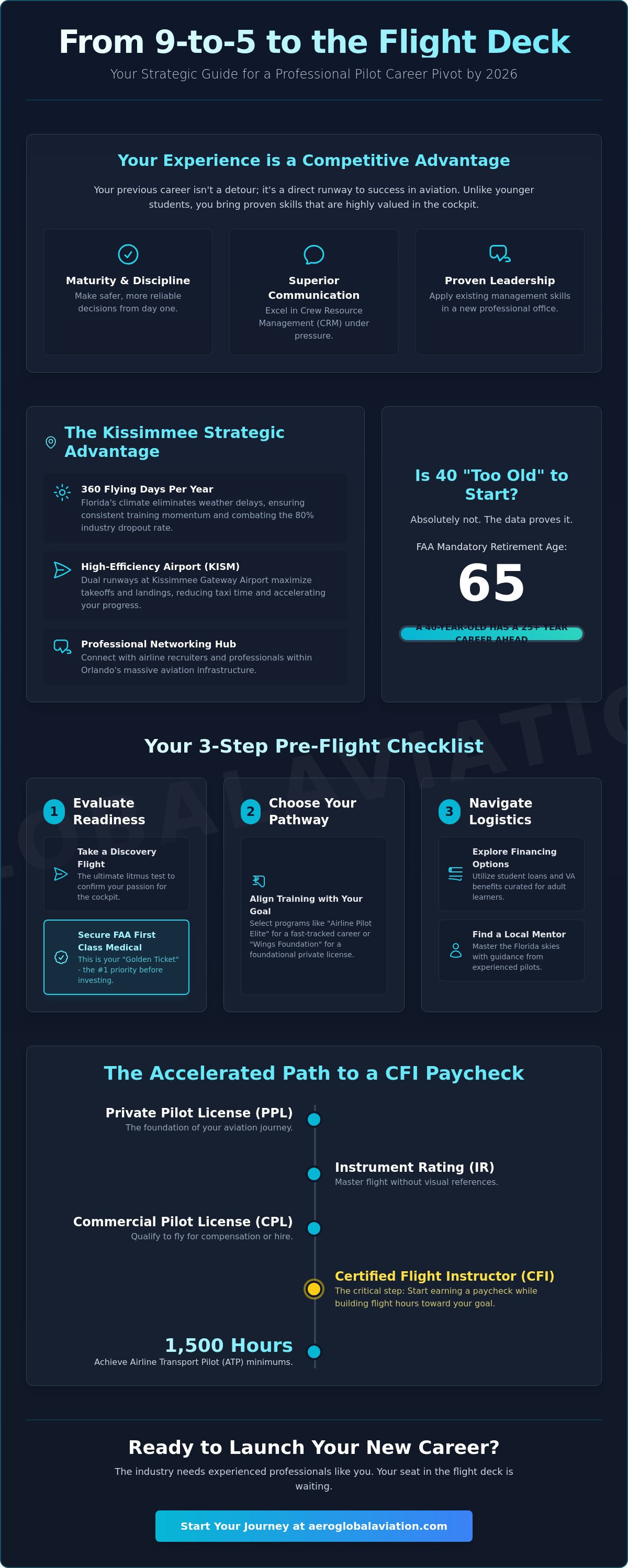
The "is 40 too old?" question is a common fear, but the current 2026 industry data tells a different story. The FAA mandates a retirement age of 65 for airline pilots, meaning a career changer at 40 still has a full quarter century of professional flying ahead of them. During this time, your previous background in management or technical fields translates into superior Crew Resource Management (CRM). You already know how to communicate under pressure and lead a team. Becoming a flight instructor simply gives you a new professional office in which to apply those leadership skills.
The Kissimmee Advantage: 360 Days of Training
Consistency is the most important factor in flight training success. Industry statistics show that approximately 80% of student pilots who begin training don't complete their certification, often due to a loss of momentum. Florida's climate allows for nearly 360 days of flying per year, which eliminates the long weather delays that plague northern schools. At Kissimmee Gateway Airport (KISM), the dual runway configuration is a massive asset. It allows for high frequency takeoff and landing repetitions without the long taxi times found at larger hubs. You'll also stay connected to Orlando's massive aviation infrastructure, providing professional networking opportunities with airline recruiters.
The Economic Reality of a Pilot Career in 2026
The industry is facing a historic pilot shortage, with projections indicating a need for tens of thousands of new pilots over the next decade. This demand has created a favorable window for career changers that hasn't existed in years. While the initial investment in training is significant, the projected ROI is compelling. Major airline starting salaries have risen to meet the demand, and the path from zero hours to a paycheck is more structured than ever. By choosing professional flight instructor training Kissimmee through an accelerated path like the Airline Pilot Elite track, you can move through your ratings quickly and start earning while you build the 1,500 hours required for the airlines.
Step 1: Evaluating Your Readiness for a Professional Pilot Pivot
Before you trade your business casual for a flight suit, you need to verify that your body and your schedule are ready for the cockpit. A career pivot into aviation is a significant commitment. It requires a level of due diligence that goes beyond simply wanting to fly. The first step isn't buying books or enrolling in ground school; it's confirming that there are no hidden barriers between you and a commercial flight deck. By taking these preparatory steps, you ensure that your investment in flight instructor training Kissimmee is built on a solid foundation.
Start with a Discovery Flight. This is a short, introductory lesson where you take the controls with an instructor by your side. It's the ultimate litmus test for your professional transition. You'll quickly discover if you're comfortable in the small cockpit environment and if the physical sensations of flight align with your expectations. Once you've confirmed your passion, it's time to handle the technical and logistical readiness checks that define a successful student pilot.
The FAA First Class Medical: Your Golden Ticket
The absolute first priority for any career changer is securing an FAA First Class Medical Certificate. This medical clearance is the "Golden Ticket" that proves you are physically fit to operate as an airline pilot. Many professionals worry that wearing glasses or being over 40 will disqualify them, but modern FAA regulations are more inclusive than you might think. Most vision issues are acceptable as long as they're correctable to 20/20. You can find several Aviation Medical Examiners (AMEs) in the Orlando and Kissimmee area who specialize in these evaluations. Obtaining this certificate before you spend a dollar on training protects you from discovering a disqualifying health condition halfway through your program.
Time Management and Training Intensity
As a working professional, you must decide between full-time accelerated training or a flexible schedule. Accelerated programs are often the best fit for the goal-oriented mindset of a career changer. They allow you to immerse yourself in the environment, which leads to faster skill retention and a quicker path to your ratings. You should plan for the following commitments:
- Accelerated Path: Expect to dedicate 40 to 50 hours per week to flight and ground study.
- Flexible Path: Requires at least 10 to 15 hours per week to maintain proficiency and avoid "skill fade."
- Relocation: Consider short-term housing in Kissimmee to eliminate commute times and stay focused on your milestones.
Transitioning from a steady 9-5 salary to a training environment requires careful financial planning. You'll need to account for your living expenses during the months you aren't earning a traditional paycheck. If you're ready to see how your specific schedule can fit into a professional timeline, you can explore our program structures to find the right pace for your pivot. Mastering the logistics now ensures that when you begin your flight instructor training Kissimmee, your only focus is the sky ahead.
Step 2: Choosing Your Pathway: From PPL to Airline Pilot Elite
Choosing your training path is the moment your dream becomes a strategic plan. While hobbyists often drift through lessons without a clear end date, a career changer needs a structured progression that respects both time and capital. At Aero Global Aviation Academy, our syllabi are designed to mirror the rigorous training environments of major airlines. This ensures that you aren't just learning to fly; you're learning to operate within a professional system from your very first hour. You'll find that having a clear destination makes the intense study requirements far more manageable.
The difference between hobby flying and professional certification lies in the precision of your maneuvers and the depth of your systems knowledge. A professional pilot doesn't just "get the plane on the ground." They execute every phase of flight according to standardized procedures. Choosing the right flight instructor training Kissimmee provider ensures that your time as a teacher is spent in a high-activity environment where these professional habits become second nature.
The Wings Foundation: Building Your Base
Your journey begins with the Wings Foundation, focusing on the Private Pilot License (PPL). Think of this as the foundation of your entire aviation career. During your first 40 to 60 hours of flight time in the clear skies of Central Florida, you'll master the fundamentals of aircraft control and navigation. While this is a milestone for many, for you, it's the gateway to professional ratings. If you want to dive deeper into these initial requirements, read our guide on How to Get Your Private Pilot License in Florida. This stage is about building the muscle memory and decision making skills that will support your future as a commercial pilot.
The Professional Track: CPL and Flight Instructor Training
Once your foundation is set, you'll transition into Commercial Pilot Training. This phase introduces you to advanced maneuvers and the high standards of professional certification. However, the most strategic move for a career changer is the Airline Pilot Elite track. This comprehensive program carries you beyond the commercial license and into specialized flight instructor training Kissimmee.
Becoming a Certified Flight Instructor (CFI) is the most efficient way to bridge the gap between your initial licenses and the 1,500 hours required by airlines. It allows you to earn a paycheck while building time, all while mastering effective teaching techniques that will make you a better captain in the future. By teaching others, you solidify your own knowledge and prove your reliability to future employers. The Airline Pilot Elite track doesn't just give you a license; it gives you a clear, funded path to the flight deck.
Step 3: Navigating the Logistics of Your Career Transition
Transitioning from a corporate office to a cockpit requires a change in your financial architecture. You aren't just paying for lessons; you're investing in a high-yield professional asset. To succeed, you must establish a financial and mental training buffer. This reserve allows you to focus entirely on your checkride preparations without the distraction of immediate financial pressure. By planning for these logistical hurdles now, you'll find the path through your flight instructor training Kissimmee much smoother. It's about creating the space to learn without the weight of the 9-5 mindset holding you back.
Financing Your Flight Deck Future
Exploring financing is a critical step for adult learners. In 2026, third-party lenders have developed specific loan products for aviation careers, recognizing the high demand for pilots. If you're a veteran, leveraging your VA benefits can significantly offset the costs of professional pilot programs. When applying for loans, present your transition as a business plan. Highlight the long-term ROI of The Airline Pilot Career Path, which shows how initial training costs are quickly recouped by major airline salaries. Most lenders look for candidates with a clear timeline and a dedicated training facility, making your choice of a professional school a vital part of the application.
The Local Kissimmee Lifestyle
Living in Central Florida during your pivot offers more than just good weather. Training at Kissimmee Gateway Airport (KISM) provides a superior quality of life compared to congested international hubs. You'll avoid the hour-long ground delays common at larger airports, meaning your training dollars go directly toward flight hours rather than idling on a taxiway. The local pilot community at KISM is welcoming and provides a rich environment for professional networking. Our 'Practical Mentor' philosophy means we help you find the best local resources, from housing near the airport to the best places to study with fellow students. This community support is what makes flight instructor training Kissimmee so effective for those relocating to the area.
You don't have to navigate these complex logistics alone. Our team is here to help you map out every financial and relocation detail of your journey. Schedule a career consultation to start building your professional pilot roadmap today.
Launching Your New Career with Aero Global Aviation Academy
Your career pivot isn't just a change in job title; it's a complete transition into a high-stakes, high-reward professional environment. At Aero Global Aviation Academy, we've designed our Career Pilot Program specifically for professionals who demand efficiency and excellence. We understand that you're looking for more than just a flight school. You're looking for a partner that respects your previous experience and provides a clear, documented path to the flight deck. Our modern fleet at Kissimmee Gateway Airport features advanced glass cockpit technology, ensuring you're trained on the same systems used in modern airliners from day one.
Our "Practical Mentor" philosophy means you'll never feel like just another tail number. From your first hour in the Wings Foundation to your final instructor rating, you'll receive personalized guidance from senior instructors who understand the unique challenges of a mid-life career change. This collaborative spirit is the backbone of our academy. We prioritize your success because we know the dedication it takes to walk away from a 9-5 and reach for the flight deck. It's a journey we take together.
Our Professional Training Environment
We maintain a structured curriculum that prepares you for the Advanced Flight Training required by major carriers. By keeping our class sizes small, we ensure that every student at Aero Global Aviation Academy receives the dedicated instructor attention they need to master complex aviation concepts. Professional standards are woven into every lesson, starting from the very first day of your training. This emphasis on discipline and precision is what sets our graduates apart when they enter the airline hiring pool. Choosing flight instructor training Kissimmee at our facility means you're training in an environment that operates with the same rigor as a professional airline training center.
Join the Aero Global Family
Training in the heart of Florida's aviation corridor gives you a local advantage that's hard to replicate elsewhere. You're surrounded by industry leaders and a constant flow of aviation activity that keeps your motivation high. We've seen numerous career changers successfully transition from diverse fields like law, engineering, and management to major airlines via our CFI track. Their success stories prove that with the right guidance, your goal is well within reach. You bring the work ethic, and we provide the roadmap.
The first step toward your new office at 35,000 feet is simpler than you think. Meet our team, tour our facilities, and see our aircraft in person to understand why we're the strategic choice for your professional pivot. You can Start your career pivot with a Discovery Flight at Aero Global today. Let's work together to turn your previous professional experience into a lifelong aviation career through premier flight instructor training Kissimmee.
Take Command of Your Future Flight Deck
Transitioning into a professional aviation career is more than a simple change of scenery; it's a strategic move that turns your years of professional maturity into a unique cockpit asset. By choosing the Airline Pilot Elite program, you aren't just earning licenses. You're building a structured bridge toward the 1,500-hour requirement while earning a paycheck as a leader in the sky. Our FAA certified instructors at Kissimmee Gateway Airport (KISM) are dedicated to guiding you through every milestone, from your first solo to your final professional rating.
The historic demand for pilots in 2026 makes this the perfect window to leave the 9-5 behind and pursue your lifelong ambition. High-quality flight instructor training Kissimmee provides the high-frequency environment you need to build proficiency quickly and reliably. You've already spent years mastering your current field, and now it's time to apply that same dedication to the flight deck. Your journey from a beginner to a professional airline pilot starts with a single, decisive step toward the hangar.
Ready to begin? Book Your Discovery Flight and Start Your Career Pivot Today. The view from the top is always better when you've finally earned your wings.
Frequently Asked Questions
Is 35 or 40 too old to start a career as a commercial pilot?
No, starting at 35 or 40 is a strategic professional move rather than a late start. FAA regulations currently mandate a retirement age of 65 for airline pilots, which means you can still enjoy a 25 year career in the flight deck. Many airlines value the maturity and decision making skills that older career changers bring from their previous professional lives.
How long does it take to go from zero experience to a commercial pilot license?
You can typically earn your Commercial Pilot License in 6 to 10 months through an accelerated training program. After reaching this milestone, many pilots spend an additional 12 to 18 months in flight instructor training Kissimmee to accumulate the 1,500 flight hours required by major airlines. This structured path allows you to move from a 9-5 to a professional cockpit in approximately two years.
Can I keep my current job while attending flight school in Kissimmee?
You can maintain your current employment if you choose a flexible, part-time training schedule that accommodates your work hours. However, most professionals who want to reach the airlines by 2026 opt for accelerated programs that require a full-time commitment. This immersion helps you retain complex skills more effectively and shortens the time between your first flight and your first paycheck.
What is the total cost of a career pilot program in 2026?
The total investment for a professional pilot program depends on the specific ratings you choose and your personal training pace. While the initial costs are significant, they're often covered through specialized aviation loans or VA benefits. Most students view this as a strategic investment, as starting salaries for regional and major airlines have risen significantly to meet the ongoing pilot shortage.
Do I need a college degree to fly for a major airline?
A four year college degree is no longer a mandatory requirement for many major airlines, and it's rarely required by regional carriers. Airlines now place a higher priority on your flight hours, technical proficiency, and the quality of your flight instructor training Kissimmee. While a degree can be a competitive asset, your certifications and safety record are the primary factors in the hiring process.
What happens if I fail the FAA First Class Medical exam?
If you don't meet the requirements for a First Class Medical, you may still be eligible for a "Special Issuance" after working with an Aviation Medical Examiner to address specific health concerns. This is why we recommend securing your medical certificate before you spend any money on flight training. It ensures that you're physically qualified for a commercial career before you begin your journey.
How do I choose between a Part 61 and Part 141 flight school for a career change?
Part 61 schools offer a flexible, student-paced environment that's ideal for those with unique schedules or specific learning needs. Part 141 schools use a highly structured, FAA-approved syllabus that mirrors the training protocols found at major airlines. Career changers often choose the structure of Part 141 or accelerated Part 61 programs to ensure they reach their professional goals as quickly as possible.
What is the difference between a private pilot and a commercial pilot license?
A private pilot license allows you to fly for personal pleasure and carry passengers, but you cannot be compensated for your flight services. A commercial pilot license is the professional certification required to earn money as a pilot. It involves more rigorous training and higher testing standards, serving as the essential gateway to careers in flight instruction or airline operations.


