
What if the most critical component of your flight training isn't the aircraft you fly, but a single document known as the I-20? For many aspiring pilots, the dream of training in the United States often feels buried under a mountain of paperwork and conflicting advice about M-1 visa flight schools in Florida. You might worry about the high stakes of a visa interview or feel confused by the difference between vocational and academic tracks. It's a high-stakes process, and the fear of a rejection due to a simple documentation error is a real concern for many international students.
This guide provides the clarity you need to master the I-20 process and launch your professional aviation career at a premier Florida academy designed for international success. We'll show you how to navigate the mandatory $350 SEVIS fee and the $185 DS-160 application with confidence. By the end of this article, you'll understand the exact steps to secure your student visa, manage relocation costs, and build a structured path toward an airline flight deck. We're looking at the 2026 requirements and the strategic advantages of training in Kissimmee, where the weather and the efficiency of a structured Career Pilot Program work in your favor.
Key Takeaways
- Identify the I-20 form as your essential certificate of eligibility and the foundation for your international pilot training journey.
- Compare the benefits of M-1 and F-1 visas to see why the vocational track is the standard at M-1 visa flight schools in Florida.
- Leverage the strategic location of Kissimmee to maximize your flight hours in a high-efficiency environment with ideal year-round weather.
- Choose the training path that fits your ambition, from the foundational Wings Foundation to the professional Career Pilot Program.
- Prepare your financial proof and enrollment documents correctly to avoid delays in your SEVIS registration and visa interview.
What is an I-20 and Why is it Essential for Flight School?
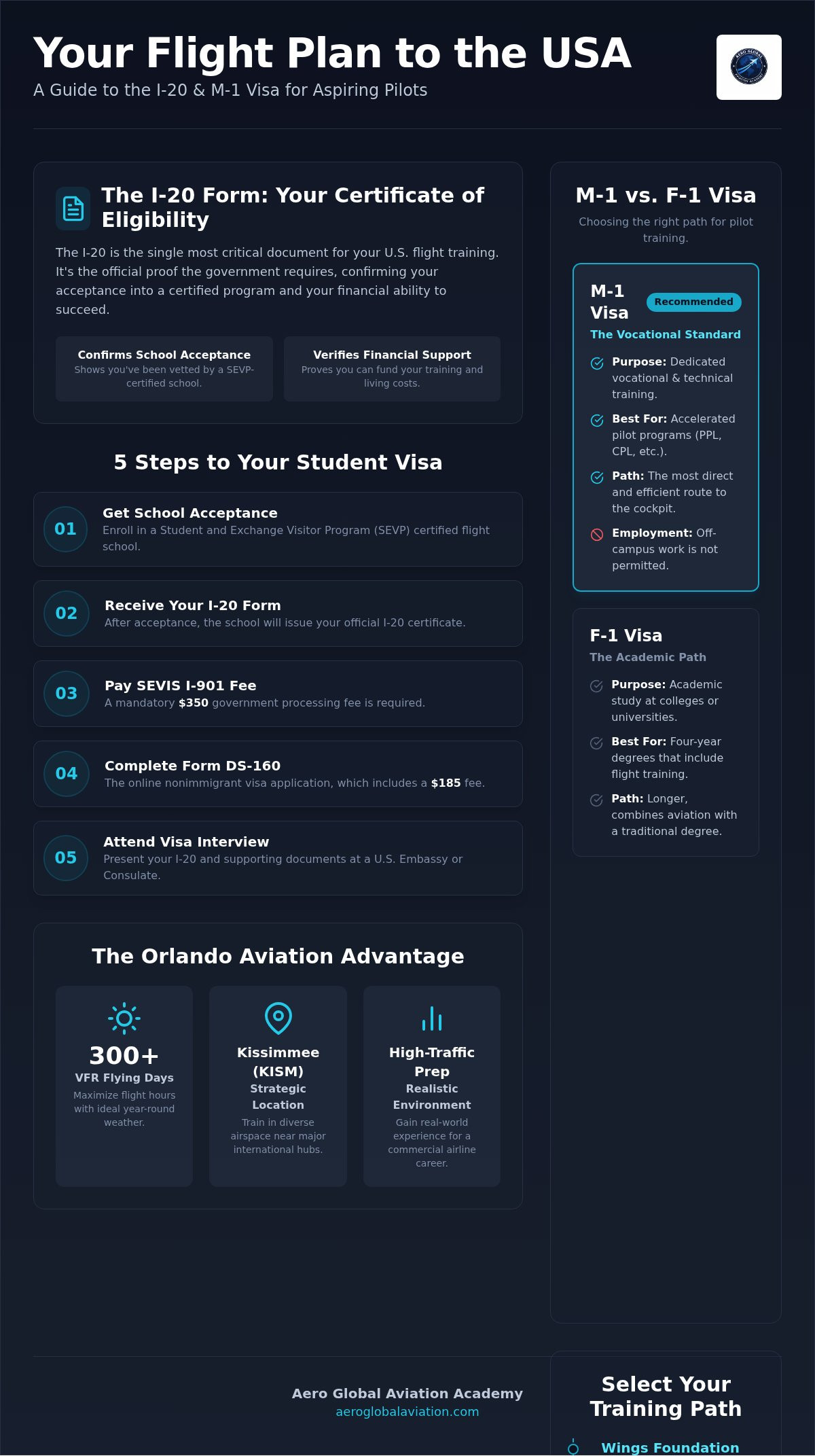
The I-20 form is officially titled the "Certificate of Eligibility for Nonimmigrant Student Status." It's more than just a piece of paper; it's your official entry into the American aviation system for 2026. Without it, you cannot apply for the student visa required to attend M-1 visa flight schools in Florida. This document confirms that you've been accepted into a professional training program and that you possess the financial resources to support your education and living expenses while in the United States.
When you arrive at the U.S. Embassy for your interview, the consular officer looks for your valid I-20 first. It acts as the primary link between your flight school and the government. It outlines your program start date, the expected cost of your training, and the specific certification you're pursuing, such as the Career Pilot Program. This document proves you're a serious candidate who has already been vetted by a professional academy.
The Role of SEVP and SEVIS in Your Pilot Journey
SEVIS is the centralized database the U.S. government uses to track international students and maintain the integrity of the visa system. Only schools certified by the Student and Exchange Visitor Program (SEVP) have the authority to issue an I-20 for pilot training. This certification ensures the school meets strict federal standards for vocational training. For a detailed M-1 visa overview, you can review the specific regulations that govern your stay. At Aero Global Aviation Academy, we maintain our SEVP status with precision to ensure our international pilots always have a secure, legal path to the cockpit.
Why International Students Choose Florida for Training
Florida isn't just a vacation destination; it's the world's most productive training ground for aviators. With over 300 days of VFR weather annually in the Orlando area, you won't spend your weeks waiting for clouds to clear. This consistent sunshine allows you to build flight hours quickly and stay on schedule. Our base at Kissimmee Gateway Airport (KISM) sits within a diverse airspace that challenges you with complex scenarios while remaining accessible for beginners. You'll train near major international hubs, gaining realistic experience in high-traffic environments that prepare you for a commercial airline career.
M-1 vs. F-1 Visas: Choosing the Right Path for Pilot Training
Choosing between an M-1 and an F-1 visa is one of the most significant decisions you'll make before arriving in the United States. While both allow you to study, they cater to very different goals. The I-20 form issued by M-1 visa flight schools in Florida specifically designates your status based on the curriculum you choose. If your goal is to transition from a student to a professional pilot as efficiently as possible, understanding these legal distinctions is vital for your success.
The primary difference lies in the nature of the education. The M-1 visa is designed for vocational and technical training, making it the industry standard for dedicated flight academies. Conversely, the F-1 visa is generally reserved for academic programs at universities or colleges that happen to include flight training as part of a four-year degree. For many, the Career Pilot Program offers a more direct route to the flight deck because it focuses exclusively on the ratings you need without the additional time and cost of a traditional degree.
The M-1 Visa: The Vocational Standard
Most international students at professional academies utilize the M-1 visa because it aligns perfectly with accelerated training schedules. This category focuses on specific certifications like the Private Pilot License (PPL), Commercial Pilot License (CPL), and Multi-Engine ratings. Your stay is typically authorized for the duration of your training plus a short period for practical training, though you can apply for extensions if your course requires more time. It's important to remember that M-1 status does not allow for off-campus employment. You are in Florida to fly, and the government expects your focus to remain entirely on your studies. You can find more details on the official student visa process to ensure you meet every requirement before your interview.
The F-1 Visa: Academic Integration
The F-1 visa is often tied to long-term academic goals. While it offers more flexibility for Optional Practical Training (OPT) after graduation, it usually requires a much larger commitment of time and money. Starting September 15, 2026, new rules require F-1 students to be admitted for a fixed period rather than the previous "duration of status" model, making it even more important to have a clear timeline. If you want to build a career quickly, the M-1 path at a specialized academy usually provides a faster return on your investment. If you're unsure which path fits your timeline, our team at Aero Global Aviation Academy can help you evaluate your options based on your long-term airline goals.
Why Train in Kissimmee? The Orlando Aviation Advantage
Kissimmee Gateway Airport (KISM) serves as more than just a training base; it's a strategic asset for your future career. When you're comparing M-1 visa flight schools in Florida, the location's impact on your training timeline cannot be overstated. Orlando provides a unique ecosystem where technical challenge meets operational efficiency. This allows you to graduate with the skills and confidence needed for a professional flight deck while enjoying the amenities of a world-class city.
Maximizing Your Training Days
Weather is the most significant variable in flight training, and Central Florida offers a distinct advantage. We average over 300 days of Visual Flight Rules (VFR) weather every year. This consistency prevents "training rust," a common problem in colder climates where students lose weeks to low clouds or ice. When you fly three or four times a week without interruption, you retain knowledge better and reach your checkrides faster. This reliability is a primary factor in our best flight schools in florida criteria. By reducing the total weeks you spend in the U.S., you save significantly on housing and living expenses, making your I-20 investment go much further.
Airspace and Infrastructure for Professional Growth
Training in the Orlando region places you in the heart of some of the most educational airspace in the country. You'll regularly interact with Class B, C, and D airspace, which builds the radio communication skills and situational awareness that major airlines demand. You aren't just flying in circles over a quiet field; you're navigating complex transitions and diverse terrain that prepare you for the realities of commercial flight. This exposure is vital for international students who need to return home with a high level of professional competence.
Beyond the airport perimeter, Orlando provides a welcoming and supportive environment for international students. From diverse culinary options to reliable transportation and housing support, the city is built to host the world. This makes the transition to M-1 visa flight schools in Florida feel less like a daunting move and more like a calculated career step. You'll build a global network of peers right here in one of the world's most active aviation hubs. This ensures your training is both productive and memorable, providing a solid foundation for your life as a professional pilot.
Selecting Your Career Track: From PPL to Airline Pilot Elite
Your I-20 isn't just a visa document; it's a blueprint for your professional future. When you apply to M-1 visa flight schools in Florida, the program you select determines the length of your stay and the milestones you'll achieve. At Aero Global Aviation Academy, we offer three primary tracks designed to meet different international career goals. Whether you're starting from zero or looking to polish specific ratings, your I-20 must accurately reflect your full intended course of study to avoid unnecessary paperwork and visa extensions later.
For those who want to master the basics first, the Wings Foundation focuses exclusively on the Private Pilot License (PPL). It's an excellent choice if you're testing the waters of American aviation before committing to a full commercial track. However, most international students looking for a professional career choose the Career Pilot Program, which provides a structured path from zero experience to a Commercial Pilot License (CPL).
The Career Pilot Program Sequence
This sequence moves logically from PPL foundations to the precision of an Instrument Rating and finally the professionalism of a CPL. You can expect a timeline of approximately 6 to 10 months depending on your dedication and the Florida weather. For a deep dive into the specific requirements for each stage, check out our commercial pilot training guide. This structured approach ensures you're fully prepared for the checkrides that define your progress, keeping your training on schedule and within your visa's duration.
Beyond the Commercial License: The Elite Path
If your ultimate goal is a first officer position at a major airline, the Airline Pilot Elite program is the definitive choice. This track includes Certified Flight Instructor (CFI) and Certified Flight Instructor Instrument (CFII) ratings. These certifications are considered the "gold standard" for building the professional flight hours required by global airlines. Building these hours under the guidance of our experienced mentors ensures that your transition to a heavy jet is seamless. We also emphasize Multi-Engine training, which is a mandatory requirement for almost every airline cockpit worldwide. Our Elite track is specifically tailored to meet the high standards of international carriers, focusing on the crew coordination and technical proficiency they demand from new hires.
Selecting the right track now saves you time at the embassy and ensures your training remains efficient. If you're ready to start your journey, apply to our Career Pilot Program today and let us help you secure your future in the skies.
How to Apply for Your I-20 at Aero Global Aviation Academy
Applying to M-1 visa flight schools in Florida is a structured process that rewards attention to detail. We act as your practical mentors throughout this journey, ensuring that every document is in place before you head to your embassy interview. We've simplified the I-20 process into five manageable steps to ensure you can focus on your future in the cockpit rather than getting lost in paperwork. Our team at Aero Global Aviation Academy provides the administrative oversight you need to move from applicant to international student with confidence.
Step 1 involves submitting your formal application and flight school enrollment agreement. This document outlines your chosen path, such as the Career Pilot Program. Step 2 requires you to provide proof of financial responsibility, typically through bank statements or a sponsorship letter. Step 3 is a clear copy of your valid passport. Once we've verified these, Step 4 is the issuance of your I-20 form. You'll then pay the mandatory $350 SEVIS I-901 fee to the Department of Homeland Security. Finally, in Step 5, you'll schedule your visa interview at the nearest U.S. Embassy or Consulate after paying the $185 DS-160 application fee.
Document Checklist for International Students
Your "Proof of Funds" must cover both the total program tuition and estimated living expenses for the duration of your stay. If you're pursuing our Airline Pilot Elite track, your bank statements should demonstrate you can handle the investment without seeking employment in the U.S. We also require your passport to be valid for at least six months beyond your intended period of stay. Our administrative team performs a rigorous review of your documents before we issue the I-20, which significantly lowers the risk of a visa rejection due to clerical errors.
Preparing for Your Visa Interview
The visa interview is your opportunity to share your passion for aviation. Consular officers often ask why you chose M-1 visa flight schools in Florida and what your plans are after graduation. Prepare a clear "Statement of Intent" that explains how your training at our Kissimmee base will launch your career in your home country. Be ready to discuss the specific ratings you'll earn and why the high-efficiency environment of Central Florida is essential for your success. Once your visa is approved, you can enter the U.S. up to 30 days before your program start date. We'll be ready to welcome you to the flight line as you begin your transition to a professional pilot.
Launch Your Global Aviation Career Today
You now have a clear roadmap for navigating the I-20 process and securing your student visa for 2026. By understanding the critical role of SEVIS and selecting a training track that aligns with your airline goals, you've already cleared the first major hurdle in your professional journey. Choosing among the premier M-1 visa flight schools in Florida allows you to take advantage of the 300+ days of sunshine and complex airspace that only the Orlando region can provide.
As an SEVP-certified training facility located at Kissimmee Gateway Airport (KISM), we're ready to act as your practical mentor. Our dedicated international student support team is here to guide you through every administrative step, ensuring your documentation is perfect and your training is efficient. Don't let paperwork stand between you and your seat in the cockpit. Start Your International Application with Aero Global Aviation Academy and take the first step toward a lifelong career in the skies. Your future as a professional pilot is within reach, and we're honored to help you achieve it.
Frequently Asked Questions
Can I work in the U.S. while on an M-1 student visa for flight school?
You cannot work off-campus while training on an M-1 student visa. The M-1 category is strictly for vocational studies, and U.S. immigration laws prohibit employment to ensure your focus remains entirely on your pilot certifications. You must arrive with sufficient liquid funds to cover your entire stay in Kissimmee without relying on a local income. While some M-1 visa flight schools in Florida offer on-campus student roles, these positions are extremely rare and limited.
How long does it take to get an I-20 from a Florida flight school?
Receiving your I-20 typically takes one to two weeks once you submit all required documentation and your enrollment agreement is signed. This timeline depends on the speed of your financial verification and passport review. At Aero Global Aviation Academy, our international support team prioritizes these applications to help you schedule your embassy interview as quickly as possible. Plan for extra time if you are coordinating sponsorship documents or bank statements from your home country.
Do I need to take an English proficiency test like TOEFL before applying?
You don't always need a TOEFL or IELTS score to apply, but you must demonstrate the ability to read, write, and speak English to meet FAA certification standards. During your initial assessment, we evaluate your communication skills to ensure you can safely navigate complex airspace and understand air traffic control instructions. If your English skills aren't sufficient for technical training, we can recommend resources to help you reach the required professional level before you begin flying.
What happens if my pilot visa is denied at the embassy?
If your visa is denied, you can typically reapply after addressing the specific reasons provided by the consular officer. Common reasons include insufficient proof of funds or a lack of clear intent to return home after training. We suggest reviewing your "Statement of Intent" and financial documents with our mentors before your second attempt. A denial isn't a permanent barrier, but it does require a more detailed and precise presentation of your professional aviation goals.
Can I transfer my I-20 from another U.S. flight school to Aero Global?
Yes, you can transfer your SEVIS record from another flight school to Aero Global Aviation Academy if you are maintaining your current legal status. This process requires coordination between the Designated School Officials at both institutions. You must remain in good standing and continue attending classes until the official transfer date. Our team in Kissimmee can help manage this transition to ensure your training continues without interruption as you move into our Career Pilot Program.
How much money do I need to show for proof of funds on the I-20?
You must show enough liquid funds to cover the total cost of your training program plus estimated living expenses for the duration of your stay. For a comprehensive track like the Airline Pilot Elite, this amount includes tuition, housing, transportation, and health insurance. Consular officers look for bank statements that demonstrate these funds are immediately available. Providing clear, organized financial documentation is the best way to prove you can support yourself at M-1 visa flight schools in Florida.
Does the I-20 cover the cost of my flight training and living expenses?
The I-20 form doesn't cover any costs; it is a legal document that certifies your eligibility for a student visa. It lists the estimated expenses you are expected to pay, but you are responsible for providing the actual funds. Think of it as a financial blueprint that tells the U.S. government you have the means to complete your vocational training. You must pay your tuition and living costs directly as you progress through your pilot certifications in Orlando.
How long can I stay in Florida after I finish my pilot training?
M-1 students typically have a 30-day grace period to depart the United States after their program end date or after completing their practical training. If you qualify for M-1 Practical Training, you might be eligible to stay for one month of work for every four months of study, up to a maximum of six months. It's important to monitor your I-94 record and consult with our international advisors to ensure you remain in legal status before returning home.


