
Imagine standing on the ramp at Kissimmee Gateway Airport, feeling the warm Florida sun as you prepare for your first solo flight over the Orlando landscape. For many international students, this vision feels out of reach due to complex visa codes and security screenings. You've likely spent hours researching commercial pilot license requirements Florida only to end up more confused by conflicting advice. It's normal to feel anxious about the technicalities before you even touch a flight yoke.
We believe that your focus should be on the cockpit, not the paperwork. This guide simplifies the entire journey, from securing your I-20 form to passing your final checkride. You'll gain a clear roadmap for the M-1 visa process, TSA background checks, and our professional training paths like the Airline Pilot Elite program. We'll show you how to transition from zero hours to a professional career with the confidence of a local. Let's explore how you can launch your future in the sunny skies of Central Florida.
Key Takeaways
- Secure your M-1 visa and TSA clearance with a step by step roadmap designed to get you into the cockpit faster in 2026.
- Discover why training at Kissimmee Gateway Airport offers a strategic advantage with year-round flying weather that keeps your training schedule on track.
- Understand the specific commercial pilot license requirements Florida schools mandate so you can transition smoothly from a student to a professional aviator.
- Choose the right training path for your career goals, whether you're starting with the Wings Foundation or pursuing the comprehensive Airline Pilot Elite program.
- Prepare for your return home by learning how to convert your FAA hours and ratings for international airline careers in jurisdictions like EASA and the CAA.
Legal Prerequisites: M-1 Visas and TSA Clearance for 2026
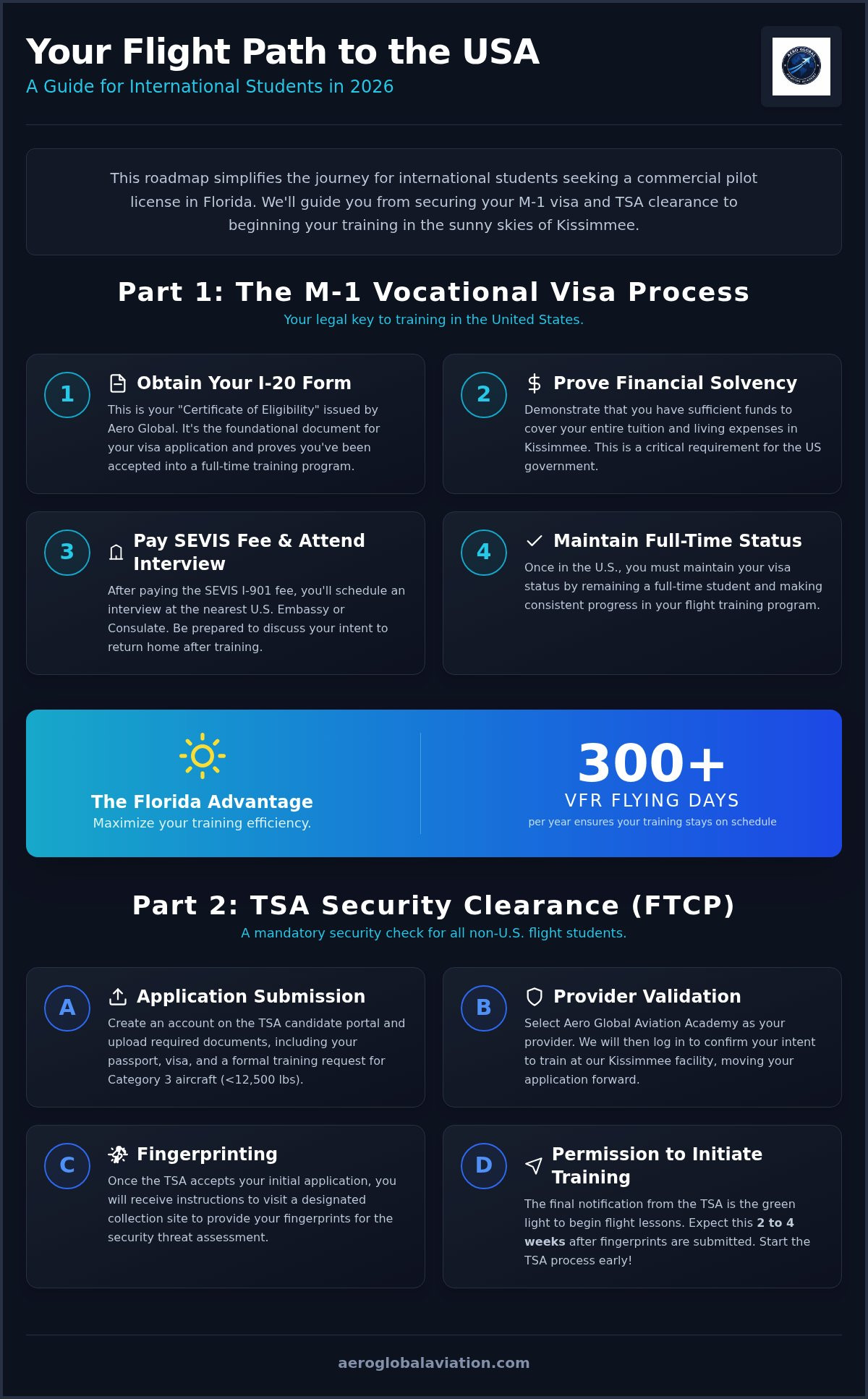
Before you can climb into a cockpit at Kissimmee Gateway Airport, you must clear the essential legal hurdles required for international flight students. Understanding the commercial pilot license requirements Florida schools operate under starts with your legal status as a non-US citizen. For 2026, the M-1 vocational visa remains the primary pathway for those seeking professional training outside of a four-year university degree. While an F-1 visa is common for academic students, the M-1 is specifically tailored for technical and vocational programs, offering a more direct route to your ratings.
Aero Global acts as your practical mentor throughout this process, beginning with the issuance of your I-20 form. This document is your official "Certificate of Eligibility for Nonimmigrant Student Status," and it's the golden ticket you'll need before visiting a US Embassy. We guide you through the documentation required to prove your eligibility, ensuring that your transition to the sunny skies of Orlando is as smooth as a perfect landing.
The M-1 Vocational Visa Process
Securing your visa requires more than just an acceptance letter. You'll need to demonstrate financial solvency, showing that you have the funds available to cover both your tuition and living expenses in Kissimmee for the duration of your training. This transparency is a key part of the US government's requirements for all vocational students. Whether you are aiming for a private or commercial rating, understanding the FAA pilot certification levels is the first step toward mapping out your financial plan.
Once you have your I-20 and have paid your SEVIS fee, you'll schedule an interview at the nearest US Embassy or Consulate. During this meeting, you'll discuss your intent to return home after completing your Career Pilot Program. To maintain your legal status while enrolled, you must remain a full-time student and keep your training progress on track. Our team provides the structured curriculum and attendance tracking necessary to keep your visa in good standing from your first hour to your last.
TSA Background Checks for Non-US Citizens
Simultaneously, you must navigate the TSA Flight Training Candidate Program (FTCP). This is a mandatory security threat assessment for all non-citizens seeking flight training in the United States. For most students, this falls under "Category 3," which covers training in aircraft weighing less than 12,500 pounds. You'll need to create an account on the TSA candidate portal and select Aero Global Aviation Academy as your validated training provider.
The process typically follows a specific rhythm in 2026:
- Application Submission: Upload your passport, visa details, and training request to the TSA portal.
- Provider Validation: We confirm your intent to train at our Kissimmee facility.
- Fingerprinting: Once the TSA accepts your initial application, you'll visit a local or international collection site to provide your fingerprints.
- Permission to Initiate Training: This final notification is the green light you need to begin your flight lessons.
The final milestone is the "Permission to Initiate Training" email. In 2026, students should expect a window of two to four weeks for TSA clearance once fingerprints are submitted. Starting this process early ensures that you don't face delays when you arrive in Orlando, allowing you to focus entirely on mastering the skies.
Why Central Florida is the Global Hub for Accelerated Flight Training
Central Florida is widely recognized as the premier destination for international students looking to satisfy the commercial pilot license requirements Florida schools offer. This region isn't just a vacation destination; it's a high-performance training ground where the environment works in your favor. By choosing to train here, you aren't just learning to fly; you're positioning yourself in a geographic corridor designed for aviation success. While you focus on your flight hours, staying compliant with M-1 visa and SEVIS requirements is vital for your progress, and our proximity to major hubs makes these logistics much easier to manage.
Weather and Training Efficiency
You can't build flight hours if your plane is grounded by snow or persistent low clouds. Central Florida provides over 300 days of Visual Flight Rules (VFR) weather each year, which is a massive advantage compared to the unpredictable climates of Europe or the Northern United States. This consistency means you'll rarely face the frustration of canceled lessons, allowing you to move through the Career Pilot Program with a steady, predictable rhythm. The local climate also offers a unique training benefit; learning to manage aircraft performance in Florida's heat and humidity builds a superior level of pilot skill. You'll graduate with a deep understanding of how environmental factors affect your climb rates and engine performance, making you a more versatile aviator on the global stage.
Kissimmee Gateway Airport Advantages
Strategic location is everything in aviation training. Kissimmee Gateway Airport (KISM) serves as a dedicated aviation facility that offers the perfect balance of complexity and accessibility. Unlike the massive international hubs like MCO, KISM allows you to spend less time idling on the taxiway and more time in the air practicing maneuvers. You'll still gain invaluable experience by operating within the complex Orlando Class B airspace, which prepares you for the radio communication and precision required at the world's busiest airports. To see how our location and facilities stack up against other options, take a look at our guide on the Best Flight Schools in Florida: Your 2026 Evaluation Checklist.
Beyond the operational benefits, the "Orlando Perk" is a real factor in student success. Balancing the intensive study required for your ratings with local amenities helps prevent burnout. Whether it's a weekend visit to a world-class theme park or a quiet afternoon by a local lake, the lifestyle here supports a healthy mental state for learning. If you're ready to see the view from 3,000 feet, the team at Aero Global is here to help you start your journey toward a professional career.
Comparing Training Paths: From Foundations to Airline Pilot Elite
Choosing your flight training path is the most critical decision you'll make after securing your visa and arriving in Orlando. Every pilot's journey is unique, and your roadmap must align perfectly with your final destination. Whether you want to fly for personal enjoyment or command a wide-body jet on international routes, we provide structured options to help you reach those milestones. You'll need to evaluate if you're flying for the pure joy of the skies or if you're looking to capitalize on the strong career outlook for commercial pilots that the industry currently offers.
For those who want to master the basics without committing to a full career track immediately, the Wings Foundation is your ideal starting point. This program focuses exclusively on the Private Pilot License (PPL), giving you the fundamental skills to navigate the Florida skies safely. It's a perfect entry point if you're testing the waters or simply want the freedom to fly yourself and your friends. However, if your goal is to earn a living in the flight deck, you'll need a more comprehensive approach to satisfy the commercial pilot license requirements Florida flight schools and the FAA demand.
The Career Pilot Program for Internationals
The Career Pilot Program serves as the standard roadmap for students moving from zero experience to a professional level. This structured path takes you through your PPL and Instrument Rating before focusing on the precision maneuvers required for your Commercial Pilot License (CPL). It's a rigorous process designed to help you master complex aircraft systems and professional decision-making. You'll spend a significant portion of your time building the 250 flight hours required for FAA certification. For a deeper look at this specific journey, explore our Commercial Pilot Training: Your 2026 Guide to Professional Flight Certification. This program ensures you have the technical proficiency to operate as a paid pilot in various aviation sectors.
Airline Pilot Elite: The Instructor Advantage
For international students who want the highest credentials, the Airline Pilot Elite program is the definitive choice. This path goes beyond the CPL by including Certified Flight Instructor (CFI) and Certified Flight Instructor Instrument (CFII) ratings. Obtaining these instructor certifications is a strategic move for non-US citizens. It allows you to build the high volume of flight hours that many global airlines require for their entry-level first officers. By teaching others to fly, you'll refine your own knowledge to an expert level while professionally accumulating time in the logbook. You can learn more about the long-term benefits of this track in The Airline Pilot Career Path: A Comprehensive 2026 Guide. This elite training prepares you for the high-pressure environment of airline cockpits, making you a top-tier candidate for carriers worldwide.
Navigating Student Life in Kissimmee and Orlando
Moving to a new country for flight training is a massive life event. While you've likely spent weeks researching the commercial pilot license requirements Florida mandates, your daily life in Kissimmee will play a huge role in your training success. We've seen that students who settle in quickly to local life often progress through their ratings with more focus and less stress. A well-rested pilot is a safe pilot; having a stable home base allows you to dedicate your full mental energy to the cockpit.
Housing and Accommodation in Kissimmee
Finding the right home near Kissimmee Gateway Airport (KISM) is your first priority. You'll want to decide between short-term rentals, which are excellent for initial ratings, or long-term leases if you're enrolled in the Airline Pilot Elite program. Living close to the academy is a strategic move. It allows you to reach those early morning flight blocks without a long commute. Most students find that the cost of living in the Orlando area is manageable compared to major international cities. You should budget for rent, utilities, and groceries while keeping a small reserve for local exploration and weekend trips.
Arrival and Integration
Your journey with us starts the moment you land. We provide initial orientation and airport pickup to take the guesswork out of your first few days. One of your first tasks will be setting up a US phone line and a local bank account. These steps are practical necessities for managing your training funds and staying in touch with family. We also help you navigate the local transportation landscape. While Central Florida is best explored with a vehicle, many of our students use rideshare services or build carpool networks within the academy community.
Don't forget to take a mental break. The intensive study required for your ratings can be demanding. Fortunately, you're in a world-class destination. Whether you're visiting the famous theme parks or exploring the natural springs of Central Florida, these activities provide the mental reset you need to stay sharp. Building a community with fellow international student pilots will be your greatest asset. You'll share study tips, celebrate checkride passes, and build a professional network that spans the globe. If you're ready to start your journey, contact us today to discuss your enrollment and take the first step toward your new career.
Beyond Florida: Converting FAA Licenses for International Airline Careers
Your time at Kissimmee Gateway is more than just a domestic certification; it's a global credential. Many students choose the US because it's the most cost-effective and efficient place to accumulate the flight hours required by international carriers. Once you've satisfied the commercial pilot license requirements Florida academies provide, you possess a foundation that is respected by airlines from London to Dubai. The prestige of being an "Orlando-trained" pilot carries weight in the international job market, signaling that you've mastered complex airspace and diverse weather conditions.
FAA to EASA/CAA Conversions
Converting your FAA ratings to EASA or CAA licenses is a structured process that typically involves passing theoretical exams and a flight skills test in your home jurisdiction. The advantage of training in Florida is the sheer volume of hours you can log quickly. While the US and Europe have different regulatory nuances, the core airmanship skills you develop while meeting the commercial pilot license requirements Florida schools follow are universal. You should focus on keeping a meticulously detailed logbook that clearly differentiates between cross-country, night, and instrument time. For a deeper look at the specific certifications you'll earn, read our Advanced Flight Training: The Complete Guide to Professional Pilot Ratings.
Your Future in the Flight Deck
The global demand for pilots in 2026 remains at an all-time high, and carriers are looking for candidates who can demonstrate professional decision-making from day one. Our "Practical Mentor" approach ensures you aren't just passing a test; you're preparing for the rigorous airline interview process. We help you understand how to articulate your experience in Orlando as a strategic asset. Whether you're aiming for a regional carrier or a major international airline, the transition from student to professional is a logical progression when you have the right support.
Your journey to the airlines doesn't end when you leave the US; it simply enters a new phase. By mastering the skies over Central Florida, you've already completed the most challenging part of your professional development. Your future career in the flight deck starts right here at Kissimmee Gateway Airport, where we turn your international aspirations into a tangible professional reality.
Launch Your Aviation Career from the Sunshine State
Navigating the complex landscape of international flight training is a significant undertaking, but it's a journey you don't have to face alone. By mastering the commercial pilot license requirements Florida mandates and leveraging the 300+ days of flying weather at Kissimmee Gateway Airport, you can significantly accelerate your path to the professional flight deck. Whether you're seeking the foundational skills of the Wings Foundation or the elite credentials of our instructor-led programs, we provide the structured roadmap you need to reach your destination. Our academy offers dedicated support for TSA clearance and I-20 issuance, ensuring that your transition to life in Central Florida is both rewarding and efficient.
You've explored how a US-based certification opens doors to global airline careers; now it's time to take the controls and transform your aspirations into a tangible reality. Start Your International Pilot Journey: Apply for the Career Pilot Program Today and let us be your practical mentor in the skies. The horizon is clear, and your future as a professional pilot is within reach.
Frequently Asked Questions
Can I train as a pilot in the US if I am not a citizen?
Yes, you can absolutely train as a pilot in the United States as a non-US citizen. International students typically enroll in SEVP-approved flight schools using an M-1 vocational visa. This pathway is designed for technical training programs like our Career Pilot Program. You'll need to satisfy specific commercial pilot license requirements Florida mandates, including a background check and a valid medical certificate, before you can begin your flight hours at Kissimmee Gateway Airport.
How long does it take for a non-US citizen to get TSA clearance?
Most international students receive their TSA clearance within two to four weeks after submitting their fingerprints. This process is part of the Flight Training Candidate Program (FTCP) and is mandatory for all non-citizens. You'll need to create a portal account and select Aero Global Aviation Academy as your training provider. Starting this process at least a month before your arrival in Orlando ensures that you're ready to fly as soon as you land.
What is the difference between an M-1 and F-1 visa for flight school?
The M-1 visa is for vocational or technical training, while the F-1 visa is reserved for academic students at universities or colleges. For professional flight training at a dedicated academy like ours, the M-1 is the industry standard. It's specifically tailored for the intensive, hands-on nature of our Airline Pilot Elite program. While the F-1 allows for longer stays, the M-1 is often a more direct and efficient route for focused pilot certification.
Do I need to be fluent in English to start pilot training in Orlando?
You must be able to read, speak, write, and understand the English language to meet FAA certification standards. English is the international language of aviation, and all radio communications and technical manuals are provided in English. We recommend that international students reach an ICAO Level 4 proficiency before beginning their training in Orlando. This ensures you can communicate clearly with air traffic control and understand complex safety procedures during your flight lessons.
How much money do I need to show for my I-20 financial support?
To receive your I-20 form, you must demonstrate that you have sufficient funds to cover the total cost of your training and living expenses for your stay. This includes tuition for courses like the Wings Foundation or the Career Pilot Program, which are designed to meet the commercial pilot license requirements Florida flight schools maintain. You'll need to provide bank statements or financial affidavits that prove your solvency to US immigration authorities before your interview.
Can I work in the US while on an M-1 student visa?
Employment opportunities are very limited for M-1 visa holders. You aren't permitted to work off-campus during your studies, as the primary purpose of your stay is full-time vocational training. Some students may qualify for a brief period of practical training after completing their program, but this is subject to strict regulatory approval. It's essential to have your full financial support secured before you arrive so you can focus entirely on mastering the skies.
Is an FAA license valid in Europe or Asia?
An FAA license is recognized globally because it meets the standards set by the International Civil Aviation Organization (ICAO). While you can fly N-registered aircraft anywhere in the world, most countries require a conversion process to fly their locally registered planes. Pilots returning to Europe or Asia typically pass local theoretical exams and a flight skills test. Training in Florida provides a strong foundation that makes these international license conversions much more manageable for professional aviators.
Does Aero Global Aviation Academy provide housing for international students?
We don't own on-campus dormitories, but we provide dedicated assistance to help you find student-friendly housing near Kissimmee Gateway Airport. Our team understands the local rental market and can suggest apartments or shared housing options that are popular with our international student community. Living close to the academy is a strategic advantage for your training, as it makes attending early morning flight blocks and ground school sessions much more convenient during your stay in Orlando.


