
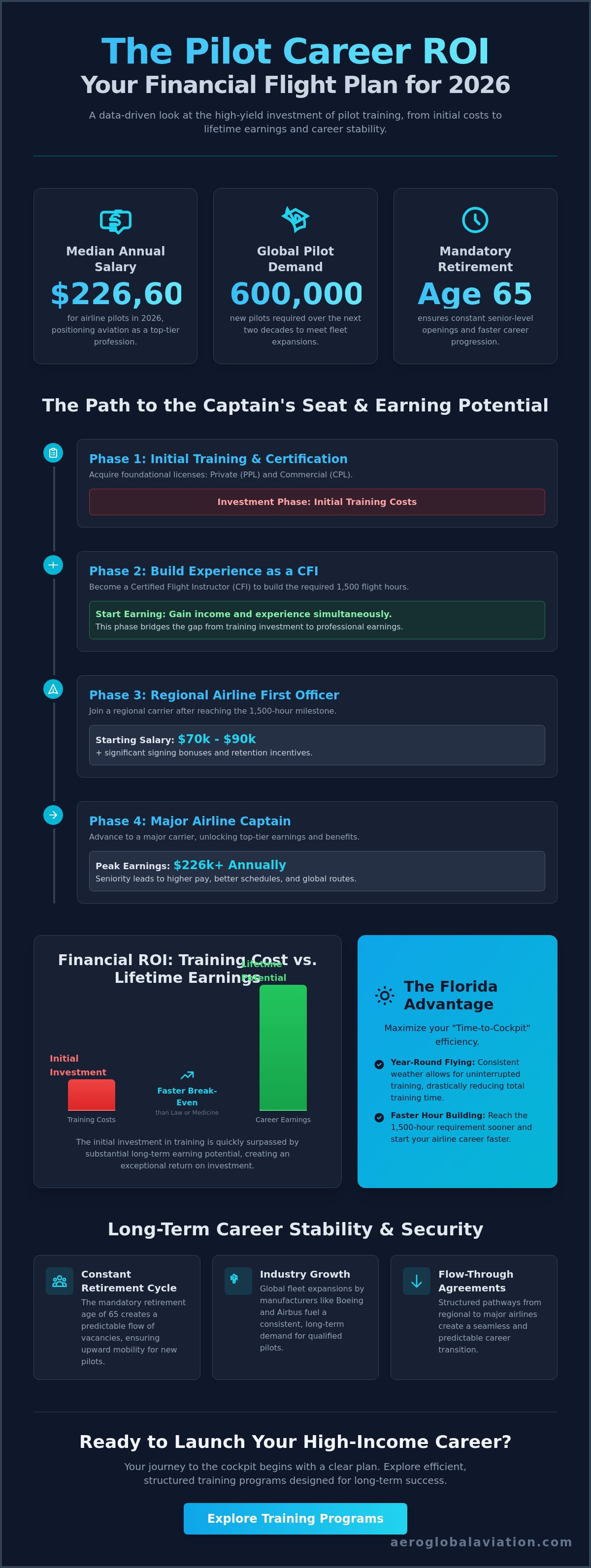
The U.S. Bureau of Labor Statistics reports the median annual wage for airline pilots reached $226,600 in 2026, positioning aviation as one of the most financially rewarding career paths available today. While that figure is impressive, you're likely more concerned with the steep climb required to reach it. It’s natural to feel anxious about the high upfront costs or the long road to 1,500 flight hours. You want to know if the investment you make today will actually pay off in the years ahead.
We understand these concerns because choosing a career in the cockpit is a life-changing decision that requires a clear roadmap. This article provides a transparent breakdown of the financial and professional reality of flight training right now. We'll explore salary projections, training efficiency, and the long-term ROI of the industry. We also answer the critical question of how long does it take to become an airline pilot Florida so you can plan your transition with absolute confidence. From analyzing the value of accelerated programs like our Airline Pilot Elite course to calculating your "time-to-cockpit" efficiency, you'll discover why the Sunshine State remains the premier destination for launching a stable, high-income career.
Key Takeaways
- Calculate your personal ROI by balancing upfront training costs against the massive lifetime earnings available to senior airline captains in 2026.
- Discover how regional weather patterns impact your timeline and learn exactly how long does it take to become an airline pilot Florida when training in a year-round flight environment.
- Master the strategy of using the Certified Flight Instructor (CFI) phase to build your 1,500 hours while gaining valuable professional experience and a steady income.
- Explore how specialized ratings and structured training paths like the Airline Pilot Elite program help you navigate market volatility and maintain long-term job security.
- Identify the most efficient path for your goals by comparing the comprehensive instructor-track curriculum with the focused Career Pilot Program.
The State of Aviation in 2026: Why Pilot Training is a Strategic Choice
Investing in flight training is more than just paying for a set of skills; it's a high-yield financial move. We define Pilot ROI as the total lifetime earnings potential of your career compared to your initial certification costs. In 2026, this math has never looked better. With median annual wages for airline pilots reaching $226,600, the "break-even" point for your training investment arrives much earlier than in traditional professions like law or medicine. You aren't just buying a license; you're securing a seat in an industry that's currently desperate for your expertise.
Global aircraft manufacturers like Boeing and Airbus continue to project a massive need for new aviators. Their 2026 outlooks confirm that over 600,000 new pilots will be required globally over the next two decades to support fleet expansions and replacement cycles. This demand creates a "sweet spot" for new students. By starting your journey now, you position yourself to enter the workforce just as airlines are launching major decade-long expansion plans. Understanding how long does it take to become an airline pilot Florida is the first step in timing your entry to catch this wave of hiring at its peak.
Mandatory retirement ages are also working in your favor. The FAA requirement for pilots to retire at age 65 ensures a constant, predictable churn at the top of seniority lists. As senior captains retire in record numbers, the path to the left seat opens up faster for those entering the industry today. This vacancy-driven seniority means you'll likely reach higher pay scales and better schedules much sooner than previous generations of pilots did.
The 2026 Pilot Shortage Reality
The pilot shortage isn't a single problem; it's a multi-layered opportunity. Regional airlines are currently facing the most acute pressure, offering rapid advancement for those who have just hit their 1,500-hour milestone. Major carriers are also recruiting aggressively, often pulling talent directly from their regional partners through revamped flow-through agreements. These pathways make the transition from a first commercial job to a major flight deck feel seamless and structured. While sectors like tech have seen recent volatility, the aviation industry provides a stable, seniority-protected environment that rewards your commitment with long-term security.
Expanding your skillset within this evolving industry can also include mastering unmanned systems; Drone Education and Certification Programs provide the Part 107 training and specialized knowledge needed to capitalize on the growing demand for professional drone pilots alongside traditional aviation careers.
Evolving Pilot Salaries and Benefit Packages
Compensation packages in 2026 have evolved to include more than just a base salary. Regional first officers now see starting pay between $70,000 and $90,000, often supplemented by significant signing bonuses and retention incentives. Beyond the money, there's a renewed focus on work-life balance. Modern contracts prioritize efficient scheduling, giving new pilots more predictable time at home. To join this workforce, you must first master the pilot certification requirements that govern the industry. Visualizing the full airline pilot career path helps you see exactly how these ratings translate into a lifestyle. Because our local weather allows for consistent, year-round flying, you'll find that how long does it take to become an airline pilot Florida is often much shorter than in other regions, letting you start earning those bonuses sooner.
Analyzing the Financial ROI: Pilot Salaries vs. Training Costs
Understanding the financial commitment of aviation starts with identifying the specific milestones of your journey. The path is divided into distinct phases: the Private Pilot License (PPL), the Commercial Pilot License (CPL), and finally, becoming a Certified Flight Instructor (CFI). While each phase requires an investment, each one also brings you closer to a high-income reality. Many students choose to bundle these certifications into a single, cohesive track to reduce overall costs and streamline their progression. This structured approach ensures you aren't just learning to fly; you're moving toward a specific professional destination.
The contrast between entry-level earnings and long-term potential is significant. As a CFI, you earn a steady income while building the 1,500 hours required for the airlines. While this is a modest start, it serves as the bridge to the major carriers. According to recent data on Airline and Commercial Pilots, the earning potential scales dramatically once you reach the flight deck of a major airline. A senior widebody captain in 2026 can see total compensation packages exceeding $540,000. This makes the break-even point, the moment where your cumulative earnings surpass your total training investment, surprisingly attainable. Most pilots reach this milestone within just a few years of joining a regional airline.
Exactly how long does it take to become an airline pilot Florida depends on your training intensity, but choosing an accelerated path is designed to maximize your ROI by getting you into a paying cockpit sooner. By treating your training as a strategic investment rather than a simple expense, you can focus on the long-term rewards of this stable profession.
The Cost of Inaction: Why Delaying Training Costs Thousands
In the aviation industry, seniority is everything. It determines your pay scale, the aircraft you fly, and your monthly schedule. If you delay your commercial pilot training by just twelve months, you aren't just losing a year of entry-level wages. You're effectively losing the final, most lucrative year of your career. Losing a year of senior captain pay can result in a lifetime earnings loss of over $500,000. Starting today is the most effective way to protect your future wealth.
Financing Your Future: 2026 Options
We recognize that the upfront tuition can feel like a hurdle, but 2026 offers more financing flexibility than ever before. Specialized aviation loans and tailored payment plans are now standard, allowing students to treat their education as a manageable investment. When evaluating the ROI of a 4-year university degree versus an accelerated academy path, the academy often provides a faster route to high-income years. At Aero Global Aviation Academy, we act as your practical mentor to help you navigate these financial hurdles. We invite you to explore our Career Pilot Program to see how a structured, efficient curriculum can turn your aspirations into a tangible career destination.
Time-to-Market: Why Training Speed is the Secret to Better Returns
In the aviation industry, time is literally money. We measure the success of a flight training program by its "Training Efficiency," which is the total number of flyable days available in a calendar year. If you're grounded by snow or persistent storms for three months out of the year, your path to the cockpit stalls, and your tuition investment doesn't move you closer to a paycheck. Achieving a high financial return on investment depends on your ability to transition from student to professional as quickly as your skills allow.
Consider the math: a student who completes their certifications in 10 to 12 months enters the workforce a full year ahead of someone in a traditional 24-month program. That extra year at the start of your career isn't just about an extra year of salary; it's about reaching the major airlines one year sooner. When you factor in the seniority-based pay raises and retirement contributions, that single year of efficiency can double your early-career ROI. When people ask how long does it take to become an airline pilot Florida, they're often surprised to learn that our regional advantages can shave months off the national average timeline.
The Florida Advantage: Flying in Kissimmee and Orlando
Central Florida serves as a strategic hub for aspiring pilots because of its near-perfect flying conditions. In Kissimmee and Orlando, we enjoy over 300 flyable days per year, allowing you to maintain a consistent training rhythm that's impossible in northern climates. Beyond the weather, the complex airspace near Orlando International Airport provides an invaluable training ground. You'll learn to navigate busy traffic and communicate with professional controllers from day one, which is a key trait we look for when identifying the best flight schools in florida. This immersion prepares you for the high-stakes environment of airline operations long before you reach a regional jet.
Structured vs. Unstructured Training
Choosing a syllabus-driven career pilot program is the most effective way to eliminate "dead time" in your training. Unstructured, pay-as-you-go models often lead to redundant flight hours and forgotten skills between lessons. Our structured curriculum at Aero Global Aviation Academy ensures that every hour in the air serves a specific purpose, moving you logically toward your next rating. We focus on professional speed and precision, treating your training like the high-level career preparation it is. This disciplined approach is why the question of how long does it take to become an airline pilot Florida has a much more favorable answer here than anywhere else.
Risk Management: Navigating Market Volatility and Job Security
A common concern for many aspiring aviators is the potential for economic shifts. You might wonder what happens if the economy faces a downturn while you're still in training. It's a valid question, but history shows that aviation is a resilient industry that operates on long-term cycles rather than short-term market fluctuations. While other sectors might see immediate layoffs during a recession, the mandatory retirement of senior captains and the global need for transport keep the pilot pipeline moving. Investing in your ratings today is a way of building a career that is inherently protected by high barriers to entry.
The FAA's 1,500-hour rule acts as a significant "moat" for your profession. Because this requirement is so rigorous, the market cannot be suddenly flooded with a surplus of labor. This regulatory standard ensures that your skills remain in high demand, keeping wages stable even when the broader economy feels uncertain. When you consider how long does it take to become an airline pilot Florida, you're actually looking at the time required to build a specialized, recession-proof asset. To ensure you're choosing a stable partner for this journey, use this checklist to evaluate any flight school:
- Fleet Health: Does the school maintain a modern fleet with high availability, or are aircraft frequently grounded for unscheduled repairs?
- Safety Culture: Is there a transparent reporting system and a dedicated Director of Safety on staff?
- Instructor Stability: Does the school have a clear path for retaining high-quality instructors?
- Financial Transparency: Are costs clearly outlined without hidden surcharges for fuel or insurance?
Diversifying Your Skills with Advanced Ratings
Marketability in aviation comes from the diversity of your logbook. While a Private Pilot License is the foundation, adding Instrument and Multi-Engine ratings makes you indispensable to employers. These certifications prove you can handle complex aircraft in challenging weather conditions, which is exactly what major carriers look for. We recommend exploring advanced flight training to understand how these specialized ratings accelerate your career. Becoming a Certified Flight Instructor (CFI) is another strategic move; it allows you to build your 1,500 hours while earning an income, effectively turning your training phase into a professional role.
The Myth of Pilot Automation
There's often talk about AI and autonomous flight, but the reality for the 2026-2040 timeframe is clear: the human pilot is irreplaceable. Regulatory bodies and the flying public require "human-in-the-loop" oversight for safety and accountability. AI can assist with calculations, but it cannot replicate the complex Pilot-in-Command decision-making required during an emergency or a unique weather event. Your value lies in your judgment and your ability to manage systems, not just your ability to manipulate the controls. While you focus on the future, remember that how long does it take to become an airline pilot Florida is a timeline that leads to a role defined by human expertise and high-level responsibility. If you're ready to start building this secure future, we invite you to learn more about our Airline Pilot Elite program.
Launching Your Career at Aero Global Aviation Academy
Choosing the right environment is the final piece of the ROI puzzle. At Aero Global Aviation Academy, we don't just provide flight hours; we offer a partnership. Our "Practical Mentor" philosophy means you have an expert guide invested in your individual success, moving you away from the impersonal feel of larger corporations. We focus on your specific milestones, ensuring that every rating you earn is a tangible step toward your professional destination. This supportive atmosphere lowers the barrier to entry, making the high-stakes world of aviation feel both logical and attainable.
Our Airline Pilot Elite program stands as the ultimate vehicle for those seeking a complete transition from zero experience to advanced instructor certification. It's designed to take you through the entire pipeline, providing the most efficient route to the 1,500-hour requirement. If your focus is more targeted, our Career Pilot Program offers a direct path from your Private Pilot License to a Commercial Pilot License. For those just beginning their journey, the Wings Foundation provides the essential Private Pilot foundation you need to launch your career with confidence. When you ask how long does it take to become an airline pilot Florida, the answer is found in these structured, milestone-driven curricula that leverage every sunny day to your advantage.
Why Aero Global in Kissimmee?
Kissimmee Gateway Airport (KISM) is our strategic home, offering a professional environment that perfectly balances accessibility with complex airspace training. You'll train in a state-of-the-art fleet equipped with G1000 glass cockpits, ensuring you're learning on the same advanced systems you'll find in modern regional jets. This technological edge gives our students a significant advantage during airline interviews. We pride ourselves on supporting a diverse community, providing the same high level of personalized attention to both our domestic and international students. Our goal is to make the transition to the flight deck as smooth as possible, regardless of where you start.
Your Next Steps to the Flight Deck
The best way to begin is by booking a discovery flight. This introductory session allows you to get behind the controls, experience our training style firsthand, and test your pilot aptitude with one of our expert instructors. It's the most effective way to see if the cockpit is where you belong. We are currently accepting applications for our upcoming 2026 intakes, and our enrollment process is designed to be clear and straightforward. How long does it take to become an airline pilot Florida depends on when you take that first step. Your career doesn't wait, and the high-income opportunities of the next decade are available to those who start now. Join us at Aero Global Aviation Academy and turn your passion for flight into a rewarding, lifelong profession.
Take Command of Your Professional Future
The aviation landscape of 2026 offers a rare alignment of high earning potential and long-term job security. You now understand that the true value of flight training lies in your "time-to-cockpit" efficiency and the wealth-building power of early seniority. By choosing a training environment that minimizes weather delays and follows a disciplined curriculum, you position yourself to reach the major airlines years ahead of the national average. A primary factor in your success is knowing how long does it take to become an airline pilot Florida when you utilize our region's three hundred flyable days per year.
At Aero Global Aviation Academy, we provide a structured PPL to CPL pathway and a professional, career-oriented curriculum designed to turn students into colleagues. Our Kissimmee-based training center serves as your home base for rapid skill acquisition and personalized mentorship. Don't wait for market conditions to change; the most successful pilots are those who start their journey today to secure their spot on the seniority list.
Start Your Career Pilot Journey at Aero Global Aviation Academy and let us help you reach your professional destination. We're excited to see you in the skies.
Frequently Asked Questions
Is being a pilot a good career in 2026?
Yes, aviation remains one of the most stable and high-paying professions due to a global shortage of qualified aviators. Manufacturers like Boeing and Airbus project a need for over 600,000 new pilots through 2040 to support fleet growth and replace retiring captains. Unlike many corporate roles, pilot careers are protected by seniority and high regulatory barriers, ensuring long-term demand for your skills.
How much does a commercial pilot make in 2026?
The U.S. Bureau of Labor Statistics reports a median annual wage of $226,600 for airline pilots in 2026. Entry-level first officers at regional airlines typically earn between $70,000 and $90,000, while senior captains at major carriers can see total compensation packages exceeding $540,000. These figures reflect the significant value airlines place on experienced flight crews in the current market.
What is the fastest way to become an airline pilot?
Enrolling in an accelerated, structured academy program in a region with high flyable days is the most efficient path. When considering how long does it take to become an airline pilot Florida, students in Kissimmee often complete their primary certifications in 10 to 12 months. This speed allows you to reach the 1,500-hour milestone and enter the airline workforce much faster than traditional self-paced training.
How long does it take to see a return on investment for flight school?
Most pilots reach their financial break-even point within two to four years of joining a regional airline. Because airline pay scales are based on seniority, your earnings increase significantly every year you remain with a carrier. Starting your training early maximizes your lifetime ROI by ensuring you reach the highest-paying captain positions during your peak earning years.
Is 30 or 40 too old to start pilot training in 2026?
Not at all, as the mandatory retirement age for airline pilots is 65. Starting at age 40 still provides a 25-year career window, which is more than enough time to reach major airline captain status and enjoy a decade of top-tier earnings. Airlines value the maturity and professional experience that second-career pilots bring to the flight deck.
What are the financing options for flight school in Florida?
Aspiring pilots can access specialized aviation loans and flexible payment plans designed to cover the cost of professional training. Many financial institutions offer programs that allow for deferred payments until you reach a specific employment milestone. We recommend treating flight school as an investment in a high-income asset rather than a simple educational expense.
How does the Florida weather affect my training ROI?
Florida weather provides over 300 flyable days per year, which directly impacts how long does it take to become an airline pilot Florida by preventing long seasonal delays. Consistent flying allows you to maintain proficiency and graduate months ahead of students in northern climates. Every month you save in training is a month sooner you can begin earning an airline salary and building seniority.
What is the difference between the Career Pilot Program and Airline Pilot Elite?
The primary difference is the final certification level and career destination. The Career Pilot Program focuses on the journey from PPL to a Commercial Pilot License, while the Airline Pilot Elite program provides a comprehensive path that includes advanced instructor certifications. The Elite track is specifically designed to help you build the 1,500 hours required for airline employment while earning an income as an instructor.


