

What if the pressure you feel right now isn't a barrier to your success, but actually a fundamental part of your flight training? Many students view anxiety as a sign of weakness, but in reality, learning the art of managing stress during commercial pilot training Orlando is just as critical as mastering a steep turn or a perfect landing. It's natural to worry about checkride performance or the financial investment of your career path. You aren't alone in feeling the weight of information overload during ground school or the challenge of balancing flight hours with your life on the ground.
We're here to help you turn that tension into a professional asset that makes you a safer, more confident pilot. This guide provides proven strategies to navigate the unique pressures of flight school and move past the common student pilot plateau. You'll discover how Orlando's over 300 flyable days a year and its busy airspace can actually work in your favor to build resilience. We'll walk through actionable coping mechanisms that ensure your journey from student to commercial professional is both rewarding and attainable.
Key Takeaways
- Learn to distinguish between acute stress during maneuvers and chronic anxiety about checkrides to better manage your mental energy throughout your training.
- Master the art of managing stress during commercial pilot training Orlando by learning to navigate busy Class B airspace and Florida's rapid weather changes with confidence.
- Implement practical tools like "chair flying" and the IMSAFE checklist to build muscle memory and verify your mental readiness before every takeoff.
- Discover how choosing a supportive academy environment over an impersonal "pilot factory" provides the mentorship needed to overcome the common student pilot plateau.
- Shift your mindset to view stress management as a professional competency that prepares you for the high-stakes environment of a career as an airline pilot.
Understanding the Psychology of Stress in Flight Training
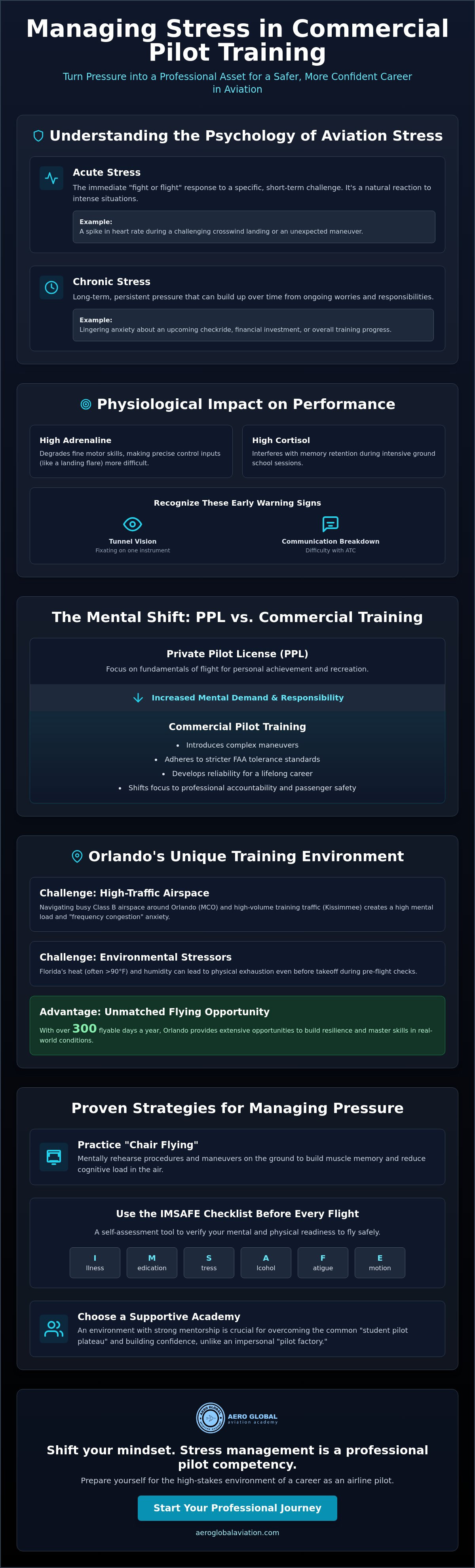
Aviation stress isn't just a case of "the jitters." It's your body's specific reaction to the intense cognitive load required to operate an aircraft. When you're managing stress during commercial pilot training Orlando, you're learning to process massive amounts of data in real-time while maintaining spatial awareness. It's helpful to distinguish between acute stress, like the spike in heart rate you feel during a challenging crosswind landing, and chronic stress, such as the lingering anxiety leading up to a major checkride. Both are natural, but they require different management techniques to ensure they don't compromise your safety or performance.
During your time in the Career Pilot Program, you'll likely hit what instructors call the "Student Pilot Plateau." This is a normal psychological phase where your progress seems to stall despite your best efforts. It doesn't mean you've stopped learning; it means your brain is busy consolidating new skills into long-term memory. Similarly, many students face "imposter syndrome" before their first solo flight. You might feel like you aren't ready to command the aircraft alone, but this is why we emphasize professional mentorship. Trust the training process and your instructor's expert judgment of your readiness.
The Physiological Impact on Pilot Performance
The psychology of stress in aviation shows that the "fight or flight" response can actually hinder your performance if left unchecked. High levels of adrenaline can degrade fine motor skills, making those precise control inputs more difficult during a landing flare. Additionally, an overproduction of cortisol during intensive ground school sessions can interfere with memory retention. You might notice early warning signs like "tunnel vision," where you focus on one instrument while ignoring others, or a breakdown in clear communication with Air Traffic Control. Recognizing these physical cues is the first step toward regaining control.
Why Commercial Training Is More Taxing Than PPL
Moving from the Wings Foundation to professional certifications represents a significant step up in mental demand. While your initial training focused on the fundamentals of flight, commercial training introduces complex maneuvers and much stricter FAA tolerance standards. The mental shift is profound. You're no longer flying for recreation; you're developing the reliability and decision-making skills required for a lifelong career. This added responsibility is a major factor when managing stress during commercial pilot training Orlando, as the stakes transition from personal achievement to professional accountability and passenger safety.
Unique Stressors for Student Pilots in Orlando and Kissimmee
Training in Central Florida offers a distinct set of advantages, like the ability to fly nearly year-round, but it also introduces specific environmental pressures. When you are managing stress during commercial pilot training Orlando, you aren't just dealing with the aircraft; you're navigating one of the most complex aviation ecosystems in the United States. Between the heavy commercial traffic at Orlando International (MCO) and the high volume of training flights at Kissimmee Gateway Airport, the cognitive load can feel significantly higher than in quieter regions. Understanding these local stressors is the first step toward mastering them.
Navigating High-Traffic Florida Airspace
The busy Class B airspace surrounding Orlando requires precise communication and constant vigilance. You'll often find yourself coordinating with Air Traffic Control (ATC) while simultaneously tracking other student pilots and large commercial jets. This creates a high mental load that can lead to "frequency congestion" anxiety. To stay ahead of the airplane, professional mentors recommend studying local transition zones on the ground until they become second nature. Maintaining situational awareness in such a multi-airport environment is a skill that will serve you well throughout your career, but it requires a deliberate approach to prevent overwhelm during those first few solo cross-country flights.
Environmental Stressors: Heat and Humidity
Central Florida’s climate is a physical factor that many newcomers underestimate. Pre-flighting an aircraft on a tarmac where temperatures regularly exceed 90 degrees can lead to rapid heat exhaustion before you even start the engine. This physical strain often manifests as irritability, slower reaction times, and increased cockpit fatigue. To maintain cognitive clarity, you must prioritize hydration and consider scheduling your primary flight blocks during the "golden hours" of early morning. These times offer cooler temperatures and less thermal turbulence, providing a more stable environment for learning complex maneuvers. At Aero Global Aviation Academy, we encourage students to treat their physical well-being as a pre-flight checklist item.
Beyond the heat, the rapid onset of afternoon convective weather is a hallmark of the Florida experience. Florida's thunderstorms are powerful and develop quickly, often requiring pilots to make "go/no-go" decisions with limited time. While this weather can be a source of stress, it's also an incredible classroom for learning risk management. Adhering to FAA pilot mental fitness standards ensures that you are making these critical weather decisions with a clear, focused mind. Managing stress during commercial pilot training Orlando means respecting these environmental limits and learning to use the local climate as a tool for building professional resilience rather than letting it become a hurdle to your progress.
Practical Strategies for Managing Training Pressure
Effective strategies for managing stress during commercial pilot training Orlando often start long before you reach the runway. One of the most high-impact tools is "chair flying." By sitting in a quiet room and mentally rehearsing every move of a flight, you build muscle memory and confidence without the cost or pressure of being in the air. This mental rehearsal bridges the gap between theory and practice. It makes the actual flight feel like a second nature repetition rather than a stressful first attempt.
Another vital tool is the IMSAFE checklist. Professional pilots use this before every flight to assess Illness, Medication, Stress, Alcohol, Fatigue, and Emotion. For students, being honest about the "S" and "E" components is critical. If you're feeling overwhelmed by ground school, creating structured study blocks can prevent burnout. When you're managing stress during commercial pilot training Orlando, breaking your tasks into manageable pieces keeps the path to commercial pilot training certification feeling like a steady climb rather than an insurmountable wall.
Your physical health acts as the foundation for your mental resilience. Recent research on student pilot stress suggests that physiological factors like sleep deprivation and poor nutrition significantly lower your "stress threshold." Maintaining a consistent sleep schedule and a basic fitness routine helps your brain process the high cognitive load of flight school. It's much easier to handle a sudden weather change or a complex ATC instruction when your body isn't already fighting fatigue.
For students who are also managing the arrival of a new baby, finding ways to mitigate this sleep deprivation is a top priority. Utilizing advanced support like the electric cradle from Numora can be a vital part of a student pilot's strategy to protect their mental well-being and ensure they arrive at the flight school refreshed and ready to learn.
Cockpit Resource Management (CRM) for Students
CRM isn't just for multi-crew flight decks; it's a vital skill for students too. View your instructor as a valuable resource and a partner in your success rather than a source of pressure. Effective communication, such as "read-backs" and "call-outs", reduces your mental workload during critical flight phases. Following Standard Operating Procedures (SOPs) also helps minimize decision fatigue. When you have a set routine for every scenario, you free up mental bandwidth to handle unexpected challenges.
Mental Preparation for Checkrides
Checkride anxiety is one of the biggest hurdles in flight training. To combat this, simulate the "Oral" portion of the exam with your peers. Discussing regulations and systems with other students helps normalize the process and highlights areas where you need more study. Visualization is another powerful technique used by airline captains. Spend time imagining yourself successfully completing each maneuver. By reframing the checkride as a "demonstration of skill" rather than a "test of worth", you can approach the day with a sense of professional pride.
Why Your Choice of Flight School Impacts Your Mental Health
The environment where you train is just as important as the aircraft you fly. Many large institutions operate as "pilot factories," focusing on high student volume rather than individual progress. This impersonal approach often leads to increased anxiety and a feeling of being left behind when concepts don't click immediately. When you prioritize managing stress during commercial pilot training Orlando, choosing a supportive academy makes a world of difference. A school that treats you as a future colleague rather than a number creates a foundation of confidence that carries you through the most demanding phases of your education.
Structured mentoring is a cornerstone of a healthy training environment. For instance, the Airline Pilot Elite program is specifically designed to reduce student anxiety through a clear, step-by-step professional progression. This structure eliminates the "what comes next" fear that often plagues independent students. Additionally, access to modern flight simulators allows you to practice emergency procedures and high-stress scenarios in a safe, controlled setting. Mastering these skills on the ground ensures that you feel prepared, not panicked, when you encounter them in the busy Florida skies.
The Role of the Flight Instructor (CFI)
Your relationship with your Certified Flight Instructor (CFI) is the most influential factor in your daily mental well-being. A "Practical Mentor" approach means your instructor is deeply invested in your individual success. They don't just teach maneuvers; they help you navigate the psychological hurdles of professional flight training. It's vital to find an instructor whose teaching style matches your learning pace. Honest and constructive debriefing sessions are also essential. These meetings should focus on specific, actionable improvements rather than general criticism, turning every flight into a positive building block for your career.
Community and Peer Support Systems
You don't have to carry the mental weight of flight school alone. Building a study group with your peers allows you to share the emotional load and celebrate common milestones. Senior students in the Career Pilot Program are an invaluable resource, offering perspective on challenges they've already conquered. This "campus" feel within a professional aviation academy provides a psychological safety net. It reminds you that the "student pilot plateau" is a shared experience, not a personal failure. If you're ready to train in an environment that puts your success first, explore our student-centric flight programs today.
Stress Management as a Professional Pilot Competency
Stress management is more than a survival tactic; it's a professional competency that airlines value as much as your ability to fly a precise instrument approach. When you're managing stress during commercial pilot training Orlando, you are essentially training your brain to remain analytical when your body wants to react emotionally. This resilience is what allows a captain to lead a crew through a technical malfunction or a complex weather diversion. By developing healthy coping mechanisms now, you're making a long-term investment in your career longevity and personal well-being. Transitioning from "surviving" flight school to "thriving" in your career happens the moment you view pressure as a tool for sharpening your focus.
Airlines and the Resilient Pilot
During airline interviews, recruiters use specific behavioral questions to evaluate your emotional intelligence. They want to hear about a time you faced a high-workload environment and how you prioritized tasks to maintain safety. They look for pilots who can admit to feeling stress but demonstrate a methodical way of managing it. The airline pilot career path rewards those who master cockpit composure by offering a clear trajectory toward the captain's seat in major air carriers. Maintaining your mental health isn't just a personal choice; it's a requirement for a long and successful career in the flight deck.
Your Future in the Flight Deck
It helps to visualize the destination when the training gets tough. The hours you spend in the Kissimmee practice area today are the foundation for the transcontinental flights you'll command tomorrow. Managing stress during commercial pilot training Orlando prepares you for the transition to advanced glass cockpits and sophisticated airline systems. Each checkride you pass and every solo flight you complete builds a layer of professional confidence that no classroom can replicate.
Embrace the challenge as a fundamental part of your professional journey. The path to the flight deck is designed to be rigorous because the responsibility is great. You have the tools, the local environment, and the mentorship needed to succeed. Take a deep breath, follow your checklists, and remember that every expert captain started exactly where you are today. Your future in aviation is bright, and the resilience you build right now is what will carry you to the finish line.
Master Your Mindset and Reach the Flight Deck
Mastering the cockpit starts with mastering your mind. By understanding the psychology of aviation pressure and utilizing local assets like our Kissimmee Gateway Airport location, you can turn anxiety into a professional strength. Whether you're navigating busy airspace or preparing for a checkride, remember that managing stress during commercial pilot training Orlando is a skill that distinguishes great pilots from good ones. You've discovered how mental rehearsal, peer support, and the right academy environment turn training hurdles into stepping stones toward your career goals.
We provide the specific tools you need to excel. Our modern G1000-equipped fleet reduces cognitive workload, while our "Practical Mentor" instruction style ensures you never fly the training journey alone. It's time to transform your aspirations into a tangible career destination. Take the first step toward your professional pilot career; Book a Discovery Flight today! We look forward to helping you soar with confidence and helping you transition from a student to a professional aviator.
Frequently Asked Questions
Is it normal to feel like I'm failing during my commercial pilot training?
Yes, it's a completely normal part of the learning process known as the "student pilot plateau." This phase occurs when your brain is busy consolidating complex new skills into long-term memory. It doesn't mean you've stopped progressing; it means you're preparing for a breakthrough. Even the most experienced airline captains once felt this same frustration during their own professional training journey.
How can I tell the difference between normal training stress and burnout?
Normal stress is typically situational and fades after a flight, while burnout is a persistent feeling of exhaustion and loss of interest. If you find that resting doesn't restore your motivation or if you feel irritable and detached from your goals for several weeks, you may be facing burnout. Identifying this early allows you to adjust your schedule before it impacts your safety or progress.
Does the busy Orlando airspace make pilot training more stressful?
While the high volume of traffic in Central Florida increases the initial mental workload, it ultimately makes you a more competent pilot. Navigating Class B airspace and coordinating with busy ATC early on builds superior situational awareness. By managing stress during commercial pilot training Orlando, you're gaining high-level experience that pilots in quieter regions may not develop until much later in their careers.
What should I do if I have a panic attack or high anxiety before a flight?
If you experience high anxiety, the most professional action is to utilize the IMSAFE checklist and "no-go" the flight. Pushing through severe anxiety can lead to dangerous errors in the cockpit. Speak with your instructor immediately; they're trained to help you navigate these psychological hurdles. Taking a day to reset is a sign of good aeronautical decision-making, not a sign of weakness.
Can I fail a checkride because of stress or nerves?
Yes, extreme stress can lead to "checkride-itis," which may cause a student to forget procedures or miss critical details. The Designated Pilot Examiner expects some nerves, but you must remain functional. This is why we emphasize mental rehearsal and visualization techniques during our courses. Building confidence through mock checkrides helps ensure your skills remain sharp even when the pressure is on.
How do professional pilots manage stress during long-haul flights?
Professional pilots rely on Cockpit Resource Management and standard operating procedures to keep stress levels manageable. By following strict routines and delegating tasks, they reduce the cognitive load during critical phases of flight. They also prioritize physical health and rest, ensuring they have the mental stamina required for long shifts. This disciplined approach ensures that they remain focused and ready for any situation.
Does Aero Global Aviation Academy offer support for struggling students?
Yes, we provide a "Practical Mentor" approach that prioritizes individualized attention for every student. Our instructors are deeply invested in your success and offer structured debriefing sessions to help you overcome specific challenges. Whether you're in the Career Pilot Program or the Airline Pilot Elite course, we foster a supportive community environment where you can learn from peers and senior students alike.
Will my stress levels go down once I get my Commercial Pilot License?
The nature of the stress will change from "learning to fly" to "professional responsibility." While you'll feel more confident in your skills, the stakes are higher when flying passengers or cargo. However, managing stress during commercial pilot training Orlando gives you the resilience needed to handle these new responsibilities with ease. You'll move from simply surviving the training to truly thriving in a rewarding career.


