Did you know that major airlines are forecasted to hire 7,672 pilots in 2026 alone? It is a staggering number that represents a massive opportunity for anyone looking to enter the cockpit, yet the path to getting there often feels like a maze of high costs and complex FAA regulations. You likely feel the weight of choosing the right school, fearing that a wrong turn could stall your career before it even begins. When you seek out professional pilot training Orlando offers a unique advantage with its year-round flyable weather and dense network of industry connections. We understand that you aren't just looking for a license; you're looking for a future where your investment leads directly to a captain's seat.
This guide provides the clarity you need to move from your first discovery flight to a professional flight deck with confidence. We'll show you how to navigate the transition from a student pilot to a certified aviator using a structured, step-by-step timeline. You will discover the specific milestones for airline employment, the importance of securing a First-Class Medical Certificate early, and how personalized mentorship makes all the difference. By the end of this roadmap, you'll have a clear understanding of how to leverage Florida's local environmental conditions to reach your career goals faster and more efficiently than you thought possible.
Key Takeaways
- Understand why Orlando's year-round flyable weather and infrastructure make it the premier global hub for starting your aviation career in 2026.
- Explore how professional pilot training Orlando programs provide a direct, structured path from your first flight to commercial certification.
- Learn about the "Kissimmee Advantage" at KISM, where reduced wait times and tarmac efficiency allow you to maximize your actual training hours.
- Get a clear 5-step checklist for navigating FAA requirements and finding the right financing to launch your career without delay.
- Discover how the Practical Mentor approach turns complex ratings into tangible career milestones for aspiring airline pilots.
Why Choose Professional Pilot Training in Orlando in 2026?
Professional pilot training is more than just learning to handle an aircraft; it is a dedicated, structured journey toward earning your wings as a commercial aviator. In Florida, this means following a path that aligns with the FAA pilot certification process to ensure you meet every safety and technical standard required by the airlines. Orlando has solidified its reputation as the world's premier hub for flight education. Choosing professional pilot training Orlando provides you with a distinct competitive edge. You aren't just training in a classroom; you're training in the heart of the industry. With over 300 days of flyable weather each year, your progress won't be stalled by the long, grey winters found in northern states. This consistency allows you to build hours and master maneuvers on a timeline that gets you into the workforce faster.
The 2026 Aviation Industry Outlook
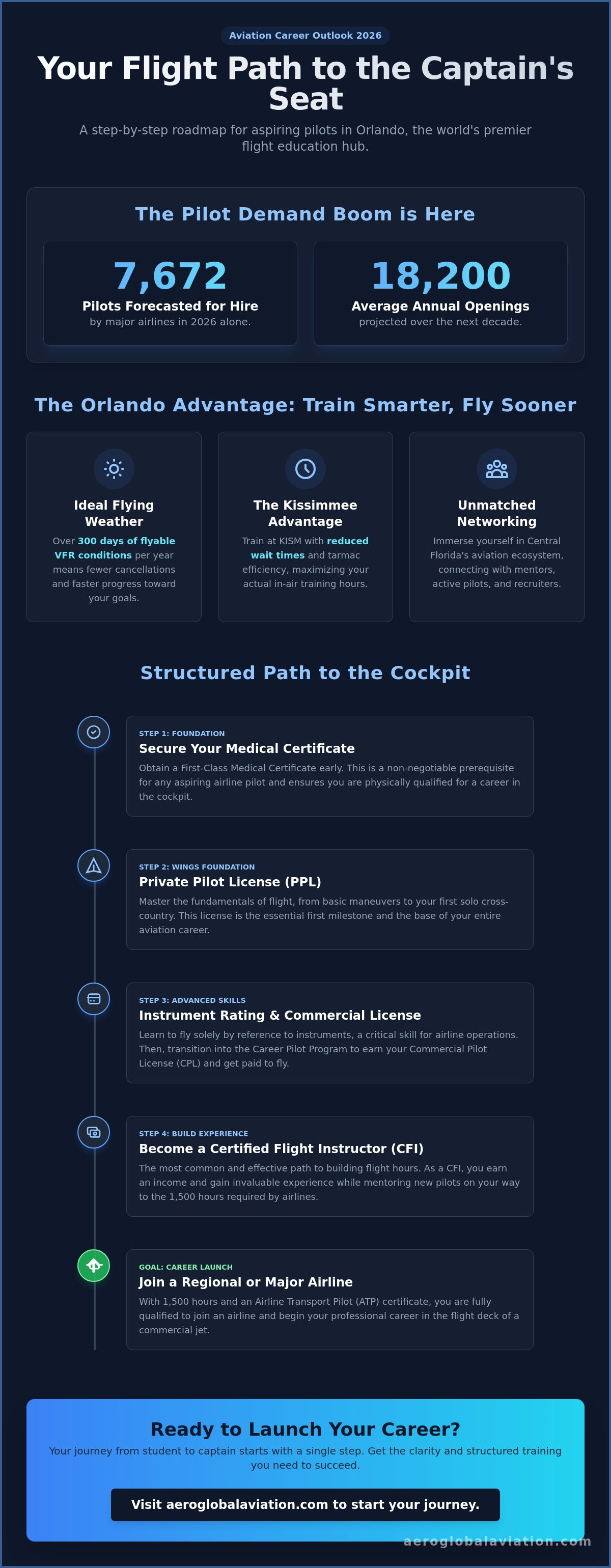
The demand for pilots has reached a critical point. Major airlines are forecasted to hire 7,672 pilots in 2026, and the industry expects an average of 18,200 openings annually over the next decade. This isn't just a trend; it's a massive shift caused by a wave of mandatory retirements. Professional academies bridge the gap between being a student and becoming a regional first officer by providing high-density training environments. Starting your journey here puts you in the direct line of sight for recruiters who value the rigorous standards maintained in Central Florida. By choosing professional pilot training Orlando, you're positioning yourself in a market that prioritizes growth and professional excellence.
Orlando vs. Other Training Hubs
While other regions struggle with unpredictable weather, Orlando offers year-round VFR (Visual Flight Rules) conditions. This means fewer canceled lessons and a more predictable graduation date. You'll gain experience in diverse airspace, ranging from quiet practice areas to the busy corridors near international hubs like Orlando International (MCO). The networking benefits are equally significant. Being part of the Central Florida aviation community means you're constantly surrounded by mentors, active airline pilots, and instructors who are deeply invested in your success. It's a supportive ecosystem designed to help you transition from the ground to the flight deck with confidence. Proximity to major airline hubs also provides students with real-world exposure to the pace and professionalism required in the commercial sector.
Structured Paths to the Cockpit: Our Professional Programs
Transitioning from a student pilot to a professional aviator requires more than just passion; it demands a logical, step-by-step framework. While some schools treat flight ratings as a disconnected checklist, we view professional pilot training Orlando as an integrated solution. This syllabus-driven approach ensures that every hour you spend in the air builds toward airline readiness. By training with modern technology, such as glass cockpits and G1000 systems, you develop the technical proficiency required to master the advanced avionics found in modern commercial jets. This early exposure to high-tech systems lowers the learning curve when you eventually transition to regional or major carriers.
Wings Foundation: Building the Private Pilot Base
Every long-term aviation career starts with a solid foundation. Our Wings Foundation program focuses entirely on the Private Pilot License (PPL), which is the essential first milestone for any flyer. During this phase, you'll master basic maneuvers, ground school essentials, and safe navigation. You'll experience the thrill of your first solo flight before progressing to cross-country proficiency. This stage is about building confidence and a deep understanding of FAA regulations, ensuring you have the skills necessary to move toward more advanced professional certifications.
Career Pilot Program: From PPL to Commercial Certification
The Career Pilot Program is designed for students who are ready to turn their hobby into a full-time profession. This track guides you from your initial private pilot license florida through to your Commercial Pilot License (CPL). You'll engage in structured time-building and intensive training to meet the rigorous commercial pilot requirements set by the FAA. This includes mastering complex aircraft operations and commercial standards that airlines expect from their new hires. If you're serious about your future, exploring our training programs is the first step toward securing your place in the 2026 hiring wave.
Airline Pilot Elite: Advanced Instructor Tracks
For those aiming for the highest tiers of aviation, the Airline Pilot Elite track provides a comprehensive path to becoming a Certified Flight Instructor (CFI). Achieving instructor ratings is often considered the gold standard for airline applications because it demonstrates a mastery of flight theory and leadership. As an instructor, you'll refine your own skills while helping new students reach their goals, all while building the high-quality flight hours required for ATP certification. This elite path ensures you're not just a pilot, but a highly qualified professional ready for the most competitive roles in the industry. By choosing professional pilot training Orlando, you're investing in a mentorship-driven environment that prioritizes your individual success from day one.
The Kissimmee Advantage: Efficient Training Environments
Choosing the right base for your flight education is a strategic decision that affects your progress and your pocketbook. While some students think training at a massive international airport is the only way to gain experience, seasoned aviators know that Kissimmee Gateway Airport (KISM) is the real strategic choice. It offers what we call "tarmac efficiency." Instead of idling on a taxiway behind a string of heavy commercial jets, you'll find yourself cleared for takeoff quickly. This keeps your engine time focused on learning rather than waiting. You get the professional experience of working with a control tower in Class D airspace while remaining just a short flight away from the complex Class B corridors of Orlando International. It's the perfect training ground for professional pilot training Orlando because it builds your radio skills without sacrificing your valuable flight time.
Optimizing Your Flight Hours
Lower airport congestion directly translates to more landings per hour. During your commercial pilot training, repetitions are the key to mastery. If you can perform six landings in an hour at KISM versus three at a busier hub, you're essentially doubling your learning speed for the same investment. This efficiency has a massive impact on your total training cost. We often call Kissimmee the "hidden gem" of Florida aviation because it provides the infrastructure of a large airport with the agility of a local field. You aren't just a number in a long line; you're a student pilot with a mission to complete, and our environment supports that focus.
Living and Training in Central Florida
Moving to Central Florida for your education is a big step, but the local community makes it feel like home. Orlando offers an abundance of student-friendly amenities and housing options within a short drive of the airport. Whether you're settling in Central Florida or looking at properties further south, maintaining a reliable cooling system is a priority for any resident; if you find yourself near the coast, specialized AC repair Cape Coral FL can help you stay comfortable while you focus on your career. The atmosphere at Kissimmee Gateway is supportive and collaborative, filled with people who share your passion for the sky. You'll find that our proximity to the Aero Global Aviation Academy facilities allows for a seamless transition between ground school and the cockpit. Navigating over local landmarks like the famous theme parks or using the Florida coastline as a reference point builds superior navigation skills. As you look toward a bright pilot career outlook, you'll realize that training in such a dynamic environment has prepared you for any challenge the airlines might throw your way. Choosing professional pilot training Orlando means choosing a location that works as hard as you do to reach the finish line.
Navigating the Challenges: Financing and Requirements
Deciding to pursue a career in the cockpit is a life-changing choice, but it often comes with questions about the financial and time commitment. We recognize that the cost of flight school is the primary concern for most aspiring aviators. However, when you look at professional pilot training Orlando as the gateway to a high-demand industry, the perspective shifts from an expense to a long-term investment. To help you get started without the overwhelm, follow this 5-step checklist:
- Secure your FAA First-Class Medical Certificate: Ensure you're medically qualified for an airline career before spending a dime on training.
- Research your training environment: Compare school structures and their proximity to efficient airports like KISM.
- Schedule a discovery flight: Get hands-on experience in the cockpit to confirm your passion.
- Finalize your financing plan: Explore loan options or block-rate savings.
- Apply for your student pilot certificate: Complete the paperwork to officially begin your journey.
One of the most critical steps is the medical exam. For those under the age of 40, a First-Class Medical Certificate is valid for 12 months. If you're 40 or older, it's valid for 6 months. Obtaining this early is a smart move. It confirms you meet the physical standards required for commercial operations. You'll also need to decide between Part 61 and Part 141 training structures. Part 141 schools use a highly structured, FAA-approved curriculum, while Part 61 offers more flexibility for those balancing other responsibilities. Both paths lead to the same professional certifications, but the right choice depends on your personal learning style and schedule.
Evaluating Flight Training Costs and ROI
It's natural to focus on hourly rates, but the true value lies in the return on investment. The median annual wage for airline pilots was $226,600 as of May 2024. When you consider that major airlines plan to hire thousands of new pilots this year, the potential for a lucrative career is immense. When looking for the best flight schools in florida, evaluate them based on their graduation success and industry connections. A school that gets you through your ratings efficiently saves you money in the long run by getting you into a paying seat sooner.
Financing Your Aviation Dreams
Financing your professional pilot training Orlando can take several forms. Many students prefer pay-as-you-go structures to manage cash flow, while others opt for block-rate financing to secure a discount by paying for chunks of time in advance. Specialized flight training loans are also available. For instance, as of June 2026, the AOPA offers loans with rates starting around 11.74%. Other lenders like Pilot Finance provide options with rates ranging from 12% to 18%. Managing your costs during the hour-building phase is easier when you have a clear financial roadmap from the start. If you're ready to take the next step, contact us today to discuss how we can help you navigate your training requirements and funding options.
Why Aero Global Aviation Academy is Your Career Partner
Choosing the right environment for your professional pilot training Orlando is about finding a partner that values your individual career as much as you do. At Aero Global Aviation Academy, we don't just see ourselves as a flight school; we are your practical mentors. Our philosophy centers on a collaborative spirit where your success is the only metric that matters. We believe that becoming a professional aviator is a transformative journey that requires more than just a flight instructor. It requires a dedicated guide who understands the high stakes of technical training and the aspirational excitement of your future career. Our career pilot program is intentionally designed to prepare you for the realities of the flight deck, including the rigorous standards expected during airline interviews.
Our Professional Training Fleet
The quality of your training is directly linked to the quality of the aircraft you fly. Our fleet consists of well-maintained, modern aircraft equipped with the technology you'll encounter in the professional world. Training on these systems ensures that your transition to advanced flight training is a natural progression rather than a steep learning curve. We maintain safety protocols that exceed standard FAA requirements, prioritizing a culture of reliability and technical excellence. This focus on high-standard maintenance doesn't just keep you safe; it teaches you the professional standards of equipment care that airlines demand from their flight crews. When you train with us, you're learning to operate within a system that mirrors the professionalism of major carriers.
Join the Aero Global Family
We pride ourselves on maintaining smaller class sizes to ensure you receive personalized instructor attention. You aren't just a number in a large, impersonal corporation; you're a member of the Aero Global family. This intimate approach allows us to tailor our mentorship to your specific learning style and professional goals. Success stories of our graduates, many of whom are now flying for major and regional airlines, serve as a testament to this student-centric model. They started where you are now, navigating the same 2026 career roadmap with the help of a dedicated local partner. We invite you to experience this difference firsthand and take the first definitive step toward your professional future. It's time to turn your passion for the sky into a rewarding, lifelong career.
Schedule a Discovery Flight at our Kissimmee Training Center
Take Command of Your Aviation Future in 2026
You've explored the roadmap from student pilot to professional aviator; the path ahead is clearer than ever. By choosing professional pilot training Orlando students leverage the strategic advantage of high-efficiency training at Kissimmee Gateway Airport. This isn't just about learning to fly. It's about following FAA-compliant career tracks that prepare you for the rigorous standards of the airline industry. Every hour spent in our modern fleet brings you closer to the captain's seat, supported by the year-round flyable weather that only Central Florida provides.
Aero Global Aviation Academy stands ready to be your practical mentor. We offer personalized mentorship from veteran instructors who are deeply invested in your individual success. We understand the challenges of financing and certification; we're here to help you navigate them with confidence. Your transition to a professional career is a structured, attainable goal when you have the right partner by your side. Don't let your ambitions stay grounded. The demand for skilled pilots is high, and your journey toward the flight deck begins with a single, decisive step.
Start Your Journey with Aero Global Aviation Academy
Frequently Asked Questions
How long does it take to complete professional pilot training in Orlando?
It typically takes between 10 and 14 months to complete a full professional pilot training Orlando program if you train on a full-time basis. This timeline covers your journey from a student pilot to a certified commercial aviator. Because Central Florida offers over 300 days of flyable weather each year, you'll experience fewer weather-related cancellations, which helps you maintain a steady training rhythm and finish your ratings on schedule.
What are the FAA requirements to become a commercial pilot in 2026?
To earn your commercial pilot license in 2026, you must be at least 18 years old and be able to read, speak, and understand English fluently. You're also required to hold at least a second-class FAA medical certificate and log a specific amount of aeronautical experience. This usually includes at least 250 hours of flight time for those training under Part 61 regulations, covering specific cross-country and night flight requirements.
Do I need a college degree to fly for a major airline?
You don't legally need a college degree to earn your commercial certificates or to fly for regional airlines. While many major airlines have historically preferred a four-year degree, the current high demand for pilots has led many carriers to prioritize flight experience and professional proficiency over a diploma. Focusing on a high-quality flight training program is the most direct way to enter the 2026 hiring market.
What is the difference between the Wings Foundation and the Career Pilot Program?
The Wings Foundation is a focused course designed specifically for students looking to earn their Private Pilot License (PPL) for personal use. The Career Pilot Program is a much more comprehensive, integrated track that takes you from zero experience all the way through to your Commercial Pilot License (CPL). If your goal is to fly for the airlines or work as a professional pilot, the Career Pilot Program is the appropriate choice.
Can I start my pilot training with zero previous flight experience?
Yes, you can absolutely start your professional pilot training Orlando journey with no previous flight time. Most of our students begin with a discovery flight and move through a structured curriculum that builds their skills from the ground up. We provide the mentorship and resources you need to transition from a beginner to a confident, professional aviator through a logical and supportive training process.
What is an FAA First Class Medical certificate and why do I need it?
An FAA First-Class Medical certificate is the highest level of medical clearance and is required for anyone who wants to fly as an airline captain. It ensures you meet the physical and neurological standards necessary for commercial flight safety. For pilots under the age of 40, the certificate is valid for 12 months, while those 40 and over must renew it every 6 months to maintain their flying privileges.
How does Orlando weather affect my flight training schedule?
Orlando's weather acts as a major advantage, providing a consistent environment that allows for nearly year-round training. While students in other regions might be grounded for weeks during the winter, you'll benefit from the high number of flyable days in Florida. This predictable climate means you can fly more often, build your required hours faster, and complete your professional certification much more efficiently.
What kind of aircraft will I fly during my professional training at Aero Global?
During your training, you'll operate modern, well-maintained aircraft that are equipped with advanced technology like G1000 glass cockpits. We believe in training you on the same types of avionics systems you'll find in modern commercial cockpits. This ensures that your transition to more complex aircraft is seamless and that you develop the technical proficiency required for a successful career with the airlines.


