
Major airlines are forecasted to hire approximately 7,672 pilots in 2026, yet the path to the cockpit often feels like a maze of complex regulations. You've likely felt the weight of the 1,500-hour rule or wondered if a four-year degree is still your only ticket to a regional seat. It's completely normal to feel some stress regarding the time and cost of meeting the latest regional airline pilot requirements, especially as the industry evolves into a more competitive landscape.
We're here to act as your practical mentor, turning those daunting milestones into a clear, achievable flight plan. This article provides a comprehensive breakdown of the FAA certifications and professional skills you'll need to be "jet-ready" for a career that now offers first-year compensation as high as $110,000. You'll gain a clear understanding of the fastest ways to build hours, the nuances of the Restricted ATP, and which advanced ratings will make you the most attractive candidate to recruiters looking for future captains.
Key Takeaways
- Identify the mandatory FAA certifications, starting with your Private Pilot License and Instrument Rating, that form the foundation of every professional flying career.
- Navigate the current regional airline pilot requirements by understanding how Restricted ATP options can potentially shave hundreds of hours off your journey to the flight deck.
- Learn why mastering glass cockpit technology and Crew Resource Management (CRM) is essential for transitioning from a single-pilot mindset to a professional airline environment.
- Get the definitive answer on the 2026 "degree vs. no degree" debate to prioritize your time and investment where it matters most to recruiters.
- Discover how a structured training path like the Airline Pilot Elite program prepares you for the high-stakes world of regional aviation through advanced instructor certifications.
The FAA Certification Baseline: Mandatory Pilot Certificates
Your journey to the flight deck begins with a structured series of milestones. These aren't just hurdles to jump; they are the building blocks of your professional identity. Understanding the FAA pilot certification levels is the first step in mapping out your career. Each rating you earn adds a layer of safety and technical proficiency that regional recruiters look for during the hiring process. To meet modern regional airline pilot requirements, you must progress through these certifications with precision and a commitment to excellence.
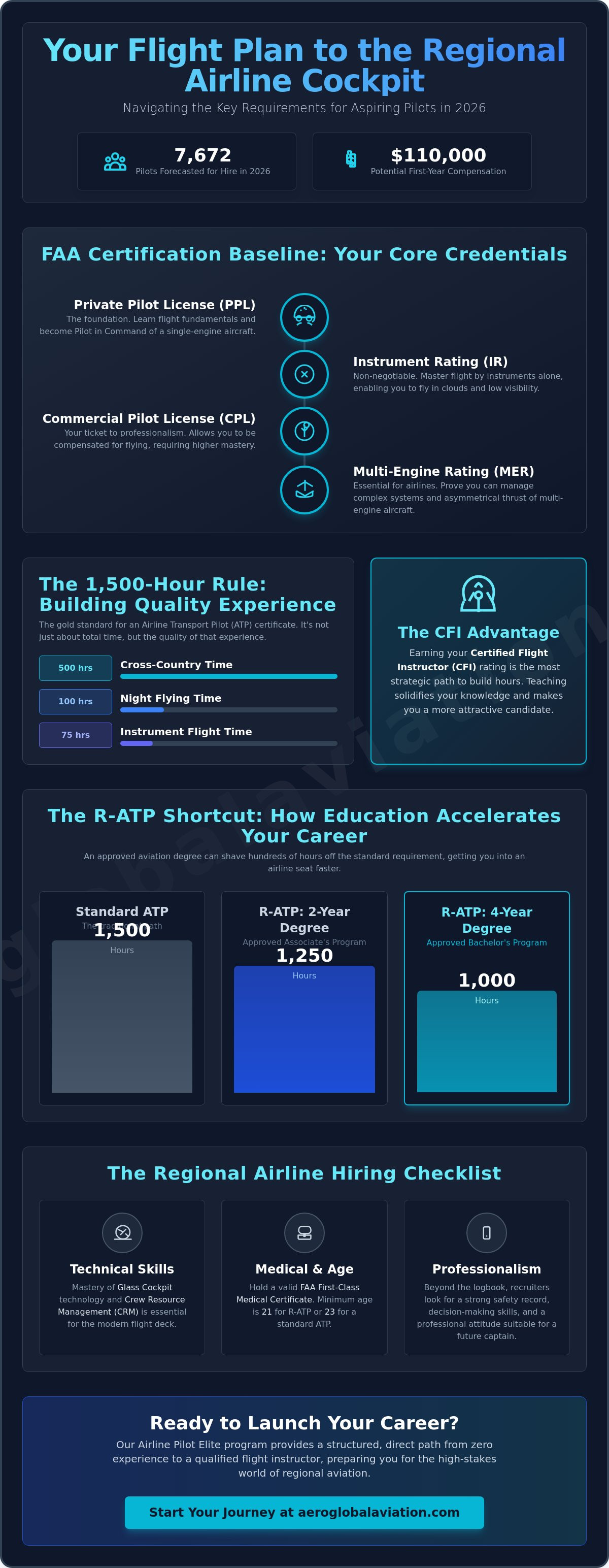
- Private Pilot License (PPL): This is your entry point. You'll learn the fundamentals of flight, navigation, and communication. It transforms you from an observer into a pilot in command of a single-engine aircraft.
- Instrument Rating (IR): This is non-negotiable for airline operations. It grants you the ability to fly solely by reference to instruments, allowing you to navigate through clouds and low-visibility conditions. It's the rating that truly professionalizes your skill set.
- Commercial Pilot License (CPL): This certification marks your transition from a student to a professional. It allows you to be compensated for your flying and requires a higher level of mastery over aircraft systems and maneuvers.
- Multi-Engine Rating (MER): Regional airlines operate aircraft with at least two engines. Having this rating is critical because it proves you can manage the complexities of asymmetrical thrust and advanced system failures.
The Role of the Certified Flight Instructor (CFI) Rating
Earning your CFI rating is often the most strategic move you can make. It's the most common path for building the professional flight time required for airline entry. Teaching others forces you to master technical knowledge at a level that flying alone never could. You'll find that explaining aerodynamic principles to a student solidifies your own understanding. At Aero Global, our Airline Pilot Elite Program is designed to take you all the way to advanced instructor certifications, ensuring you're ready to lead others while you build your own logbook.
Medical and Age Requirements for 2026
Safety is the industry's highest priority. To fly for a regional airline, you must hold an FAA First-Class Medical Certificate. This exam ensures you meet the vision, hearing, and cardiovascular standards necessary for high-stakes operations. Regarding age, the FAA requires pilots to be at least 23 years old for a standard ATP, though Restricted ATP options allow for entry at 21. If you're starting later in life, don't let the "young man's game" myth stop you. You might wonder, is 40 too old to become a pilot? The reality is that many successful airline pilots begin their second careers in their 40s or even 50s, bringing valuable life experience to the cockpit.
The 1,500-Hour Rule: Building Quality Flight Experience
Securing your seat in a regional cockpit requires more than just a license; it requires a deep logbook of diverse experience. The 1,500-hour rule remains the gold standard for those seeking an Airline Transport Pilot (ATP) certificate. To understand the legal foundation, you can review the specific requirements under 14 CFR Part 61 Subpart G. For most civilian pilots, this means documenting 1,500 total flight hours. Within that total, you must also meet specific sub-requirements, such as 500 hours of cross-country time, 100 hours of night flying, and 75 hours of instrument flight time. Meeting these regional airline pilot requirements proves you have the stamina and technical range for professional operations.
The Restricted ATP (R-ATP) is a powerful alternative for students who choose specific educational paths. If you graduate from an approved four-year aviation university, you can qualify with just 1,000 hours. Those with a two-year associate's degree from an approved program may qualify at 1,250 hours. These reductions recognize the high value of structured, academic training environments. Regardless of your total hours, recruiters look closely at your Pilot-in-Command (PIC) time. They want to see that you've been the final authority on the aircraft, as this demonstrates the leadership and decision-making skills needed for airline operations.
Fast-Track Strategies for Hour Building
Building time efficiently is all about consistency and location. Training in Florida offers a massive advantage because the year-round flying weather allows you to fly nearly every day. You'll avoid the seasonal delays that plague northern flight schools. Beyond instructing, you might consider pipeline programs or aerial survey work. These roles provide steady hours while exposing you to diverse airspace and complex weather patterns. It's a strategic way to move through your Career Pilot Program milestones faster. By maintaining a high frequency of flight, you keep your skills sharp and reach your goals months ahead of your peers.
Logging High-Quality Hours
Recruiters don't just count your hours; they audit the quality of your experience. Logging 500 hours as a Certified Flight Instructor (CFI) is often viewed more favorably than 500 hours of solo cross-country flying. When you give dual instruction, you're constantly managing another person's mistakes and explaining complex systems. This experience builds a level of situational awareness that is vital for regional airline pilot requirements. Keep your logbook meticulously organized. In 2026, digital audits are the norm, so ensure every entry clearly distinguishes between night, cross-country, and PIC time to make the hiring process seamless.
Technical Skills and Advanced Training Requirements
Regional airlines aren't just looking for pilots who can keep the blue side up. They're searching for future captains who can manage the high-tempo environment of a modern flight deck. This means your technical skills must be sharp long before you step into a simulator. Mastering the Garmin G1000 and similar advanced avionics suites is a critical component of current regional airline pilot requirements. You need to move beyond basic navigation and learn how to manage data, interpret system health, and maintain situational awareness while moving at jet speeds.
Transitioning from a single-pilot environment to a multi-crew setting is perhaps the biggest hurdle for new commercial pilots. Crew Resource Management (CRM) isn't just a buzzword; it's a survival skill. It involves the effective use of all available resources, including your fellow crew members, to ensure flight safety. Many university aviation programs integrate CRM into their core flight training to prepare students for the rigors of Part 121 operations. When you walk into an interview, recruiters want to see that you've already adopted this professional mindset.
Multi-Engine Mastery for the Flight Deck
Regional airlines typically look for a minimum of 25 to 50 hours of multi-engine experience, but depth of knowledge matters more than the raw number. You must demonstrate total command over engine-out procedures and asymmetrical thrust management in high-performance twins. Investing in advanced flight training allows you to master these complex aircraft operations before you face the pressure of an airline training program. This preparation ensures you're "Jet-Ready," showing recruiters you can handle the high workload of a multi-engine jet during critical phases of flight.
Standard Operating Procedures (SOPs)
The most successful candidates are those who have already traded "flying for fun" for "flying by the book." Professional efficiency relies on your ability to follow Standard Operating Procedures (SOPs) with absolute consistency. High-quality training environments mimic the airline experience by requiring students to use structured flows and checklists. This discipline prepares you for high-altitude endorsements and the precise maneuvers required in controlled airspace. By mastering these SOPs early, you prove that you have the professional temperament required to meet the strictest regional airline pilot requirements.
The Regional Airline Hiring Checklist: Beyond the Logbook
Hitting your flight hour milestones is a massive achievement, but the final approach to a regional seat involves a rigorous screening of your character and professional history. Meeting the technical regional airline pilot requirements is only half the battle. Airlines look for individuals who embody the responsibility of a captain from day one. This means your background, education, and even your digital presence come under the microscope during the hiring process. You aren't just being interviewed for your ability to fly; you're being evaluated as a long-term investment for the company.
In 2026, the "Degree vs. No Degree" debate has reached a practical middle ground. While a four-year degree is no longer a strict prerequisite at many regional carriers to combat the pilot shortage, it remains a powerful competitive advantage. If you choose the path without a degree, your training record and professional references must be impeccable. Beyond education, you'll undergo intensive FAA background checks via the Pilot Records Database (PRD), which replaced many legacy PRIA functions. This database tracks every checkride outcome and training incident. Transparency is your best friend. A single failure won't end your career, but failing to disclose it certainly will. You'll also need to secure TSA and Homeland Security clearances to operate in commercial environments.
Professionalism and Soft Skills
Regional recruiters are searching for "Captain potential" in every First Officer candidate. This requires demonstrating leadership qualities and a collaborative spirit long before you reach the flight deck. In high-stress ATC environments, your ability to communicate clearly and remain calm is vital. Networking within the aviation community is also a significant asset. If you're training in a hub like Orlando, take every opportunity to connect with current airline pilots. These professional relationships often provide the "inside track" on company culture and hiring trends that you won't find in a job posting.
The Pilot's Digital Footprint
Your life outside the cockpit matters to modern airlines. Expect recruiters to audit your social media and professional online presence to ensure you align with their brand values. Maintaining a clean FAA record is equally critical. Repeated checkride failures can signal a lack of "trainability," which is a major red flag for regional airlines. As you prepare your resume, focus on the commercial pilot salary ROI by highlighting your advanced certifications and any leadership roles you've held. Ready to build a professional record that stands out to recruiters? Start your journey with our Career Pilot Program and gain the mentorship you need to succeed.
Launch Your Regional Career with Aero Global Aviation Academy
Meeting the modern regional airline pilot requirements is a significant undertaking that demands a structured and reliable training partner. At Aero Global Aviation Academy, we don't just teach you how to fly. We prepare you for the lifestyle and professional rigors of a Part 121 carrier. Our career pilot program is specifically tailored to align with 2026 airline standards, ensuring every hour you log in our aircraft translates into a skill recruiters value. We've built our curriculum around the Airline Pilot Elite path, which takes you from your first solo to your advanced instructor certifications in a seamless, high-velocity environment.
Personalized mentorship is the heartbeat of our academy. Unlike large, impersonal flight schools that treat students like numbers, we act as your practical mentor. We guide you through the transition from student to instructor, helping you build those critical 1,500 hours while refining your leadership skills. This hands-on approach ensures that you aren't just meeting the minimum regional airline pilot requirements; you're exceeding them with the confidence of a future captain. You'll find that our instructors are deeply invested in your individual success, providing the technical and emotional support needed to reach the flight deck.
The Aero Global Advantage in Orlando
Location is a strategic asset in flight training. Training in Kissimmee, Florida, gives you access to a diverse and challenging airspace that prepares you for real-world airline operations. You'll navigate complex traffic patterns and communicate with professional controllers, building the "radio courage" necessary for major metropolitan hubs. Our fleet is equipped with Garmin G1000 avionics, ensuring you develop glass-cockpit proficiency from your very first flight. This focus on modern technology and multi-engine readiness means you'll be comfortable with the advanced systems found in regional jets. Plus, our local network of regional airline alumni provides a bridge to your first professional job, offering insights and referrals that are often the key to a successful interview.
Take Your First Step Toward the Flight Deck
Your journey begins with a single decision. We invite you to visit our Kissimmee center to experience our professional-grade facilities firsthand. Scheduling a discovery flight is the best way to feel the thrill of the cockpit and see why our training environment is so effective for building hours quickly. Our career advisors are ready to sit down with you to map out a personalized 1,500-hour plan that accounts for your timeline and professional goals. We'll help you understand how to maximize your training efficiency and navigate the latest FAA regulations with ease. Don't let your dream stay on the ground. Start your journey to the airlines with Aero Global today!
Your Flight Path to the Regional Cockpit Starts Now
The landscape for aspiring aviators in 2026 is full of opportunity, provided you approach your training with a strategic mindset. You've learned that meeting regional airline pilot requirements involves more than just logging time. It requires a commitment to technical excellence, from mastering G1000-equipped aircraft to developing the crew resource management skills essential for modern airline operations. By focusing on the quality of your flight hours and maintaining a professional record, you ensure your transition to the regional flight deck is both smooth and successful.
Our instructors in Kissimmee, Orlando, are dedicated to your success, providing a curriculum specifically designed for Part 121 airline readiness. We offer a high-quality training fleet and the personalized mentorship you need to move from student to professional. Your future in the clouds is waiting for you to take the controls. Take the next step toward your professional destination today and join a community of pilots who share your passion for the sky.
Enroll in the Airline Pilot Elite Program and Secure Your Future
We're excited to help you turn your dream of flight into a rewarding career. The journey to the cockpit is a structured process, and we're here to guide you every step of the way. Let's get you ready for departure.
Frequently Asked Questions
Do regional airlines require a 4-year college degree in 2026?
Most regional airlines do not strictly require a four-year college degree in 2026. While major carriers still prefer candidates with degrees, regional airlines have shifted their focus toward high-quality flight training and reliable performance records to address the ongoing pilot shortage. Earning a degree can still be beneficial, as it often allows you to qualify for a Restricted ATP with fewer total flight hours.
How many flight hours do I actually need to get hired by a regional?
You typically need 1,500 total flight hours to meet the standard regional airline pilot requirements for an Airline Transport Pilot (ATP) certificate. However, certain pathways allow for lower minimums through a Restricted ATP. Military pilots can qualify with 750 hours, while graduates of approved four-year university aviation programs may qualify with 1,000 hours. Those with an approved two-year associate's degree can often qualify with 1,250 hours.
What is the difference between a regional airline and a major airline?
Regional airlines operate smaller aircraft like regional jets and turboprops on shorter routes that connect smaller cities to major hubs. They often fly under contract for major airlines, such as Delta Connection or United Express. Major airlines operate larger fleets on long-haul domestic and international routes. Most pilots use their time at a regional airline to gain the experience necessary to move into a seat at a major carrier.
Can I get hired by a regional airline with a checkride failure on my record?
Yes, you can certainly get hired with a checkride failure on your record. Airlines look for honesty and a commitment to professional growth rather than a perfect history. You should be prepared to discuss the failure during your interview, explaining what you learned from the experience and how you improved your skills afterward. Recruiters value pilots who demonstrate resilience and a high level of self-awareness.
What is the typical starting salary for a regional airline pilot in 2026?
In 2026, first-year first officers at regional airlines can expect total compensation between $70,000 and $110,000. This includes sign-on bonuses and hourly pay rates that generally range from $90 to $150. This significant increase in pay over the last few years reflects the industry's commitment to attracting well-trained candidates who are ready to meet the rigorous regional airline pilot requirements of a professional flight deck.
How long does the hiring process take once I reach 1,500 hours?
The hiring process usually moves quite quickly once you reach your hour milestones, often taking between four to twelve weeks. After you submit your application and pass the initial screening, you'll be invited for a technical and HR interview. If you receive a conditional job offer, the airline will schedule your background checks and training date, moving you into the cockpit as soon as a class becomes available.
Is multi-engine time more important than total flight time?
Total flight time is necessary to meet regulatory minimums, but multi-engine experience is critical for proving your readiness for jet operations. Regional airlines generally look for at least 25 to 50 hours of multi-engine time. This experience shows recruiters that you can manage the complexities of asymmetrical thrust and advanced systems, making you a much more attractive candidate during the competitive screening process.
What is the Restricted ATP (R-ATP) and do I qualify for it?
The Restricted ATP is a certificate that allows pilots to fly for an airline with fewer than 1,500 hours or at age 21 instead of 23. You qualify if you have a military flying background or if you graduated from an FAA-approved university aviation program. This pathway is a strategic way to start your airline career sooner while maintaining the high safety standards required by the FAA and regional carriers.


