

What if your childhood college fund wasn't just for lecture halls, but could actually pay for your seat in a cockpit? Thanks to the landmark "One Big Beautiful Bill Act" passed on July 4, 2025, using a 529 plan for flight school Florida is now a reality for aspiring aviators in 2026. You've likely spent years worrying that these savings were locked away for traditional four-year degrees, but the updated federal rules have transformed these accounts into a strategic fuel tank for your professional pilot training.
It's natural to feel some hesitation about "non-qualified" withdrawal penalties or the specific differences between Part 141 and Part 61 eligibility. You want to focus on mastering your maneuvers, not worrying about IRS audits. We're here to help you make sense of the financial details. This guide will show you exactly how to unlock your 529 savings to cover professional training costs, including essential gear like iPads and headsets. We'll also explore why Florida's 300 days of annual sunshine make it the most efficient place to turn those savings into a commercial certificate. By the time you finish reading, you'll have a clear flight plan for your finances and your future career.
Key Takeaways
- Understand how the 2026 IRS updates for vocational training allow you to fund professional pilot certification using your existing savings.
- Identify exactly which costs qualify for tax-free withdrawals, including core tuition, flight fees, and required ground school materials.
- Discover the strategic advantages of using a 529 plan for flight school Florida by comparing traditional investment accounts with Florida Prepaid tuition units.
- Learn why selecting an FAA-approved Part 141 school and securing a First-Class Medical Certificate are critical steps for ensuring plan compliance.
- See how structured paths like the Career Pilot Program are designed to align with your financial goals and accelerate your journey to a professional cockpit.
Can You Use a 529 Plan for Flight School in Florida? (2026 Rules)
The short answer is a resounding yes. As of 2026, the path to the flight deck is more accessible than ever for families who have spent years saving. The traditional image of a 529 plan being strictly for university lecture halls is officially a thing of the past. Recent federal shifts have redefined what it means to invest in a career, recognizing that professional pilot training is a high-value vocational pursuit. If you're looking into using a 529 plan for flight school Florida, you're stepping into a landscape where your savings can finally match your professional ambitions.
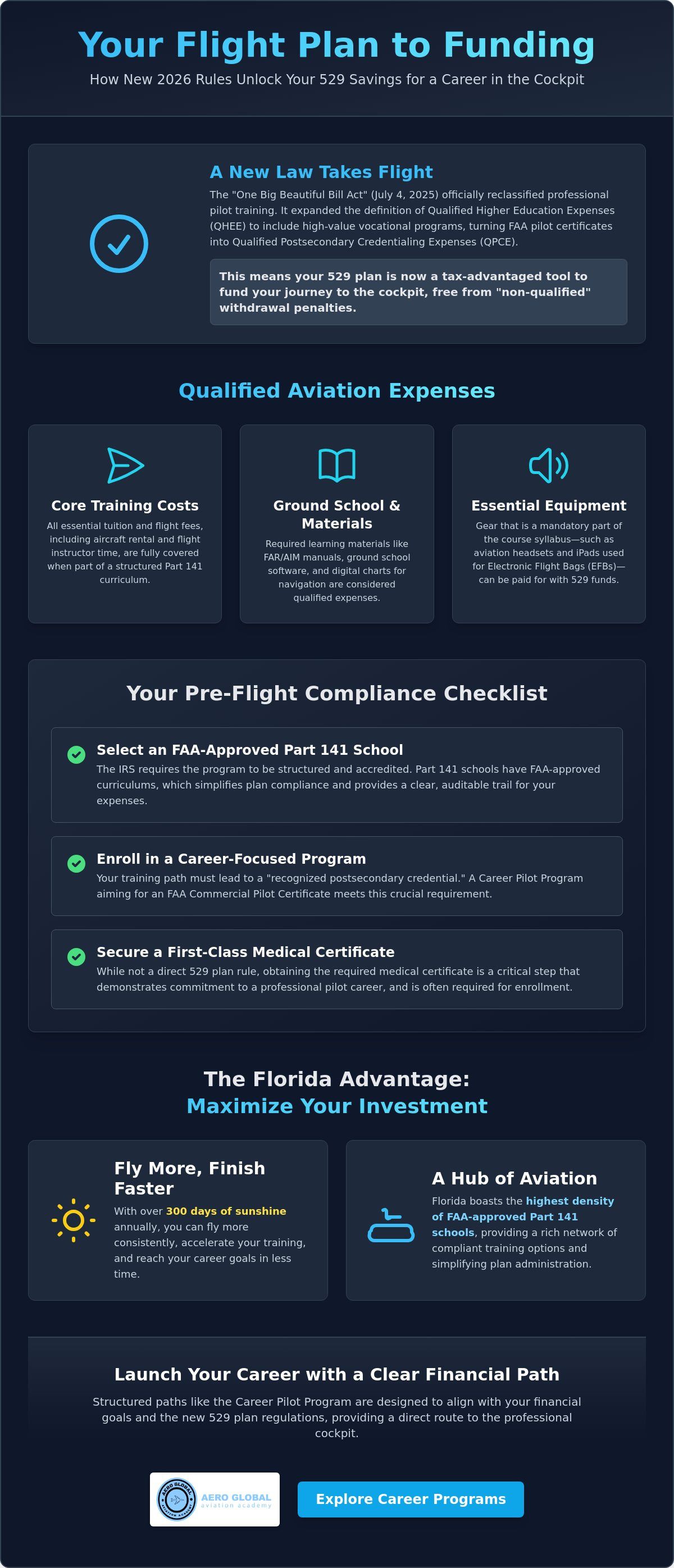
The IRS now recognizes "qualified vocational programs" under a much broader umbrella. Following the passage of the "One Big Beautiful Bill Act" (H.R. 1) on July 4, 2025, the definition of Qualified Higher Education Expenses (QHEE) expanded to include costs associated with programs that teach a specific trade or skill. For you, this means that the rigorous training required to earn your wings is no longer an "alternative" path in the eyes of the tax code; it's a primary educational destination. By treating FAA pilot certificates as Qualified Postsecondary Credentialing Expenses (QPCE), the government has cleared the runway for you to use tax-advantaged funds for tuition, fees, and even certain equipment.
The SECURE Act 2.0 and Professional Certifications
The SECURE Act 2.0 laid the groundwork for this transition by emphasizing the value of recognized postsecondary credentials. It shifted the focus from where you learn to what you achieve. Federal law now explicitly recognizes FAA professional licenses as valid educational outcomes, placing them on the same financial tier as a college degree. This change ensures that your investment in a commercial pilot certificate is protected from the "non-qualified" withdrawal penalties that once worried flight students. A 529 plan now qualifies for aviation training when the program leads to a recognized postsecondary credential, such as an FAA commercial pilot certificate.
Why Florida Residents Have a Strategic Advantage
Living and training in the Sunshine State offers more than just perfect flying weather. Florida's massive aviation infrastructure acts as a built-in validator for 529-eligible programs. Because the state is a global hub for the industry, the density of FAA-approved Part 141 schools is higher here than anywhere else in the nation. This infrastructure makes the process of verifying your school's eligibility much simpler for plan administrators.
When you're choosing a flight school in Florida, you're tapping into a network that understands how to handle these funds. Our regional pride isn't just about the scenery; it's about the efficiency of our training environment. Using a 529 plan for flight school Florida allows you to maximize your savings because you're training in a location where you can fly more hours per month, reaching your career goals faster and more cost-effectively than in northern climates. It's a strategic move that turns your financial plan into a powerful tool for career advancement.
Qualified Aviation Expenses: What Your 529 Plan Actually Covers
Understanding what counts as qualified aviation expenses is the first step toward a stress-free training experience. When you're using a 529 plan for flight school Florida, the core of your spending will go toward commercial pilot training tuition and flight fees. These aren't just extra costs; they are the essential building blocks of your career. In a Part 141 environment, flight hours and instructor fees are typically bundled as part of the curriculum, making them clearly eligible for tax-free withdrawals. This structure provides a transparent trail for the IRS and ensures your funds are working directly toward your certification.
Beyond the cockpit, your plan covers the intellectual tools of the trade. This includes everything from ground school software and FAR/AIM manuals to the digital charts you'll use for cross-country navigation. If a material is listed as a requirement for your course syllabus, it's usually a safe bet for your 529 funds. Keeping organized records of these purchases is vital. You should treat your flight training like any other professional education, where every book and software license is an investment in your future expertise.
Essential Flight Gear as a Qualified Expense
Modern flight decks have evolved, and your financial strategy should too. An iPad equipped with GPS and ForeFlight is no longer a luxury; it's a critical safety tool for navigating Florida's busy airspace. Because these devices are required for digital charts and G1000-integrated flight planning, they fall under the "required materials" rule. Similarly, a high-quality aviation headset is both a safety and communication requirement for every student. While flight bags and checklists might seem minor, documenting them as school-required gear helps justify the expense. Always check your school's required equipment list before making a purchase to ensure it aligns with 529 rules.
Housing and Living Expenses in Orlando/Kissimmee
If you're enrolled at least half-time in a professional program, you can use your savings for room and board. This is a huge advantage for students moving to the Orlando or Kissimmee area to train at Kissimmee Gateway Airport. However, there's a specific limit you must follow to stay compliant. Your 529 room and board funds cannot exceed the school's posted allowance for that year. If you choose off-campus housing, ensure your monthly expenses stay within the "cost of attendance" (COA) figures provided by the institution to avoid tax penalties. Navigating these rules might feel like flying through heavy clouds, but having a clear plan makes all the difference. If you're ready to see how your savings align with a professional path, you can explore our training options to get started.
Navigating Florida Savings: 529 Investment Plans vs. Florida Prepaid
When you evaluate Florida Savings: 529 Investment Plans vs. Florida Prepaid, you're choosing the engine that will power your aviation career. Florida is unique. Because our state has no state income tax, the traditional "state tax deduction" benefit found elsewhere doesn't apply here. Instead, the advantage lies in tax-free growth and flexible spending. Using a 529 plan for flight school Florida allows your investments to compound without the drag of federal taxes, potentially outpacing the rising costs of aircraft fuel and maintenance. This financial efficiency is a massive win for your future flight deck career.
Another strategic tool is the ability to use your 529 funds to pay down debt. Federal law allows a $10,000 lifetime limit per beneficiary to be used for qualified student loan repayments. If you took out a loan to bridge the gap during your commercial training, your 529 can help you clear that balance once you're in the captain's seat. It's a smart move. This flexibility ensures your savings remain useful at every stage of your professional journey.
Using the Florida Prepaid College Plan for Pilot Training
If your family invested in a Florida Prepaid Plan, you aren't restricted to traditional four-year degrees. You can apply the "transfer value" of your tuition units toward specialized training at an eligible aviation academy. This value is typically based on the average tuition rates at Florida's public universities. When pursuing a private pilot license florida, you must ensure the school maintains the proper "eligible educational institution" status. While Prepaid units are less flexible than investment plans, they provide a solid foundation for modular training when coordinated correctly with your school's billing office.
The 529-to-Roth IRA Rollover for Finished Pilots
What happens if you reach your multi-engine rating and still have money in the bank? The SECURE Act 2.0 introduced a game-changing rollover option. You can now transfer up to $35,000 from a 529 plan into a Roth IRA over your lifetime. The account must be open for at least 15 years to qualify for this move. This allows young airline pilots to jumpstart their retirement savings the moment they land their first commercial job. It turns a "college fund" into a lifelong wealth-building tool. Start your path today. Your future self will thank you for this foresight.
The Part 141 Requirement: Choosing the Right Florida Flight School
Selecting your training center is the most important decision you'll make after deciding to fly. While many local airports offer lessons, using a 529 plan for flight school Florida requires a specific type of certification to keep your withdrawals tax-free. You should look for schools that operate under FAA Part 141 regulations. These programs follow a rigid, FAA-approved syllabus that mirrors a collegiate environment, making them much easier to justify as qualified vocational training. To ensure your financial plan stays on course, follow these five essential steps:
- Step 1: Verify the school's FAA Part 141 certification. This is the critical link for 529 compliance.
- Step 2: Obtain your First-Class FAA Medical Certificate to prove your professional career intent to the IRS.
- Step 3: Request a formal Cost of Attendance (COA) letter from the admissions office to define your withdrawal limits.
- Step 4: Align your airline pilot career path timeline with your fund disbursements to avoid out-of-pocket gaps.
- Step 5: Maintain detailed, timestamped receipts for every flight hour, ground school session, and piece of required gear.
Success in aviation depends on preparation, and that includes your paperwork. When you have a clear COA letter in hand, you know exactly how much you can spend on housing and tuition without triggering a penalty. It's about creating a transparent trail that shows every dollar is an investment in your professional future. Ready to map out your journey? You can start your career pilot training with a team that understands your goals and your financial roadmap.
FAA Part 141 vs. Part 61: The Tax Implications
The distinction between Part 141 and Part 61 is more than just a training style. Part 141 schools are structured academies that undergo regular FAA inspections. This institutional framework allows them to obtain an OPE ID or FICE code, which is often the "golden ticket" for 529 eligibility. While Part 61 offers a more casual, modular approach, it frequently lacks the federal recognition needed to satisfy tax-advantaged savings rules. If your goal is a professional flight deck, the structured Part 141 path is your most reliable financial bridge.
The FAA Medical: The Hidden Financial Requirement
Many students don't realize that their medical exam is a financial document as much as a physical one. A First-Class Medical is the best evidence of professional intent for 529 plan administrators. It proves that you're physically qualified to hold the commercial certificates you're paying for. You can find several Aviation Medical Examiners (AMEs) throughout Central Florida, particularly around the Orlando and Kissimmee areas, who can complete this check in a single visit. Securing this certificate early validates your withdrawals and shows the IRS you're serious about your career.
Financing Your Future at Aero Global Aviation Academy
At Aero Global Aviation Academy, we don't just teach you how to fly; we help you engineer a sustainable career. We've designed our career pilot program specifically to accommodate students using a 529 plan for flight school Florida. Our team acts as your Practical Mentor, providing the structured environment and documentation required to satisfy plan administrators while you focus on mastering the skies. Whether you are starting with our Wings Foundation for a private pilot license or aiming for the advanced instructor certifications in our Airline Pilot Elite track, we ensure your financial flight plan is as precise as your navigation. It's about turning your savings into a professional destination.
We understand that every student's financial situation is unique. Some families come to us with a fully funded 529 Investment Plan, while others are navigating the conversion of Florida Prepaid units. Our admissions team is trained to help you bridge the gap between your account balance and your commercial goals. We provide the transparent billing and formal Cost of Attendance letters you need to make tax-free withdrawals a reality. By choosing a partner that understands the 2026 IRS landscape, you avoid the stress of "non-qualified" penalties and keep your focus where it belongs: on the flight deck.
A Structured Path to the Flight Deck
Our academy operates under strict FAA Part 141 standards, which is the essential benchmark for ensuring your withdrawals remain qualified. This structure provides the clear academic framework that tax professionals look for when validating educational expenses. By training at our Kissimmee base, you also benefit from lower living costs compared to the high-density metro hubs of Miami or Tampa. This allows your 529 housing allowance to go much further, covering your room and board without exceeding the school's posted allowance. Additionally, our fleet features modern glass-cockpit aircraft. These advanced systems justify the use of 529 funds for high-tech required materials like iPads and specialized flight software, as these tools are integral to operating modern avionics.
Start Your Journey in Central Florida
Training at Kissimmee Gateway Airport (KISM) gives you a professional edge. You'll gain experience in a busy environment while enjoying the year-round flyable weather that makes Florida the training capital of the world. This efficiency means you spend less time waiting for clouds to clear and more time building the hours needed for your commercial rating. We invite you and your family to visit us for a personalized financial consultation. We'll sit down with you to review your specific savings goals and help you choose the training track that maximizes your investment. Your first step is as simple as booking a discovery flight to experience the cockpit firsthand. Contact our admissions team to discuss your 529 plan strategy and let's get your career off the ground.
Take Flight with Your Financial Future
You now have the map to navigate the updated 2026 tax landscape with confidence. By prioritizing Part 141 structured training, you ensure your educational withdrawals remain qualified while your career stays on course. Using a 529 plan for flight school Florida is no longer a complex financial hurdle; it's a strategic advantage that transforms your long-term savings into immediate professional progress. It's time to turn those years of careful planning into hours in the logbook.
At Aero Global Aviation Academy, we're committed to your success through our career-first mentorship model. Our Kissimmee Gateway Airport location provides the ideal environment for year-round training, helping you reach your goals with maximum efficiency. Don't let financial uncertainty keep you on the ground when the skies are calling. Download Our 2026 Guide to Financing Flight Training in Florida to finalize your plan and start your journey today. Your future as a professional pilot is within reach, and we're ready to help you clear the runway for takeoff.
Frequently Asked Questions
Can I use my 529 plan for the Private Pilot License (PPL) alone?
Yes, you can use your savings for the Wings Foundation course or any program leading to an FAA certificate. As of the "One Big Beautiful Bill Act" passed on July 4, 2025, FAA pilot certificates are recognized as qualified postsecondary credentials. This means your initial training is an eligible expense when you're enrolled in a structured professional path at a Part 141 school. It's a great way to start your journey with financial confidence.
Does the Florida Prepaid College Plan cover flight hours at Aero Global Aviation Academy?
Yes, your Florida Prepaid units have a specific transfer value that can be applied toward vocational training. Since Florida Prepaid moved to year-round enrollment in May 2026, it's more flexible than ever for aspiring pilots. We help you coordinate with the Florida Prepaid College Board to ensure your units are applied correctly toward your Career Pilot Program hours. This allows you to lock in the value of your family's investment.
What happens if the IRS audits my 529 flight school withdrawal?
Don't let the fear of an audit stall your progress. You simply need to maintain a clear paper trail that includes your school's Part 141 syllabus, detailed receipts, and a formal Cost of Attendance letter. These documents prove that every withdrawal was used for a required educational purpose. When using a 529 plan for flight school Florida, staying organized is the best way to protect your tax-free status and keep your focus on flying.
Can I use 529 funds to pay back a flight school loan?
Yes, federal law allows you to use a lifetime maximum of $10,000 from your 529 account to pay down qualified student loans. This is an excellent strategy for managing your finances after completing advanced training like the Airline Pilot Elite program. If you have siblings, they can also use up to $10,000 each from the same plan for their own student debt. It's a powerful tool for reducing your post-graduation financial burden.
Are pilot supplies like headsets and iPads covered by a 529 plan?
Yes, essential gear is covered as long as it's listed as a requirement for your specific course of study. This includes noise-canceling headsets for safety and iPads for digital navigation charts. Because modern cockpits rely on these tools for flight planning and communication, they are considered "required materials" by the IRS. Always keep your course syllabus and receipts as proof that these items were mandatory for your professional training.
Do I need to be enrolled in a degree program to use a 529 for flight school?
No, you don't need to be pursuing a four-year degree to access your 529 savings. Current federal rules recognize vocational programs that lead to recognized credentials, such as FAA commercial certificates, as qualified education. This shift allows you to focus entirely on professional pilot training without the need for unrelated college courses. It makes the path to the flight deck much more direct and cost-effective for career-minded students.
Can my parents use their 529 funds for my pilot training in Florida?
Yes, your parents can use the funds they've saved as long as you are the designated beneficiary of the account. They can easily update the beneficiary information if the plan was originally intended for someone else. This allows your family to leverage tax-advantaged growth to fund your professional certifications. Using a 529 plan for flight school Florida is a collaborative way to reach your career goals while maximizing your family's financial resources.
What is the maximum 529 withdrawal amount for room and board?
Your withdrawal for housing and food is limited by the official "Cost of Attendance" (COA) figures provided by your flight school. You can use these funds as long as you're enrolled at least half-time in a professional training track. If you live off-campus in the Kissimmee area, ensure your monthly spending stays within the school's posted allowance to avoid penalties. Staying within these IRS-approved limits ensures your living expenses remain a qualified educational cost.


