What if the most challenging part of your aviation journey isn't mastering the flight controls, but simply knowing where to start? It's completely natural to feel a bit overwhelmed by FAA regulations or the complexity of navigating a busy Class D airport. You're likely eager to feel the wheels leave the ground, yet the administrative requirements can feel like a daunting barrier. We understand that initial anxiety; at Aero Global Aviation Academy, we're here to ensure your first flight lesson in Kissimmee is a supportive, structured, and deeply rewarding entry into the world of professional flight.
This guide clears the clouds by providing a transparent roadmap of your first 48 hours as a student pilot at Kissimmee Gateway Airport. You'll discover exactly how to handle the IACRA application and medical requirements without the stress of guesswork. We'll walk you through the specific dynamics of our local airspace, from your first tactical briefing to the moment you taxi past the control tower. By the time you finish reading, you'll have the clarity and confidence to step onto the flight line ready to turn your career aspirations into a tangible destination.
Key Takeaways
- Transform your perspective from a civilian to a student pilot through a strategic orientation that establishes safety protocols and a professional academy culture.
- Navigate the administrative essentials with ease by preparing your FAA Medical Certificate and citizenship verification before your first day of training.
- Gain a tactical advantage by understanding the specific layout of Kissimmee Gateway Airport (KISM) and the unique benefits of training in the busy Orlando airspace.
- Master your first flight lesson Kissimmee by blending ground school theory with advanced simulator sessions to build technical confidence before you ever touch the flight controls.
- Map out your long-term success by choosing a structured training path that aligns your initial certifications with your ultimate professional flight deck goals.
The Strategic Launch: What is Flight School Orientation?
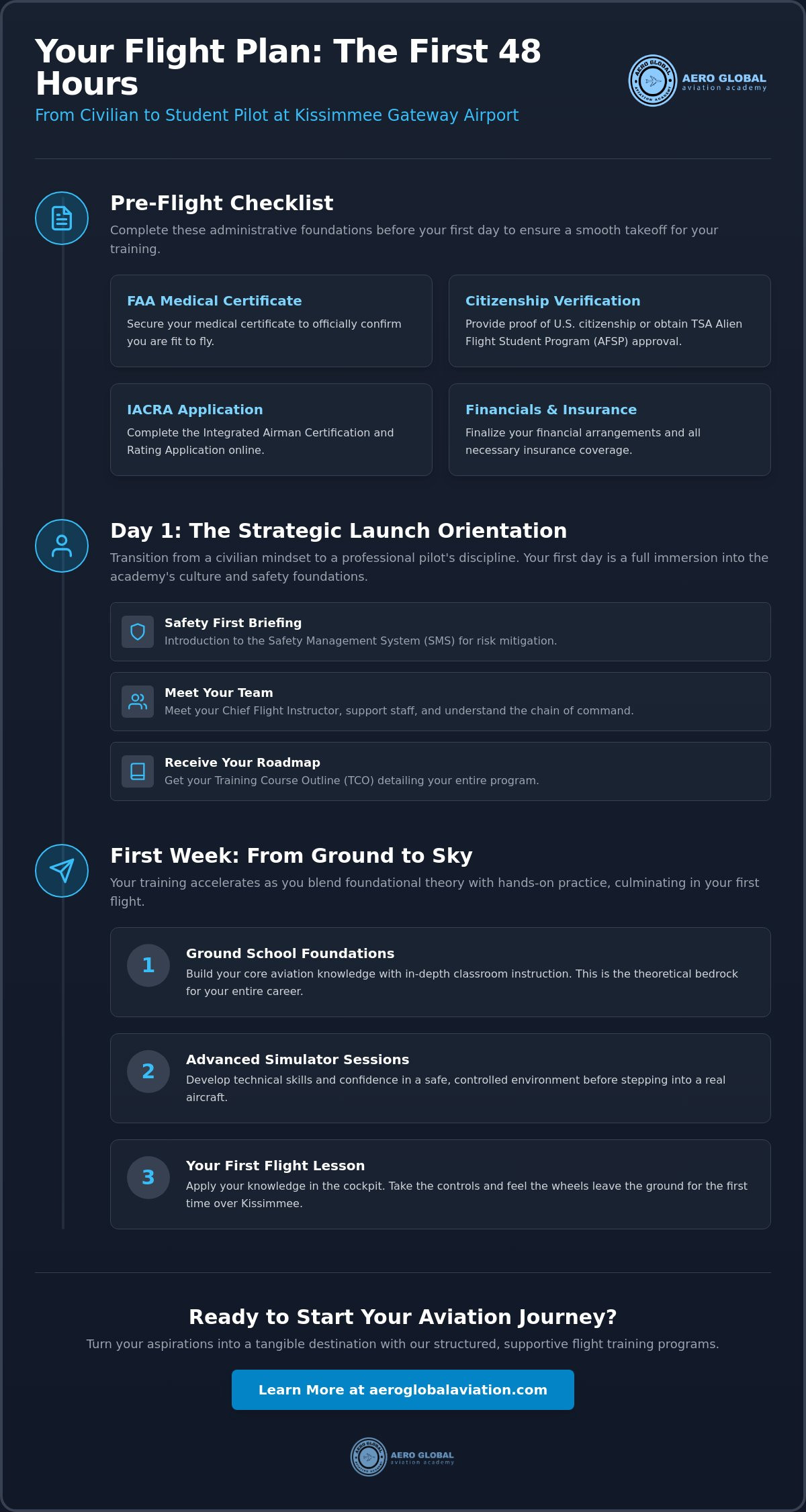
Orientation marks the exact moment you stop being a spectator and start your journey as a pilot. It's much more than a simple tour; it's a formal transition where you shed a civilian mindset to adopt the discipline required for professional flight training. Think of this as your induction into an elite community. You'll spend a full day immersed in briefings that establish the institutional culture and safety foundations of the academy. This structured start ensures you are fully compliant with FAA regulations before you ever approach the aircraft for your first flight lesson Kissimmee.
The goal of this day is to replace uncertainty with a clear roadmap. We cover everything from school-specific operational rules to federal compliance. By the time the final briefing concludes, you'll understand the "why" behind every procedure. This foundation is what allows you to focus entirely on the joy of flying when you finally reach the flight line.
The Purpose of the First Briefing
Your first briefing is where the abstract idea of flying becomes a concrete professional path. You'll meet your Chief Flight Instructor and establish a clear understanding of the chain of command. This isn't just about hierarchy; it's about safety. We introduce you to the Safety Management System (SMS) immediately, teaching you how we identify and mitigate risks in a high-stakes environment. You'll also learn the expectations for professional conduct and the flight deck dress code. Wearing the uniform isn't just about tradition. It signals your commitment to the high standards of the aviation industry and prepares you for the professional environment of a commercial cockpit from day one.
Evaluating Your Choice of School
Orientation provides a unique opportunity to validate your decision and ensure the academy meets your high standards. Use this time to apply the criteria found in the best flight schools in Florida evaluation checklist. You aren't just a student; you're a partner in this process. Take a close look at the maintenance facilities and the quality of the fleet during your facility tour. A well-maintained hangar and a transparent maintenance log are the hallmarks of a school that prioritizes your safety above all else.
Building rapport with the support staff is equally vital. During the day, you'll meet the dispatch and maintenance teams who keep the operation running smoothly. These individuals are essential to your progress. Learning how to communicate effectively with dispatch ensures your scheduling remains efficient, while understanding the maintenance workflow gives you confidence in the aircraft you'll soon be piloting. This day of preparation transforms initial anxiety into a clear, actionable plan for your aviation career.
The Pre-Flight Checklist: Paperwork and Administrative Foundations
Before you ever reach the ramp for your first flight lesson Kissimmee, we must address the administrative foundation that makes your training legal and safe. Think of this phase as your first pre-flight check. Just as a pilot inspects the aircraft before takeoff, we must verify your eligibility and documentation to ensure a smooth ascent into your new career. This process isn't just about "red tape"; it's about establishing the professional record that will follow you all the way to the flight deck of a major airline.
The administrative phase involves several non-negotiable milestones. We start with the verification of U.S. citizenship or the necessary TSA Alien Flight Student Program (AFSP) status for our international partners. Once your identity is confirmed, we'll enroll you in our digital management and scheduling software. This platform becomes your primary tool for tracking progress and booking aircraft. You'll also receive the Training Course Outline (TCO), which serves as the detailed syllabus for your specific program, ensuring you always know which skills you're mastering next.
Finalizing your financial arrangements and insurance coverage is the last step in this initial checklist. If you're feeling a bit lost in the paperwork, our team at Aero Global Aviation Academy is here to act as your practical mentor, helping you navigate every form with confidence.
Regulatory Compliance for 2026
In 2026, the FAA requires all student pilots to be at least 16 years old and proficient in English. You must ensure your Integrated Airman Certification and Rating Application (IACRA) account is active, as this is how you'll apply for your student pilot certificate using FAA form 8710-1. The most critical "Day 0" document is your FAA Medical Certificate. Whether you pursue a First, Second, or Third Class medical, you cannot fly solo without it. We recommend completing this physical early to identify any potential hurdles before you invest significant time in training. Reviewing the official FAA pilot requirements will help you stay ahead of these regulatory milestones.
The Wings Foundation Enrollment
The administrative path for those pursuing a private pilot license Florida through our Wings Foundation course is designed for maximum efficiency. During enrollment, we'll help you set up your digital logbook, a modern essential that replaces the traditional paper books of the past. Your digital logbook integrates directly with the Wings Foundation syllabus, allowing you and your instructor to track every maneuver and flight hour in real-time. This high level of organization ensures that your transition from a beginner to a certified private pilot is structured, rewarding, and completely transparent.
Navigating Kissimmee Gateway Airport (KISM): Your Training Ground
Stepping onto the ramp at Kissimmee Gateway Airport (KISM) for the first time is a pivotal moment in your career. KISM is a Class D towered airport that recorded 133,171 landings and takeoffs in 2025, making it a vibrant and high-energy hub for learning. As you prepare for your first flight lesson Kissimmee, you'll begin to see the airport layout as a strategic map rather than a confusing maze. You'll learn to navigate the primary runways, 15/33 and 6/24, and master the taxiway transitions that lead directly to the Aero Global ramp. Operating at a towered airport from day one is a significant advantage. It forces you to develop the professional habits and radio discipline required for a career in commercial aviation.
Safety at such a busy facility relies on strict adherence to established protocols. The control tower at KISM operates daily from 0700 to 2200, providing a controlled environment where every movement is coordinated. This structure builds your confidence quickly. You'll also be introduced to the local practice areas located just outside the airport's immediate airspace. These designated zones provide the perfect "open classroom" where you can practice basic maneuvers away from the main traffic flow. Utilizing AOPA flight training resources can help you visualize these procedures and airspace structures before you even arrive for your first briefing.
The Kissimmee Advantage
Training in Central Florida offers benefits that few other regions can match. Our consistent year-round weather allows for a high-frequency flight schedule, ensuring you stay on track toward your goals without long gaps in your training. KISM's location is strategically perfect. It sits just beneath the complex Class B airspace surrounding Orlando International (MCO). This proximity is a gift to a student pilot. You'll learn to navigate high-traffic environments and communicate with air traffic control with a level of sophistication that students at quiet, rural airports rarely experience. These skills make you a more capable and marketable pilot from the very start.
While the Florida sun is perfect for accumulating flight hours, it can be taxing on home infrastructure; if you want to ensure your own residence stays as cool as a modern cockpit, check out BulletProof Air for expert tips on avoiding common HVAC installation errors.
Facility and Fleet Familiarization
During your first week, you'll go beyond the cockpit to understand the machinery behind the mission. We take you through the Aero Global hangars and maintenance bays so you can see the meticulous care our technicians provide. You'll also get a hands-on introduction to our fleet, specifically the Garmin G1000 glass cockpit systems. Mastering this advanced technology early is essential, as it mirrors the systems you'll eventually use in regional and major airline jets. You'll also learn the daily rhythm of the school, from checking in at the dispatch desk to utilizing our pre-flight briefing rooms. These spaces are where the tactical planning for your flight happens, turning every hour in the air into a productive step toward your future.
From Ground School to the Cockpit: Your First Week Schedule
The first week of your training is a high-energy period where your professional identity truly begins to take shape. You aren't just reading about flight anymore; you're living it. Your schedule will be a balanced blend of classroom theory, simulator practice, and the beginning of your flight blocks. This structured approach ensures that when you finally sit in the pilot's seat, you aren't guessing. You're executing a well-rehearsed plan.
Ground school serves as your intellectual foundation. You'll dive deep into aerodynamics, Central Florida weather patterns, and FAA regulations. Mastering these subjects is essential for your safety and your success on the FAA written exam. We provide the digital and physical resources you need to prepare effectively, turning complex data into actionable knowledge that you'll apply every time you step onto the ramp. Expect a significant self-study workload outside of class hours to stay ahead of the curve.
Before you start the engine for your first flight lesson Kissimmee, you'll likely spend time in our advanced flight simulators. These tools allow you to practice maneuvers in a controlled environment without the pressures of actual flight or air traffic. It's the perfect way to build muscle memory and confidence. Scheduling revolves around "Flight Blocks," which are dedicated windows of time where the aircraft and your instructor are reserved exclusively for you. This consistency is what allows you to progress quickly through your syllabus. Ready to see the flight line for yourself? Contact our admissions team today to schedule your tour.
The Ground School Experience
Transitioning from theory to practice happens in our classrooms. For those enrolled in our Wings Foundation, you'll follow a specific PPL syllabus designed to build your skills logically. We use modern training aids to ensure you're fully prepared for every milestone. This isn't just about passing a test; it's about building the knowledge base required for a lifelong career. Your self-study time will focus on mastering the PPL syllabus and utilizing school resources for FAA written exam preparation.
Meeting Your Certified Flight Instructor (CFI)
One of the most important moments of your first week is meeting your Certified Flight Instructor (CFI). This mentor-student relationship is the heart of your training. Chemistry and clear communication are vital because your CFI is your primary guide through the complexities of the cockpit. Together, you'll establish a training schedule that aligns with your specific career goals. This is also when you'll finally set the date and time for your first flight lesson Kissimmee, marking the moment you finally take the controls.
Designing Your Career Path at Aero Global Aviation Academy
Orientation isn't just an administrative hurdle; it's the tactical briefing that launches your professional trajectory. At Aero Global, we view this initial phase as the foundation for our comprehensive career pilot program. You're joining a thriving aviation community here at Kissimmee Gateway Airport, where networking with seasoned instructors and fellow students begins on day one. These connections often lead to your first job as a flight instructor or your first recommendation to a regional carrier. We take regional pride in our location, knowing that the professional networks built here in Central Florida are among the strongest in the industry.
Your journey typically begins with the Wings Foundation, where you master the fundamentals of flight. However, we're always looking toward your next milestone. As you move from orientation toward your first flight lesson Kissimmee, you're actually starting a structured progression that leads through instrument ratings and commercial certification. This isn't just about learning to fly; it's about transforming into a professional who can meet the rigorous demands of the modern airline industry. The transition from a beginner to a professional is a logical, rewarding process when you have a dedicated local partner guiding your steps.
The Airline Pilot Elite Track
Aspiring airline pilots often choose our Airline Pilot Elite track for its direct, high-standards roadmap. This program guides you from your Private Pilot License (PPL) all the way to becoming a Certified Flight Instructor (CFI). By training to these standards from the very beginning, you ensure that your skills align with what major airlines expect from their flight crews. We help you plan for specific commercial pilot training milestones, ensuring each hour in the logbook brings you closer to your ultimate destination. This curriculum is designed to be action-oriented, moving you quickly from one certification to the next lifestyle change your career enables.
Your First Solo and Beyond
During your orientation week, we encourage you to visualize your first solo flight. It's one of the most significant emotional milestones in an aviator's life. The transition from a student who needs guidance to a pilot who commands the aircraft alone is a profound shift in mindset. This journey requires dedication, discipline, and a genuine passion for the field. As you prepare for your first flight lesson Kissimmee, remember that you're not just taking a discovery flight. You're beginning a lifelong career path that offers broad professional possibilities. Prepare your mindset for the flight deck, trust your training, and embrace the professional world that is now within your reach.
Your Path to the Flight Deck Starts Here
You've now seen how the transition from a civilian to a student pilot is a structured, attainable process. By mastering the administrative checklist and understanding the unique dynamics of the Kissimmee Gateway Airport, you've already cleared the first hurdles of your training. This foundation ensures that when you arrive for your first flight lesson Kissimmee, you can focus entirely on the tactical skills that turn a beginner into a professional aviator.
Our FAA-certified instructors are dedicated to your individual success, providing the personalized attention needed to navigate our professional Career Pilot Tracks. With our strategic Kissimmee Gateway Airport location as your home base, you're perfectly positioned to gain the high-traffic experience required by major airlines. Ready to start your journey? Book a Discovery Flight at our Kissimmee Training Center today! We're excited to help you turn your passion for flight into a rewarding lifelong career.
Frequently Asked Questions
What documents do I need to bring to flight school orientation?
You must bring proof of U.S. citizenship, such as an unexpired U.S. passport or a birth certificate accompanied by a government issued photo ID. If you aren't a U.S. citizen, you'll need to provide your TSA authorization documents instead. Having these records ready ensures your training file is legally compliant and allows us to focus on your aviation goals from the very first hour.
Will I get to fly on my first day of flight school in Kissimmee?
Your first day is dedicated to administrative foundations, safety briefings, and facility tours rather than active flying. While you won't take off on day one, you'll work with your Certified Flight Instructor to schedule your first flight lesson Kissimmee for later in the week. This structured start ensures you have the necessary ground knowledge before you ever touch the flight controls.
How long does the orientation process usually take?
The orientation process typically requires a full business day of briefings and tours. You should plan to spend about eight hours at the academy meeting the maintenance and dispatch teams while learning our specific operational protocols. This comprehensive introduction is designed to lower the barrier to entry by giving you a clear roadmap of our institutional culture and safety systems.
Do I need a headset and flight bag before I start orientation?
You don't need to purchase your own headset or flight bag before your first day. We often provide loaner equipment for your initial sessions, and your instructor will act as a practical mentor to help you choose professional gear that meets industry standards. Waiting until after orientation allows you to make an informed investment in the tools you'll use throughout your career.
Is ground school included in the orientation week?
Yes, ground school sessions are integrated into your first week's schedule to build your theoretical foundation immediately. You'll begin mastering aerodynamics, weather patterns, and FAA regulations alongside your initial simulator or flight blocks. This balanced approach ensures that your transition from a beginner to a professional pilot is both logical and rewarding from the very start.
What happens if I don’t have my FAA Medical Certificate yet?
You can begin ground school and dual flight instruction without a medical certificate, but you cannot fly solo. We strongly recommend completing your FAA medical exam as early as possible to ensure there are no surprises that could delay your progress. Securing your certificate before you start helps you move through your training milestones with total confidence and reliability.
Can I start flight training in Kissimmee if I am not a US citizen?
International students can certainly train with us by participating in the TSA Alien Flight Student Program (AFSP). You'll need to complete a background check and receive formal TSA authorization before you can begin your first flight lesson Kissimmee. Our team is experienced in this process and will help you navigate the international registration requirements to ensure a smooth start.
What is the dress code for flight school orientation at Aero Global?
We maintain a professional dress code that typically consists of a white pilot shirt and dark trousers. Adopting a professional appearance from day one helps you transition into the mindset of a commercial aviator and reflects the high standards of the industry. This discipline is a core part of our academy culture and prepares you for the professional environment of a future flight deck.


