With a projected shortfall of 24,000 pilots hitting the U.S. aviation industry this year, the cockpit has never been more accessible or more lucrative. You've likely seen the headlines about rising training costs and wondered if the financial risk is worth the reward. If you're asking is becoming a pilot a good investment 2026, the answer lies in looking past the initial training period and focusing on the unprecedented career leverage you hold right now. We understand that this is a life-changing decision. It's why we approach flight training with the practical mindset of a mentor rather than an impersonal corporation.
You'll discover the current reality of pilot compensation, including entry-level regional salaries that now start at approximately $98,560. We'll show you how to minimize your time on the ground by leveraging Florida's year-round flying weather to reach your 1,500-hour milestone faster. This article provides a clear roadmap through different training pathways, helping you build a strategy that maximizes your return on investment while securing your future in the skies.
Key Takeaways
- Analyze current market demand and why the 2026 pilot shortage offers a unique strategic entry point for your professional career.
- Evaluate the financial landscape to determine if is becoming a pilot a good investment 2026 by comparing training costs to the high lifetime earnings of major airline pilots.
- Discover how the unique lifestyle and global travel opportunities provide intangible professional growth that few other industries can match.
- Learn to minimize your financial risk by selecting high-efficiency training paths in climates that allow for more flight hours in less time.
- Explore structured programs like the Airline Pilot Elite track that guide you through every milestone from your Private Pilot License to advanced instructor certifications.
The Aviation Market Outlook: Why 2026 is a Strategic Entry Point
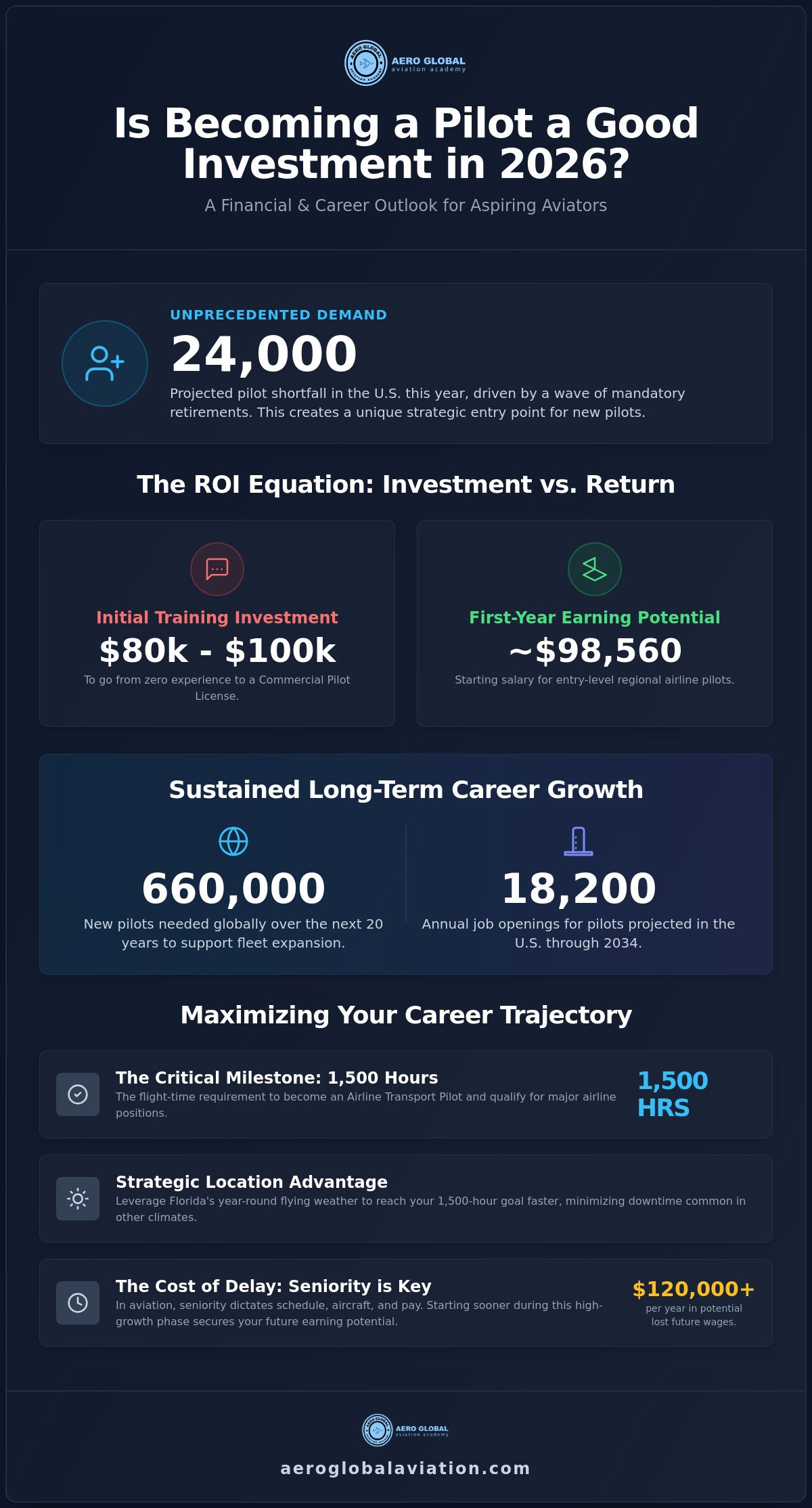
The aviation industry is currently navigating a historic transition that makes this year a unique window for new students. If you're weighing the costs and asking is becoming a pilot a good investment 2026, the data suggests the market is in your favor. We are currently seeing the peak of a domestic pilot shortage, with a projected shortfall of 24,000 pilots in the United States alone. This gap is largely driven by a massive wave of mandatory retirements as current captains reach the FAA regulated age of 65. Because these departures are predictable, airlines are forced to recruit aggressively to keep their fleets in the air.
Recruitment strategies have shifted from short-term fixes to long-term talent acquisition. Major carriers are no longer just looking for immediate hires; they're looking for partners they can develop over decades. This makes your commercial pilot certificate more than just a license. It's a high-value professional asset that grants you entry into a normalized, predictable hiring cycle that offers more stability than we've seen in years.
The 2026 Global Pilot Demand
Global demand is surging as international travel markets fully stabilize and major carriers take delivery of thousands of new aircraft through 2030. Industry projections indicate that 660,000 new commercial pilots will be needed over the next twenty years to support this fleet expansion. Regional airlines serve as the primary entry point for this growth, offering paths for new pilots to build the 1,500 hours required for major airline positions. Pursuing a career as an aircraft pilot today means entering a field where the U.S. Bureau of Labor Statistics expects roughly 18,200 job openings every year through 2034. This sustained demand ensures that your skills remain a premium commodity across the globe.
Why Timing Matters in Flight Training
In aviation, seniority is the foundation of your career progression. It dictates everything from your monthly schedule and the aircraft you fly to your total lifetime earnings. Starting your journey in 2026 allows you to secure your place in the seniority list during a high-growth phase, which can lead to faster upgrades from First Officer to Captain. You can study the airline pilot career path to see how early entry compounds your financial gains over time.
To maximize this timing, efficiency is your greatest ally. Our location in Kissimmee, Florida, provides a strategic advantage because our year-round flying weather eliminates the seasonal downtime that plagues schools in northern climates. By choosing a path that prioritizes rapid progression, you minimize the opportunity cost of lost seniority wages, which can exceed $120,000 per year in the later stages of your career. Every day you spend grounded is a day of potential earnings left on the table.
Analyzing the ROI: Flight Training Costs vs. Career Earnings
The financial commitment required to enter the cockpit is often the biggest hurdle for prospective students. On average, the cost of professional pilot programs in 2026 ranges from $80,000 to $100,000 to move from zero experience to a Commercial Pilot License. While this figure is significant, you shouldn't view it as a simple expense. Instead, treat it as the purchase of a high-yield professional asset. Determining if is becoming a pilot a good investment 2026 requires a cold look at the numbers—an analytical process not unlike the advanced valuation techniques taught at Financial Modelling University—to see how quickly that initial debt can be retired compared to the lifetime earnings of a major airline captain.
Your return on investment starts with the strategic acquisition of ratings. A Private Pilot License (PPL) is your foundation, but the real value comes from Instrument and Multi-Engine ratings. These certifications are the keys to professional utility; they allow you to fly in diverse weather conditions and operate complex aircraft, which are non-negotiable requirements for any commercial career. By focusing on these specialized skills early, you reduce your time-to-income and position yourself for the most lucrative roles in the industry.
Short-Term Investment vs. Long-Term Gains
The transition from student to professional happens faster than most expect. Once you achieve your commercial certification, you can begin earning as a flight instructor or a regional pilot. Our Career Pilot Program is designed to bridge this gap efficiently, moving you from the classroom to the flight deck with professional readiness. Completing your commercial pilot training is the critical "breakeven" milestone where your training starts paying for itself. This phase is about building the 1,500 hours required for airline transport certificates while receiving a paycheck, effectively turning your work hours into a subsidized path toward the major airlines.
Projected 2026 Pilot Salaries
The current market has driven entry-level compensation to historic highs. In 2026, starting salaries for Regional First Officers are approximately $98,560 annually. This is a dramatic shift from previous decades and allows new pilots to manage their training investments more comfortably from day one. Data from the Bureau of Labor Statistics shows that the median annual wage for airline pilots reached $226,600 in 2024, and those figures continue to trend upward as the 2026 pilot shortage peaks. When you factor in signing bonuses that can reach $100,000 at the regional level, the ROI becomes even more compelling. If you're ready to see how these numbers apply to your specific goals, you can start your professional journey with a personalized training plan at our Kissimmee academy.
Intangible Assets: The Lifestyle and Professional Growth of a Pilot
While the financial ROI is compelling, the true value of this career often lies in the intangible assets that come with the uniform. Beyond the salary, is becoming a pilot a good investment 2026 when you consider the unique quality of life and the professional prestige found on the flight deck? For many, the "office view" from 35,000 feet is a benefit that no corporate cubicle can match. This isn't just about the scenery; it's about the global networking opportunities and the travel benefits that allow you and your family to see the world in ways few other professions permit. You aren't just learning to fly; you're joining an elite community of professionals dedicated to safety and precision.
The role demands and develops a specific set of high-level transferable skills. Every flight requires leadership, rapid decision-making, and technical mastery of complex systems. These traits make you a valuable asset in any globalized industry. By following the standards set by the Federal Aviation Administration, you cultivate a mindset of professional discipline that serves you well throughout your entire life. This career path offers a sense of purpose and a clear trajectory for growth that is increasingly rare in the modern job market.
The Modern Pilot Lifestyle
The lifestyle for a pilot in 2026 is more flexible than it was a decade ago. Airlines have modernized their schedule bidding systems, allowing you to have more control over your time off as you gain seniority. Many pilots enjoy "commutable" bases, which means you can live where you choose and fly to your starting hub. This high-engagement career keeps your mind sharp and offers a deep sense of community. You'll find mentorship in every cockpit, as experienced captains take pride in guiding the next generation of aviators through the nuances of professional flight.
Professional Resilience and Skill Sets
Mastering advanced flight training and glass cockpit systems provides you with a "recession-resistant" skill set. Even during economic shifts, the global need for logistics and transport remains a constant. There is also an immense personal satisfaction in achieving milestones, starting with the moment you earn your private pilot license in Florida. We see it every day at our academy; the confidence a student gains after their first solo flight or successful checkride is transformative. It's about more than a job. It's about achieving a level of technical excellence that defines who you are.
Minimizing Risk: How to Choose a High-Efficiency Training Path
Every investment carries a degree of risk, and flight training is no different. The key to ensuring that is becoming a pilot a good investment 2026 for you personally depends on how effectively you manage your resources. Efficiency isn't just about finishing fast; it's about reducing the total cost by avoiding unnecessary delays. When you choose a training path, you're essentially choosing how much interest you'll pay on your time. A structured approach like our Airline Pilot Elite program eliminates the guesswork, providing a clear sequence of certifications that move you from a beginner to a professional instructor with precision. Avoiding red flags is equally important. When choosing a flight school in Florida, look for transparent maintenance logs and a commitment to modern technology. If a school relies on outdated avionics or has a history of grounded aircraft, your investment is at risk before you even leave the ground.
The Central Florida Weather Advantage
Geography is one of the most significant financial variables in flight training. Kissimmee offers a strategic advantage because our year-round flying weather allows for nearly 360 days of operation. In contrast, students in northern states often lose entire months to snow, ice, and low ceilings. This creates a "momentum" factor in learning. When you fly four or five times a week, you retain skills better and spend less time reviewing previous lessons. This consistency reduces the total number of hours required to reach proficiency, which directly lowers your overall training cost. Additionally, the Orlando region features a complex variety of airspace. Training here prepares you for the high-intensity environments you'll face at major international airports, giving you a competitive edge during airline interviews.
Part 61 vs. Part 141: Which Fits Your Investment Goal?
The FAA provides two primary frameworks for training, and the right choice depends on your current lifestyle. Part 61 programs offer maximum flexibility, making them the ideal choice for career-changers who need to balance flight hours with a current job. Part 141 programs are more rigid and follow a strictly choreographed syllabus, which often suits full-time students who thrive in a classroom-like environment. Regardless of the path you choose, prioritize schools that utilize Garmin G1000 glass cockpit systems. Mastering this technology early is vital because it mirrors the systems used in modern airliners, making your transition to a regional jet much smoother. If you're ready to build a training schedule that respects both your time and your budget, you can apply for a discovery flight to see our fleet and meet our instructors in person.
Aero Global Aviation Academy: Maximizing Your Professional Potential
Choosing the right environment to begin your journey is the final, most critical step in determining if is becoming a pilot a good investment 2026 for your specific goals. At Aero Global Aviation Academy, we don't operate like a large, impersonal corporation. Instead, we act as a practical mentor, providing the expert guidance and personalized attention you need to navigate the high stakes of professional flight training. We understand that you aren't just looking for a license; you're looking for a career. Our structured programs are designed to move you toward that destination with efficiency and confidence, ensuring you're ready for the cockpit from day one.
We offer three distinct pathways tailored to your professional ambitions. For those who want to test the waters, our Wings Foundation course provides a solid start by focusing exclusively on your Private Pilot License. If you're ready to commit to a full career change, our Career Pilot Program offers a direct, streamlined path from zero experience to your Commercial Pilot License. For students aiming for the highest tier of the industry, the Airline Pilot Elite track provides the most comprehensive preparation, taking you all the way through advanced instructor certifications. This approach ensures that every hour you spend in the air is a direct investment in your future seniority.
Tailored Training in Kissimmee
Our training philosophy is built on the idea that professional habits should begin during your very first discovery flight. At our Kissimmee base, we maintain low instructor-to-student ratios so that your progression is never stalled by a lack of resources or attention. We implement an "airline-oriented" curriculum that mirrors the discipline and procedures used by major carriers. This means you'll learn to operate in complex airspace and master advanced systems in a supportive, student-centric environment. We invite you to visit our academy and experience this culture firsthand. Seeing our modern fleet and meeting our dedicated team will help you realize that a professional pilot career is a structured and attainable goal.
Your Next Steps to the Cockpit
The enrollment process for our 2026 semesters is designed to be as clear and functional as a pre-flight checklist. We offer various financing options and payment plans for our career tracks, helping you manage the upfront costs while you focus on your training. Because the 2026 pilot shortage is projected to hit its peak this year, the timing to start is ideal. By joining a program that leverages Florida's superior flying weather, you can reach your 1,500-hour milestone faster than your peers in other regions. Don't let uncertainty ground your ambitions. Contact us today to book an introductory lesson and take your first step toward a rewarding, high-growth career in the skies.
Take Command of Your Future in the Skies
The aviation landscape of 2026 offers a rare alignment of high demand and competitive compensation. By entering the market now, you position yourself to benefit from the current shortage of 24,000 pilots while securing a spot on the seniority list that will define your lifetime earnings. When you look at the rapid salary escalations and the unique global lifestyle, it's clear that is becoming a pilot a good investment 2026 for those ready to commit to professional excellence. We aren't just a flight school; we are your dedicated partners in this transformation.
Success in this industry depends on choosing a path that prioritizes efficiency and quality. Our FAA-certified curriculum and modern Garmin-equipped training fleet ensure you're learning on the systems the airlines expect. By training in the year-round flying weather of Orlando, you'll minimize downtime and reach your goals faster than you ever thought possible. Your journey from a beginner to a professional aviator starts with a single, decisive step. Book Your Discovery Flight in Kissimmee Today and let us help you turn your passion for flight into a high-yield professional reality. The horizon is waiting for you.
Frequently Asked Questions
Is there still a pilot shortage in 2026?
Yes, the United States is currently experiencing its peak pilot shortage in 2026 with a projected shortfall of 24,000 aviators. This gap is primarily driven by mandatory retirements at age 65 and a global need for 660,000 new pilots through 2044. For those wondering is becoming a pilot a good investment 2026, this demand creates significant leverage for new hires, leading to faster career progression and more stable employment opportunities across the industry.
How much can a new commercial pilot expect to earn in 2026?
Entry-level airline pilots at regional carriers can expect starting salaries of approximately $98,560 annually in 2026. Beyond the base pay, many airlines offer substantial signing bonuses that can reach $100,000 to attract qualified candidates. This high starting compensation allows new pilots to manage their training debt effectively while positioning themselves for the median airline pilot wage, which reached $226,600 in 2024 and continues to trend upward as demand remains high.
What is the average ROI time for flight school?
Most professional pilots achieve a full return on their training investment within three to five years after joining a major carrier. Although the journey from zero experience to a commercial license typically requires an investment of $80,000 to $100,000, the rapid salary escalations at the five and ten year marks are significant. When you factor in the high lifetime earnings of a captain, the initial training costs represent a relatively small percentage of your total career income.
Can I become a pilot while working another job?
Yes, it's entirely possible to earn your ratings while maintaining a current job by enrolling in a flexible Part 61 program. This framework allows you to dictate your own training pace and schedule lessons during evenings or weekends. Many of our students are mid-career professionals who use this flexibility to transition into the cockpit without sacrificing their current financial stability. It's a practical way to build your future while managing your present responsibilities.
Why is Florida considered the best place for flight training investment?
Florida provides a unique financial asset through its year-round flying weather, allowing for nearly 360 days of flight operations. In northern climates, seasonal snow and ice can ground students for weeks at a time, leading to skill decay and increased costs. By training in Kissimmee, you maintain constant momentum, which reduces the total hours needed to reach proficiency. This efficiency ensures that is becoming a pilot a good investment 2026 remains a reality by getting you to work faster.
What medical requirements must I meet to become a professional pilot?
Are there age limits for starting a pilot career in 2026?
You can begin flight training at any age, provided you can pass the required medical exams. While the FAA currently mandates retirement at age 65 for major airline pilots, many individuals start their aviation journey in their 40s or 50s. These mid-career entrants often find rewarding roles in corporate aviation, flight instruction, or regional airlines. The industry values the diverse professional backgrounds and decision-making skills that older students bring to the training environment.
How does the Airline Pilot Elite program differ from standard flight training?
Our Airline Pilot Elite program is a total professional certification track that moves you from your first flight to advanced instructor ratings. Unlike standard modular training that focuses on one license at a time, this program is a choreographed path designed for maximum efficiency and airline readiness. It prepares you for the highest tier of aviation by integrating advanced systems and professional standards into every lesson, ensuring you're a competitive candidate for major carriers.


