

What if the secret to reaching an airline flight deck years ahead of your peers isn't just how hard you work, but exactly where you fly? If you are researching how to build flight hours quickly Kissimmee offers a unique competitive edge that most other locations simply can't match. You likely already know the frustration of watching your logbook stall due to unpredictable weather or the high costs of solo aircraft rentals. It's a common hurdle, and feeling stuck in the time-building phase can make that 1,500-hour milestone feel like a distant dream.
We are here to help you turn that ambition into a structured reality. You will discover how to leverage over 300 days of VFR weather and tap into local networking for entry-level roles that pay you to fly. We will break down the most efficient strategies for 2026, including how instructor certifications through the Airline Pilot Elite program can transform your training into a steady climb toward the majors. Get ready to stop waiting and start logging the hours that matter most.
Key Takeaways
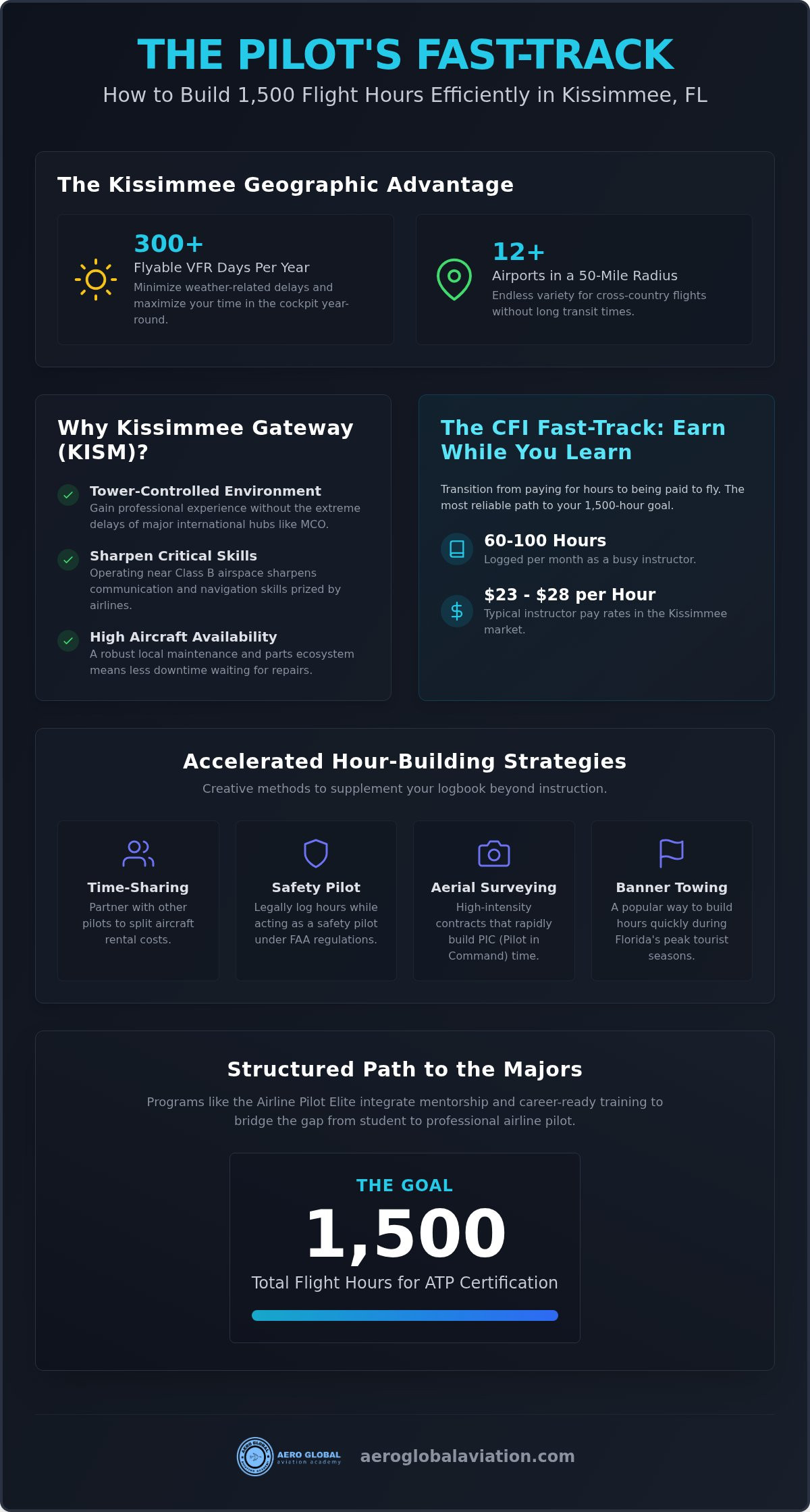
- Learn why Kissimmee’s unique climate provides over 300 flyable days a year, significantly cutting down your total time-building timeline.
- Discover how to build flight hours quickly Kissimmee style by utilizing strategic time-sharing partnerships and the FAA’s safety pilot regulations.
- Explore the CFI fast-track to earn a steady income while logging critical hours toward your 1,500-hour airline requirement.
- Identify high-intensity opportunities like aerial survey contracts and banner towing that rapidly pad your logbook during Florida's peak seasons.
- Find out how structured programs like the Airline Pilot Elite integrate mentorship and career-ready training to bridge the gap to major airlines.
Maximizing Your Logbook: Why Kissimmee is the Strategic Hub for Fast Flight Hours
Kissimmee Gateway Airport (KISM) serves as a high-octane engine for your professional career. While pilots in other states wait for snow to melt or low ceilings to lift, you'll be in the cockpit and moving forward. Understanding how to build flight hours quickly Kissimmee requires looking closely at the local geography. The region offers a dense network of over a dozen regional airports within a 50-mile radius, including locations like Winter Haven and Lakeland. This provides endless variety for cross-country requirements without the long, wasted transit times found in more isolated flight training hubs.
The Florida Weather Advantage in 2026
Central Florida's climate is your greatest ally in the race to 1,500 hours. With over 300 flyable days per year, your schedule remains consistent and predictable. You can reliably book morning and evening blocks when the air is smooth and the visibility is miles long. Unlike northern flight schools where winter icing can ground fleets for weeks at a time, Kissimmee's year-round warmth keeps the propellers turning. In this high-stakes environment, flyable days are the primary metric for hour-building speed.
Kissimmee Gateway Airport (KISM) as Your Launchpad
Choosing KISM over larger hubs like Orlando International (MCO) is a tactical move for any aspiring professional. You get the benefit of a professional, tower-controlled environment without the agonizing 30-minute taxi delays common at major airline hubs. This means you get more takeoffs and landings per hour of engine time. Operating so close to Orlando’s complex Class B airspace forces you to sharpen your communication skills early, which is a vital part of pilot certification in the United States. You'll navigate using world-famous landmarks while building the professional habits that airline recruiters prioritize during the hiring process.
Beyond the runways, the local aviation infrastructure in Central Florida is designed for high-volume training. Because this area is a global hub for flight schools, maintenance facilities and parts suppliers are concentrated right here in our backyard. This ensures high aircraft availability; your progress won't stall because a plane is waiting on a part from across the country. Operating within this ecosystem prepares you for the logistical pace of the airlines, making every hour logged in Kissimmee a significant step toward a professional mindset.
The Certified Flight Instructor (CFI) Fast-Track: Earning While You Learn
The transition from paying for every flight hour to being paid to log them is a pivotal moment in any aviator's life. If you're looking for the most reliable way on how to build flight hours quickly Kissimmee offers a high-demand environment for instructors that few other regions can replicate. Becoming a Certified Flight Instructor (CFI) effectively turns your expertise into currency. Every hour you spend teaching a student the fundamentals of flight counts toward your 1,500-hour Airline Transport Pilot (ATP) requirement. Beyond the logbook, instructing forces you to master the FAA regulations for commercial pilots. This deep dive into the rules ensures you're fully prepared for the technical rigor of airline interviews and high-stakes flight deck operations.
Transitioning from Student to Instructor
Moving into a teaching role requires a structured approach to your own training. First, you'll need to finalize your Commercial Pilot License (CPL) requirements. Once you have that foundation, you should enroll in a dedicated CFI/CFII training course. This phase focuses on the "fundamentals of instructing," which teaches you how to communicate complex aerodynamic principles to beginners. After you pass the FAA practical test, you're cleared to begin your professional career. In the Kissimmee market, a busy instructor can realistically expect to log between 60 and 100 hours per month. This high volume of flying, combined with local instructor pay rates often ranging from $23 to $28 per hour, makes this path both professionally and financially rewarding.
Maximizing Instructor Hours at Aero Global
At Aero Global, we embrace the "Practical Mentor" approach to flight training. We don't just want you to log time; we want you to become a superior pilot and a dedicated leader. Our Airline Pilot Elite program is specifically designed to produce instructors who are ready for the flight deck from day one. By joining our team, you gain access to a steady flow of new students through our Career Pilot Program. This constant activity ensures your schedule stays full year-round, regardless of seasonal shifts.
To maximize your billable time and logbook entries, we highly recommend adding CFII (Instrument) and MEI (Multi-Engine) ratings. These advanced instructor certifications allow you to teach a wider range of courses, keeping you in the air even when basic private pilot demand fluctuates. If you're ready to start your professional journey and see how our team supports your growth, you can explore our training options to find the perfect fit for your goals. This proactive strategy ensures you reach the 1,500-hour mark with a diverse and impressive logbook.
Beyond Instruction: Creative Ways to Log Hours in Central Florida
While instructing is a proven path, it isn't the only way to fill your logbook in the Sunshine State. If you are researching how to build flight hours quickly Kissimmee provides a playground of professional niches that leverage the region's massive tourism and development sectors. These roles often require sharp stick-and-rudder skills and a proactive mindset, but they offer high-volume flying that can significantly shorten your timeline to 1,500 hours. Diversifying your experience through these creative avenues makes you a more versatile candidate when you eventually transition to a regional flight deck.
Aerial Mapping and Surveying in 2026
Florida's rapid infrastructure expansion has created a consistent local market for aerial survey pilots. These contracts often involve flying precise, long-duration grids to capture high-resolution data for developers and government agencies. You'll gain valuable "time-in-type" experience in rugged workhorses like the Cessna 172 or the Cessna 206, which are staples of the survey industry. Because these missions require immense focus on track-keeping and fuel management, they build the disciplined habits airlines look for. While survey work is highly seasonal and often peaks during the clear skies of the winter and spring months, planning your training around these windows can lead to hundreds of logged hours in a single deployment. Understanding the career outlook for airline and commercial pilots helps you see how these specialized hours contribute to your long-term marketability.
Tourism and Coastal Operations
The Orlando and Kissimmee tourism corridor offers unique opportunities for sightseeing pilots to log time while showcasing the region's landmarks. Additionally, the proximity to the coast allows for high-skill roles like banner towing over Cocoa Beach and Daytona. This type of flying is demanding; it requires precision at low altitudes and a deep understanding of local wind patterns and coastal weather shifts. It's an excellent way to build confidence in high-traffic environments while enjoying the regional pride of the Florida aviation community. Safety is paramount in these operations, so you'll need to meet specific tailwheel or low-altitude endorsements before jumping in.
For those looking for even more variety, Central Florida's skydiving centers often seek pilots for high-cycle operations. These roles are perfect for building multi-engine time or gaining experience in high-altitude environments. You might also consider aircraft ferrying, which involves moving planes between maintenance hubs and private owners across the state. Each of these paths offers a different rhythm than the traditional flight school environment, allowing you to tailor your journey to 1,500 hours based on your personal interests and professional goals. By stepping outside the standard instruction route, you turn the "time-building" phase into a diverse professional internship.
Strategic Time-Building: Reducing Costs and Maximizing Efficiency
Building your way to 1,500 hours requires more than just persistence; it demands a tactical approach to your budget. If you want to know how to build flight hours quickly Kissimmee has a vibrant community of pilots looking to do exactly what you're doing. Time-sharing partnerships allow you to split the cost of aircraft rental down the middle with another student, effectively doubling your flying time for the same investment. By joining local flying clubs at Kissimmee Gateway, you can often access hourly rates that are significantly lower than standard commercial rentals. These clubs foster a collaborative spirit where you can learn from seasoned aviators while keeping your training costs manageable.
The Safety Pilot Framework
One of the most effective ways to increase your productivity is utilizing the "Safety Pilot" framework under FAA Part 91. When one pilot flies "under the hood" to practice instrument maneuvers, the other pilot acts as the required safety pilot to maintain a lookout for other traffic. In this specific scenario, both aviators can log time simultaneously. It's a perfectly legal way to reach your goals faster while sharing the financial burden. You can find reliable partners within the Aero Global Aviation Academy community, where students often coordinate schedules to maximize their logbook entries. Accuracy is vital here; ensure your logbook entries clearly reflect who was the sole manipulator of the controls and who acted as the safety pilot to remain compliant with FAA standards.
Cross-Country Efficiency
Strategic planning of your cross-country routes can shave weeks off your timeline. Instead of flying aimless circles, plan "point-to-point" missions to other Florida hubs like Miami, Tampa, or Jacksonville. These longer legs help you meet the specific cross-country requirements for your ATP certificate with fewer total flights. Integrating night flying into these routes is another smart move. The airspace is less crowded, and the cooler night air often makes for a smoother ride. Night cross-country flights are a critical metric for airline readiness because they prove a pilot can manage complex navigation and physiology in low-visibility environments.
By combining these shared-cost strategies with smart route planning, you'll find that the path to 1,500 hours becomes much more attainable. If you're ready to see how a structured environment can accelerate your progress, start your flight training journey today and join a community dedicated to your success. Utilizing these professional shortcuts doesn't just save money; it builds the resourcefulness you'll need as a commercial captain.
Launching Your Career with Aero Global’s Elite Programs
Reaching the final stretch of your training requires a shift in focus from basic skills to professional mastery. While you’ve learned the strategies for how to build flight hours quickly Kissimmee is the place where you put those plans into high gear through our structured environments. Our Airline Pilot Elite program is specifically designed to bridge the gap between your commercial rating and the airline flight deck. By integrating hour-building directly into the core curriculum, we ensure you have a clear, uninterrupted path to your goals. You will have access to a modern fleet of aircraft that are maintained to the highest standards, meaning your schedule stays on track without the delays often found at smaller, less-equipped schools.
Mentorship is what truly sets our academy apart. You won't just be logging time; you'll be learning from experienced pilots who have successfully navigated the 1,500-hour journey themselves. These mentors provide the "Practical Mentor" guidance that helps you understand the nuances of professional aviation. Beyond the cockpit, we provide significant networking opportunities. Regional airline recruiters frequently visit our Kissimmee campus, giving you the chance to build relationships and showcase your progress long before you sit down for a formal interview.
Structured Professional Progression
Your journey gains significant momentum during the Commercial Pilot Training phase. This is where you transition from a student mindset to a professional one, learning to operate with the precision and discipline required by the majors. Following this, Advanced Flight Training sharpens your technical abilities, making your logbook stand out to recruiters. We focus on building quality hours that demonstrate your ability to handle complex scenarios, weather challenges, and high-density airspace operations. This philosophy ensures that when you reach the hiring minimums, you are truly ready for the responsibility of a First Officer seat.
Final Steps to the First Officer Seat
As you approach the 1,500-hour mark in 2026, we help you prepare for the final hurdles, including ATP-CTP course readiness. Our team stays current on regional airline hiring trends to ensure your transition is as smooth as possible. You can leverage the entire Aero Global network to secure interviews and navigate the final steps of your career launch. We are deeply invested in your individual success and take pride in seeing our graduates move into professional cockpits across the country. If you are ready to take the next step in your aviation career, Contact Aero Global Aviation Academy today to start your fast-track journey!
Take Control of Your Professional Aviation Timeline
You now have a clear roadmap for your journey to the airlines. By leveraging over 300 days of VFR weather and choosing the right instructional paths, you can turn a multi-year grind into a structured, fast-paced career launch. Whether you pursue the CFI route or explore creative survey contracts, knowing how to build flight hours quickly Kissimmee style is about working smarter, not just harder. It's about maximizing every minute in the cockpit and building the professional habits that airline recruiters demand.
We believe that every hour in your logbook should represent growth and professional readiness. With our modern fleet, Kissimmee-based training for maximum flyable days, and professional instructor-led mentorship, we provide the tools you need to succeed. Our team is here to guide you through every cross-country leg and technical rating. Don't let your dreams stall on the tarmac while others are logging time.
Start your journey to the airlines with Aero Global’s Career Pilot Program and see how quickly you can reach your 1,500-hour goal. Your seat on the flight deck is closer than you think, and we're ready to help you get there.
Frequently Asked Questions
How many hours can I realistically build per month in Kissimmee?
Dedicated pilots in this region typically log between 60 and 100 hours per month. Kissimmee Gateway Airport offers over 300 flyable days a year, which means you won't face the long weather delays common in northern states. This consistency allows you to maintain a high-frequency flight schedule and reach your professional goals much faster than in other training hubs.
Is becoming a CFI the only way to build flight hours quickly?
No, instructing is just one of several effective paths. While being a CFI is the most common method to earn while you fly, you can also explore aerial survey contracts, banner towing, or skydiving pilot roles. Central Florida's massive tourism and development sectors create unique niches that allow you to pad your logbook with diverse and high-quality flight time.
Can I log hours as a safety pilot for someone else?
Yes, you can log time as a safety pilot under FAA Part 91 regulations. When another pilot is flying "under the hood" to practice instrument skills, you act as the safety pilot to maintain visual clearance. This is a proven strategy for how to build flight hours quickly Kissimmee pilots use to share costs while both aviators log valid time simultaneously.
What is the 1,500-hour rule and does it apply to all pilots?
The 1,500-hour rule is the FAA requirement for an Airline Transport Pilot (ATP) certificate. It applies to any pilot who wants to fly as a First Officer for a Part 121 commercial airline. Some exceptions exist for military pilots or graduates of specific university programs, but the vast majority of civilian pilots must reach this milestone before they can join a regional carrier.
Are there specific types of flight time airlines look for most?
Airlines prioritize cross-country, night, and multi-engine time because these hours demonstrate advanced decision-making skills. They want to see that you can navigate complex airspace and manage a variety of physiological challenges. Logging hours in Kissimmee's busy environment proves you have the professional habits and communication skills necessary to succeed in a high-pressure airline flight deck.
How much does it cost to build flight hours if I'm not instructing?
Costs depend on the aircraft type and how you structure your flights. Renting a standard trainer like a Cessna 172 in the Kissimmee area typically ranges from $175 to $195 per hour wet. You can significantly reduce this financial burden by joining a flying club or entering a time-sharing partnership where you split the hourly rental costs with another student.
Can I build flight hours while working a full-time job?
Yes, the Florida climate makes it very possible to fly around a standard work schedule. Because the weather is so consistent, you can book early morning or late evening blocks when the air is smooth and the runways are less crowded. This flexibility allows you to make steady progress toward your 1,500-hour goal without giving up your current income.
Why is multi-engine time so important for my airline career?
Multi-engine time is vital because it proves you can handle the complexity of modern commercial airliners. These aircraft have redundant systems and demanding emergency procedures that require a higher level of technical proficiency. Gaining experience in twins shows recruiters that you can manage engine-out scenarios and complex fuel systems, making you a much more attractive candidate for any regional airline.


