
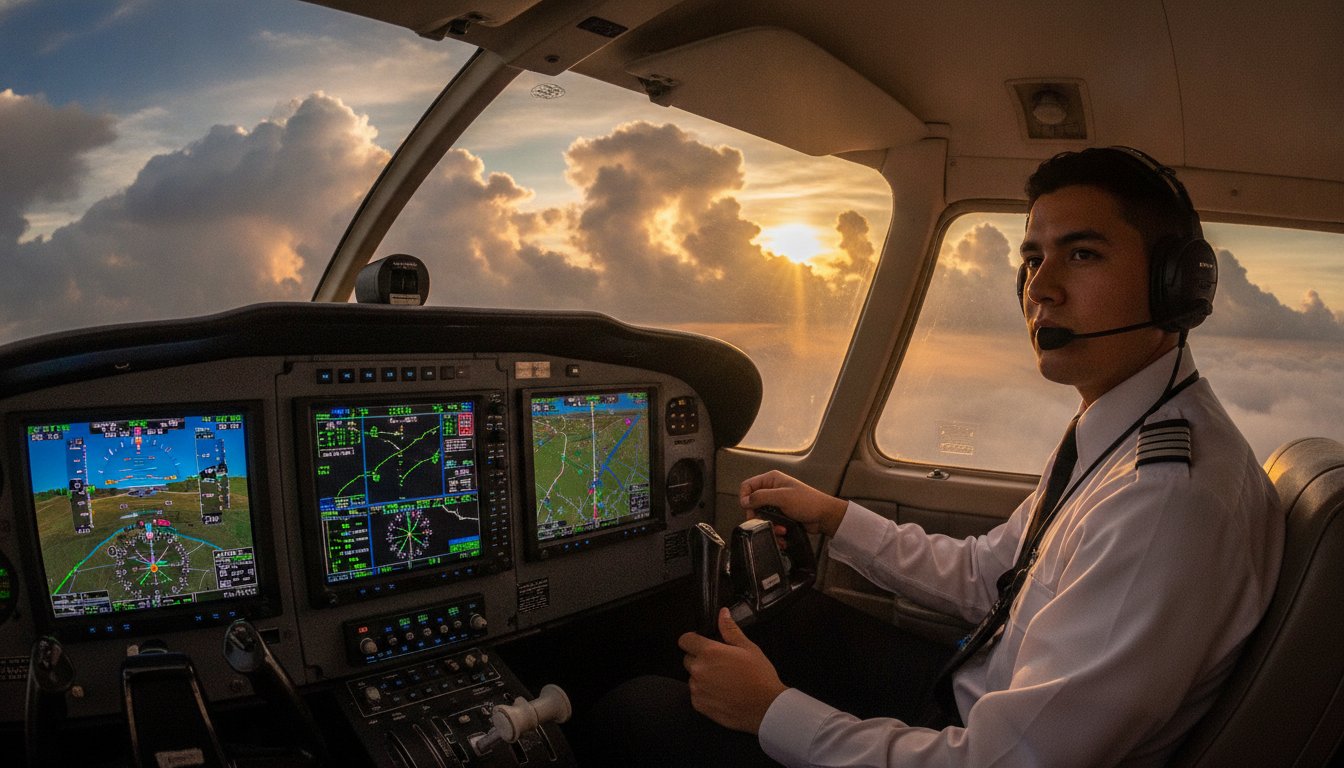
Earning your wings in the clear blue of a practice area is one thing, but mastering the intricate dance of the clouds over Miami or Orlando is what separates a pilot from a professional. You probably feel the weight of the decision between Part 61 and Part 141 training, or perhaps you're staring at the complex charts of busy Class B airspace with a mix of excitement and nerves. It's natural to wonder if the investment will truly pay off, but understanding the instrument rating requirements Florida aviators must meet is the first step toward a transformative career.
We're here to act as your practical mentor, clearing away the confusion so you can focus on the flight deck. This guide provides a definitive checklist of the FAA's 2026 mandates, including the specific flight hours and technical skills you'll need to master. You'll discover how training in our unique environment turns potential anxiety into a tactical advantage for your professional journey. We'll also explore how this rating serves as a core pillar of a Career Pilot Program, giving you the confidence to choose a path that leads directly to the airline cabin.
Key Takeaways
- Secure your Private Pilot License first to lay the essential groundwork for the high-stakes world of IFR certification.
- Gain a clear understanding of the instrument rating requirements Florida mandates, including the critical balance of cross-country PIC time and dual instruction.
- Evaluate the time-saving benefits of a Part 141 syllabus against the flexibility of Part 61 to determine which route accelerates your aviation career.
- Master the nuances of Orlando’s busy Class B airspace and local procedures at Kissimmee Gateway Airport to build elite situational awareness.
- Explore how integrated programs like Airline Pilot Elite combine multiple ratings to move you toward your professional destination with maximum efficiency.
FAA Instrument Rating Requirements Florida: The Essential Prerequisites
An Instrument Rating (IR) is the professional qualification that empowers you to fly under Instrument Flight Rules (IFR). It means you're no longer limited to clear skies and daytime visibility. With this rating, you gain the technical mastery to navigate an aircraft solely by reference to your flight instruments. Whether you're aiming for a seat in a commercial airliner or simply want the peace of mind to fly through a Florida afternoon cloud layer, understanding the specific instrument rating requirements Florida pilots must meet is your first step toward the flight deck.
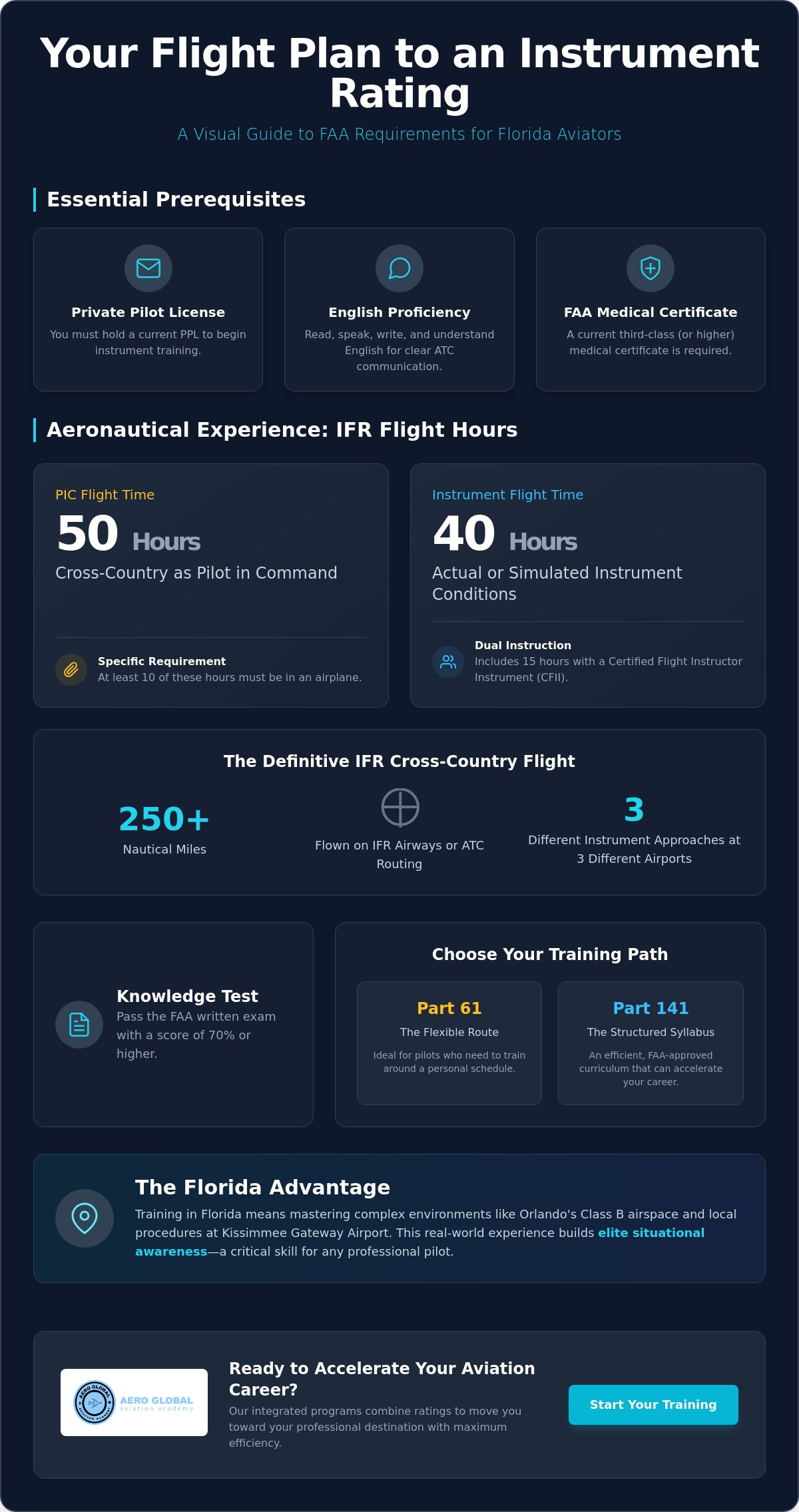
Before you begin specialized training, you must hold at least a current Private Pilot License (PPL). This foundation ensures you have the basic stick-and-rudder skills required to handle an aircraft before adding the complexity of IFR procedures. If you're still working on that first milestone, our guide on how to get your private pilot license florida will help you launch your journey. Additionally, you must be able to read, speak, write, and understand the English language to FAA standards. Clear communication with Air Traffic Control is a non-negotiable safety requirement. Finally, you'll need at least a current third-class FAA medical certificate to prove you're physically ready for the high-stakes environment of instrument flight.
The 2026 FAA Regulatory Framework
The path to certification is governed by 14 CFR Part 61.65, which outlines the rigorous FAA Instrument Rating prerequisites for aeronautical experience. Under Part 61, you'll need to accumulate 50 hours of cross-country flight time as Pilot in Command (PIC), with at least 10 of those hours completed in an airplane. This ensures you have the navigational experience to handle longer routes before you lose your outside visual references. Meeting these instrument rating requirements Florida mandates ensures you're prepared for the state's complex airspace. You must complete 40 hours of actual or simulated instrument time, which includes at least 15 hours of dual instruction from an authorized flight instructor.
Ground School and Knowledge Test Foundations
Success in the cockpit starts on the ground. You'll need to pass the Instrument Rating Knowledge Test, commonly known as the "written" exam, with a score of 70% or higher. This test covers essential topics like IFR navigation systems, advanced weather reports, and the specific FAA flight regulations that govern instrument flight. Our graduates find that the transition is a logical progression of their skills. We focus on turning complex technical data into practical knowledge, ensuring you don't just pass the test but truly understand the environment you're about to enter.
Aeronautical Experience: Breaking Down the IFR Flight Hours
Transitioning from visual flight to instrument mastery is a structured journey that transforms how you perceive the sky. While the prerequisites set the stage, the aeronautical experience requirements are where you build the muscle memory needed for a career in the clouds. To satisfy the instrument rating requirements Florida examiners look for, you must follow the specific flight time prescriptions outlined in 14 CFR § 61.65. This logged experience ensures you aren't just a passenger in the cockpit, but a pilot capable of managing complex systems under pressure.
The path to your checkride follows four primary milestones:
- Step 1: Cross-Country Foundation. You'll need 50 hours of cross-country flight time as Pilot in Command (PIC). At least 10 of these hours must be in an airplane for Part 61 students.
- Step 2: Instrument Immersion. You must log 40 hours of actual or simulated instrument time. Within this block, 15 hours must be dual instruction from a CFII (Certified Flight Instructor Instrument).
- Step 3: The Long IFR Cross-Country. This is a definitive 250-nautical-mile flight performed under IFR. You'll fly along airways or ATC-directed routing and execute three different types of instrument approaches at three different airports.
- Step 4: Technical Mastery. You'll demonstrate proficiency in basic attitude instrument flying, radio navigation, and emergency procedures without ever looking out the window.
Dual Instruction and Simulated Instrument Time
Building simulated time often involves wearing a "view limiting device" (a hood or foggles) while a safety pilot monitors the horizon. This collaborative environment is vital for safety and learning. We integrate these hours into our advanced flight training by using FAA-approved simulators. These devices allow you to practice high-stakes approaches or system failures in a controlled setting, maximizing every minute of your training budget. You'll also complete 3 hours of focused instrument training in the two months preceding your practical test to ensure you're checkride-ready.
Glass Cockpit vs. Six-Pack Training
As we move through 2026, the industry standard has shifted toward Technically Advanced Aircraft (TAA). While learning on traditional "six-pack" analog gauges builds great foundational skills, airline recruiters now prioritize proficiency in glass cockpit systems like the Garmin G1000 NXi. Mastering these digital displays is essential for modern situational awareness. We focus on balancing these high-tech automation management skills with "partial panel" training. This ensures that if your primary flight display ever fails, you have the raw skills to bring the aircraft home safely. If you're ready to start logging these hours in a modern fleet, consider visiting Aero Global Aviation Academy to see how we bridge the gap between training and the airlines.
Part 61 vs. Part 141: Which Path Fits Your Career Goals?
Choosing between a Part 61 and a Part 141 program is one of the most significant decisions you'll make on your journey to the flight deck. It impacts your timeline, your budget, and how you eventually present yourself to airline recruiters. While both paths lead to the same FAA certificate, the instrument rating requirements Florida students follow under each regulatory framework differ in structure and minimum flight time. Think of it as choosing between a custom-tailored mentorship and a high-intensity academic academy. Both will get you to the destination, but the rhythm of the journey is distinct.
Airlines often look favorably upon candidates who have trained in a disciplined, structured environment. This preference stems from the fact that Part 141 programs mirror the rigorous training standards found at major air carriers. By following a strict syllabus and passing mandatory stage checks, you demonstrate that you can thrive in a professional setting where performance is constantly measured. Beyond the resume boost, the financial implications are clear: fewer required hours often result in a lower total investment for your certification.
The Professional Advantage of Part 141
Part 141 flight schools operate under a highly structured, FAA-approved syllabus that allows for a significant reduction in required flight hours. Specifically, the instrument training requirement is reduced to just 35 hours, whereas Part 61 requires 40. Perhaps more importantly, Part 141 programs typically do not require the 50 hours of cross-country PIC time that Part 61 students must accumulate. This can shave weeks or even months off your training timeline. We use these efficiency metrics as key criteria when evaluating the best flight schools in florida. The frequent stage checks act as "mini-checkrides," building the ironclad confidence you'll need during airline technical interviews.
When Part 61 Makes Sense
Part 61 is often the ideal choice for working professionals or pilots who already have a substantial amount of flight experience. It offers the flexibility to schedule lessons around your life, rather than forcing your life to fit a rigid school calendar. When considering Part 61 versus Part 141, consider how you learn best. Part 61 allows for highly personalized instructor-student mentoring that adapts to your unique learning pace and style. If you already have your cross-country hours logged from previous adventures, the instrument rating requirements Florida examiners set for Part 61 might actually feel more accessible. You have the freedom to focus on specific weak points without being tethered to a pre-set lesson plan, making it a powerful option for self-motivated aviators.
Navigating Florida’s Airspace: Practical Requirements for Local Pilots
Mastering the instrument rating requirements Florida mandates involves more than just checking boxes on an FAA form. It requires you to become a tactical expert in some of the busiest and most dynamic airspace in the country. When you fly out of Kissimmee Gateway Airport (KISM), you're immediately integrated into the Orlando Class B environment. This demands elite situational awareness. You'll need to memorize local noise abatement procedures and master tower handoffs while maintaining your IFR scan. Positional awareness in this region often relies on a mix of digital waypoints and local landmarks like Lake Toho, ensuring you always know exactly where you sit in the arrival flow.
The "Go/No-Go" decision is perhaps the most critical skill you'll develop here. Florida’s convective activity isn't just a weather report; it's a daily operational reality. Learning when to fly and when to stay on the ground is the hallmark of a professional. By mastering these local nuances, you aren't just earning a rating. You're preparing for the high-pressure environments of commercial aviation where safety and efficiency are the highest priorities.
Central Florida Weather Management
Dealing with 2026 climate patterns means understanding how rapid-onset afternoon thunderstorms can change your flight plan in minutes. These storms are intense and unpredictable. You'll also need to account for Florida’s high density altitude. On a humid 95-degree day, your aircraft performance drops significantly, affecting your IFR climb gradients and safety margins. We believe that training in "actual" IMC (Instrument Meteorological Conditions) builds superior confidence. There's no substitute for the feeling of breaking out of a cloud layer and seeing the runway exactly where your instruments said it would be.
Air Traffic Control (ATC) Communication Mastery
Professional radio etiquette is your lifeline in the Central Florida training corridors. You'll learn the specific "Clearance Delivery" and "Departure Control" procedures that keep traffic flowing smoothly around Orlando International. This isn't just about talking on the radio; it's about understanding the logic behind every instruction. Mastering this local environment is the perfect preparation for the airline pilot career path, where clear communication and airspace knowledge are daily requirements. If you're ready to master these complex skies, apply to Aero Global Aviation Academy today and start your journey toward professional excellence.
Accelerate Your Career with Aero Global Aviation Academy
Meeting the instrument rating requirements Florida examiners demand is a rigorous process, but you don't have to navigate it alone. At Aero Global Aviation Academy, we've designed our programs to act as a bridge between your current skills and your ultimate professional destination. Our "Airline Pilot Elite" program is specifically engineered for efficiency, integrating your instrument rating, commercial certificate, and instructor ratings into a single, cohesive path. By combining these milestones, you eliminate the downtime and redundant training often found in modular programs, ensuring every hour in the logbook moves you closer to an airline cockpit.
Success in instrument training starts with a rock-solid foundation. Our "Wings Foundation" approach ensures your private pilot basics are ironclad before you ever put on the foggles. We believe that if you can't fly the airplane instinctively in clear weather, you won't have the mental bandwidth to manage a complex IFR approach in the clouds. To support this high standard, we provide access to a modern fleet of aircraft equipped with Garmin G1000 glass cockpits at our Kissimmee facility. Training on the same technology used by regional airlines isn't just a luxury; it's a strategic advantage that makes your eventual transition to the jets feel like a natural next step.
The Career Pilot Program Advantage
One of the biggest hurdles for students is the jump from instrument flight to professional operations. We solve this by bridging the gap between your IR certification and commercial pilot training. Our curriculum uses rigorous stage checks that mirror the intensity of an FAA checkride, which is why our students feel so prepared when the examiner finally sits in the right seat. This structure is why Aero Global Aviation Academy is the preferred choice for career pilot program candidates in the Orlando area. You'll also benefit from mentorship by instructors who have personally navigated the path to major regional airlines and are eager to share their real-world wisdom.
Start Your IFR Journey Today
The best way to understand how we help you master the instrument rating requirements Florida pilots face is to see it in action. We invite you to visit our training center at Kissimmee Gateway Airport to tour our fleet and meet our team of dedicated mentors. Whether you're ready to dive into a full career track or want to start with a discovery flight to experience the G1000 for yourself, we're here to provide a personalized training consultation tailored to your goals. Contact Aero Global Aviation Academy to schedule your IFR consultation and take the first step toward unlocking your professional aviation career.
Take Command of Your Aviation Future
You've seen how the path to IFR certification is both a technical challenge and a career-defining milestone. By understanding the instrument rating requirements Florida aviators must navigate, from logging specific cross-country hours to mastering the Garmin G1000 NXi, you're already ahead of the curve. You now know how to distinguish between the flexible Part 61 route and the streamlined efficiency of a Part 141 syllabus. More importantly, you understand that mastering Central Florida's unique weather and busy Orlando airspace turns a legal requirement into a tactical professional advantage.
We're committed to your success through our FAA Part 141 approved curriculum and a modern G1000 NXi training fleet that prepares you for the next generation of flight. Our experienced Central Florida mentors don't just teach you to pass a checkride; they prepare you for a lifetime of professional excellence. Ready to master the clouds? Explore our Airline Pilot Elite program in Kissimmee! Your transition from a private pilot to a career-ready professional is a structured, attainable process. We can't wait to see you in the cockpit.
Frequently Asked Questions
How many hours do I need for an instrument rating in Florida?
You'll need either 40 hours of actual or simulated instrument time under Part 61 or a minimum of 35 hours if you're enrolled in a Part 141 program. For those following Part 61, you must also accumulate 50 hours of cross-country flight time as pilot in command. These instrument rating requirements Florida examiners verify ensure you have the endurance for long-distance navigation and the technical skill to fly without visual references.
Can I use a simulator to meet the instrument rating requirements?
Yes, you can credit up to 20 hours of training in an FAA-approved flight simulator or aviation training device toward your total rating requirements. Using a simulator is a cost-effective way to master procedural tasks like holding patterns and approach plates before you ever leave the ground. It allows us to pause the flight to explain complex concepts, ensuring you're fully prepared for the actual cockpit environment.
Do I need a new medical certificate for my instrument rating?
You don't need a new medical certificate specifically for the rating, but you must possess at least a current third-class FAA medical certificate. This certificate ensures you meet the physical standards required to operate an aircraft safely. If you're planning on a professional career, we often suggest obtaining a first-class medical early on. This confirms there aren't any health hurdles between you and your future airline seat.
What is the "Long IFR Cross-Country" requirement?
The "Long IFR Cross-Country" is a 250-nautical-mile flight performed under instrument flight rules along airways or ATC-directed routing. This mission requires you to execute three different types of instrument approaches at three different airports. It's the ultimate test of your situational awareness and endurance. Completing this flight proves you can handle the complexities of a professional cross-country environment with absolute confidence.
Is it better to train for an instrument rating under Part 61 or Part 141 in Florida?
Part 141 is generally better for career-minded pilots due to its structured syllabus and reduced flight hour requirements. Part 61 offers more flexibility if you're a working professional who needs a self-paced schedule tailored to your life. Choosing the right path depends on your long-term goals and current experience levels. We're here to help you evaluate which framework aligns best with your personal timeline and professional aspirations.
What happens if I fail the IFR Knowledge Test?
If you fail the IFR Knowledge Test, you can retake it after your instructor provides additional training on the specific areas where you struggled. You'll need a new endorsement from your CFII before you can sit for the exam again. Don't let a setback discourage you. We treat these moments as learning opportunities to strengthen your technical knowledge before you move on to the practical flight training phase.
How long does it typically take to complete an instrument rating course in Kissimmee?
Full-time students in Kissimmee typically complete their instrument rating in 4 to 8 weeks. This timeline depends on your previous experience, the frequency of your lessons, and your dedication to ground school study. Training in Florida's consistent climate allows for a steady progression without the long weather delays found in other regions. We work with you to create a schedule that keeps your momentum high.
Can I get an instrument rating without a Private Pilot License?
No, you cannot earn an instrument rating without first holding at least a current Private Pilot License (PPL). The PPL provides the foundational flight skills and aeronautical knowledge required to safely operate an aircraft in visual conditions. Meeting the instrument rating requirements Florida mandates starts with this essential prerequisite. Once you have your PPL, you're ready to begin the specialized training that unlocks the ability to fly through the clouds.


