

Did you know that choosing the flight school with the lowest hourly rate could actually be your most expensive mistake in 2026? It's completely normal to feel a bit lost in the sea of FAA legalese when you're just trying to launch your career. You want to be in the cockpit, not buried in a manual trying to decipher the technical nuances of a Part 141 vs Part 61 flight school Florida. Whether you're aiming for a major airline or seeking the personal freedom of the skies, the structure you choose today dictates how quickly you'll reach your destination.
This guide simplifies the complex regulatory landscape so you can stop worrying about "what ifs" and start planning your first solo. You'll discover the critical differences in training hours, cost structures, and how Florida's unique environment with over 300 days of sunshine accelerates your progress. We'll provide a clear decision-making framework that aligns with your professional goals, helping you choose a program that fits your life and your budget. By the end of this article, you'll have the confidence to select a career-track path that turns your passion for aviation into a tangible reality.
Key Takeaways
- Learn how to distinguish between the structured oversight of a Part 141 program and the flexible, pace-controlled nature of Part 61 training.
- Discover why choosing a Part 141 vs Part 61 flight school Florida depends on whether you're pursuing a professional airline career or seeking a hobbyist certification like the Wings Foundation.
- Understand how Central Florida's 350+ flyable days and the strategic complexity of Kissimmee airspace accelerate your training timeline regardless of the regulation you choose.
- Explore how Part 141 stage checks and structured curricula provide the fastest path to the flight deck through career-track programs.
- Gain a clear decision-making framework to match your current lifestyle and long-term aviation aspirations with the right training structure for your goals.
Part 141 vs. Part 61 Flight Schools: The Core FAA Differences
When you decide to become a pilot, you'll immediately encounter two numbers: 61 and 141. These aren't just random digits; they represent specific chapters of the Federal Aviation Regulations (FAR) that dictate how your training is structured and supervised. Choosing between a Part 141 vs Part 61 flight school Florida isn't about finding a "better" school. It's about selecting the framework that fits your learning style and career speed.
The FAA oversees both paths to ensure every pilot meets the same rigorous FAA pilot certification standards. Whether you train under the flexible rules of Part 61 or the highly structured syllabus of Part 141, you'll take the exact same checkride with a Designated Pilot Examiner (DPE) to earn your license. The primary difference lies in the paperwork, the oversight, and the minimum hours required to reach that finish line. By understanding these structural differences, you can choose the path that gets you into the cockpit most efficiently.
What is a Part 61 Flight School?
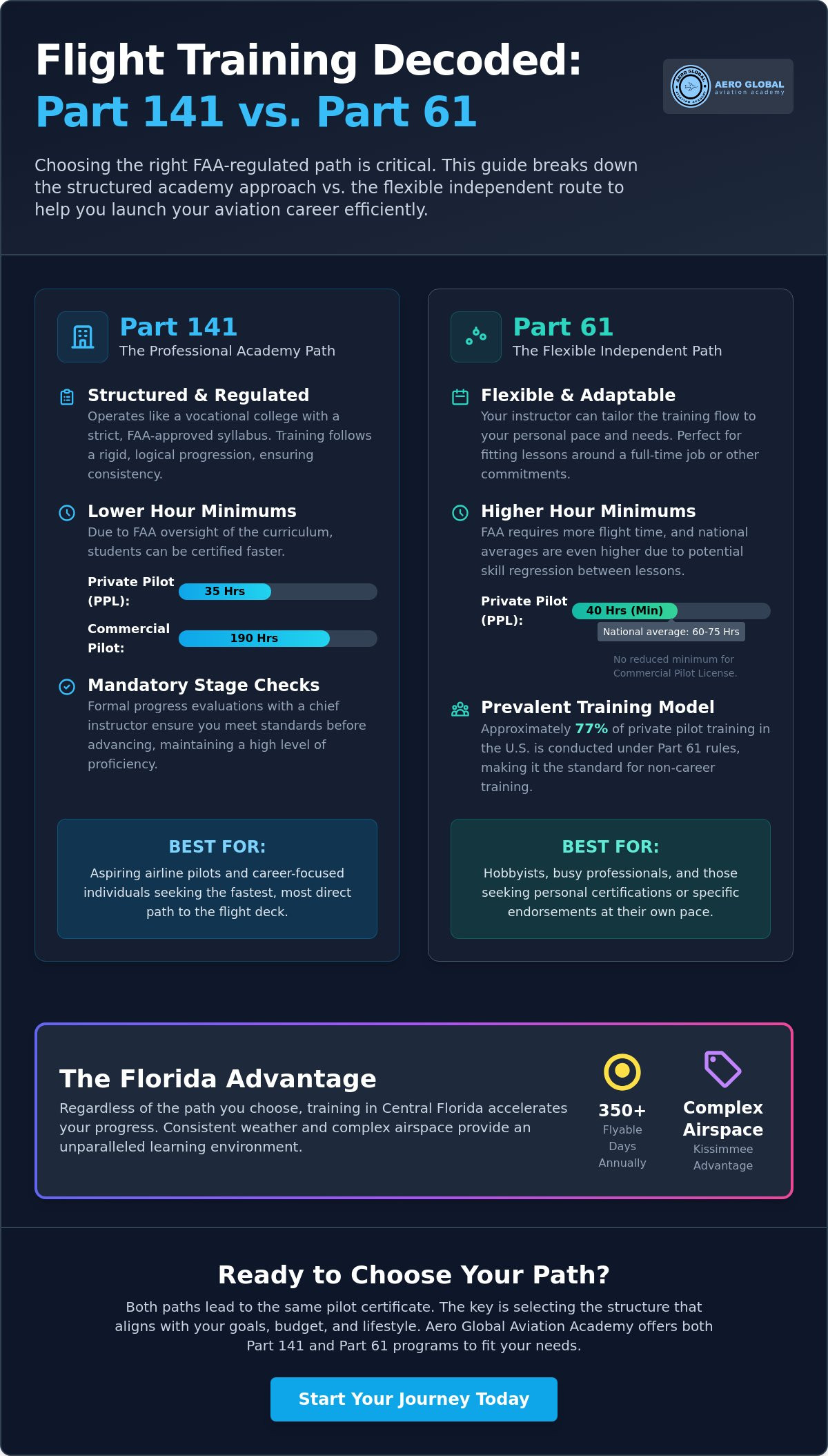
Think of Part 61 as the independent study path. In this model, your Certified Flight Instructor (CFI) has the freedom to tailor the lesson flow to your specific needs. If you're struggling with landings but excelling at navigation, your instructor can pivot the schedule immediately. This flexibility makes Part 61 a favorite for students training around a full-time job or personal commitments. Under these regulations, the FAA requires a minimum of 40 flight hours for a Private Pilot License (PPL). However, national averages in 2026 show most students finish closer to 60 or 75 hours because the lack of a rigid schedule can lead to skill regression between lessons.
What is a Part 141 Flight School?
Part 141 schools operate more like a vocational college or professional academy. They must use an FAA-approved syllabus that follows a strict, logical progression. These programs are designed for high-volume, career-track environments where consistency is key. Because the FAA has vetted the curriculum so thoroughly, they allow for lower minimums; you only need 35 hours for a PPL and as few as 190 hours for a Commercial Pilot License. A hallmark of this path is the "Stage Check." These are formal progress evaluations conducted by a chief instructor to ensure you're meeting standards before moving to the next phase. This structure makes a Part 141 vs Part 61 flight school Florida comparison vital for anyone aiming for a professional flight deck.
Part 61 Training: The Flexible Path for Independent Learners
Part 61 is the ultimate choice for those who need a customized experience. Unlike the rigid FAA regulations for Part 141 academies, Part 61 puts you in the captain's seat of your own schedule. Approximately 77% of private pilot training in the U.S. happens under these rules. It's the standard for anyone who isn't ready to commit to a full-time, college-style schedule. When weighing a Part 141 vs Part 61 flight school Florida, the flexibility of the latter is often the deciding factor for busy professionals in the Sunshine State.
This path is perfect for the Wings Foundation student. If you have a demanding career or family life, you can fly twice a week or twice a month. You aren't beholden to a syllabus that penalizes you for missing a specific lesson date. This freedom allows you to build a deep bond with a specific instructor or switch aircraft if your learning style changes. You have the autonomy to progress as fast or as slow as your life allows.
Who Should Choose Part 61?
It's the gold standard for hobbyists and independent learners. If you want a Private Pilot License Florida for weekend getaways or personal travel, Part 61 gives you the breathing room to learn at your own pace. It also serves pilots seeking specific, non-career ratings like tailwheel or high-performance endorsements. It's ideal for students who may need to pause and restart their training based on financial shifts or work projects without losing their spot in a rigid program.
Cost Realities of Part 61
You pay as you go, which lowers the initial barrier to entry. There are no massive upfront tuition deposits, making it accessible for many. However, there's a catch you should prepare for. Without a strict syllabus, some students hit "training plateaus." If you fly inconsistently, you might spend the first 20 minutes of every lesson re-learning what you forgot. While the FAA minimum is 40 hours, the national average is 60 to 75 hours. To keep your total investment low, you must stay disciplined and find a mentor-style instructor who keeps you focused. If you're looking for a mentor to guide you through this flexible journey, consider starting with the Wings Foundation to get your wings on your own terms.
Part 141 Flight Schools: The Fast-Track to Professional Aviation
If your ultimate goal is a seat on a commercial flight deck, the structure of a Part 141 environment is often your most logical choice. While Part 61 focuses on individual flexibility, Part 141 academies are designed to mirror the training pipelines of major airlines. This rigorous approach is why our Career Pilot Program thrives under these regulations. When you evaluate a Part 141 vs Part 61 flight school Florida, you're essentially choosing between a self-paced journey and a professional fast-track. Understanding the Part 61 vs Part 141 differences from a career perspective helps you see that standardization isn't just about rules; it's about building a professional resume.
A key feature of the Part 141 path is the "Stage Check." These are formal progress evaluations that ensure you're meeting specific standards at every milestone. Instead of just flying with your regular instructor, you'll periodically sit with a chief instructor who verifies your skills. This creates a high level of accountability and ensures you're truly checkride-ready. Some high-volume schools even earn "examining authority," which allows them to conduct final certifications in-house. This can save you weeks of waiting for a busy external examiner. Beyond the technicalities, there's a psychological advantage to training in a cohort. You're surrounded by peers with the same aspirations, creating a supportive, high-performance culture that keeps you motivated.
Reduced Hour Requirements and Efficiency
The most tangible benefit of Part 141 is the reduction in required flight hours. For a Commercial Pilot License (CPL), you can qualify with just 190 hours of total time, compared to the 250 hours required under Part 61. Finishing 60 hours earlier isn't just about saving money on aircraft rentals. It means you can start your career months sooner, potentially earning an airline salary while your peers are still building time. This efficiency is also why Part 141 is the standard for veterans using VA benefits and international students on M-1 or F-1 visas.
Ground School and Theory
Success in professional aviation requires more than just stick-and-rudder skills. It demands a deep understanding of complex weather, navigation, and instrument flight rules (IFR). Part 141 programs utilize structured classroom environments where you'll master these concepts alongside your flight training. This formal ground school prepares you for the intense training environments you'll face later at a regional or major airline. Statistics consistently show that students in structured theory programs maintain higher checkride pass rates. This record of success is a powerful signal to recruiters that you can handle the academic rigors of a professional pilot career.
The Florida Factor: Why Airspace and Weather Matter in 2026
Florida is more than just a vacation destination; it's a strategic training ground that offers unparalleled advantages for aspiring aviators. Whether you're comparing a Part 141 vs Part 61 flight school Florida, the local environment acts as a silent instructor, teaching you lessons you simply can't get in a flight simulator. With over 300 days of flyable weather annually, students in Central Florida avoid the frustrating seasonal delays that plague northern states. This consistency is vital for building muscle memory and keeping your training costs down by avoiding the need to re-learn maneuvers after a long winter break.
However, the "always sunny" reputation is a bit of a myth that the best flight schools in Florida address head-on. In reality, you'll learn to navigate complex convective weather and typical Florida afternoon thunderstorms. This real-world experience is invaluable. Dealing with high-density traffic in the Orlando area ensures you're comfortable talking to air traffic control (ATC) from day one, a skill that separates hobbyists from professionals. You'll graduate with the confidence to fly in some of the busiest airspaces in the world.
The Advantage of Kissimmee Gateway Airport
Training at Kissimmee Gateway Airport (KISM) puts you in the heart of one of the busiest and most educational airspaces in the country. Its proximity to Orlando International (MCO) gives you a front-row seat to Class B airspace operations, allowing for high-level ATC interaction that builds immense confidence. KISM itself features multiple runways and a variety of instrument approaches, making it a premier hub for advanced flight training. The flat local terrain provides a safe, expansive training ground where you can focus entirely on mastering your aircraft without the added stress of mountain obscurations or complex topographical obstacles.
Year-Round Training Continuity
The biggest drain on a flight training budget is inconsistency. When you can fly year-round, you maintain a steady progression that significantly shortens your time to certification. This continuity is a massive strategic benefit for those on the airline pilot career path. Every day you aren't grounded by snow or ice is a day you're moving closer to your first airline paycheck. By choosing a Part 141 vs Part 61 flight school Florida, you're leveraging the climate to ensure your transition from student to professional is as seamless as possible. If you're ready to take advantage of these perfect flying conditions, explore our training programs in Kissimmee and start your journey today.
Choosing Your Path at Aero Global Aviation Academy
Deciding between a Part 141 vs Part 61 flight school Florida is a personal milestone that requires balancing your professional dreams with your current reality. At Aero Global, we don't believe in a one-size-fits-all approach. We act as your practical mentor, helping you navigate these regulations to find the most efficient route to the flight deck. Whether you're seeking the foundational skills of our Wings Foundation or the comprehensive training of our Airline Pilot Elite program, we provide the individualized attention you need within a professional, high-standard structure. This collaborative spirit ensures that your technical requirements are always met with the supportive guidance necessary to turn a challenging course into a rewarding career milestone.
Our Airline Pilot Elite program is the ideal destination for students who crave the structure discussed in previous sections. It takes you from your first flight all the way to advanced instructor certification, ensuring you aren't just a pilot, but a leader in the aviation community. By integrating the rigorous standards of a Part 141 mindset with the personalized support of a local partner, we ensure you reach the airlines with the flight hours and confidence required to succeed. This program is specifically designed to bridge the gap between a beginner and a professional, making the complex world of aviation feel attainable and rewarding.
Decision Matrix: 141 or 61?
To help you choose, consider these questions: Is your goal a major airline career, or personal travel? Do you have a rigid timeline, or do you need to balance training with a full-time job? Many of our students find that starting with a Part 61 approach for their initial Private Pilot license allows them to build a solid foundation at their own pace before transitioning to a more structured environment for commercial pilot training. Our Kissimmee-based admissions team is ready to sit down with you to map out a personalized plan that respects your budget and your schedule.
Next Steps to Your First Solo
The best way to resolve the Part 141 vs Part 61 flight school Florida debate is to experience it for yourself. Book a discovery flight at our Orlando-area facility to get a feel for the aircraft, the airspace, and our instructional style. We also understand that professional training is a significant investment. To make your dreams more accessible, we offer financing and payment plan options through partners like Stratus Financial for our professional tracks. Don't let uncertainty ground your ambitions. Start your aviation journey with Aero Global today and take the first step toward a career that truly takes off.
Take Command of Your Aviation Future
Choosing between a Part 141 vs Part 61 flight school Florida ultimately comes down to your personal destination. If you crave a structured, fast-track environment designed to mirror the airlines, the Part 141 path provides the efficiency you need. If you require the freedom to balance training with a busy professional life, Part 61 offers the flexibility to learn on your own terms. Regardless of the regulatory path you select, training in the high-density airspace of Central Florida ensures you develop the elite communication skills and weather-related confidence that modern recruiters demand.
At Aero Global Aviation Academy, we're committed to being your practical mentor throughout this transformative journey. Our expert instructors in Kissimmee and Orlando utilize a modern fleet to guide you through personalized PPL to CPL tracks. We've built structured career paths that turn your passion into a professional reality, ensuring every hour in the logbook brings you closer to the flight deck. The sky is waiting for you, and the right program is the key to unlocking it.
Are you ready to stop dreaming and start flying? Explore Our Career Pilot Programs in Kissimmee and see how our dedicated team can help you earn your wings. We can't wait to see you in the cockpit.
Frequently Asked Questions
Is a Part 141 certificate better than a Part 61 certificate for airline hiring?
No, airlines don't prefer one training path over the other. Recruiters evaluate your total flight time, training record, and checkride performance rather than the regulatory structure of your school. Both paths lead to the same FAA pilot certificates, and your success depends on your individual skill and professionalism during your interviews.
Can I switch from a Part 61 school to a Part 141 school mid-training?
You can switch, but it requires a formal evaluation to transfer your hours. When moving to a Part 141 program, the school will conduct a proficiency check to determine how much credit you can receive for previous training. Typically, you can transfer a portion of your hours depending on the specific curriculum requirements. It's best to consult with your new school early to minimize any lost time.
Does Part 141 flight school cost more than Part 61?
Not necessarily, though the pricing structures differ significantly. Part 141 schools often have higher hourly rates because of the increased FAA oversight and structured resources provided. However, because the hour requirements are lower, the total cost can be comparable. When comparing a Part 141 vs Part 61 flight school Florida, look at total program estimates rather than just the hourly rate of the aircraft.
Are Part 141 schools the only ones that accept GI Bill benefits?
Yes, the VA typically only provides reimbursement for flight training at FAA-approved Part 141 schools. To use GI Bill benefits for vocational flight training, the program must be specifically approved for veteran use. This is a major reason why career-track veterans choose the structured 141 environment. Always verify the specific school status with their admissions team before you enroll.
How many hours do I really save in a Part 141 program?
You save a significant amount of time on your commercial certificate. For a Private Pilot License, the minimum is 35 hours under Part 141 compared to 40 hours under Part 61. The real savings happen at the Commercial level, where Part 141 allows you to graduate with 190 hours instead of the 250 hours required by Part 61. Saving 60 flight hours can get you into a professional cockpit months sooner.
What happens if I fail a stage check in a Part 141 school?
Failing a stage check is a normal part of the learning process designed to ensure you're safe. If you don't meet the standards, your instructor will provide targeted remedial training on the specific maneuvers or knowledge areas that need improvement. Once you're ready, you'll re-test that portion of the check. These evaluations act as a safety net to ensure you're fully prepared for the final FAA checkride.
Is Kissimmee a good place for a beginner to start Part 61 training?
Kissimmee is an outstanding location for beginners because of its diverse airport environment. Starting your Part 141 vs Part 61 flight school Florida journey at KISM exposes you to air traffic control and complex airspace from your very first lesson. This builds a high level of comfort that students at smaller, uncontrolled fields often lack. It's a strategic choice for anyone looking to master the technical side of flying.
Do I need to attend ground school for Part 61?
You don't have to attend a formal classroom ground school, but you must master the same theoretical knowledge. Part 61 allows you to use home-study courses or online programs to prepare for your FAA written exam. Your instructor will then verify your knowledge through one-on-one ground briefings before signing you off. This flexibility is a key reason why many independent learners choose the Part 61 path.


