
The cheapest hourly aircraft rental rate in Florida could actually be the most expensive way to earn your wings. If you're staring at a spreadsheet trying to decode Part 61 vs Part 141 flight school costs Florida, you aren't alone. It's easy to feel overwhelmed by the "pay-as-you-go" flexibility of one path versus the structured, intensive curriculum of the other. You want a career in the sky, but you don't want to be grounded by unexpected fees or regulatory confusion.
We understand that every dollar counts when you're building your professional future. This 2026 comparison gives you a clear, dollar-for-dollar breakdown of what it really takes to become a pilot in the Kissimmee and Orlando area. You'll master the financial nuances between these two training styles and discover which one reaches the airlines faster. We'll look at everything from FAA exam fees to recent 2026 regulatory modernizations, providing a realistic budget for comprehensive tracks like our Career Pilot Program.
Key Takeaways
- Understand how Part 141's FAA-approved syllabi can reduce your total flight hour requirements, making it a powerful choice for those aiming for a commercial career.
- Compare Part 61 vs Part 141 flight school costs Florida to see how Central Florida's aircraft rental rates and instructor fees impact your long-term investment.
- Leverage the "Florida Advantage" of 300+ flyable days to maintain training momentum and avoid the costly plateaus caused by frequent weather delays.
- Budget accurately for essential extras like medical exams and DPE checkride fees to ensure your 2026 flight training journey remains financially predictable.
- Explore how structured tracks like the Career Pilot Program provide a direct and efficient path from your first solo to a professional airline cockpit.
Part 61 vs. Part 141: Why the Regulatory Path Dictates Your Florida Flight School Budget
Your journey to the flight deck begins with a critical decision that influences every dollar you spend. Choosing between Part 61 and Part 141 isn't just about paperwork. It's about selecting a training philosophy that matches your career goals. In the competitive Florida aviation market, understanding Part 61 vs Part 141 flight school costs Florida is the first step toward a smart investment. Your destination determines the map you'll use, and for many, the structured path offers the most reliable return on investment.
The Part 61 Approach: Flexibility at a Potential Premium
Part 61 is often described as the "pay-as-you-go" method. It follows the general FAA certification standards but allows for a highly personalized schedule. This is often the ideal choice for recreational flyers or students who need to balance training with a busy professional life. If you're looking at our Wings Foundation course to fly for personal enjoyment, this flexibility is a major benefit.
However, this freedom comes with financial risks for career-track students. When evaluating Part 61 vs Part 141 flight school costs Florida, remember that the lowest hourly rate rarely leads to the lowest total certificate cost. Without a rigid schedule, it's easy to fall victim to "skill fade." If you only fly once a week, you'll likely spend a significant portion of each lesson reviewing previous maneuvers. This inefficiency adds up quickly. While the hourly rate might look identical to other programs, the total number of hours required to reach proficiency often climbs, turning a "flexible" budget into an expensive one.
The Part 141 Advantage: Structured Efficiency for Future Professionals
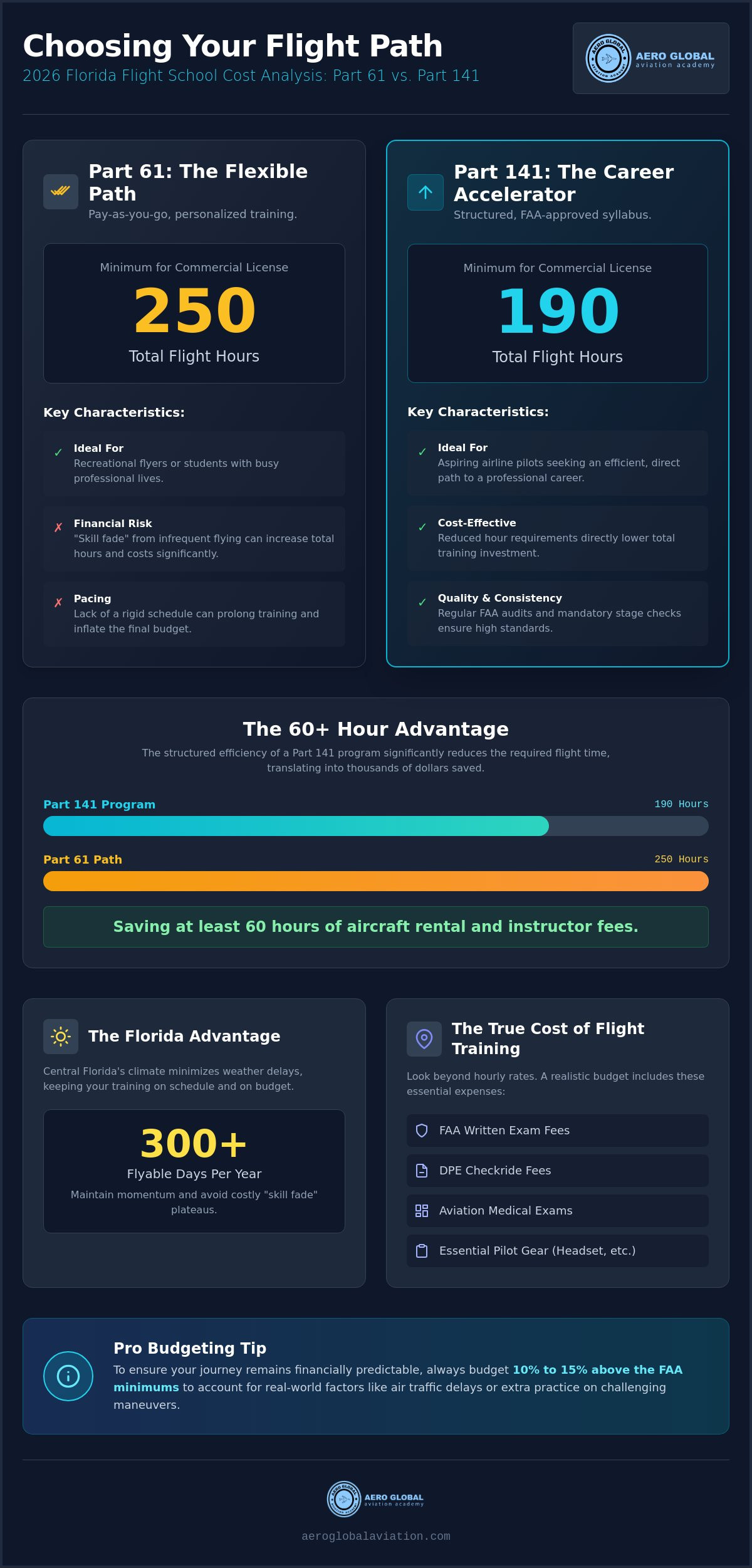
For those pursuing our Career Pilot Program, Part 141 provides a streamlined route to the airlines. The most significant financial advantage is the reduced hour requirement for certification. Under Part 141, you can qualify for a Commercial Pilot License in just 190 flight hours, whereas Part 61 requires a minimum of 250 hours. Saving 60 hours of aircraft rental and instructor fees can put thousands of dollars back into your pocket.
This efficiency is possible because the FAA approves the specific syllabus used by the school. Every lesson is a building block that leads directly to the next milestone, ensuring no time is wasted in the air. Part 141 oversight ensures training consistency and quality control through regular FAA audits and mandatory stage checks. This structure is especially valuable in Florida's high-density airspace. Training in a professional environment from day one prepares you for the rigors of airline operations, making you a more disciplined and safety-conscious pilot.
Ultimately, your "Career Pilot" mindset should dictate your path. If you view flight training as a professional apprenticeship rather than a hobby, the structured efficiency of a Part 141-style program is almost always the more cost-effective choice for your Florida pilot career.
Breaking Down the 2026 Costs: Hourly Rates vs. Total Program Investment
Analyzing the raw numbers is essential for any aspiring aviator. In 2026, Central Florida remains a premier hub for training, but you must look beyond the sticker price of a single hour in a Cessna 172 or Piper Archer. While Part 61 schools might advertise competitive hourly rates for independent instructors, the total program investment often tells a different story. Academy-based instruction typically includes integrated resources that independent instructors can't match, such as dedicated maintenance teams and standardized training environments. These factors directly influence Part 61 vs Part 141 flight school costs Florida by impacting how many hours you actually spend in the air to reach proficiency.
The "Zero to Hero" approach is where the most significant savings happen. By bundling your ratings into a comprehensive track, you eliminate the expensive downtime between certificates. This continuity keeps your skills sharp and reduces the total hours spent in the cockpit. We always recommend budgeting 10% to 15% above the FAA minimums. Real-world factors like air traffic delays at busy Orlando-area airports or a particularly challenging maneuver mean very few students finish at the exact minimum hour mark. Preparing for this buffer ensures your training never stalls due to financial stress. If you're ready to start this journey, our Career Pilot Program offers the structured path needed to manage these costs effectively.
PPL and CPL Cost Milestones in Florida
Your first major milestone is the Private Pilot License. You can find a detailed breakdown of these initial expenses in our guide to the Private Pilot License in Florida. Once you move toward professional certification, the cost gap between regulatory paths widens. Under Part 61, you must build 250 hours for your commercial certificate. In contrast, a Part 141 program allows you to reach that same goal in just 190 hours. This 60-hour difference represents a massive saving in aircraft rental and instructor fees. You can explore the full timeline for this investment in our 2026 guide to Commercial Pilot Training.
Ground School and Simulator Expenses
Modern flight training relies heavily on technology to drive down expenses. Using FAA-certified simulators for instrument and procedure training is a highly cost-effective strategy. Simulators allow you to pause, repeat difficult approaches, and practice emergency procedures without the high hourly cost of fuel and aircraft wear. Part 141 programs utilize structured training syllabi that integrate these simulator sessions perfectly with your flight hours.
Ground school also plays a pivotal role in your budget. While online ground schools offer convenience, the in-person classroom instruction found in structured programs often leads to higher retention. This reduces the risk of checkride failures and the need for expensive retraining. When you calculate Part 61 vs Part 141 flight school costs Florida, the efficiency of a structured ground program often pays for itself by getting you through your exams on the first attempt.
The 'Florida Advantage': How Weather and Structured Syllabi Cut Training Expenses
Choosing where you train is just as important as how you train. When you evaluate Part 61 vs Part 141 flight school costs Florida, you must account for the "cost of time." In many northern states, winter brings weeks of grounded flights and gray skies. This lead to skill fade, where students spend their first few lessons back just re-learning maneuvers they forgot during the forced break. In Orlando and Kissimmee, we enjoy over 300 days of VFR (Visual Flight Rules) weather every year. This climate isn't just a luxury; it's a strategic financial asset. It allows you to maintain a high frequency of training, which is the most effective way to keep your total investment from ballooning.
At Aero Global, our Part 141-style programs are designed to exploit this geographic edge. By flying consistently, you move through the syllabus without the repetitive review sessions that plague students in less favorable climates. The efficiency of Central Florida's weather, combined with the rigorous FAA regulations for Part 141, creates a momentum that saves you money. You're paying for progress, not just for time in the logbook.
Training Continuity and Skill Retention
The hidden drain on any flight school budget is the "training plateau." This happens when gaps between lessons force you to spend expensive flight hours reviewing basic skills instead of learning new ones. Flying three to five times a week is significantly cheaper than flying once a week because your retention remains high. A structured Part 141 schedule forces this progress, ensuring that every hour in the cockpit moves you closer to your rating. The airline pilot career path is accelerated by Central Florida's geography.
Orlando Airspace: Training in a High-Value Environment
Some students worry that busy airspace might increase costs due to taxi delays, but the opposite is often true for your career ROI. Training at Kissimmee Gateway Airport (KISM) places you in a complex, high-value environment from day one. You'll learn to communicate with controllers and navigate diverse traffic patterns without the extra cost of specialized "advanced" clinics later. This real-world experience makes you a more hireable pilot. When comparing Part 61 vs Part 141 flight school costs Florida, remember that the quality of the environment matters. Orlando's regional airport fees and fuel prices remain competitive, allowing you to train in a world-class aviation hub without the premium prices found in other major metropolitan areas.
The True Cost of Flight Training: Budgeting for Medicals, Exams, and Gear in Kissimmee
The true price of becoming a pilot extends well beyond the fuel and the flight instructor's time. When you're weighing Part 61 vs Part 141 flight school costs Florida, don't forget the administrative side of the FAA. Think of these expenses as the professional tools of your trade. Budgeting for your First Class Medical certificate is the first step for any career-minded student. In Florida, this exam typically costs between $100 and $200. While a Third Class Medical is sufficient for recreational flying, airlines require the higher standard. Securing this early ensures you're medically eligible for the career you're investing in.
You also need to prepare for the "checkride cash." Designated Pilot Examiners (DPEs) are independent professionals, and their fees for practical tests in Florida generally range from $700 to $900. These are separate from your school tuition. Additionally, your flight bag needs proper gear. A quality noise-canceling headset, an iPad Mini, and a ForeFlight subscription are essential for modern navigation. Living in the Kissimmee and Orlando area also requires planning. While the region is an aviation paradise, full-time students should budget for local housing and transport to ensure they can focus entirely on their training without financial distractions.
FAA Administrative and Exam Fees
Plan for your written knowledge tests early. Each FAA written exam costs approximately $175. If you fail a checkride, the financial impact is more than just the re-examination fee. You'll also need additional flight hours for remedial training. This is where the structure of a Part 141 program acts as a financial safeguard. Because the syllabus is so rigid and includes regular stage checks, students often have higher first-time pass rates. This efficiency saves you from the "hidden" costs of repeating expensive milestones. Once you graduate, remember to budget for advanced ratings like Multi-engine add-ons or CFI certifications to stay competitive.
Financing and Scholarship Opportunities
The structure of a Part 141 academy often opens more doors for funding. Many specialized student loan programs require the school to have Part 141 accreditation because it guarantees a specific level of oversight and a clear graduation timeline. Florida also hosts numerous aviation scholarships in 2026 for dedicated students. The ROI of a career pilot program is best measured by how quickly it gets you into a paying cockpit. Every month of delay is a month of lost airline seniority and salary. Contact us at Aero Global Aviation Academy to see how we help you plan for every expense on your way to a professional career.
Investing in Your Future: Why Aero Global Aviation Academy’s Structured Programs Offer Superior ROI
True return on investment in aviation isn't measured by the lowest hourly rate, but by how quickly you transition from a student to a salaried professional. When you analyze Part 61 vs Part 141 flight school costs Florida, the most significant factor is the "seniority clock." Every month you spend stuck in a less efficient training program is a month of lost airline wages and retirement contributions. At Aero Global Aviation Academy, we act as your practical mentor. We combine the rigorous efficiency of a structured curriculum with the personalized attention of a dedicated local partner. Our goal is to ensure your investment leads directly to a rewarding career destination.
We've designed our academy to eliminate the friction that often drains flight training budgets. By integrating professional mentorship with high-quality maintenance and modern aircraft, we provide a reliable environment where you can focus on mastering the skies. Choosing a structured path here in Kissimmee means you aren't just a customer at a flight school. You're a professional pilot in training. This mindset shift, supported by our optimized Part 61 vs Part 141 flight school costs Florida strategies, ensures you reach your milestones with precision and confidence.
Our Professional Pilot Tracks
- Wings Foundation: This program builds a rock-solid Private Pilot base, ensuring you have the fundamental skills required for a lifetime of safe flying.
- Career Pilot Program: This is our most popular track for those seeking a direct path from their first solo to a Commercial Pilot License. It focuses on efficiency and professional readiness.
- Airline Pilot Elite: For the ultimate investment in your future, this track takes you from zero experience all the way through advanced instructor certifications.
Our advanced flight training prepares you for the complex world of multi-engine operations and flight instruction. Training at a dedicated academy offers a level of standardization and resource availability that small flying clubs simply can't match. You'll benefit from a community of like-minded peers and instructors who are all focused on the same professional goals.
Take Flight in Kissimmee
Kissimmee Gateway Airport (KISM) offers the perfect balance of training complexity and operational efficiency. You'll gain experience in a controlled environment that prepares you for major hubs like Orlando International, but without the extreme delays and costs associated with larger airports. This strategic location is one of our greatest assets for keeping your training on schedule and within budget.
We invite you to visit our facility, meet our professional instructors, and see our fleet in person. Booking a discovery flight is the best way to evaluate if our structured approach matches your career aspirations. Don't let your dreams stay on the ground. Reach out to us at Aero Global Aviation Academy today and take the first step toward your seat on the flight deck.
Take Command of Your Professional Pilot Career
Choosing the right regulatory path is one of the most significant financial decisions you'll make as an aspiring aviator. By mastering the nuances of Part 61 vs Part 141 flight school costs Florida, you can select the training style that maximizes your budget and minimizes your time to the flight deck. Remember that the efficiency of a structured syllabus, combined with Central Florida's year-round flying weather, often provides a much faster return on investment than a pay-as-you-go approach. Every hour saved in training is an hour sooner you can start earning a professional salary.
At Aero Global Aviation Academy, we specialize in taking you from your first solo to a professional cockpit through our Career Pilot Program. Located at the strategic Kissimmee Gateway Airport, we provide the mentorship and structured paths you need to reach major airline employment with confidence. You don't have to navigate complex regulations or hidden fees alone. Our team is dedicated to your individual success and ready to guide you through every milestone.
Schedule your discovery flight at Aero Global Aviation Academy and start your career journey today! The sky is waiting for you, and we're here to help you reach it.
Frequently Asked Questions
How much does a Private Pilot License cost in Florida in 2026?
Obtaining a Private Pilot License in Florida typically costs between $15,000 and $20,000 in 2026. This comprehensive range includes aircraft rental, instructor fees, and required ground school materials. Your total investment depends heavily on how frequently you fly. Consistent training usually results in fewer total hours, while students who fly three times a week often finish closer to the lower end of the cost spectrum.
Is Part 141 really faster than Part 61 for career pilots?
Part 141 is generally faster for career-track students because it allows for significantly lower flight hour requirements for advanced certificates. For example, you can earn a Commercial Pilot License with just 190 hours under Part 141, whereas Part 61 requires 250 hours. This structured approach is a major factor when comparing Part 61 vs Part 141 flight school costs Florida, as it reduces the total time spent paying for aircraft and instructors.
What are the hidden costs of flight school that tuition doesn't cover?
Tuition often excludes essential administrative and personal expenses such as FAA medical certificates, written knowledge tests, and pilot gear. You should budget for a quality headset, an iPad with navigation software, and renter's insurance. Additionally, fees for the final practical exam are paid directly to the examiner. These "hidden" costs can add several thousand dollars to your total training budget over the course of your program.
Can I switch from Part 61 to Part 141 mid-training?
You can switch between programs, but you may not receive full credit for all your previous flight hours. Part 141 schools follow FAA-approved syllabi that have strict requirements for how and where hours are logged. The FAA typically limits the amount of "outside" time that can be applied to a Part 141 course. It is usually most cost-effective to choose a path and complete a specific rating before making a transition.
Why is flight training in Orlando/Kissimmee considered cost-effective?
The Orlando and Kissimmee area is highly cost-effective because it offers over 300 flyable days per year, which prevents expensive training plateaus. Constant progress means you spend less time reviewing old material and more time mastering new skills. This geographic advantage helps lower the overall Part 61 vs Part 141 flight school costs Florida by significantly reducing the total calendar time and flight hours needed to reach graduation.
Do airlines prefer Part 141 graduates over Part 61?
Airlines value the disciplined and standardized training environment that a Part 141 academy provides to its students. While you can reach the airlines through either regulatory path, the structured nature of Part 141 mirrors the training environment you will encounter at a major carrier. This familiarity often makes graduates more prepared for the rigors of airline transition programs and initial operating experience.
What is the average hourly rate for flight instructors in Florida?
In 2026, flight instructor rates in Florida generally range from $60 to $90 per hour. This fee applies to both dual flight instruction and ground training sessions. High-quality instruction is a critical investment because an experienced mentor can help you master complex maneuvers more efficiently. While independent instructors might offer lower rates, academy-based instructors often provide a more standardized curriculum that speeds up your overall professional progress.
How much should I budget for FAA checkride fees in 2026?
You should budget between $700 and $900 for each practical exam with a Designated Pilot Examiner in Florida. These fees are paid directly to the examiner and are not typically included in your flight school's tuition rates. If a re-test is required, you may also need to pay an additional fee. Keeping this "checkride cash" set aside ensures you can schedule your exam as soon as your instructor provides the final endorsement.


