

Did you know that choosing the path with more flexibility might actually slow down your progress toward a commercial cockpit? It sounds backward, but the decision between part 61 vs part 141 training often comes down to whether you prioritize a custom schedule or a fast-track syllabus. You probably feel the weight of this choice, especially when FAA terminology starts to blur together and the fear of overspending on flight hours becomes real. It's a high-stakes investment, and you want to ensure every hour in the sky moves you closer to your stripes.
Choosing between part 61 vs part 141 training won't change the privileges of your license. A Private Pilot certificate earned under Part 141 allows you to fly the same aircraft and carry the same passengers as one earned under Part 61. To get a better sense of the requirements, you might explore Private Pilot Certification options to see how these regulations translate into a daily training schedule. The real difference lies in the "how" and "when" of your education; one path offers a loose, adaptive schedule, while the other provides a rigorous, pre-approved syllabus designed for maximum efficiency and professional development.
We're here to clear the air and help you discover the most efficient route for your aviation career in 2026. You'll learn exactly how the 60-hour difference in commercial minimums impacts your timeline and why the structured environment of a Part 141 school remains the standard for airline recruiters even as modern regulations evolve. We'll also look at how the sunny skies of Orlando and Kissimmee provide the perfect backdrop for our Career Pilot Program. By the end of this article, you'll have a clear roadmap to your professional certification and the confidence to start your journey today.
Key Takeaways
- Master the distinction between the standard Part 61 rules and the FAA-approved curriculum of Part 141 to find the structure that fits your personal learning style.
- Analyze the significant gap in Commercial Pilot minimums to understand how part 61 vs part 141 training can impact your total investment and time to hire.
- Navigate the complexities of the GI Bill and vocational reimbursement caps to maximize your funding for professional pilot development.
- Explore how the unique climate and training environment in Kissimmee accelerate your progress toward advanced ratings and certifications.
- Map your flight plan by matching your career aspirations to our tailored paths like the Career Pilot Program or the comprehensive Airline Pilot Elite course.
Understanding the FAA Regulatory Maze: What Are Part 61 and Part 141?
Think of Title 14 of the Code of Federal Regulations (CFR) as the master rulebook for everything that happens in American skies. It's the legal foundation for aviation in the United States. Within this massive manual, the FAA provides two distinct frameworks for earning your wings. While the technical requirements and training environments differ, the end result is identical. Whether you train at a local airfield or a large academy, Pilot certification in the United States remains a standardized achievement recognized globally.
Choosing between part 61 vs part 141 training won't change the privileges of your license. A Private Pilot certificate earned under Part 141 allows you to fly the same aircraft and carry the same passengers as one earned under Part 61. The real difference lies in the "how" and "when" of your education. One path offers a loose, adaptive schedule, while the other provides a rigorous, pre-approved syllabus designed for maximum efficiency and professional development.
Part 61: The Flexible, Instructor-Led Approach
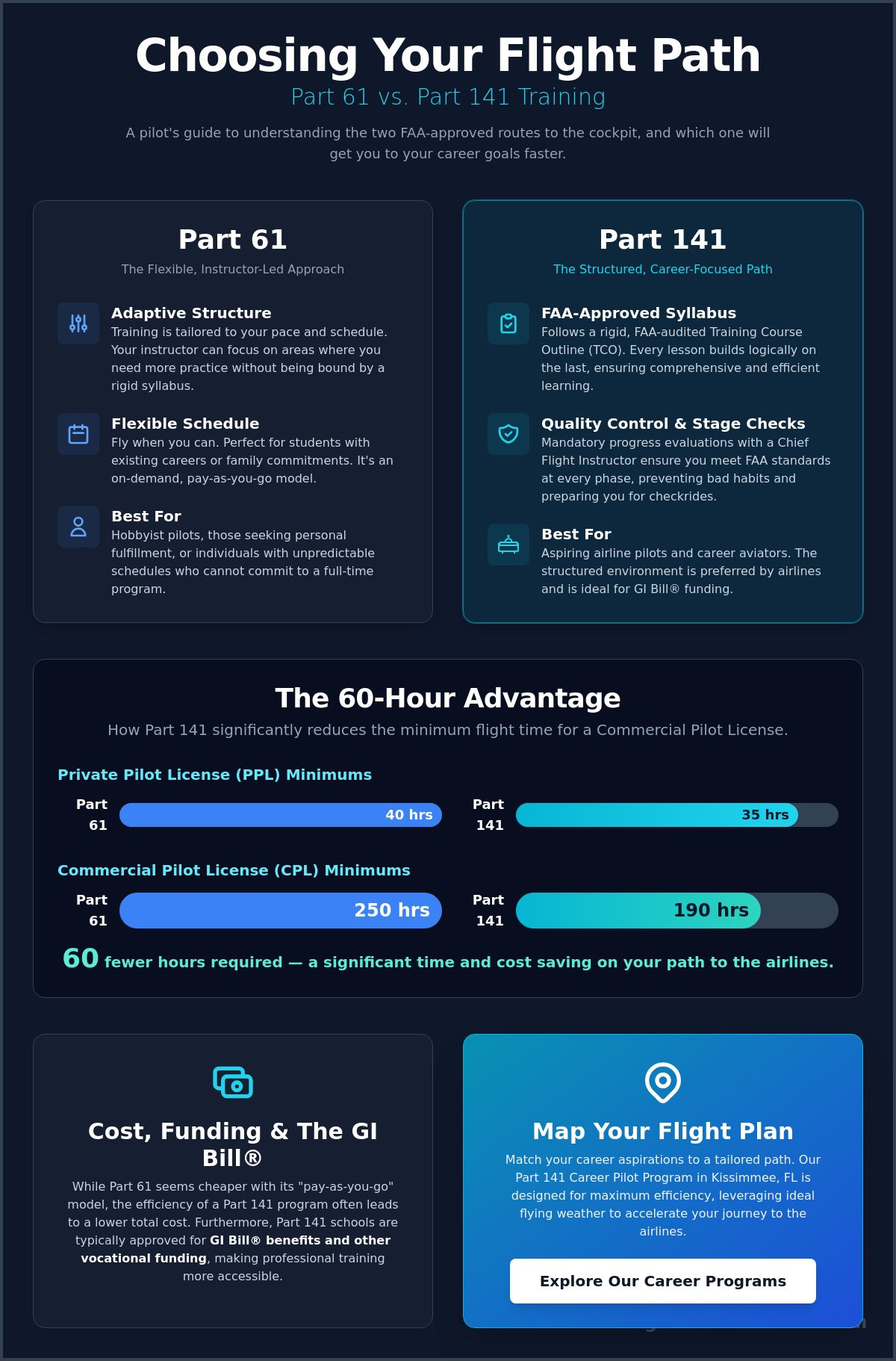
Part 61 is often described as the "standard" way to learn. It focuses on the direct relationship between you and your flight instructor. This path is incredibly adaptive. If you have a demanding career or family commitments, Part 61 allows you to fly when your schedule permits. There's no mandatory timeline for completion. You and your instructor work through the requirements until you've mastered the necessary skills. This is a popular choice for students starting with our Wings Foundation course, where the primary goal is personal fulfillment rather than a rapid career transition.
Part 141: The Structured, Academy-Style Environment
Part 141 schools operate under a much higher level of FAA scrutiny. To maintain this status, a school must submit a detailed Training Course Outline (TCO) for FAA approval. This document acts as a rigid roadmap for your education. It ensures that every lesson and ground school session follows a logical, building-block sequence. When evaluating part 61 vs part 141 training for a professional career, this structured environment is often the deciding factor. The FAA conducts regular audits to ensure the school follows its approved curriculum, creating an academic atmosphere that mirrors airline training.
Breaking Down the Training Structure: Flexible vs. Formal
Choosing between part 61 vs part 141 training is really a choice between two different learning lifestyles. Part 61 operates on an on-demand basis. You schedule a flight, meet your instructor, and pay as you go. It's built for life's unpredictability. In contrast, Part 141 requires formal enrollment. You're joining a structured academy with a specific start date and a clear graduation target. This enrollment model extends to ground school too. While Part 61 allows for self-study via home-study courses, Part 141 often requires a set number of hours in a classroom or a formal ground school environment, ensuring you don't miss any critical theory before you ever leave the ground.
One of the most valuable features of the formal path is the stage check system. While a student in a part 61 vs part 141 training comparison might fly with the same instructor for months, a Part 141 student must pass periodic evaluations with a Chief Flight Instructor. These checks act as a quality control filter. They ensure you're actually meeting FAA standards before moving to the next phase. It's a safety net that prevents small mistakes from becoming expensive, ingrained habits that could hurt your performance during a final checkride.
Curriculum and Syllabus Requirements
In a Part 141 environment, your instructor must follow an FAA-approved Training Course Outline (TCO). Every lesson is scripted, which means you always know exactly what to study before arriving at the hangar. Part 61 offers more room to breathe. If you're struggling with crosswind landings, your instructor can spend three lessons focusing solely on that maneuver without needing to justify it to a rigid syllabus. However, many high-quality schools now apply a professional pilot track curriculum to their Part 61 students, giving them the best of both worlds: flexibility and a proven roadmap.
Instructor Consistency and Student Support
Standardization is the heartbeat of a professional academy. Because Part 141 schools are audited, their instructors often undergo more frequent internal training to ensure everyone is teaching to the same high standard. In a less formal Part 61 setting, you might face 'instructor hopping' if your mentor leaves for the airlines mid-way through your course. This can lead to redundant training and wasted money. Reading through AOPA's comparison of Part 61 and Part 141 highlights how critical it is to find a school that prioritizes mentorship regardless of the regulatory path. Whether you choose the flexibility of Part 61 or the rigor of 141, having a dedicated mentor is what ultimately gets you to the finish line.
If you're ready to see how these structures look in practice, our Career Pilot Program offers the perfect blend of professional oversight and personalized support to help you reach your goals.
Flight Hour Minimums and Timeframes: Which Path Is Faster?
When you look at the raw numbers, the differences in part 61 vs part 141 training requirements seem small at first, but they compound quickly as you move toward professional ratings. For a Private Pilot License, the FAA mandates a minimum of 40 hours under Part 61, while Part 141 allows for certification in just 35 hours. While five hours might not sound like a revolution, the gap widens significantly at the commercial level. These standards are strictly governed by the FAA regulations for Part 141 pilot schools, which allow for a more condensed path due to the rigorous oversight and structured curriculum involved.
It's vital to stay grounded in reality. While the minimums are a helpful benchmark, the national average to obtain a Private Pilot License sits between 60 and 70 hours. Meeting the minimum is rarely the goal; being safe and checkride-ready is what matters. A Part 141 environment often helps students stay closer to those minimums because the training is so consistent and frequent. If you only fly once a week under Part 61, you'll likely spend the first 20 minutes of every lesson relearning what you forgot since your last flight, which can quickly inflate your total time and cost.
The 190-Hour Commercial Pilot Advantage
The most compelling reason to choose the structured path is the 60-hour reduction for the Commercial Pilot License. Under Part 61, you need 250 hours. Under Part 141, that requirement drops to 190 hours. This 60-hour difference can represent a cost savings of $9,000 to $15,000, assuming typical aircraft rental rates between $150 and $250 per hour. Reaching your Commercial Pilot License (CPL) sooner means you can start earning money as a pilot earlier. Keep in mind that you still need to reach 1,500 total flight hours for the Airline Transport Pilot (ATP) certificate to fly for the airlines. The 141 path simply gets you to the "earning" phase of your career much faster.
Time to Completion: Full-Time vs. Part-Time
Students in our career pilot program often choose the Part 141 structure because they want a clear graduation date. A full-time student in an accelerated Part 141 environment can often reach their commercial certification in 6 to 10 months. A Part 61 student might take 12 to 24 months depending on their personal schedule and aircraft availability.
- Part 141 (Full-Time): High intensity, 4-5 flights per week, completion in under a year.
- Part 61 (Part-Time): Flexible pace, 1-2 flights per week, completion based on individual progress.
Cost, Financing, and the GI Bill: Debunking the 'Cheaper' Myth
A common misconception in the flight deck lounge is that Part 141 is automatically the more affordable choice because the FAA allows for fewer flight hours. While the math seems simple, the reality of part 61 vs part 141 training costs is more nuanced. Part 141 schools often carry higher administrative overhead to maintain their FAA-approved status and rigorous auditing schedules. These costs frequently translate into higher hourly rates for aircraft rentals and instruction. You might fly 60 fewer hours to reach your commercial goal, but if the hourly rate is significantly higher, the total investment often levels out with the more flexible Part 61 path.
Part 61 offers a distinct financial advantage for those who prefer to "pay as they go." You aren't locked into a massive upfront tuition payment or a strict enrollment contract. If you have an extra few hundred dollars this month, you can book several lessons; if things get tight, you can pause without penalty. However, keep in mind that the cost of a private pilot license florida students encounter often fluctuates based on fuel prices and fleet age rather than the regulatory part number alone. A realistic budget for your initial private pilot training in 2026 typically falls between $15,000 and $20,000 regardless of the syllabus you follow.
Veterans and the GI Bill Benefits
For our veteran community, the choice is often made by the regulations themselves. To utilize the Post-9/11 GI Bill for flight training, you must attend a Part 141-approved program. For the academic year running from August 1, 2026, to July 31, 2027, the reimbursement cap for vocational flight training is set at $17,661.89. It's vital to remember that the GI Bill generally does not cover the initial Private Pilot License unless it's part of a larger degree-granting program at a university. Most veterans use their benefits to fund advanced ratings like Instrument and Commercial after they've earned their PPL out of pocket.
Flight Training Financing and Loans
Lenders often view the two paths through different lenses of risk. Traditional aviation loan providers frequently prefer the structured nature of Part 141 schools or formal Career Pilot Programs because the syllabus provides a predictable timeline for completion. This structure gives lenders confidence that you'll reach the "earning" phase of your career on schedule. While financing a Part 61 track is possible, it often requires more personal collateral or higher credit scores because the training timeline is open-ended. When calculating your ROI, consider that finishing 60 hours sooner under Part 141 could mean entering the airline job market several months earlier, which often outweighs the slightly higher hourly costs.
If you're ready to build a financial plan that gets you into the cockpit without the guesswork, contact our team at Aero Global Aviation Academy to discuss which training path matches your budget.
Training in Orlando: How Aero Global Aviation Academy Matches Your Goals
While the debate over part 61 vs part 141 training often focuses on regulations and hour minimums, your physical training environment is the "secret sauce" that determines your actual graduation date. Florida is famous for its 300-plus days of flyable weather each year. This climate is a strategic asset for our students. In other parts of the country, a student might lose weeks of progress to winter storms or low clouds. In Central Florida, the consistent VFR conditions allow both our Part 61 and Part 141 tracks to move forward without the friction of seasonal delays. Choosing pilot training kissimmee means you spend your time in the cockpit rather than waiting in the flight lounge for the skies to clear.
Aero Global Aviation Academy approaches every student as a future colleague. We don't just teach you to pass a checkride; we mentor you for the lifestyle and technical demands of a professional career. This mentorship is woven into every program we offer. Whether you are starting with the Wings Foundation for your initial certificate or moving into advanced flight training for your instrument and multi-engine ratings, you'll find a supportive community that understands the high stakes of your investment. We bridge the gap between basic FAA requirements and the real-world skills needed to command a modern flight deck.
Kissimmee Gateway Airport (ISM) as a Training Hub
Training at Kissimmee Gateway Airport provides a unique tactical advantage. We operate in a complex airspace environment that sits right under the "shelf" of Orlando International (MCO). This proximity is invaluable. You'll learn to communicate with professional controllers and navigate busy traffic patterns from day one. Unlike training at a quiet, rural strip, ISM prepares you for the fast-paced radio work and precision required in airline operations. You get the benefit of a dedicated training airport without the long taxi delays and commercial jet wake turbulence found at larger international hubs.
Customizing Your Path at Aero Global
Your journey to the flight deck shouldn't be a one-size-fits-all experience. We invite you to schedule a discovery flight to walk through our hangars, meet our instructors, and see our structure firsthand. We take the time to analyze your career timeline and budget to recommend the path that makes the most sense for you. If you're aiming for the airlines as quickly as possible, our Airline Pilot Elite program provides the comprehensive, zero-to-hero roadmap you need. If you require more flexibility, our Career Pilot Program offers professional structure with a schedule that respects your other commitments. Join one of the best flight schools in florida today and let's turn your aviation aspirations into a tangible career destination.
Take Command of Your Aviation Future
Choosing your path between part 61 vs part 141 training is the first major command decision you'll make as a pilot. Whether you prioritize the rigid efficiency of a structured syllabus or the adaptive pace of an instructor-led program, your success depends on finding a school that treats your professional goals as a shared mission. You now understand how the right training environment can save you dozens of flight hours while preparing you for the high standards of an airline flight deck.
At Aero Global Aviation Academy, we've built a Professional Pilot Track focused entirely on airline readiness. Our home at Kissimmee Gateway Airport provides over 360 flyable days every year; this ensures your momentum stays high from your first solo to your commercial checkride. Our expert mentors are dedicated to your individual success, offering the personalized guidance that large corporations often lack.
Take the first step toward your airline career—book a discovery flight at Aero Global today!
The cockpit is waiting for you. We're ready to help you navigate the requirements and launch a career that takes you exactly where you want to go. Let's get started today.
Frequently Asked Questions
Is Part 141 better than Part 61 for airline jobs?
Neither path is objectively better because both lead to the exact same FAA pilot certificates. Airlines primarily focus on your total flight time, your performance during checkrides, and your professional discipline. However, many students prefer Part 141 because the rigid, academy-style environment closely mirrors the training you'll experience at a major airline.
Can I switch from a Part 61 school to a Part 141 school mid-training?
You can switch, but you won't receive hour-for-hour credit for your previous work. FAA regulations allow a Part 141 school to credit only up to 25% of your training from a Part 61 school toward their approved curriculum. This process usually involves a flight evaluation to determine exactly where you fit into their structured syllabus.
Which flight training path is cheaper in the long run?
Part 141 is often more cost-effective for career pilots because it allows you to earn a Commercial Pilot License in 190 hours instead of 250. When evaluating part 61 vs part 141 training, the 60-hour reduction often outweighs the higher hourly rates found at structured academies. Part 61 remains the more affordable choice for hobbyists who need to spread their training costs over several years.
Do airlines care if I trained under Part 61 or Part 141?
Airlines don't have a strict requirement for one over the other. They want to see that you've mastered the necessary skills and can handle complex aeronautical decision-making. While a Part 141 background proves you can succeed in a formal academic setting, your ability to fly safely and professionally is what ultimately gets you hired.
What are the minimum flight hours for a Private Pilot License in 2026?
The FAA minimum requirements are 40 hours for Part 61 and 35 hours for Part 141. These are legal minimums, not averages. Most students in 2026 realistically require between 60 and 70 hours of flight time to reach the proficiency levels needed to pass their checkride with confidence.
Can I use the GI Bill for Part 61 flight training?
No, the Post-9/11 GI Bill only applies to FAA-approved Part 141 programs. For the academic year starting August 1, 2026, the reimbursement cap for vocational flight training is $17,661.89. Keep in mind that you typically need to earn your Private Pilot License out of pocket before these benefits can be used for advanced ratings.
How long does it take to finish a Part 141 Commercial Pilot course?
A full-time student can typically complete the course in six to ten months. This rapid timeline is only possible if you maintain a high-frequency schedule of four to five flights per week. The structured nature of the syllabus ensures you move through each stage without the delays often found in more casual training environments.
Is it possible to work a full-time job while training under Part 141?
It's very difficult to balance a full-time career with the demands of a Part 141 program. These courses require significant time for ground school, flight planning, and frequent flying to stay on schedule. If you need to maintain your current employment, the flexible "pay-as-you-go" model of Part 61 is usually a much better fit for your lifestyle.


